Brand 01 · captured 2026-08-20TryAstro (“Astro”)
Verdict. A four-and-a-half-month-old, deliberately anonymous, pure paid-acquisition funnel selling the exact product we sell — and scaling hard right now. The operator is AA ECOM INDUSTRIES LLC, a Delaware shell that also runs an unrelated jewelry dropshipping store; the LLC name never touches a customer-facing surface. Their monetization is the inverse of ours: a $1–$13.67 pay-what-you-want trial front end that attaches a $49.99/month subscription, followed by a three-offer OTO gauntlet with dedicated downsells. The machine is competent — per-variant server-side step tracking, 16 lander iterations in four months, two parallel legal footers for two ad platforms — and the compliance posture is far outside anything we can copy: fabricated first-person testimonials attributed to four real living public figures, fabricated matched statistics inside the quiz, and the subscription disclosed in exactly one of 120 parsed ads. They are beatable on trust. Their entire reputation problem is billing surprise, and our transparent-recurring rule is the direct counter-position.
The company
No legal entity is named anywhere on the customer-facing surfaces — not in Terms, Privacy, Refund Policy, Contact or the footer. The operator trades as the bare word “Astro” and gives two different addresses on two different pages, both rented mail drops:
- 2332 Galiano Street, 2nd Floor, Coral Gables FL 33134 (Terms, Privacy, funnel footer) is the Colonnade Building, sold as a Regus / Davinci virtual office. 25 unrelated entities registered at that address, none named Astro or any variant.
- 30 N Gould Street, Sheridan WY 82801 (Contact page) is the most notorious registered-agent farm in the United States — 200,000+ businesses at one building.
WHOIS is privacy-redacted. Phone 754-208-1594 is a Comcast VoIP business line in Broward County FL, with no reverse-lookup name. The entity was recovered from the Google Ads Transparency verified-advertiser record and then confirmed against the Delaware Division of Corporations registry (file #10200404). Florida Sunbiz has no entity named TryAstro or AA Ecom Industries; Wyoming SoS and OpenCorporates were CAPTCHA-blocked.
Portfolio shell, not an astrology company. The same LLC's boilerplate appears on “Kiss of Honey” (kissofhoney.shop / .co, jewelry dropshipping), with contact piglootmtc@gmail.com and a Los Angeles phone — different front-facing contacts, one Delaware wrapper. Stack fingerprint: Next.js on Vercel, Supabase, Stripe, AWS SES. A one- or two-engineer operation.
Traffic engines
| Lane | Evidence | Shape |
|---|---|---|
| Meta (main) | Page “Stars Aligned” (1080334358497209): 187 active ads, 120 parsed; 39 launched 08-12 → 08-14 | ~90% video: 8–18s vox-pop shorts, ~50s mids, 80–127s VSLs; 111/120 reuse one primary-text sentence; all land on /flows/g or /g |
| Verified advertiser AA ECOM INDUSTRIES LLC, 17 ads, video-first (YouTube “Try Astro”) | PMax / Demand Gen shape (zero search keywords); lands /g → g_v16_wsg_pa3 with extra $29.97 / $19.97 price points | |
| TikTok | Pixel D6S5L3RC77U2LASTTLGG live on site | Ads not enumerated this pass |
| Advertorial | daily-cosmic.com bridge domain (1 of 120 ads) | Pre-sell → /g. The only ad in the account that discloses the subscription. |
| Second Meta page | “Astrology Secrets Daily” (1071483029377353) | Zero active ads. Dormant reserve shell. A shell going live is the tell that the first page got restricted. |
Recon lesson worth keeping. Brand-name Ad Library searches cannot find them. “Astro”, “TryAstro”, “Astro Soulmate” and “Soulmate Sketch” returned 44 pages, none theirs; even “Stars Aligned” returns nine pages that exclude their page ID. The checkout domain is the only reliable handle. Their page name, product brand, domain, advertorial domain and checkout entity are five different strings.
The funnel — g_v16_wsg, live-captured
Mobile capture at 390×844, persona woman 30–39, single. Run 2 passed the face-scan gate with an authorized upload of our own AI-generated persona image and reached the card-entry screen. Stopped there. No payment made.
Shape: landing age gate → social-proof interstitial → 44 questions across 7 named sections → mandatory face scan / photo upload → belief-priming micro-quiz over the loader → email → pay-what-you-want trial → locked-portrait reveal → $1 checkout → decline → scripted spin wheel → “$1 trial win” page carrying the $49.99/mo attach.
Design: black starfield, white serif headlines, rounded answer cards, thin top progress bar, section label in letterspaced caps above each question. Interstitial “reward” screens every 4–6 questions echo the user's last answers back as a mini-reading — personalization theater plus sunk cost.
| Step | Screen | Content |
|---|---|---|
| 01 | Age gate (landing) | “Ready to see your Soulmate's face?” · 60-sec quiz promise · “163 people taking the quiz right now” · 4 age cards with couple-holding-sketch photos · 4.8★, 60M+ readings, “#1 Lifestyle” · “330 portraits today” |
| 02 | Social proof | “21M+ people have seen their soulmate with Astro” · Cosmopolitan / Bustle logos · 7 five-star “eerily familiar” testimonials · “4.8 rating · 133K+ reviews” |
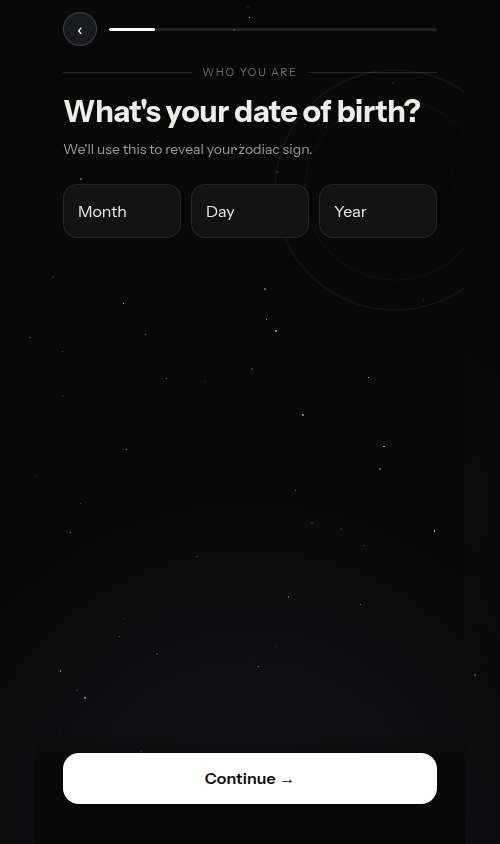
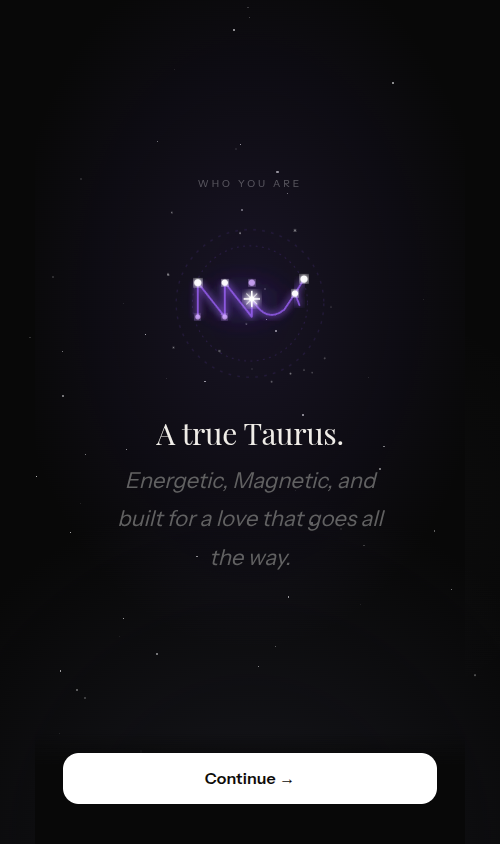
| 03–06 | WHO YOU ARE | Gender (M/F/Non-binary) · Interested in (Men/Women/Both) · DOB dropdowns → zodiac echo interstitial (“A true Taurus…”) |
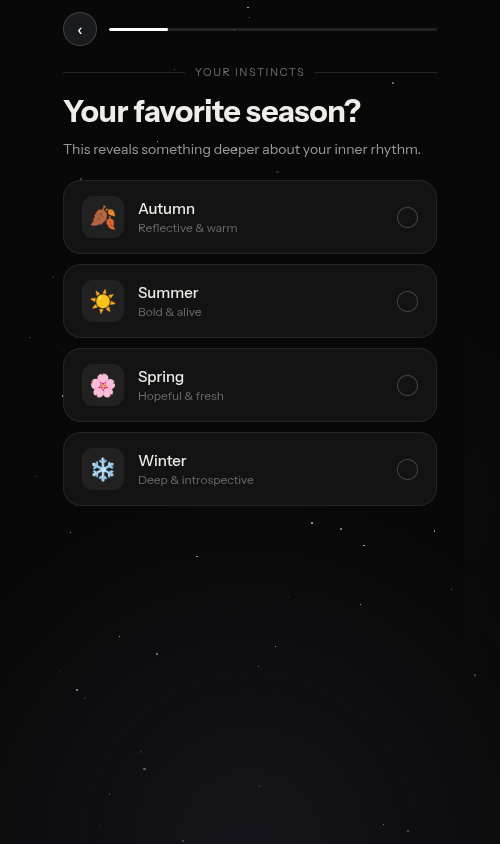
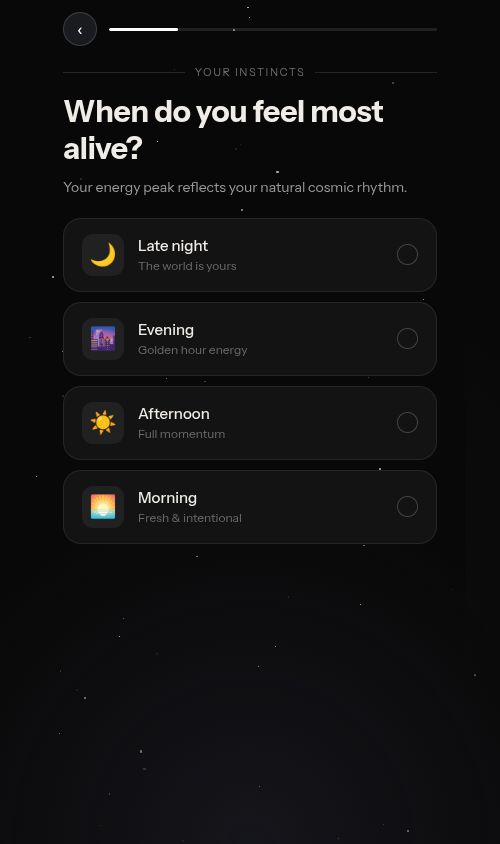
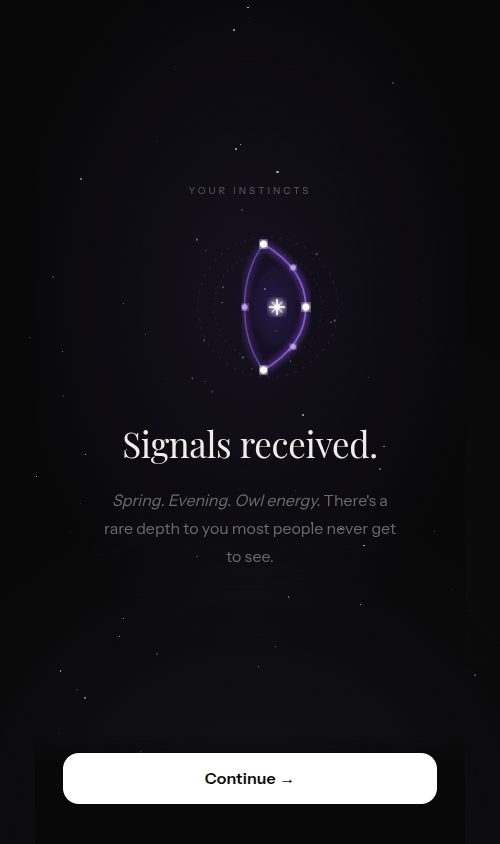
| 07–13 | YOUR INSTINCTS | Favorite season · When most alive · Music vibe · Intro/extro/ambivert · Spirit animal (Wolf/Owl/Deer/Swan) · Energy you give off → echo interstitial (“Signals received. Spring. Evening. Owl energy.”) |
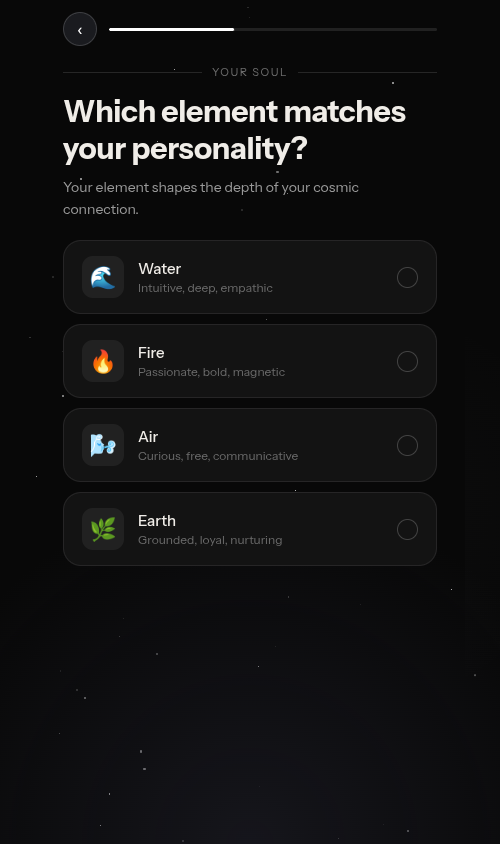
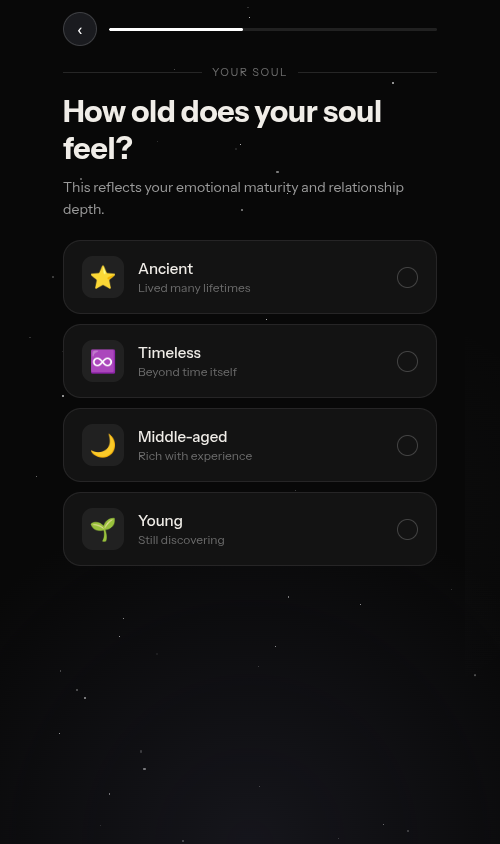
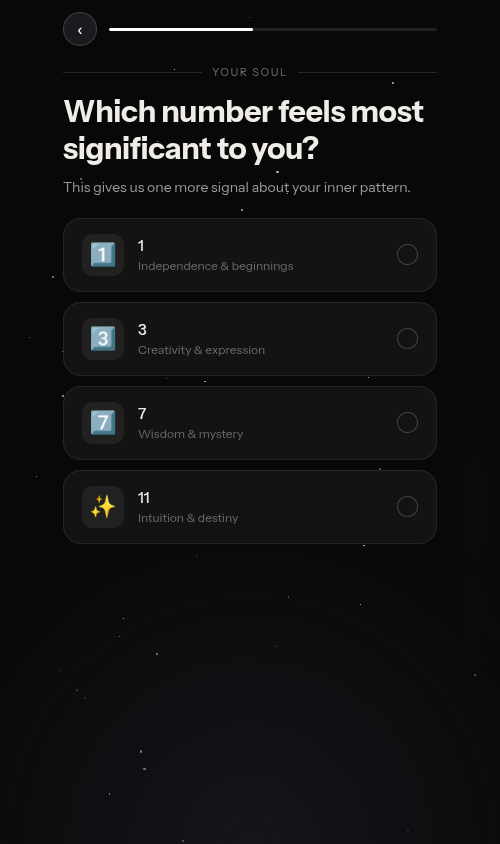
| 14–19 | YOUR SOUL | Element · Soul age · Significant number (1/3/7/11 with meanings) · Intuition strength · Heart vs head → echo interstitial (“A Water soul…”) |
| 20–25 | YOUR EXPERIENCES | Relationship status · “Connection so intense it felt destined?” · “Dream about a person whose face you can't quite see?” · Biggest personal challenge · Biggest relationship fear → interstitial (“You've felt it before. That pull.”) |
| 26–32 | YOUR SOULMATE (sketch inputs) | Hair color · Height · Smile type · First thing you notice · Eye energy · Age range → echo interstitial (“Taking shape. Dark hair. Taller.”) |
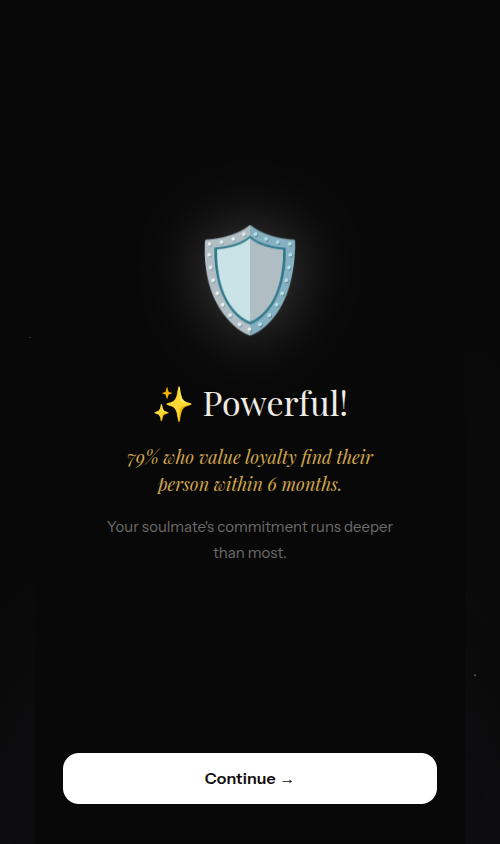
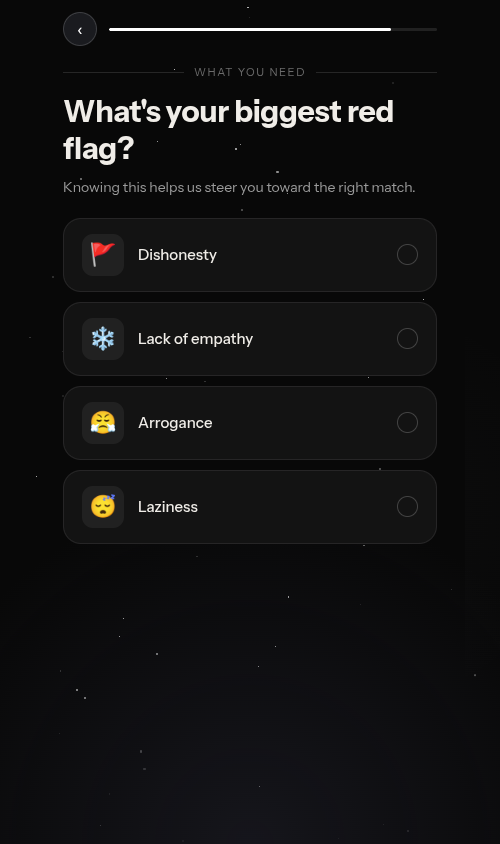
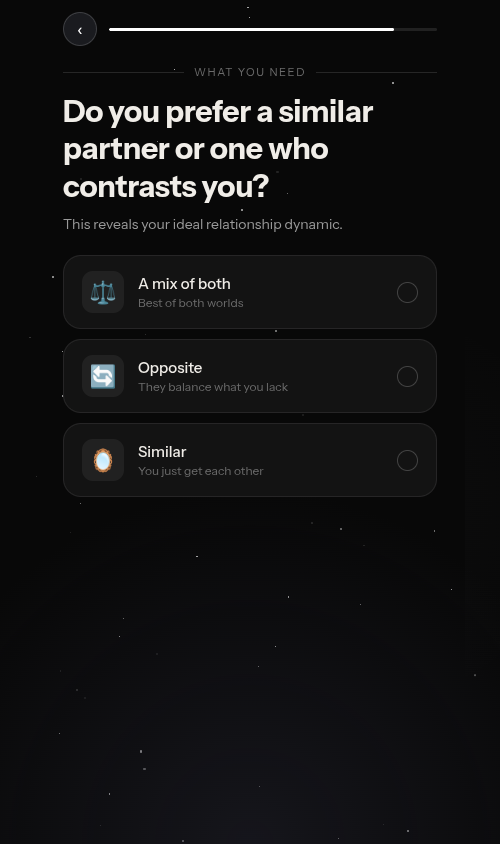
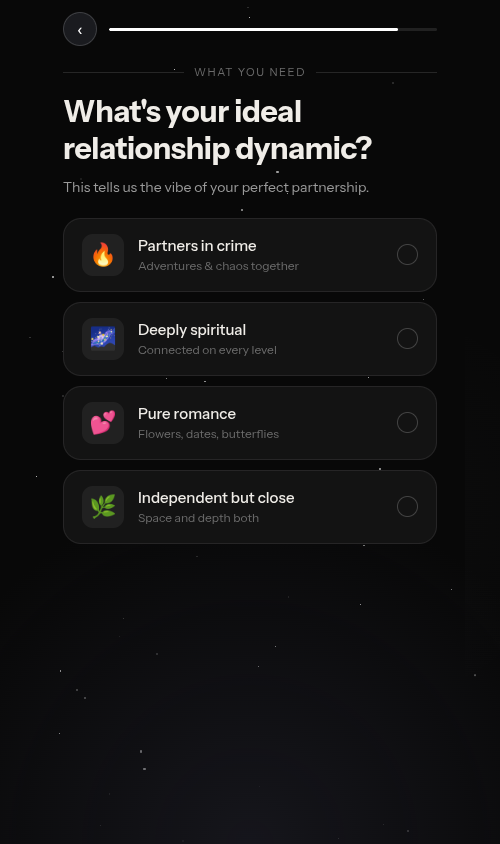
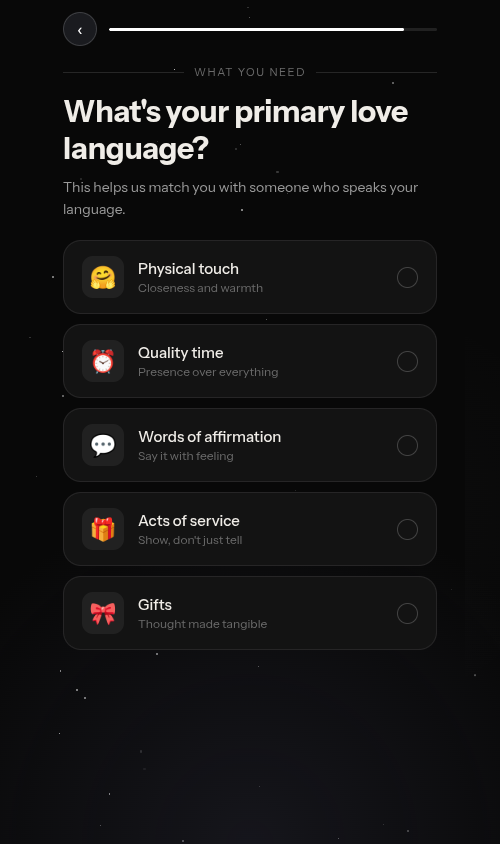
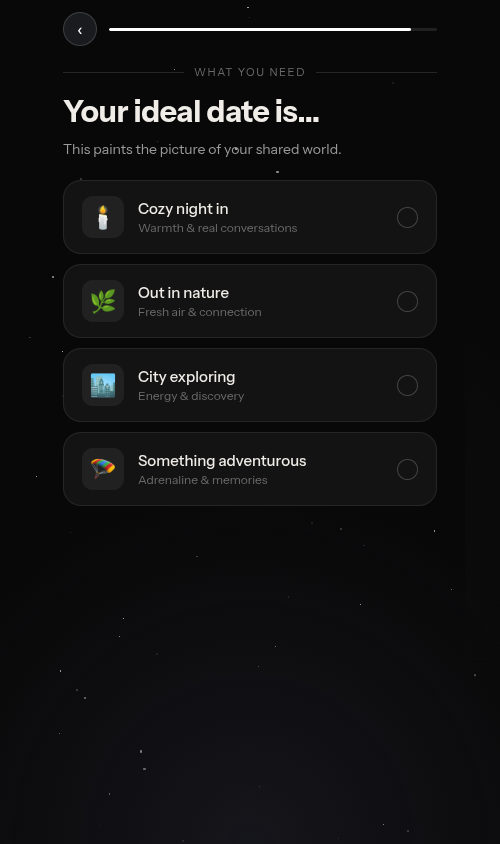
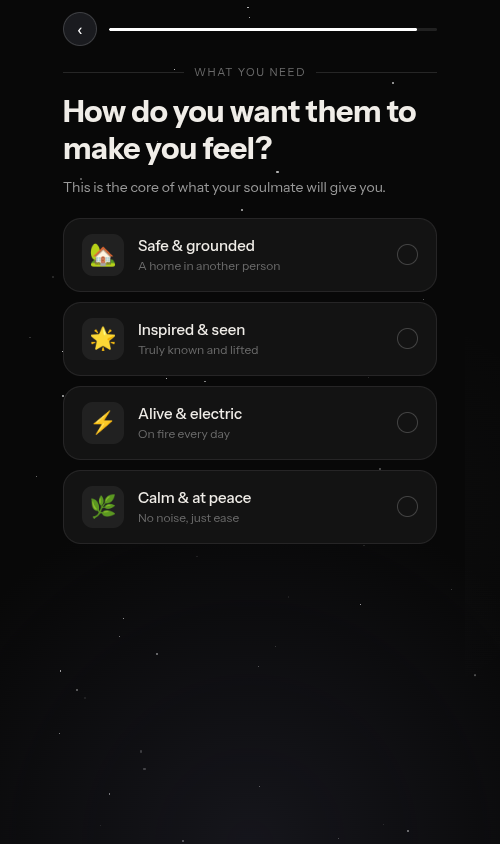
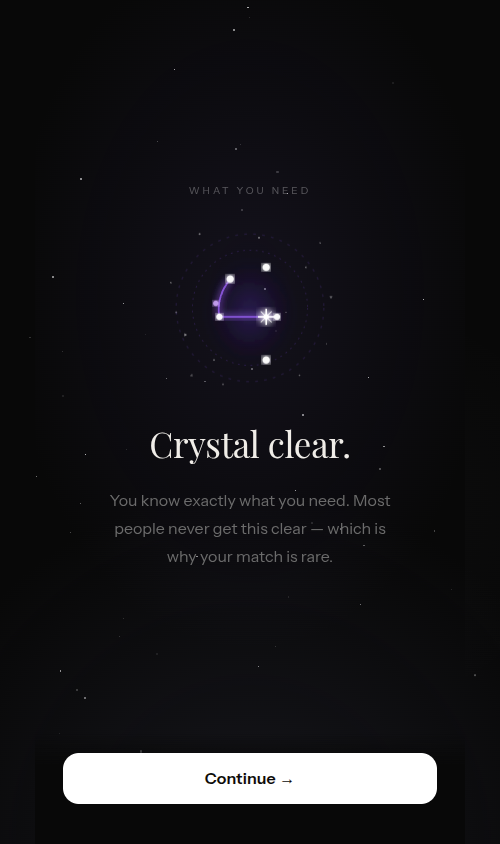
| 33–42 | WHAT YOU NEED | Appearance importance (1–5) · Key quality → fabricated matched-stat interstitial (“79% who value loyalty find their person within 6 months”) · Red flag · Similar vs opposite · Relationship dynamic · Love language · Ideal date · How they make you feel → interstitial (“Crystal clear.”) |
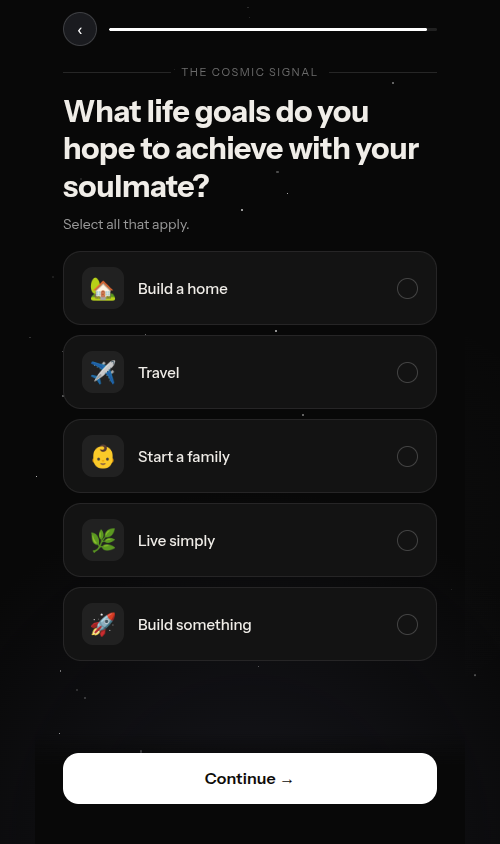
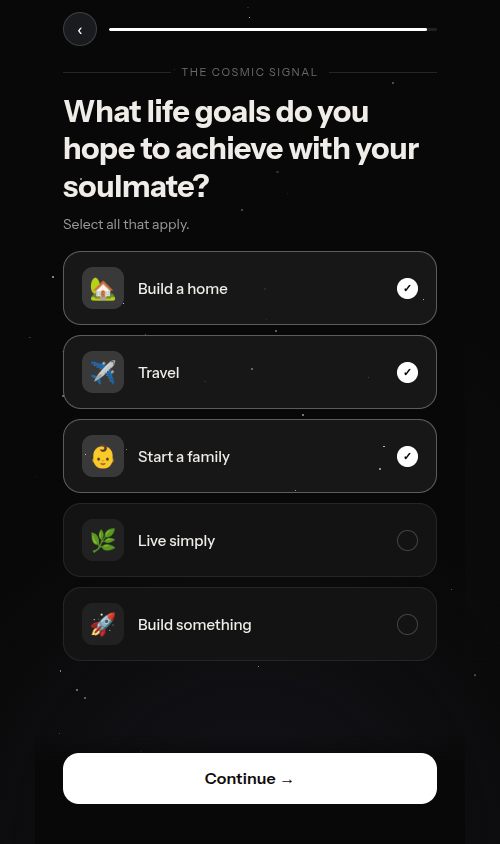
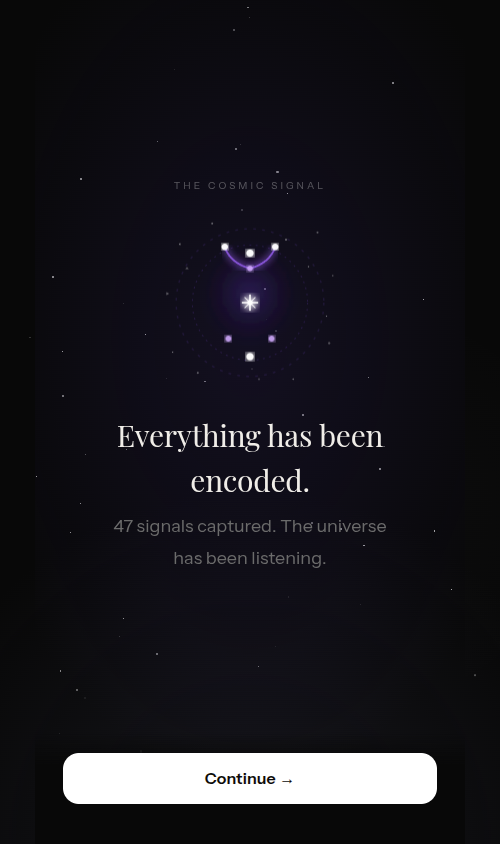
| 43–44 | THE COSMIC SIGNAL | Multi-select life goals (“Select all that apply”) → “Everything has been encoded. 47 signals captured.” |
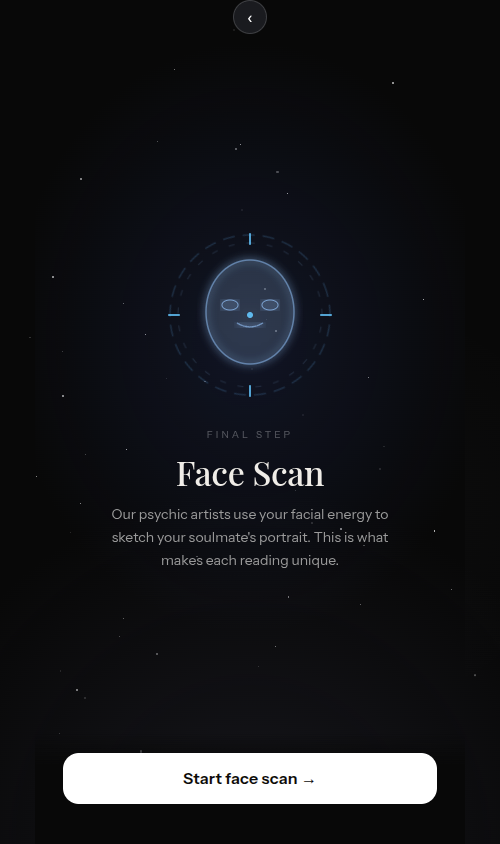
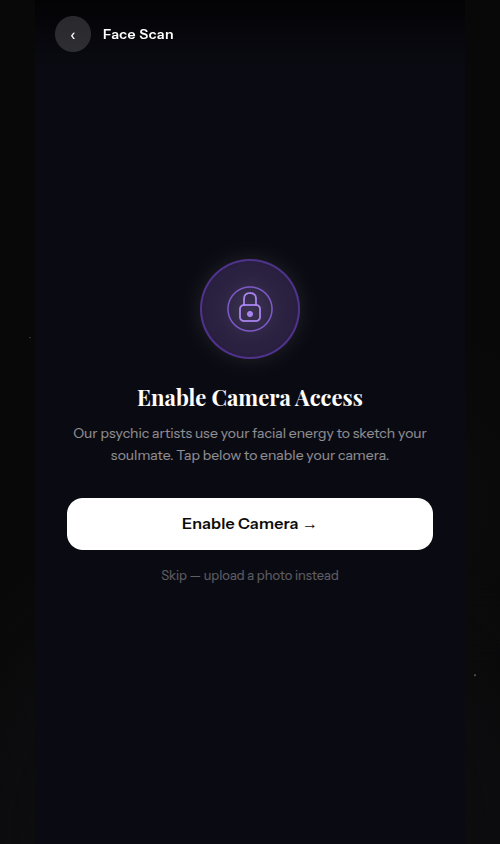
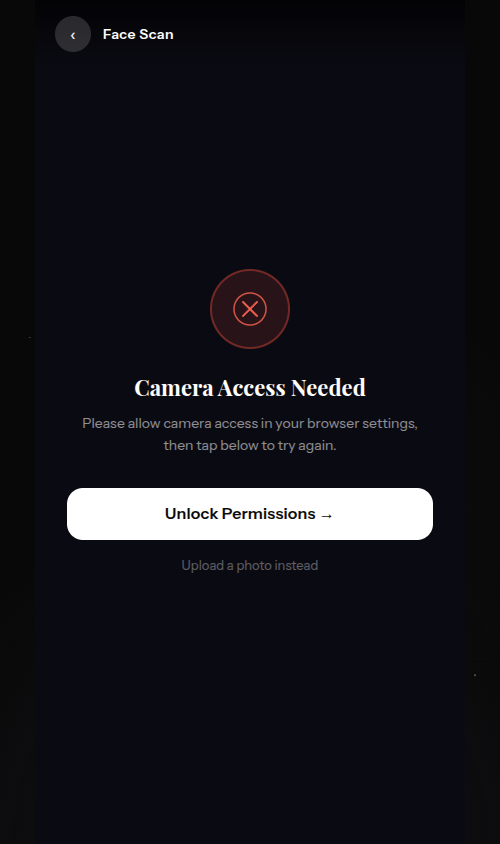
| 45–48 | Face Scan gate | “FINAL STEP — Face Scan. Our psychic artists use your facial energy to sketch your soulmate's portrait.” · Enable Camera / “Skip — upload a photo instead” · both paths REQUIRE a real photo (3 file inputs in DOM). Run 1 stopped here. |
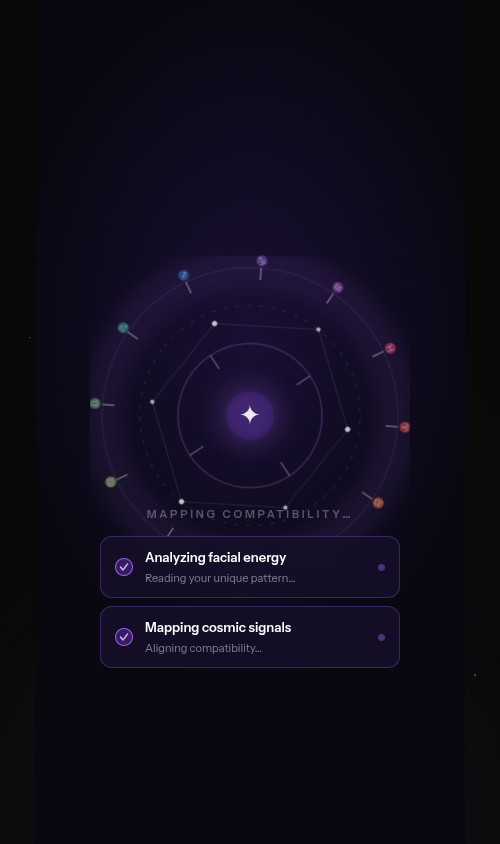
| 49–50 | Photo upload + loader | Uploaded persona photo via hidden file input · “READING YOUR ENERGY…” checklist loader (Analyzing facial energy → Mapping cosmic signals → Encoding soul signature → Rendering your portrait) |
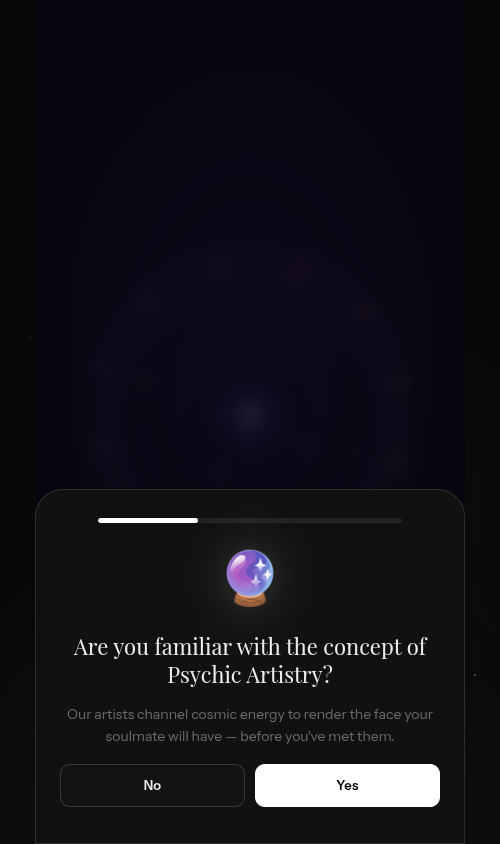
| 51–54 | Belief micro-quiz over loader | 4 yes/no belief primers during the “processing” wait: Psychic Artistry familiarity · love at first sight (“55% of couples… instant connection”) · “Do you consider yourself a spiritual person?” (“spiritual openness directly amplifies the accuracy”) · “Are you ready to see your soulmate's face?” (“Once revealed, it's yours forever”) |
| 56 | Email capture | “Where should we send your drawing to?” · “We respect your privacy. No spam, ever.” |
| 57–58 | Transition | “The cosmic patterns are becoming clear… We have your soulmate's image. ✶” |
| 59 | Pay-what-you-want trial | “Choose a price that feels right for you” · tiles $1 / $5 / $9 / $13.67, arrow on $13.67, guilt copy under $1 (“help us support those who need to select the lowest trial prices”) · FREE: 3 instant reports · CTA “See my sketch ✶” |
| 61 | Locked-portrait reveal | 8:00 countdown · blurred/locked portrait + 4 🔒 features · “SOULMATE ENERGY SIGNALS” teaser panel (Vibe/Spirit/Element/Connection) · 4 username-style testimonials · “7-day money-back guarantee” · “Starting from $1 today · Cancel anytime” |
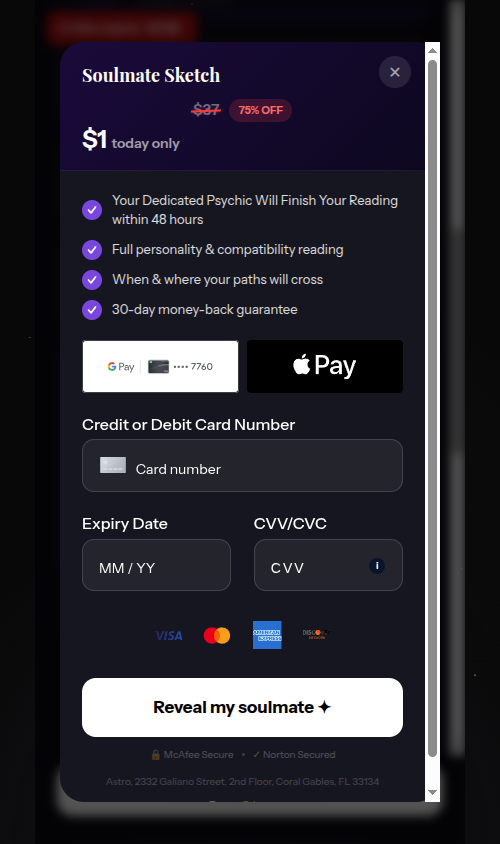
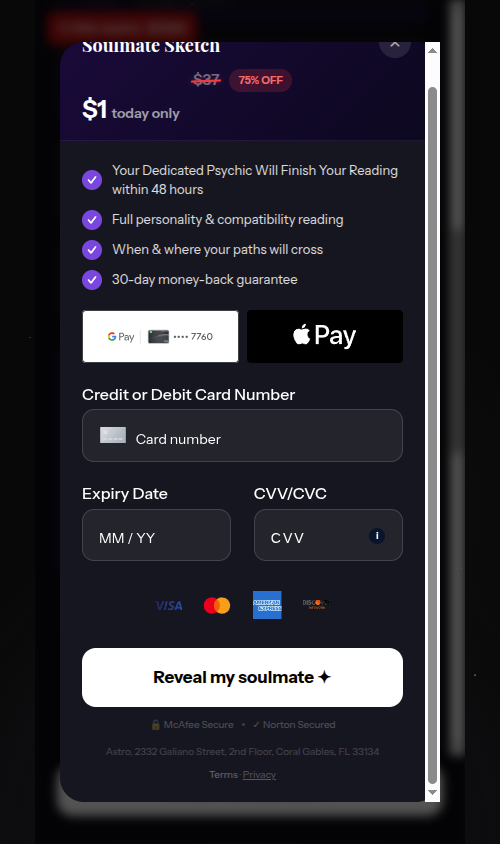
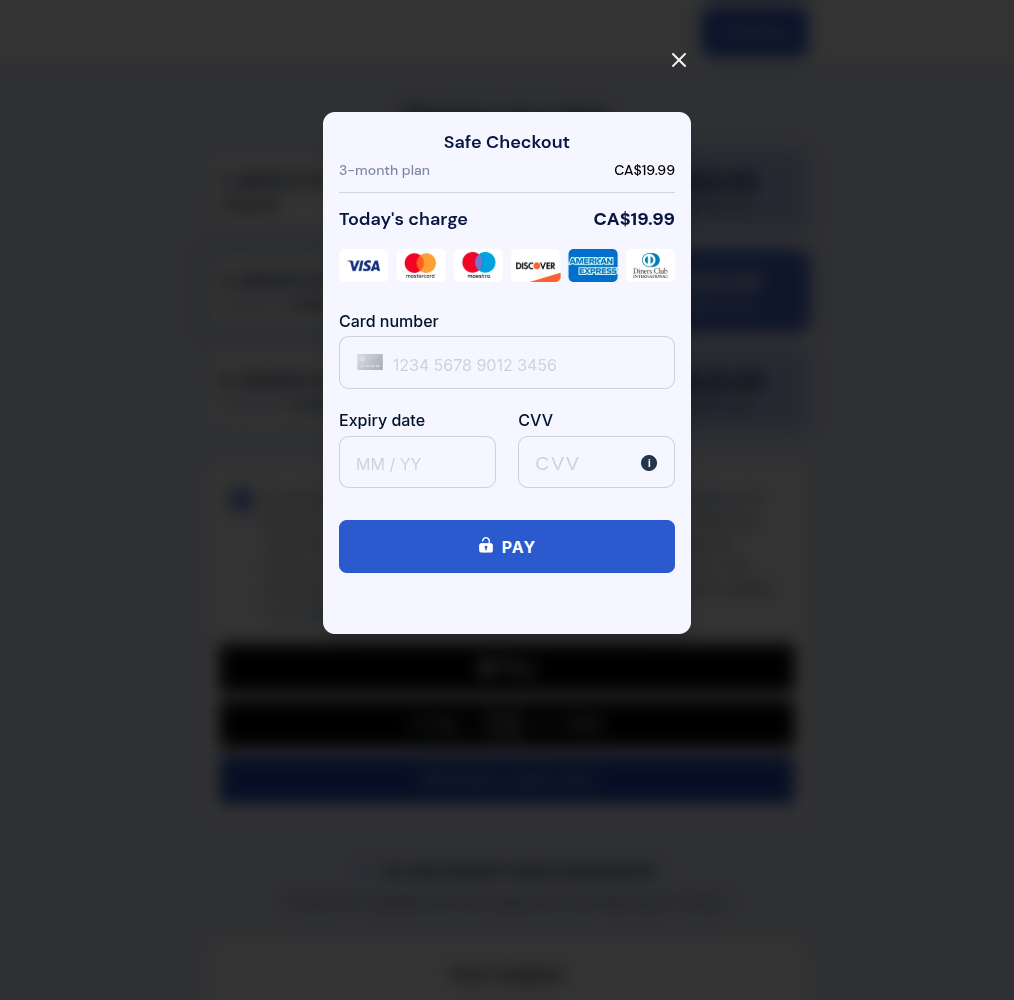
| 62 | Checkout (stop point) | “Soulmate Sketch” modal: |
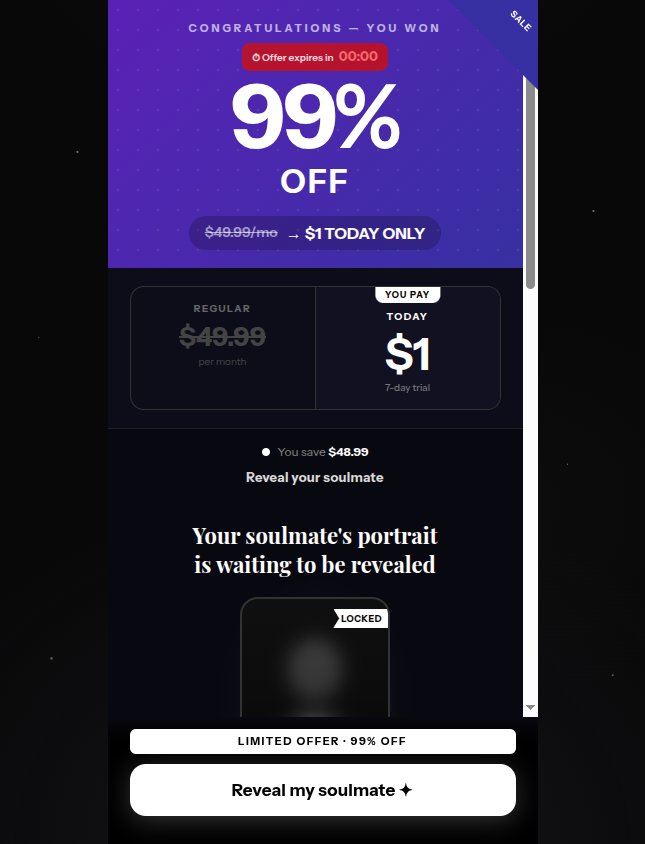
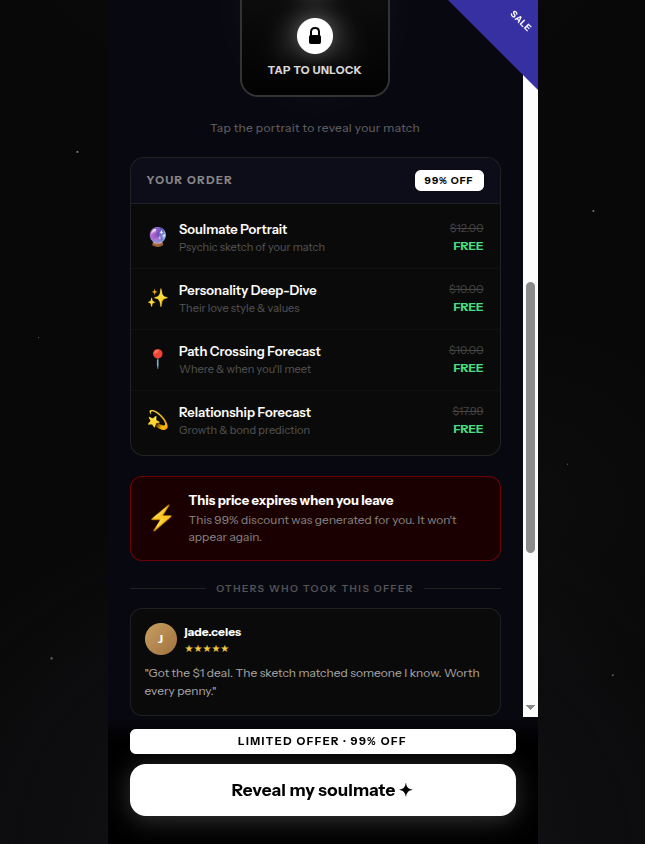
| 63–65 | Decline → spin → $1 sub downsell (live) | Declining checkout triggers a spin wheel (“YOU'VE UNLOCKED 1 FREE SPIN!”, segments $1 TRIAL / 10% / TRY AGAIN / 25% / 5% / 50% / FREE TRIAL / FREE — the spin lands on $1 TRIAL) → “CONGRATULATIONS — YOU WON” sales page: 99% OFF, $49.99/mo → $1 TODAY, 7-day trial; order stack of 4 items marked FREE ($12/$10/$10/$17.99); “This price expires when you leave… won't appear again”; tap-to-unlock blurred portrait; fine print “$1 today. Then auto-renews at $49.99/month after your 7-day trial unless canceled.” No visible decline control on this page. Hidden exit-overlay in DOM: “Cancel anytime… manage at tryastro.org/portal”. |
Downstream of payment Not live-verified
Extracted from hidden pre-rendered slides in the g_v16_wsg bundle. No purchase was made,
so none of this was observed in a real post-purchase session.
- Reader persona “Alyssa” (“Soul Reader · Cosmic Interpreter”, 4.9★ / 14,207 readings) with a 48h countdown and staged drip unlocks: personality 24h, meeting location 48h, career 72h, net worth 96h. She is their Stella — a single named human fronting an automated pipeline, promised “within 48 hours by email”.
- $12 one-time Priority Upgrade (12h vs 48h delivery).
- OTO ladder ×2 (full price, then half-off recovery), each with a 3:00 countdown and self-deprecating decline copy (“No thanks, I'll keep repeating the pattern”).
- Decline recovery: inline card retry, “Attempt 1 of 3”, no navigation away — the same shape as our Upsell Checkout v2 failure ladder.
| Step | Offer | Anchor | Price | Decline downsell |
|---|---|---|---|---|
| OTO 1 | 6-report bundle — Past Life · Life Purpose · Career Path · Future Children · Net Worth Forecast · Best Place to Live | $294 | $41.97 | “Build Your Own Bundle” — 6 readings at $6.00 each = $36.00, and removing readings raises the per-reading price |
| OTO 2 | 33-Day Karma Unblocking Program — “It's not you, it's a karmic blockage” | $265 | $29.97 | “Scholarship Rate” — same program at $14.97, framed as “we'll cover half” |
| OTO 3 | Lifetime AI Astrologer Chat — unlimited chat, daily insights, love forecasts | $456 | $19.97 | “Final Price Drop” — $9.97 lifetime |
Every OTO carries a 30-day money-back guarantee against the front end's 7-day. Note the arbitrage: the same 6 reports sell for $41.97 in the funnel gauntlet but $19.97 in the portal — the OTO's scarcity claim is contradicted by their own pricing page. They also sell a $60 “real psychic” 3-minute video reading and run a referral loop (“Share Astro with 3 friends and we'll unlock unlimited chats”).
The flow matrix and the two-footer compliance split
/flows/g issues a 307 to /flows/g_v16_wsg — the live champion.
Slugs are individually enumerable (real routes 200, fake ones return a 46,362-byte Next.js 404).
25 live flow slugs confirmed by HTTP status sweep: g_v1–g_v16
(g_v7 retired, a genuine gap), g_v16_wsg, r–r_v6,
control, normal, main. All front the same offer.
g_* family (Google) | r_* + control (Meta) | |
|---|---|---|
| Footer links | Terms · Refund Policy · Privacy · Contact | Terms & Policies · Your Privacy Choices |
| Refund Policy link | present (×2) | absent |
| CPRA opt-out link | absent | present |
| Address + phone in footer | visible | hidden |
Google Ads requires a visible refund policy for trial/subscription advertisers; the CPRA
“Your Privacy Choices” link is the shape Meta and native networks expect. Two parallel
legal footers for two ad platforms out of one codebase. The _wsg suffix is a content
suffix, not a traffic one — it is 56KB larger than g_v16, and that entire delta is the
post-purchase upsell ladder.
Every quiz step posts its variant ID server-side to /api/track-flow-step, so they measure
step-level drop-off per variant. 16 g_ iterations and 6 r_ iterations in four
months is a serious testing cadence.
Creative strategy — volume is everything, copy is frozen
Volume and format
- 187 active ads matching keyword
tryastro.org; 120 fully parsed (64%) via 12 paginated keyword calls. - Format split on the parsed set: 106 VIDEO / 14 IMAGE (88% video). Page pull: 93 / 7 (93% video).
- 45 distinct assets in a 100-ad sample — each winner runs in ~2 duplicate ads, with
collation_count2–7 per ad. - Placements on every ad inspected: Facebook, Instagram, Audience Network, Messenger, Threads.
Three deliberate length tiers
| Tier | Durations (s) | Ads |
|---|---|---|
| Short hooks | 8, 11, 12, 13, 14, 15, 17, 18 | 23 |
| Mid | 28–58 | 39 |
| Long-form VSL | 80–127 | 29 |
Vox-pop shorts buy cheap attention; gender-matched VSLs do the selling; the ~50s tier bridges.
Launch cadence
Start dates cluster: a steady drip of 1–9 ads/day from 2026-05-07 to 2026-07-17, then a big refresh on 2026-08-12 (13 ads), 08-13 (4) and 08-14 (22). 39 ads in three days, the week before this pull. They are scaling right now, not coasting.
Landing URLs — the negative result that matters
| URL | Count | Share |
|---|---|---|
https://tryastro.org/flows/g | 71 | 59% |
https://tryastro.org/g | 41 | 34% |
http://tryastro.org/g | 8 | 7% |
Three landing URLs, all the same flow. The g_v16_wsg variant is assigned
server-side after the click, so their split-test matrix is invisible from the Ad Library.
Getting it requires hitting the funnel repeatedly — the method this survey used. Note also the
sloppiness: 8 ads still point at http://, eating an extra redirect hop. CTAs split between
“Learn more” (107) and “See details” (13). No Shop Now, no lead forms.
Ad copy — one sentence on 117 of 120 ads
“Wondering who's meant for you? Our artists draw their face — see the person destined to be in your life 💕✨” — 111 of 120 (a further 6 are the same line with the emoji stripped)
Headline: “Get a hand-drawn Drawing of the face you're destined to meet 💕✨See the face of the person meant to be in your life” — 117 of 120
The main headline is two sentences jammed together with no separator and a capital-D “Drawing” mid-phrase. Machine-assembled, never proofread, running on ~97% of a 187-ad account. They do not test copy. They test video and let one sentence ride. 101 of 120 ads carry no link description at all.
The angle in one line: human artists (“our artists draw their face”) plus destiny (“the person destined to be in your life”). Never AI. In short-form copy, never astrology mechanics either — astrology only appears once the viewer is inside a VSL or the advertorial.
The VSL skeleton — one script, gender-flipped
Two long VSLs run the same eight beats, beat for beat, pointed at two audiences. The female version (96s, “Teresa”) and the male version (108s) differ only in dressing.
| # | Beat | Female version | Male version |
|---|---|---|---|
| 1 | Someone specific already exists | “someone who isn't telling you how he really feels” | “a woman who has loved you in silence” |
| 2 | Explain their coldness away | “he's terrified of getting hurt” | “doesn't have the courage” |
| 3 | Proximity claim | “closer than you realize” | “already in your contact list” |
| 4 | Open loop + retention promise | “By the end of this video, you'll see his face” | “…you'll see her face” |
| 5 | Reader credential | “My name is Teresa… over 20 years” | “For the last 10 years… actors, athletes, executives” |
| 6 | Celebrity testimonial (fabricated) | Julia Roberts + Teresa Caputo | Sam Elliott + Tyler Henry |
| 7 | Mechanic + timing bonus | two astral cards → pencil, <2 min, + when he appears | date of birth → pencil, <2 min, + when she appears |
| 8 | Closing window + chosen-one urgency | “this portal does not stay open… once a year” | “the signal doesn't stay open forever… once a year” |
Do not copy Beat 6 puts fabricated first-person testimonials in the
mouths of four real, living, named public figures. That is not a grey area, it is straightforward false
endorsement of identifiable people. Testimonial videos are served from their Supabase bucket as
deep11.mp4, deep12.mp4, deep13.mp4, deep15.mp4 —
the deep prefix and non-contiguous numbering are consistent with deepfake output
Inference from filenames.
The account's biggest-reach creative is the opposite: a 50s vox-pop street interview with multiple speakers and no pitch at all, carrying 1.17M EU reach. Pure top-of-funnel curiosity bait.
Targeting and reach
- Worldwide, not US-only. Reach spans 27 EU/EEA countries plus GB and the French overseas territories. They buy the cheapest impressions on earth and funnel everyone into one English-language flow. Our standing rule is USA-only; theirs is the opposite.
- “All genders” is a setting, not an outcome. Both VSL ads are set to All, Worldwide, 18–65. The Teresa creative's UK breakdown comes back ~96% female (35–44 band: 2,792 female vs 107 male). They never gender-target; the creative selects the audience and Meta's optimiser segments.
- They genuinely advertise to men. Beat-for-beat gender-flipped VSLs are a deliberate two-audience build. Direct input to the open Lane A / Lane B gender-expansion scoping.
- Age skews by creative, not by setting. Vox-pop shorts land mostly on 18–24; the Teresa VSL lands on 35–54, the band that actually buys.
- Reach figures: vox-pop ad EU 1,167,270 / UK 79,344. Teresa VSL EU 18,201 / UK 7,905. Spend and
impressions are
nullon every ad — Meta only exposes those for issue/political ads.
The advertorial — their best asset, barely running
One ad of 120, on the bridge domain daily-cosmic.com. A 7,044-character first-person
confession advertorial in a woman's voice (52, three years of failed dating apps, $4,000 across coach /
matchmaker / course / retreat), headlined “I spent $4,000 trying to meet someone in 3 years”.
Structure: failure stack → “maybe I'm the problem” → 2am Googling → rejection of
generic advice → mechanism reveal → product → proposal → a fake “EDIT:”
and a fake Q&A. Paragraph separators are U+2800 braille-blank characters, a known trick to
stop Facebook collapsing whitespace.
“The reason you keep missing him is that you've never seen his face. The brain doesn't recognize people from descriptions. It recognizes them from faces… once you've seen his face — even drawn, even once — your mind locks it in.”
That is the sharpest positioning statement in the entire account, and it is running on a single ad. It is also the only ad anywhere that discloses the subscription: “like most of these apps it continues as a subscription after the trial unless you cancel… The $1 is what gets you in to see the sketch.”
The Google lane
Confirmed live on 2026-08-20 via the
Ads Transparency Center:
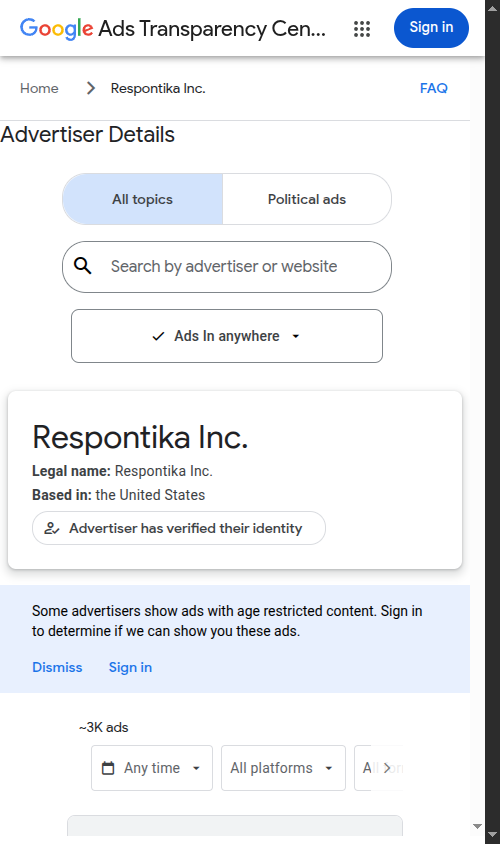
AA ECOM INDUSTRIES LLC, identity verified, US, 17 ads, last shown the day of the check, all landing on
tryastro.org/g. Observed copy: “Take The 60-Second Soulmate Reading Quiz…”,
“See What Your Soulmate Looks Like Now…”, “Detailed Astrological Soulmate Drawing…”,
all sharing the tagline “Get Deep Cosmic Insights Into Your Love Life and a Detailed Sketch of Your
Soulmate”.
On-site corroboration: Google Ads conversion tag AW-16987805146 with four conversion labels
(purchase / checkout / pageview / lead), wired to mirror Meta pixel events into Google conversions and
special-casing content_name === 'Astro Upsell' so upsell revenue feeds the bidder. That is a
full-funnel setup, not a leftover tag. No Bing / Microsoft UET tag was found.
Zero paid keywords in DataForSEO Labs for tryastro.org, with a geico.com
control proving the field populates. The evidence leans PMax / Demand Gen, YouTube-weighted, not classic
keyword search Reasoned read, campaign type never disclosed.
Ad spend: not determined — no source in this pass returns it, and any dollar figure
would be fabricated.
Organic — there is no SEO arm
20 ranked keywords, ~47 visits/month (estimate), 9 referring domains (all spam: seopxl-*.shop,
betwinnermirror.com, backlink spam score 34), 4 indexed pages. All 20 keywords are flagged
is_new — the whole footprint appeared inside the current comparison window.
Two findings inside that noise are genuinely useful:
- Their
/helppage is doing unintentional post-purchase SEO. Its ranked queries are billing-complaint queries: “how to check astro bill”, “quiz atrix guide charge”, “no tel astro customer service”, “astro returns”. Customers who got charged search the descriptor on their statement and land on the help page. That is the shape of a subscription funnel generating billing confusion — the same failure mode our $7.77/mo chargeback work chased. - They rank for competitors' brand names — “easystars soulmate” (1,300/mo), “astro club soulmate”, “respontika soulmate”, “quizatrix guide”. Positions 25–49, so almost no traffic, but it maps the vertical.
Vertical SERP check on “soulmate sketch” (US, desktop, depth 30): zero paid ad slots on the entire SERP, tryastro absent from the top 30, and an AI Overview that flatly calls these offers “marketing funnels or automated generators rather than genuine psychic readings”. Organic search is hostile ground for this category, which is consistent with everyone in it staying on paid social.
Their exposure — what not to copy
The billing contradiction is the engine of everything else. The same page bundle ships both “you won't be charged again unless you choose to subscribe” (marketing copy / FAQ / Terms / Privacy) and “you will be charged $49.99 every month. No partial refunds applicable” (checkout fine print). The first is opt-in; the second is a standard auto-renew authorisation. This single inconsistency is a ROSCA / negative-option exposure.
- Their own
/helphas dedicated FAQ entries for “I only paid $1, why was I charged more?”, “I cancelled but I'm still being charged” and “I didn't sign up for this”, plus explicit chargeback deflection: “Contact us directly, it's faster than going through your bank.” You do not build that FAQ unless those are your top tickets. - Policy pages contradict each other.
/refund(April 2026) still describes a dead $15 one-time model with “no trial period and no recurring or auto-renewing charges”;/terms(June 2026) describes the $1 trial into $49.99/month. Guarantee copy is 7-day on the reveal page and 30-day on checkout, one screen apart. - The Privacy Policy is factually false. It states “We do not use third-party advertising cookies” while every variant ships Meta Pixel, TikTok Pixel, Google Ads conversion tag and Microsoft Clarity. That is a live CPRA exposure.
- Unverifiable social proof: “60M+ readings”, “21M+ people”, “133K+ reviews”, “#1 Lifestyle”, Cosmopolitan and Bustle press badges with no article or citation, live-activity counters that are client-side theatre. A four-month-old domain claiming 60M readings is not plausible.
- “Real psychic” / “real artist” claims against 48-hour delivery at $1–$9.95 pricing and a two-person infrastructure footprint Likely automated, flagged as exposure not proven fraud.
- The subscription is disclosed in exactly one of 120 parsed ads.
This is the profile platforms nuke. Our TikTok account was permanently suspended for far less. Trustpilot sits at 3.3★/~106 after four months — real volume, genuinely split base: the product lands for some buyers and the billing burns others. No FTC, state AG, BBB or class action was found, but the domain is four months old, so absence is expected rather than exonerating.
Open threads
- 67 of 187 Meta ads unparsed (36%). TikTok ad enumeration not done despite a live pixel.
- Post-purchase OTO screens remain DOM-sourced only — no purchase made.
- Historical / inactive ad sweep (
status=ALL) not run; would show older page names, dead domains and retired copy. auralyapp.comconnection unresolved. Wyoming SoS and OpenCorporates remain CAPTCHA-blocked.- The
/flows/esSpanish variant implies a Spanish-language traffic lane not investigated.
Funnel gallery
66 screenshots · click to enlarge · ← → to navigateFull g_v16_wsg walkthrough in step order, mobile 390×844.
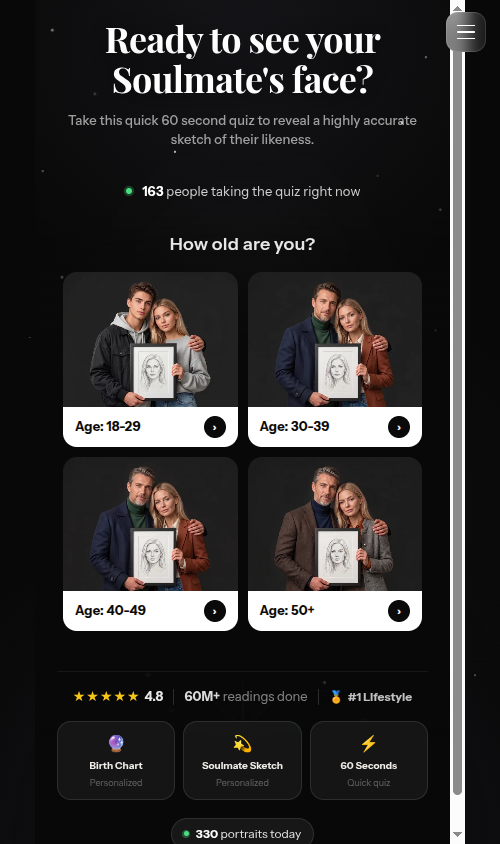 step 01 age gate
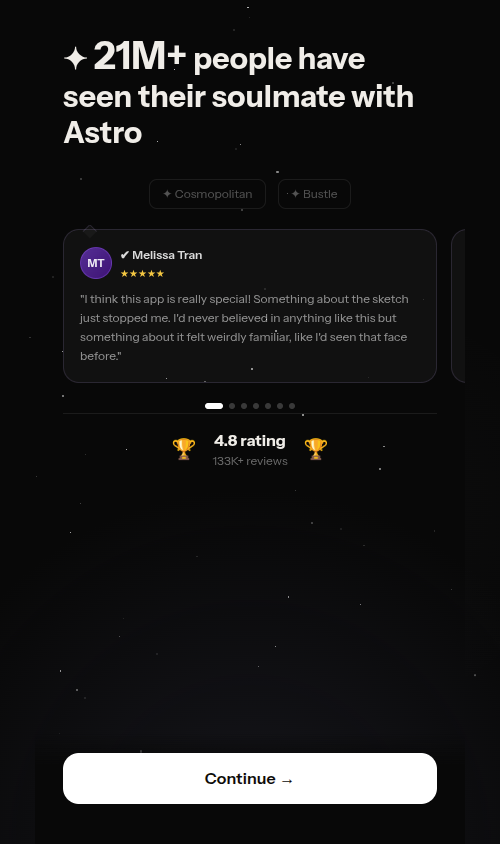 step 02 social proof interstitial
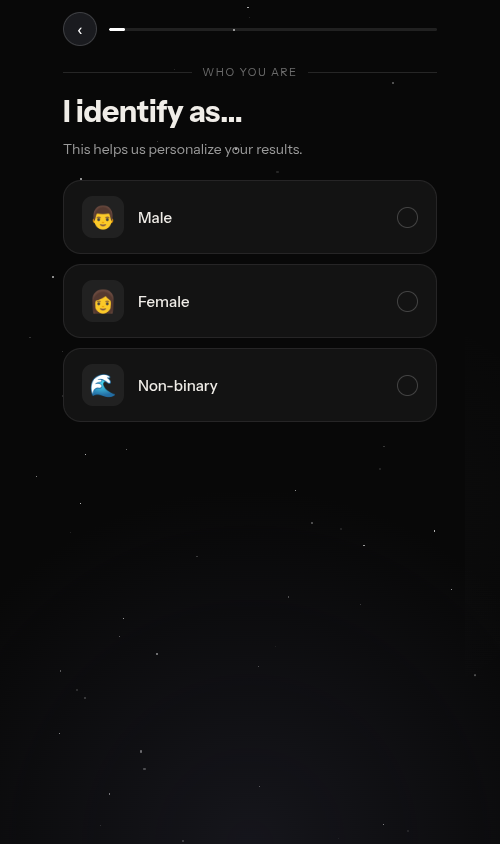 step 03
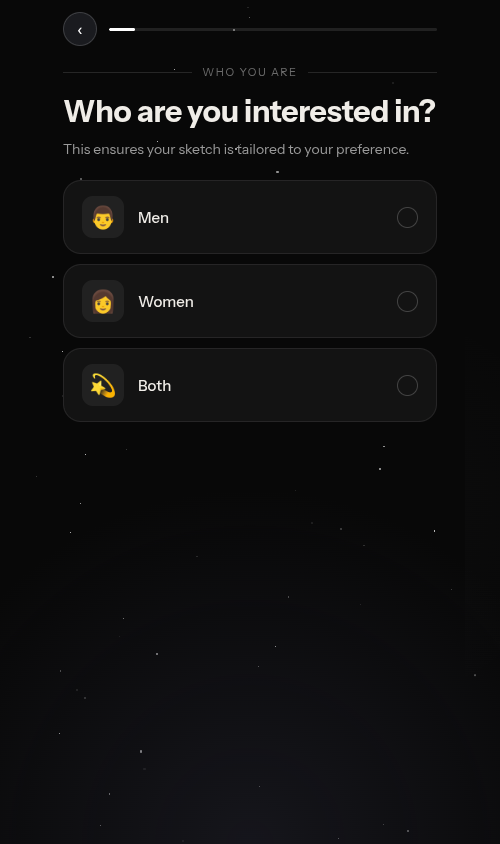 step 04
 step 05
 step 06
 step 07
 step 08
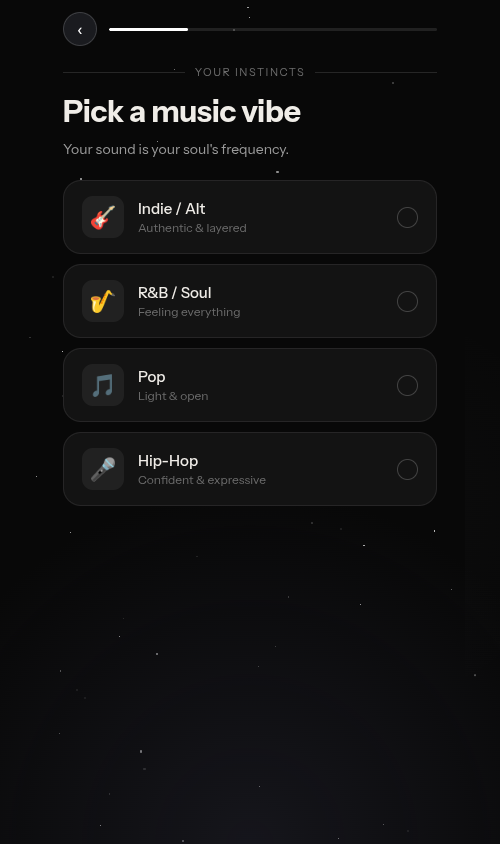 step 09
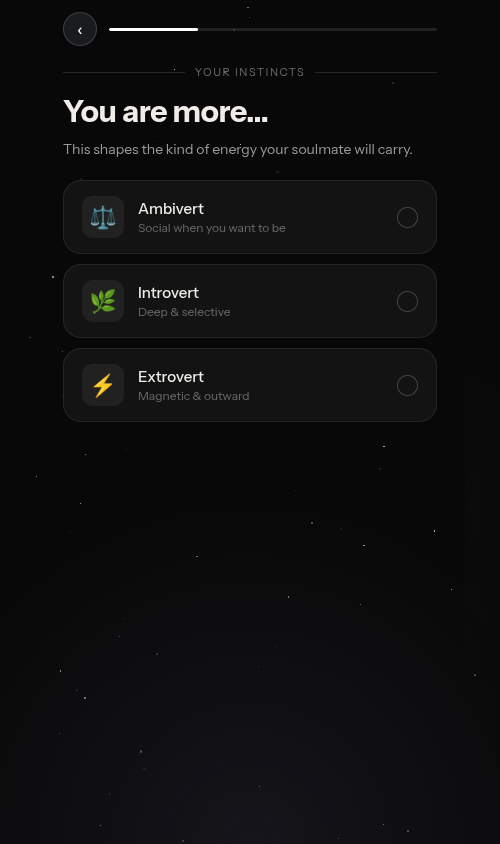 step 10
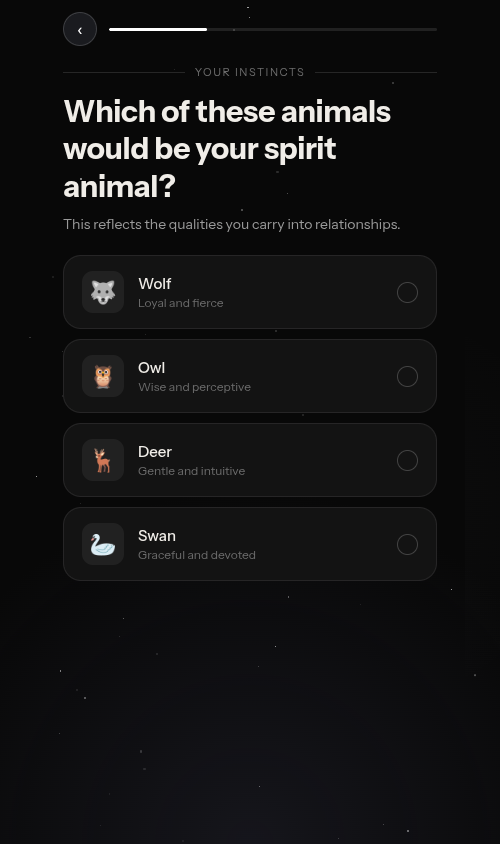 step 11
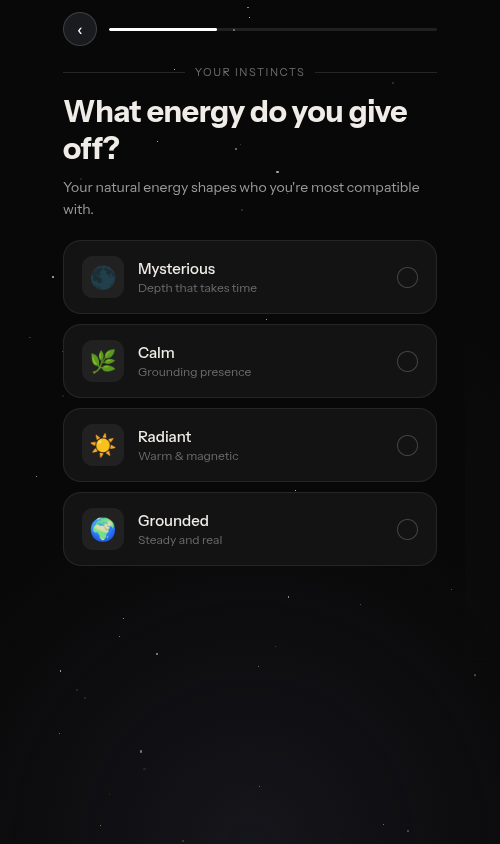 step 12
 step 13
 step 14
 step 15
 step 16
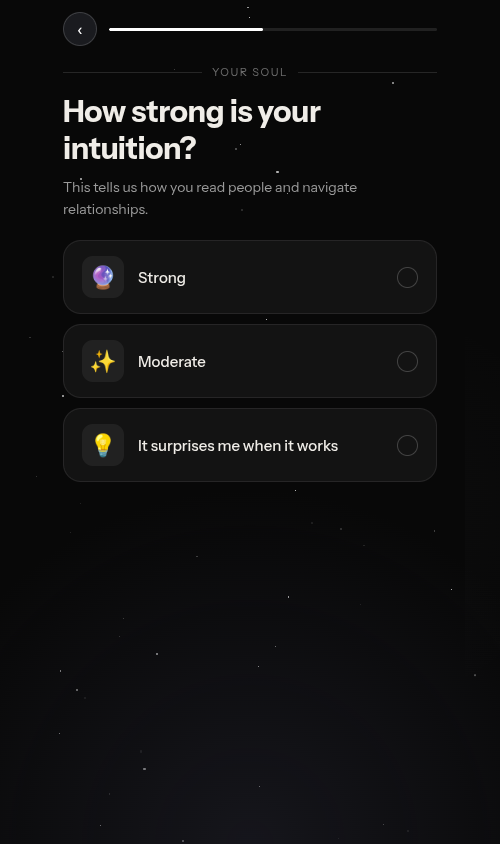 step 17
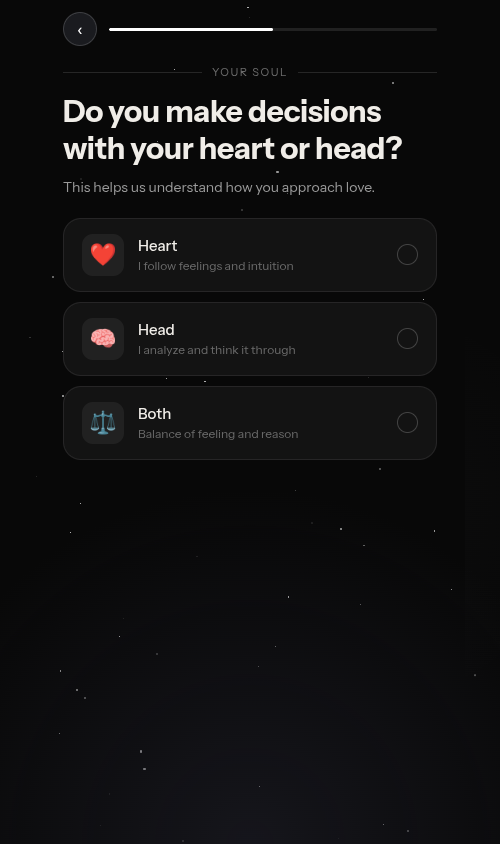 step 18
 step 19
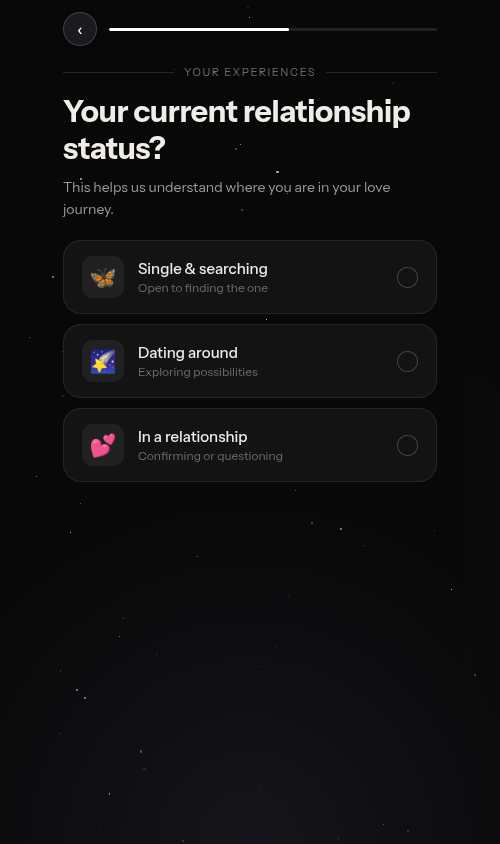 step 20
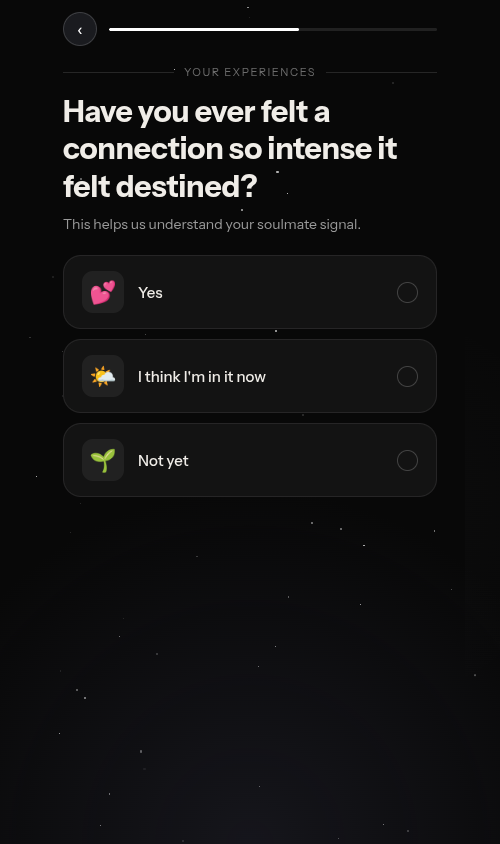 step 21
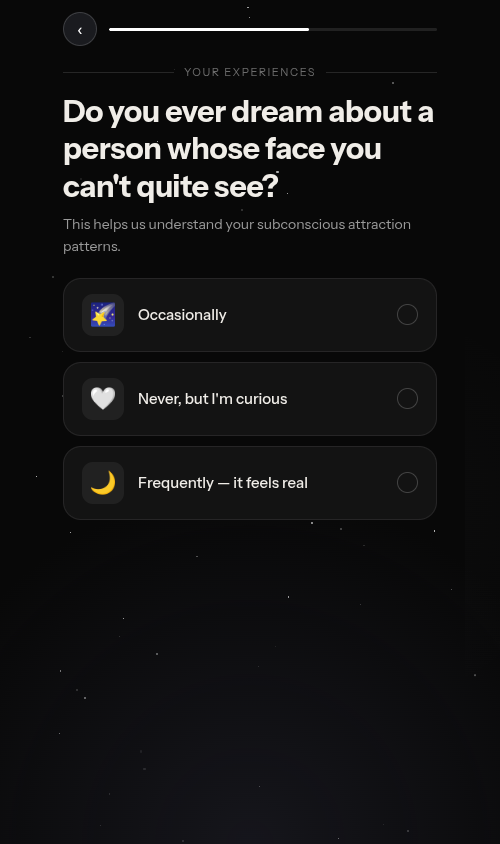 step 22
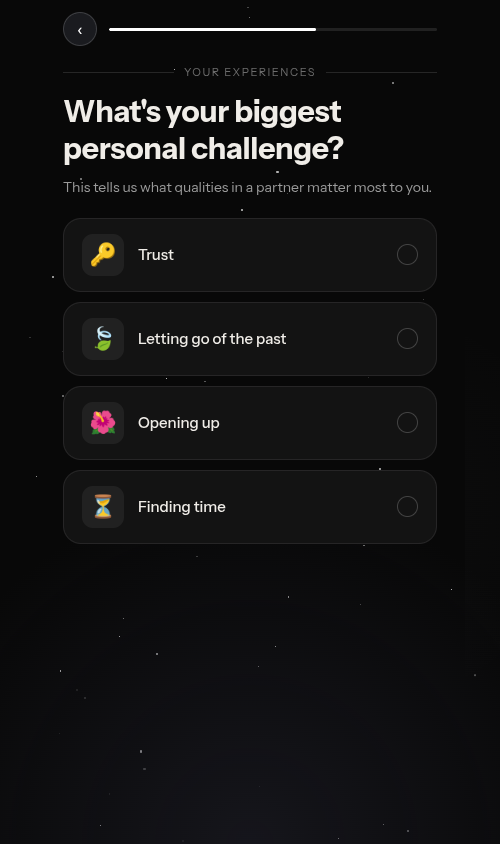 step 23
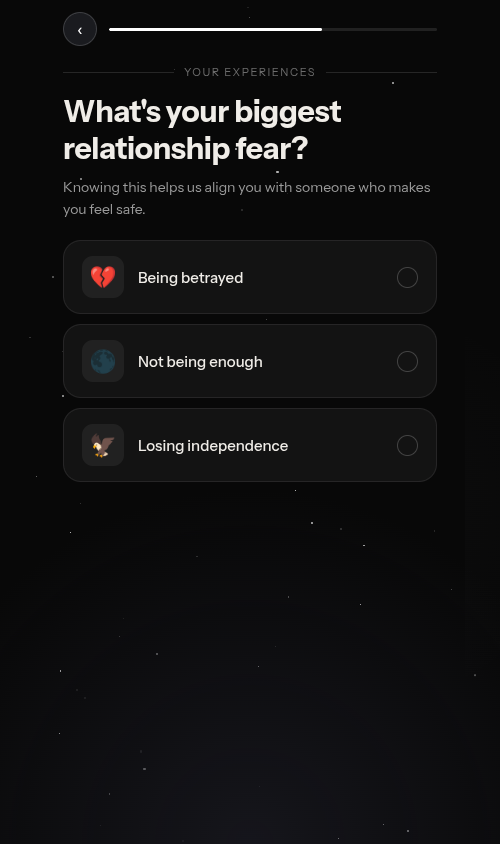 step 24
 step 25
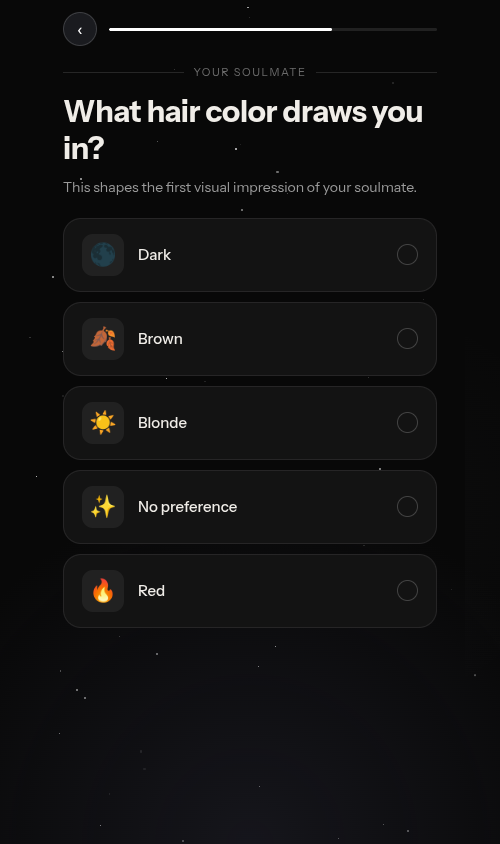 step 26
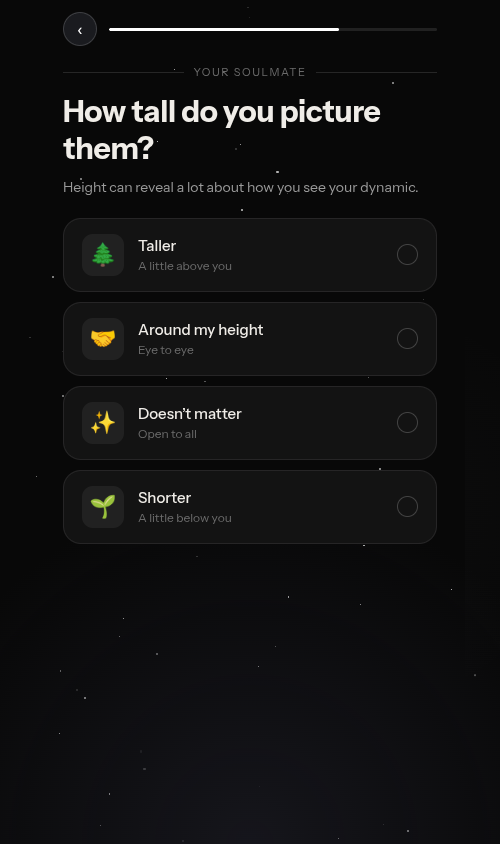 step 27
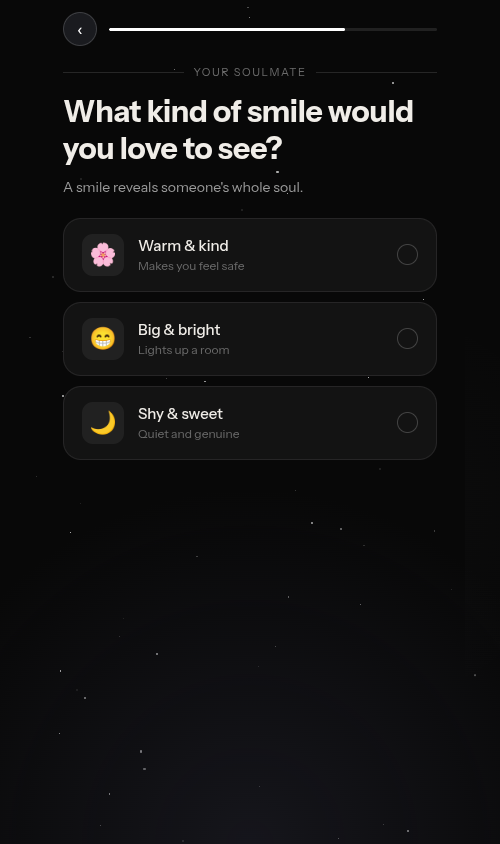 step 28
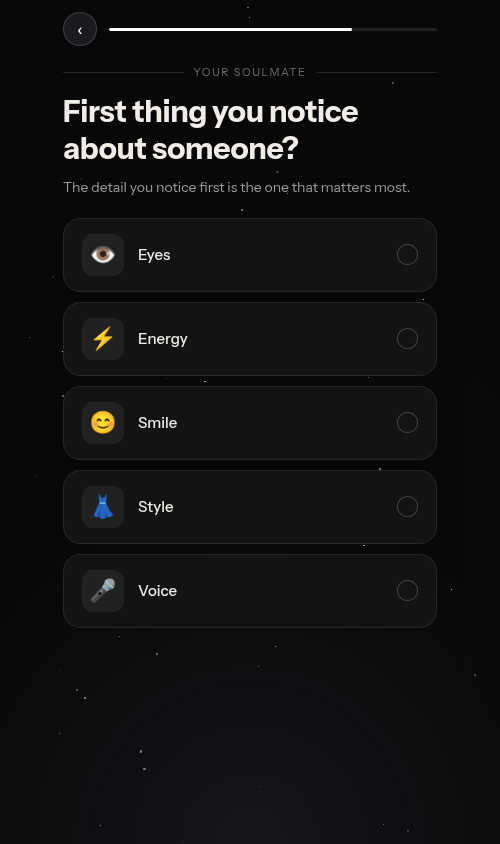 step 29
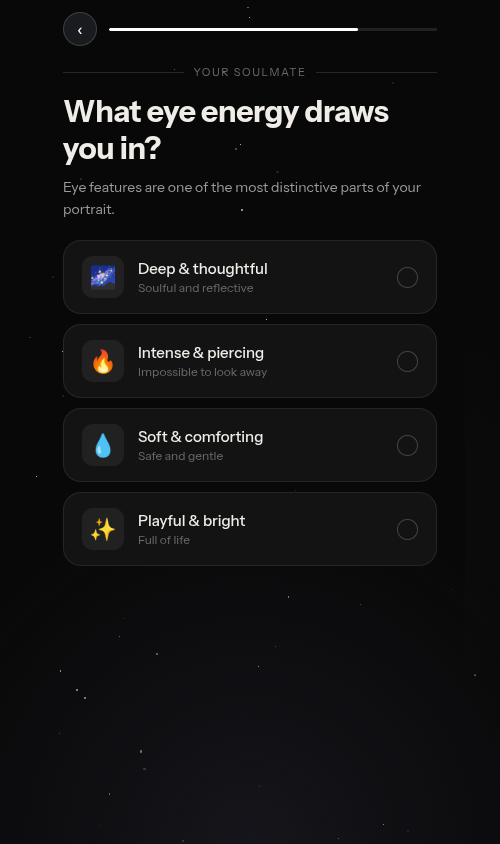 step 30
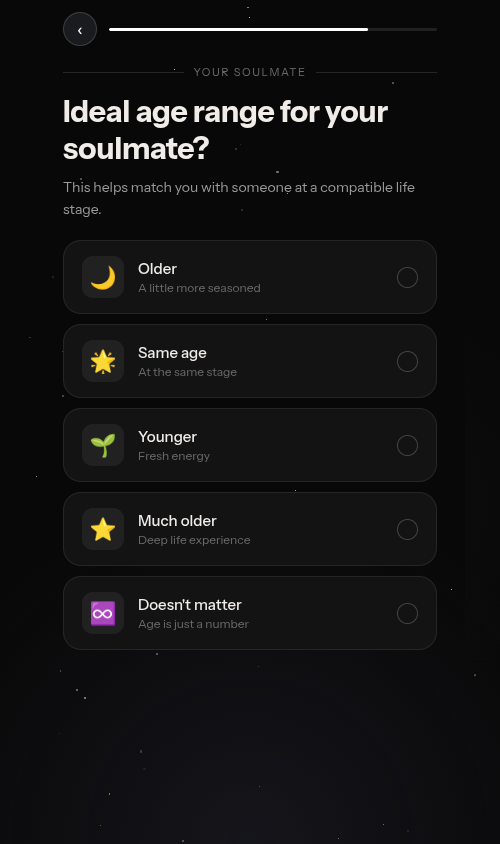 step 31
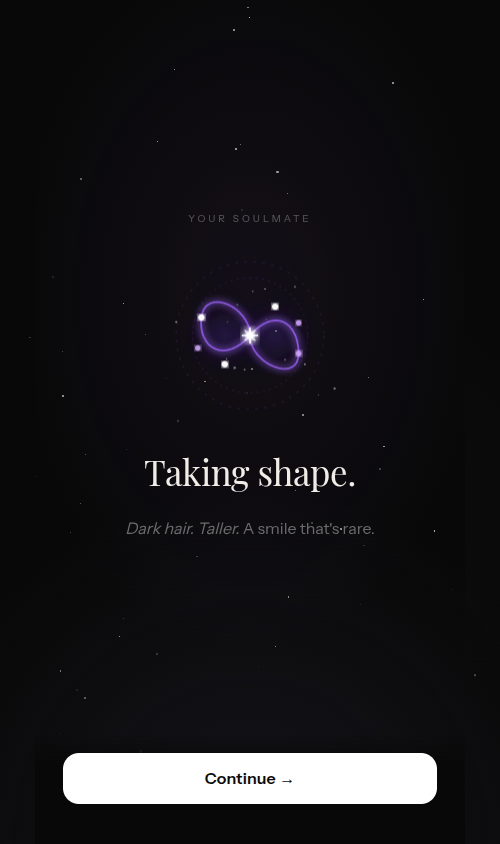 step 32
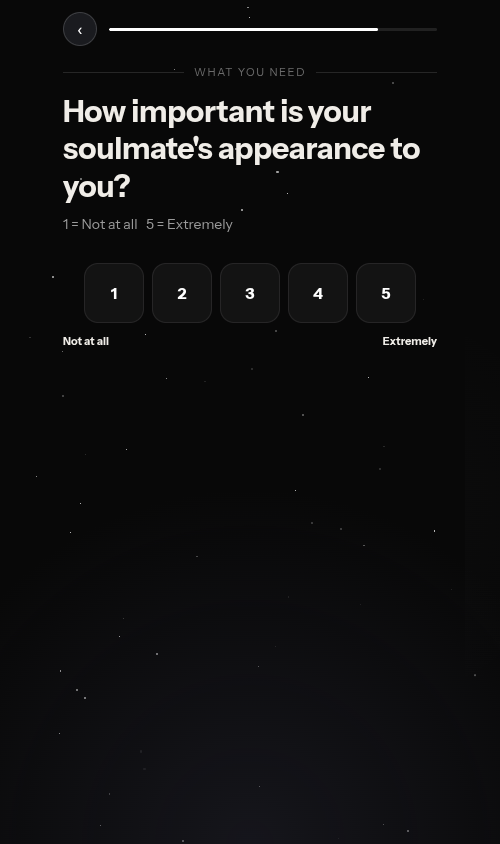 step 33
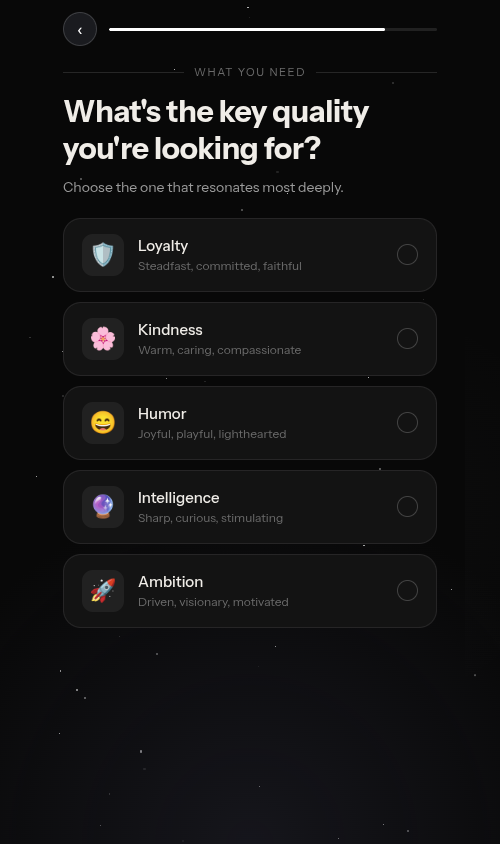 step 34
 step 35
 step 36
 step 37
 step 38
 step 39
 step 40
 step 41
 step 42
 step 43
 step 43b multiselect
 step 44
 step 45
 step 46
 step 47
 step 48
 step 49 face scan gate
 step 50 analyzing facial energy
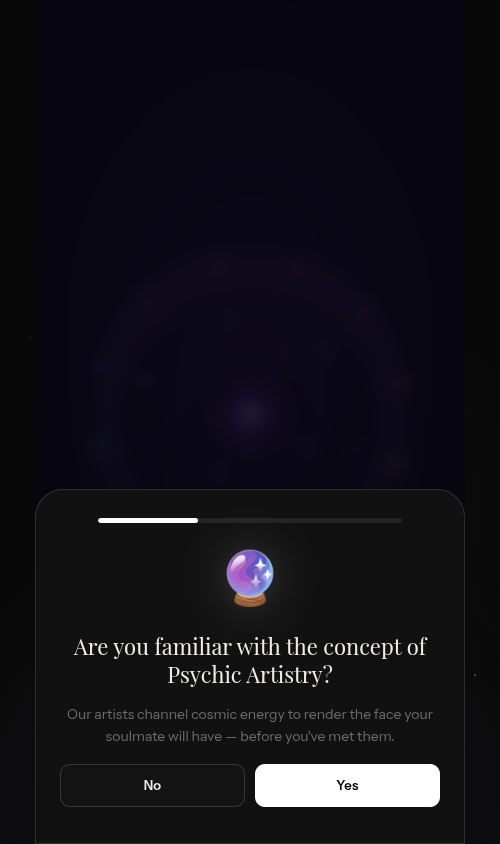 step 51 psychic artistry question
 step 52 love at first sight question
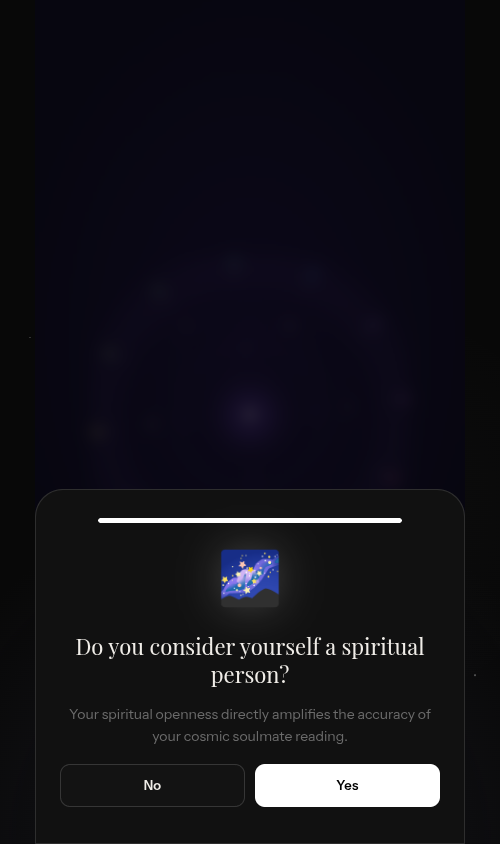 step 53 spiritual person question
 step 54 ready to see face question
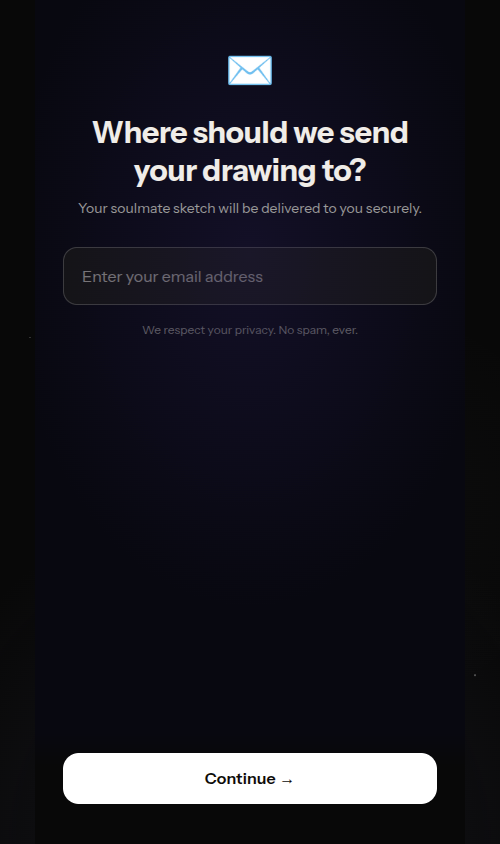 step 56 email capture
 step 57 cosmic patterns transition a
 step 58 cosmic patterns transition b
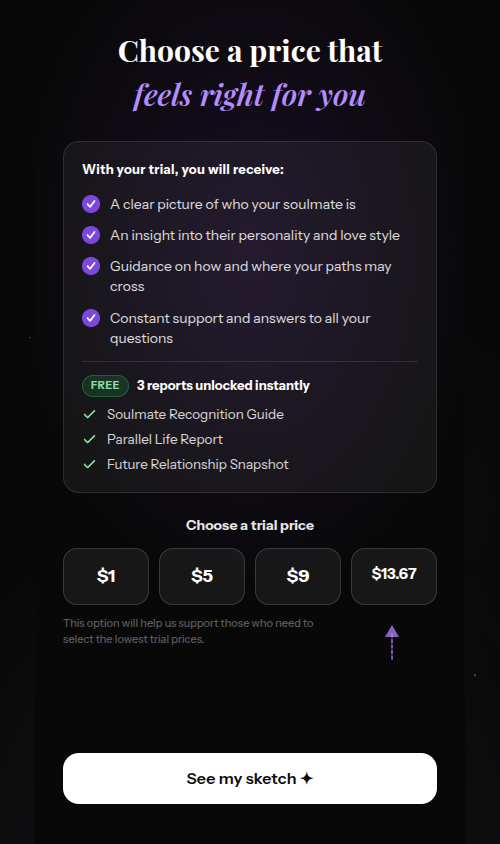 step 59 choose trial price
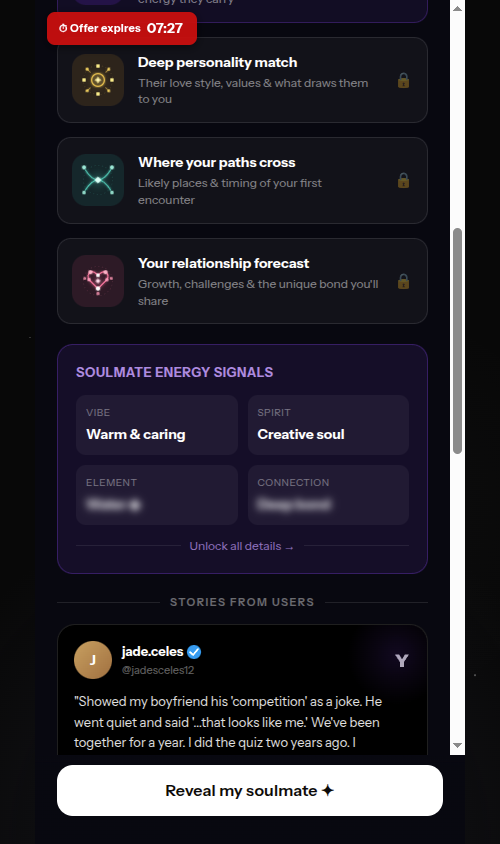 step 61 reveal page b scrolled
 step 62 checkout payment a
 step 62 checkout payment b
 step 63 current state
 step 64 newsalespage b
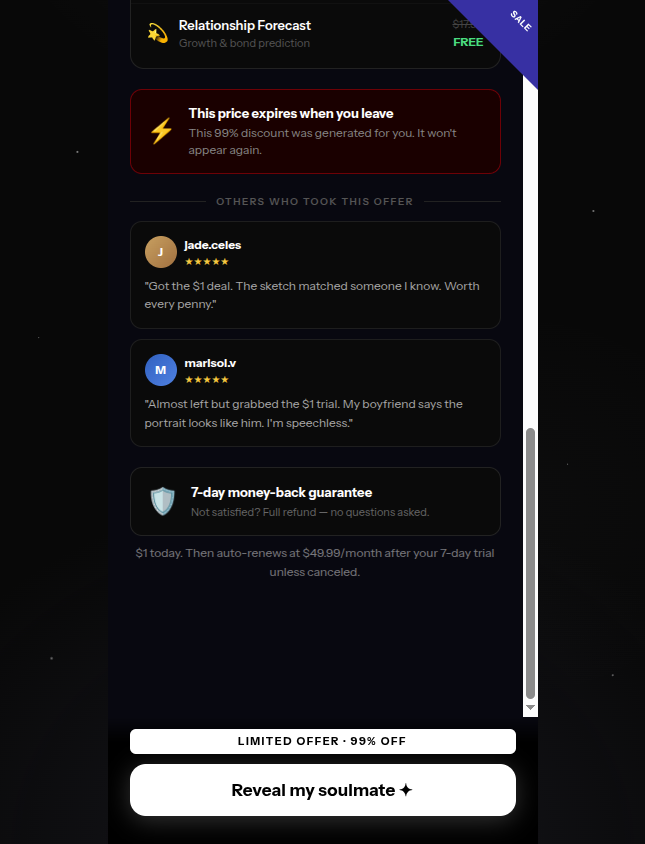 step 64 newsalespage c
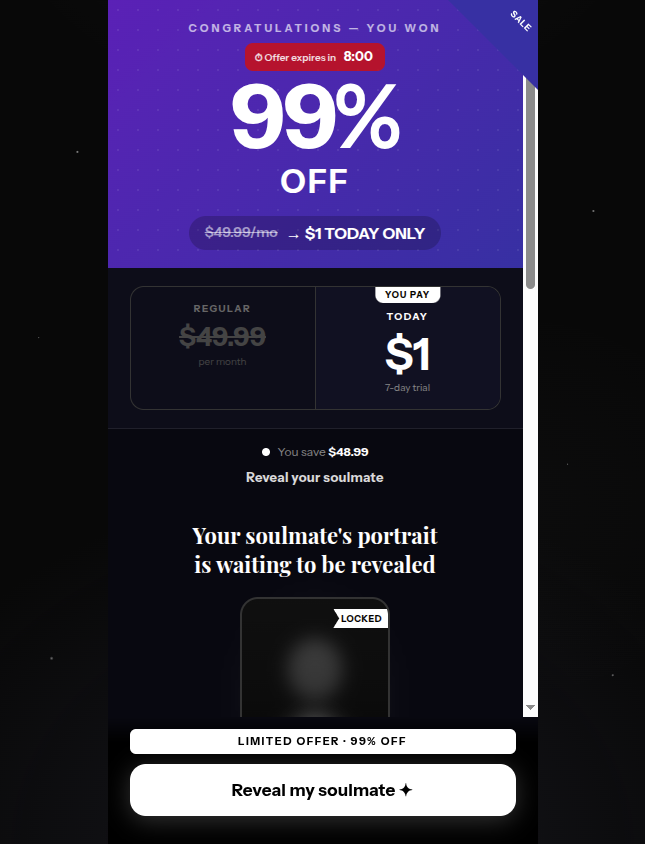 step 65 after back forward
Brand 02 · captured 2026-08-21Respontika / Staroly
Verdict. A three-year-old, three-entity CIS-operated subscription network selling the same product under a name they already own: “Soulmate Sketch” is a literal line item in their $10.99 upsell and “Reveal your Soulmate in a sketch!” is their funnel hero. The corporate stack is Kovexa Limited (UK) → an unverified “Respontika Inc.” (Austin TX virtual mailbox) → Spiritika Limited (Cyprus) as split merchant of record. They run four captured arms off one quiz engine: the Meta ad path redirects to Staroly at $5 → $14.50/week (~$63/mo, descriptor STAROLY.COM, no upsells); the native respontika weekly path bills CA$1.00 → CA$9.99/week (~CA$43/mo, descriptor RESPONTIKA.COM) and does carry a $10.99 upsell plus a 29:59-countdown downsell; a third native arm runs the identical quiz to a CA$39.99/month paywall with the CA$1.00 trial split into two transactions of $0.40 and $0.60; and a fourth arm sells something else entirely — a 28-day astrology course on term billing (CA$9.99 / CA$19.99 / CA$29.99), no trial, no sketch. That fourth arm is the real lesson here: they solved LTV with a content backend, not by raising the sketch price. No arm has a face scan, and all three sketch arms promise the sketch “within 2 minutes”. Their consent checkbox is legally tighter than TryAstro's and visually buried. And they are carrying the bill for it: Trustpilot 3.4 across 838 reviews with 45.6% one-star, a BBB Pattern of Complaints alert, a suppressed Trustpilot ad rating, and roughly one cancellation search per brand search on Google. Their deliverable is the weak point — sold as “a description of their appearance and energy”, i.e. text, and multiple buyers report receiving nothing at all. Watch Staroly, not just Respontika: it is the same machine with the astrology filed off and a clean reputation, which is what a reputation-damaged operator runs next.
id6741732531 (3.8★/349 ratings, Entertainment), Play com.app.respontika. Paid acquisition per the store listings.The network
One legal document names three different addresses in three jurisdictions. That is not sloppiness — it is three real entities plus boilerplate bleed from a fourth. Resolved map:
| Entity | Registry | Role | Status |
|---|---|---|---|
| KOVEXA LIMITED | UK Companies House #15648552 | Data controller for respontika.app; probable operating parent | Confirmed Active, accounts filed to 2025-04-30, not overdue |
| “Respontika Inc.” | Claimed: Austin TX, 701 Tillery St Unit 12-1539 | Data controller for respontika.com; US merchant of record; Google-verified advertiser name | Not confirmed in any registry |
| SPIRITIKA LIMITED | Cyprus ΗΕ 483921 | EU merchant of record; operator of staroly.com | Confirmed Active, nominee-fronted |
The malformed “3 Orbis Bridges Court Road Wharf London GB SW11 3GW” block sitting under the “Respontika Inc.” heading in the .com Terms is Kovexa's address, left in from shared boilerplate. It also explains the stray “laws of the United Kingdom” IP clause sitting next to Delaware governing law and a claim that the services are hosted in Germany and/or the Netherlands.
Cyprus director/secretary Andreas Charalampous holds both roles and appears across numerous unrelated Cyprus companies at an address shared with a corporate-services firm. That is the standard nominee pattern; his name does not identify the beneficial owner. Bonio is different — sole active director of a UK operating company with filed accounts, which is a beneficial-owner-level signal Likely the operator; confirmed only as sole active director.
Why the split merchant of record matters: US buyers bill through the unverified Texas entity, EU buyers through the Cyprus entity, with a compliance-forward corporate page at spiritika.eu built to reassure acquirers. An operator carrying this dispute volume needs redundant processing Reasoned inference, not a stated fact.
Operator-origin fingerprints: SPF includes spf2.esputnik.com and
_spf.ukraine.com.ua; MX includes mx.ukraine.com.ua. Two Meta pages self-categorise
as “Екстрасенс” (Ukrainian for psychic). A redirect experiment param reads
lada-team_resp-to-strl-5d — a “lada-team” routing respontika traffic to Staroly.
Read: CIS team, UK/US/Cyprus billing wrappers.
Portfolio
| Domain | What it is | Entity named on it |
|---|---|---|
| respontika.com | Main quiz funnel + subscription site; brand and traffic router | Respontika Inc. + Spiritika as MoR |
| respontika.app | Same product, second domain, same app IDs | Kovexa Limited + Spiritika as MoR |
| spiritika.eu | Corporate front page — no consumer offer at all; reads as processor-facing underwriting material | Spiritika Limited |
| staroly.com | Sibling consumer brand, same playbook, astrology sanded off and “modern psychology” bolted on. FAQ text near-verbatim reused from respontika.com. | Operated by Spiritika Limited |
Six AI “expert” personas (Amanda, Courtney, Olivia, Kristin, Chris, Shawn) carry human names, human photos, tenure claims (6–12 years) and approval ratings (97–98%) — and are explicitly disclosed as AI in the same viewport:
“At Respontika, our ‘experts,’ ‘coaches,’ and ‘psychologists’ are AI-powered assistants created by our team… These assistants are not real people and do not hold medical or psychological licenses.”
The disclosure is real and prominent, and they still take the hit — because the persona cards oversell exactly what the fine print then disclaims. Staroly drops the AI disclaimer while still claiming “expert psychologists” in its FAQ.
FOUR captured arms off one quiz engine
Not two funnels — four, sharing one quiz engine, one CRM and one pair of upsell routes. Three sell the sketch on a trial-to-subscription ladder; the fourth sells a different product on straight term billing with no trial at all. Which sketch arm a buyer gets depends on the entry path, and the price ladder and the statement descriptor change with it. All four were walked end to end. No payment was made on any arm.
| # | Arm | Path | Entry | Recurring | Descriptor | Upsells |
|---|---|---|---|---|---|---|
| 1 | Staroly weekly | /funnels/sketch-3p → 302 to staroly.com | $5.00 / 7 days | $14.50 weekly | STAROLY.COM | none |
| 2 | Native weekly | /funnels/soulmate/weekly | CA$1.00 / 7 days | CA$9.99 weekly | RESPONTIKA.COM | $10.99 + $10.99 timer |
| 3 | Native monthly | /funnels/soulmate/monthly-50c/0 | CA$1.00 / 7 days split $0.40 + $0.60 | CA$39.99 monthly | respontika.com | same routes DOM only |
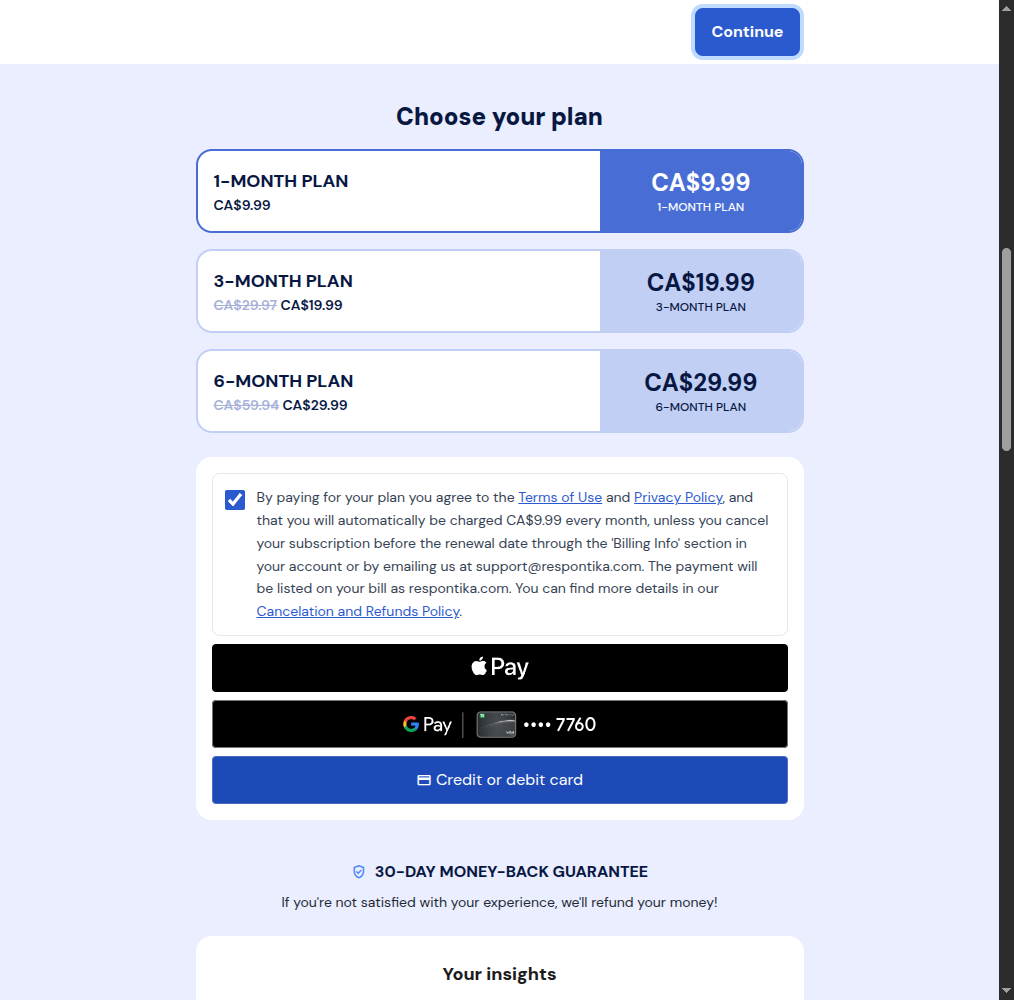
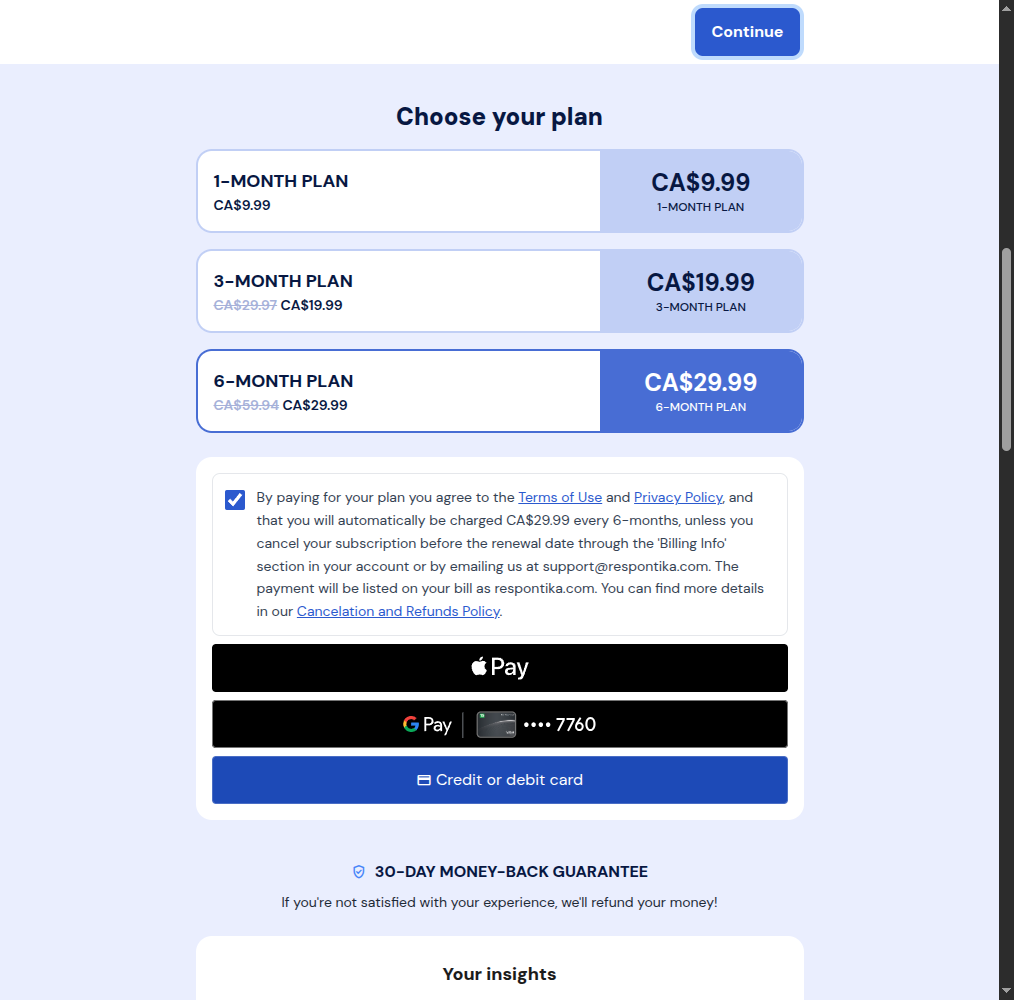
| 4 | 28-Day Challenge different product | /funnels/main | no trial — direct charge | CA$9.99 / CA$19.99 / CA$29.99 per 1 / 3 / 6 months | respontika.com | none observed |
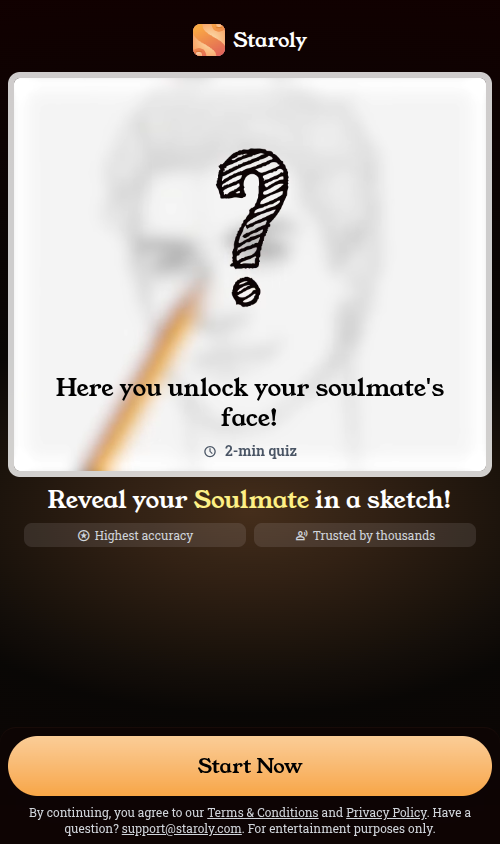
A. Staroly — the Meta ad path
respontika.com/funnels/sketch-3p 302s mid-click to
staroly.com/onboarding/soulmate-weekly-exp-coreb-sk-anima-anim-scratch
(exp_name=lada-team_resp-to-strl-5d_respontikacom). Captured shape: landing → 16-question
quiz (soulmate age and ethnicity spec capture, agree-scales, spirit animal) → DOB → a
“98% done” fake-progress interstitial at Q8 → answer-echo profile → email gate with a
blurred sketch → paywall.
- Offer: $5.00 for a 7-day trial (coupon STAROLY66, struck from $14.50), then
$14.50/week until canceled (~$63/mo). Descriptor
STAROLY.COM. - 30-day money-back guarantee stated on the paywall.
- No upsell and no downsell on this path.
Currency caveat — the single biggest sensitivity in the revenue model.
This arm's prices rendered as a bare $ with no currency code, in the same Canadian session
where arms 2–4 rendered an explicit CA$. It is modelled as USD, which is
the assumption most flattering to the network. If it is actually CAD, this arm's monthly-equivalent falls
from $62.79 to $45.84 and the network's mid-case run-rate drops roughly
20% — about $600k/yr. Arm 1 carries 55% of modelled volume, so resolving this one
character is the highest-value open thread on the page. Unresolved
B. Respontika native weekly — no redirect
respontika.com/funnels/soulmate/weekly serves respontika's own quiz: blue
brand palette, steps /1…/23, no hop to Staroly. Same 16-question skeleton,
but an element question (Water / Fire / Earth / Air) replaces the spirit animal, and a
social-proof review screen opens the flow. After email capture comes a promo-code screen
(“one time exclusive promo code for 90% discount”, code RESPONTIKA90) and then the
paywall.
- Offer: CA$1.00 for a 7-day trial, then CA$9.99/week until canceled
(~CA$43/mo). Descriptor
RESPONTIKA.COM. Footer address: 701 Tillery Street Unit 12-1539, Austin TX 78702. - Prices rendered in CAD for a Canadian session — pricing is geo-aware, so no cross-brand number should be compared without normalising currency first.
- This path DOES have an upsell stack.
/upsells/soulmateis a $10.99 one-time “Expanded” report tier (6 deliverables, explicitly “not a recurring subscription”). Declining it fires/upsells/timer— a 29:59 countdown reselling the same $10.99 as “was $21.98, SAVE 50%” to get the sketch “in seconds” instead of 30 minutes. The wait is manufactured, and it is the same lever TryAstro pulls with its 24–96h drip.
C. Respontika native monthly — the CA$39.99 arm Captured live 2026-08-22
respontika.com/funnels/soulmate/monthly-50c/0 runs the identical 16-question quiz
template as arm B — same element question, same personalization summary, same loader, same
email gate, no photo gate anywhere. The quiz is not the variable being tested. The paywall is.
- Offer: CA$1.00 for a 7-day trial, then CA$39.99/month until cancelled.
Coupon
RESPONTIKA97(“97% off”) is auto-applied. Descriptorrespontika.com. 30-day money-back guarantee. Apple Pay + Google Pay + card. - Retention claim at the moment of card entry: the modal carries “91% of users stay with us after the initial 7-day period.” Presented as reassurance, doing the exact opposite job of a cancel reminder.
- A fine-print contradiction. The consent text promises “a promotional discount” on the first monthly charge and then names CA$39.99 — the same as the full price. Almost certainly a template leftover from an arm where the two differed, but it means the discount on this arm is nominal.
⚠ The split-transaction tactic — new, and worth knowing about.
The CA$1.00 trial on this arm is not charged once. The consent text states it
“will be processed consecutively as two separate transactions in the amounts of $0.40 and
$0.60”. That is a processor-side behaviour — managing decline rates and per-MID risk
across multiple processors — and it is disclosed in the fine print rather than hidden. We do not
need it and should not copy it, but seeing it on a competitor is a reliable tell that their
payment processing is under strain. It also explains the URL: the 50c in
monthly-50c is the split, not a $0.50 entry price, which corrects the earlier inference in
brand-company.md §7.
Consent text, verbatim: “By paying for your plan you agree to the Terms of Use and Privacy Policy. For the 7-day trial period, you authorize us to charge an amount of CA$1.00, which will be processed consecutively as two separate transactions in the amounts of $0.40 and $0.60. Upon expiration of the 7-day trial period, unless canceled beforehand, your selected subscription automatically starts as a monthly plan. A promotional discount will apply, and you will be charged CA$39.99 for the first monthly plan. Starting from the second monthly plan, the full price of CA$39.99 per month will apply, unless you cancel the subscription anytime before the renewal date through the ‘Billing Info’ section in your account or by emailing us at support@respontika.com. The payments will be listed on your bill as respontika.com. You can find more details in our Cancelation and Refunds Policy.”
Why this arm changes the model. It explains the US complaint reports of $29.99 and $39.99 charges, which had no matching captured ladder before this walk. And it is a higher-variance ladder, not a cheaper one: a single successful rebill collects 4× what a weekly rebill collects, so the per-start ceiling sits materially above the weekly arms even though the mid-case value comes out the same.
D. The 28-Day Challenge — a different product entirely Captured live 2026-08-22
respontika.com/funnels/main does not sell a sketch. It sells an
astrology/ritual self-improvement course delivered as four weekly modules (week 1 =
“Foundations and Mindfulness”). This is their retention and LTV backend, and it is the most
strategically interesting thing in this entire teardown.
Everything about the shape is lighter than the sketch arms: a 6-question quiz instead of 16, no interstitials, no fake-progress screen, no photo gate, no promo-code screen. It is a qualification form, not a sunk-cost machine — which is exactly what you build when you are selling to someone already on your list rather than to cold traffic.
| Term | Price | Struck from | Label |
|---|---|---|---|
| 1 month | CA$9.99 | — | — |
| 3 months | CA$19.99 | CA$29.97 | “Most Popular” — pre-selected default |
| 6 months | CA$29.99 | CA$59.94 | “Save 50%” |
Auto-renews per term. Descriptor respontika.com. 30-day guarantee.
No split-transaction language — that tactic is specific to the CA$1.00 trial arms.
Consent text, verbatim (3-month default; the 1- and 6-month variants swap only the amount and the interval): “By paying for your plan you agree to the Terms of Use and Privacy Policy, and that you will automatically be charged CA$19.99 every 3-months, unless you cancel your subscription before the renewal date through the ‘Billing Info’ section in your account or by emailing us at support@respontika.com. The payment will be listed on your bill as respontika.com. You can find more details in our Cancelation and Refunds Policy.”
⚠ The dual-entity footer — and a correction. This arm's footer discloses two entities: “Respontika Inc, 701 Tillery Street… Austin, Texas” and “Spiritika Limited, ABC Business Center, Charalampou Mouskou 20… Paphos, Cyprus”. The sketch arms' footers show only Respontika Inc. This is the first customer-facing surface where both entities appear together, and it points at the course product routing through a different merchant of record than the sketch products — which is precisely what an operator does when the primary MID is carrying too many disputes. This corrects the earlier read that only Respontika Inc. appears on customer-facing footers: true of the sketch arms, not of this one.
- Copy contamination. The personalization card inside this non-sketch funnel says “Done to your Soulmate sketch” and “Palm reading goal”. Shared template, sloppy re-skin, never proofread — the same machine-assembled-and-shipped signature as their Meta ad headline.
- No cross-sell exists. Nothing on the sketch arms links to this product. If it is sold into the sketch list, that happens over email/CRM, not on-funnel.
- The decline path dead-ends. The card modal has an X; closing it returns to the pricing screen with no exit-intent offer and no downsell. For an operator this aggressive, that is a real gap in their own funnel.
| Ladder | A · Staroly | B · Native weekly | C · Native monthly | D · Challenge |
|---|---|---|---|---|
| Entry URL | /funnels/sketch-3p → 302 | /funnels/soulmate/weekly | /funnels/soulmate/monthly-50c/0 | /funnels/main |
| Product | Sketch | Sketch | Sketch | 28-day course |
| Quiz length | 16 questions | 16 questions | 16 questions | 6 questions |
| Trial price | $5.00 / 7 days | CA$1.00 / 7 days | CA$1.00 / 7 days (split $0.40 + $0.60) | no trial |
| Recurring | $14.50 / week | CA$9.99 / week | CA$39.99 / month | CA$9.99–29.99 / term |
| Monthly-equiv (USD) | $62.79 if USD | $31.58 | $29.19 | $3.65–7.29 |
| Discount device | Coupon STAROLY66 | Promo screen, RESPONTIKA90 | Coupon RESPONTIKA97, auto-applied | Struck-through anchors + “Most Popular” |
| Statement descriptor | STAROLY.COM | RESPONTIKA.COM | respontika.com | respontika.com |
| Upsell / downsell | None | $10.99 + $10.99 timer | same routes DOM only | None |
| Footer entities | Spiritika (staroly.com) | Respontika Inc. only | Respontika Inc. only | Respontika Inc. + Spiritika |
| Face scan | None | None | None | None |
Common to the three sketch arms
- No face scan, no photo upload, no birth time or place — DOB only. That is the whole biometric surface, and it is empty.
- Mandatory consent checkbox spelling out trial price, rebill amount, descriptor and card-storage consent, unchecked by default and gating the pay button — legally tighter than TryAstro, though the recurring price is visually buried under the huge trial figure.
- Sketch promised “within 2 minutes” — instant AI, no delivery theater.
- The
/upsells/soulmateand/upsells/timerroutes at $10.99 are shared infrastructure — confirmed live on arm B, confirmed to still exist from arm C's DOM.
Billing cadence is the sharpest structural difference between them and everyone else — and they run both cadences at once. At CA$9.99/week they collect ~CA$43/mo and can bill four or five times before a typical cancel decision, against a single monthly decision point at TryAstro. At CA$39.99/month they collect 4× per charge with fewer decision points. Running both against the same 16-question quiz is a deliberate hedge — high-frequency/low-ticket against low-frequency/high-ticket — and the VWO install says they are measuring exactly that. It is also why their cancellation-search volume nearly equals their brand-search volume.
The $10.99 upsell bundles six deliverables, the first of which is literally called “🎨 Soulmate Sketch” and is described as “a description of their appearance and energy based on your astrological chart” — text, not necessarily a drawn portrait. That gap is their weakness and our differentiator.
Beyond the subscription, the Terms monetise further: chats are capped at 2 minutes with paid overage, chatting with a different expert costs extra, premium reports carry additional non-refundable fees, and users are invited to leave tips for their AI expert.
Refund policy — the chargeback machine
Last updated January 24, 2023, over three years stale against the April 2026 privacy policy. Seven-day refund window, discretionary denial reserved, and hard carve-outs with no refund available for: expert chat fees, tips older than 3 days, premium reports, and — the sharp one — “Subscriptions that have been billed more than once.” Combined with a 1–7 day trial and weekly billing, the window to notice and act is very small. That carve-out converts a refund request into a dispute, and disputes are what get processors pulled.
Ad engines
| Lane | Volume | Shape |
|---|---|---|
| Meta | 83 active on page “Love Sketch” (866466499876425) + 4 dark persona pages | ~70/30 video/static; no voiceover — burned-in text over licensed pop tracks; winners mass-duplicated (one cluster = 113 ads); Worldwide 18–65 minus NL/CY/GP; delivery 3–4.6× female, centre of mass 25–44 |
| 452 lifetime creatives under advertiser AR16321800259460136961 | 380 responsive display / 65 static / 7 search / 0 video. Peak Nov 2025 (107/mo), dark Jun–Jul 2026, Aug 2026 relaunch with 31 all-new creatives. Live search ad: “Soulmate Sketch Try Now”. | |
| Apps | iOS + Android | Paid acquisition via YouTube / IG / FB per the store listings |
| Microsoft | Bing cookies (MUID, SRM_B, ANONCHK on .c.bing.com) | They run Microsoft Ads — the same lane we are testing |
The four dark Meta pages are worth keeping on a watchlist, because a dark page going live is the tell that the live page got restricted: Anna Ley (272803212582058), Nova Sinclair (585922614600012), Soulmate Sketch (595053747035199), Sofia Clairé (889203500932062). Three fake-psychic personal names plus two generic product names — the same play we run with Stella/Lara, executed as disposable page identities rather than a persistent brand.
One body copy, one CTA, for a full year
Body: ✨ Ever Wondered Who's Destined for You?
Get a Custom Portrait Based on Your Energy 💖
Title: Take quiz and check it out!
Link description: 💘Unlock Your Future Love!
CTA: Learn more (video) / See details (image)
An exact-phrase search for “Ever Wondered Who's Destined for You” returned only respontika pages — 30 of 30 hits across the five page IDs, zero other advertisers. That string is a reliable fingerprint for future monitoring.
Their landing-path matrix is two paths, ever: /funnel-sketch (52 ads, 2025-08 → 2026-08,
legacy) and /funnels/sketch-3p (36 ads, 2026-02 → now). No UTMs, no per-creative params, no
ad-ID macros. They test almost nothing. Their edge is duplication volume, not iteration
— which is exactly where our creative-testing cadence is an advantage.
The key Meta finding: no voiceover, ever
A transcript pull on their most-duplicated video (47s) returned song lyrics only, and Gemini video analysis confirms “no voiceover or specific sound effects” across all 30 scenes. The entire sales argument is burned-in on-screen text over a licensed pop track. No script, no talking head, no narration, no character voice. One exception exists: a 57s video opens with a 5-second deep, calm, echoey male VO over a stormy sky — a cold-open hook, not narration.
That is dramatically cheaper to produce than our VO + Omni pipeline and sidesteps voice-consistency work entirely. The format itself is the hypothesis, not the script.
Top hooks — verbatim
- The overhead-sketch reveal (video, primary format, 47s). Two floating panels above a
real person's head labelled
me|my soulmate, both blurred, then resolving into pencil portraits. Mid-roll banner: “I'LL DRAW THE PERSON YOU MAY MARRY” / “TAKE TEST”. End-roll: “See who your soulmate really is!”. ~30 micro-scenes of 1–3 seconds, all selfie/static-medium angles, deliberately native UGC-looking, diverse cast. Several scenes deliver the payoff: the sketch resolves, then a real person matching that sketch walks into frame. Sketch → real-person match is the whole mechanic, repeated ~10 times in 47 seconds. - The Twin Flame / Karmic / Soulmate taxonomy (video, 57s, strongest concept). Cold open on a stormy sky, male VO: “Your soulmate has a face. Want to see it?” Then a yellow banner held for the remaining 52 seconds: “THIS WILL GIVE YOU GOOSEBUMPS. WE ALREADY KNOW WHAT YOUR SOULMATE LOOKS LIKE.” Three slots above each subject's head — blue flame, green flame, red fiery heart — each filling with a different sketched face: Twin Flame — Wrong person ❌ / Karmic — Wrong timing ⏰ / Soulmate — Right everything ✅
- The tattoo pattern-interrupt (static). A woman's bare shoulder against a night-city window, tattooed with a photorealistic man's face and, in tattoo lettering, “THEY WILL DRAW THE PERSON YOU'LL MARRY”. Reads as a real photo, not an ad.
- The split-screen proof (static). Left: pencil sketch of a bald bearded man. Right: photo of a real man in USMC digital camo who matches it. Red chips: “Got this sketch” | “Met him 3 months later!” The cleanest proof asset in the set — the sketch/reality claim made literal in one frame. We do not currently have an equivalent.
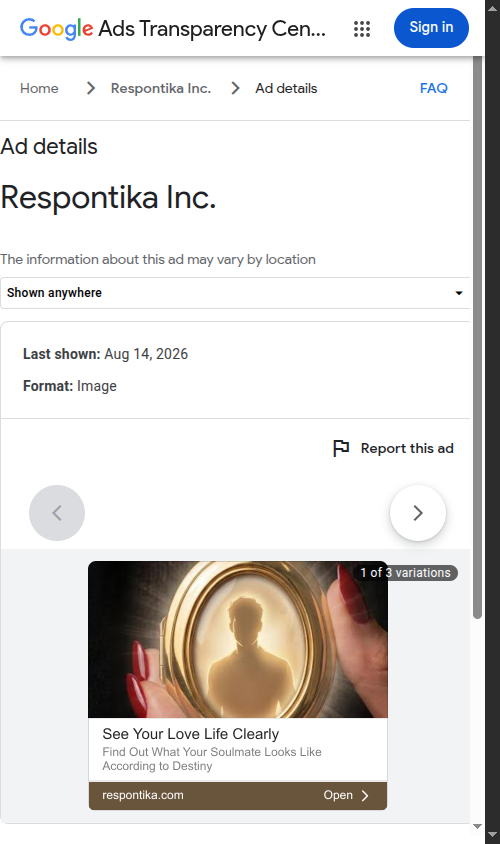
- The antique locket (static). White-gloved hands holding an oval gold-framed miniature portrait on an old leather case. Serif headline “Check Your Soulmate Face”. Heritage/artifact framing — the sketch as a treasured antique rather than a digital output.
- The torn-paper line art (static). Black-and-white editorial line drawing of a couple on torn paper texture: “SEE YOUR SOULMATE'S FACE”.
“TAKE TEST” beats every purchase-intent CTA they could have used. Every creative, every format, one year. Quiz-first framing, zero commerce language on the ad surface.
Targeting
Worldwide with Guadeloupe, Netherlands and Cyprus explicitly excluded (likely payment, refund or regulatory friction — worth noting if we ever go broad-geo). Gender All, age 18–65. EU reach 55,028 / GB 18,219 on the top ad. Platforms: Facebook, Instagram, Audience Network, Messenger, Threads, and newer August 2026 ads add WhatsApp.
| GB age band | Male | Female | F:M |
|---|---|---|---|
| 18–24 | 857 | 2,053 | 2.4× |
| 25–34 | 1,528 | 5,109 | 3.3× |
| 35–44 | 998 | 4,591 | 4.6× |
| 45–54 | 419 | 1,830 | 4.4× |
| 55–64 | 99 | 426 | 4.3× |
| 65+ | 68 | 291 | 4.3× |
Same pattern across all 30 EU countries reported. They set gender to All and let the algorithm find women — but their creatives deliberately include male reaction shots, which is what keeps the “All” setting viable. No interest stacking, no lookalikes indicated: pure creative-led broad targeting.
The Google lane — 98.5% display, and the search lane is live
| Format | Count | Share |
|---|---|---|
| Responsive / display | 380 | 84.1% |
| Static image | 65 | 14.4% |
| Search text | 7 | 1.5% |
| Video | 0 | 0% |
Correction carried forward: the earlier brief said “~2,000 ads”. Google's own count for this advertiser and domain is 400–500, and exhaustive pagination returned 452 unique creative IDs. The 2,000 figure is wrong by ~4×. Use 452.
Cadence by month of first appearance: 33 (Sep 2025) → 93 → 107 (Nov, peak) → 85 → 34 → 24 → 30 → 6 → 9 → 0 (Jun 2026) → 0 (Jul) → 31 (Aug). Currently live: 13 creatives in the last 3 days, 31 in the last 30, and all 31 are the August cohort. Nothing from the 2025 library still serves. They are in an active re-test right now, not steady-state scaling.
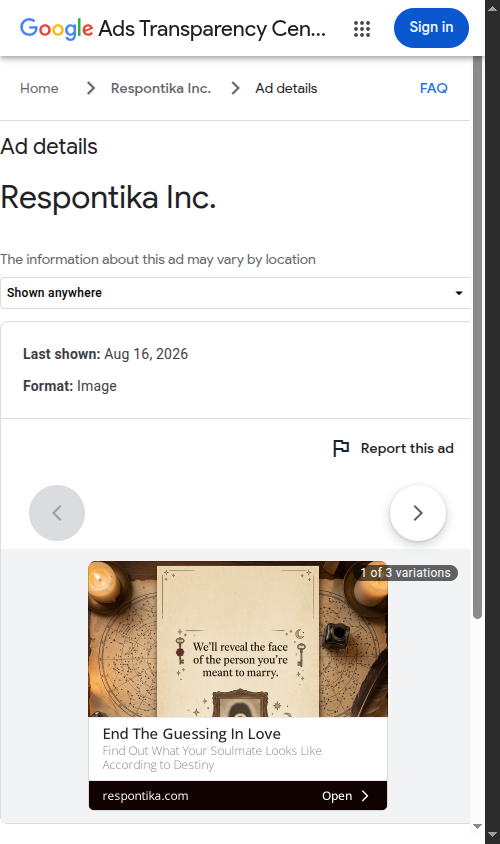
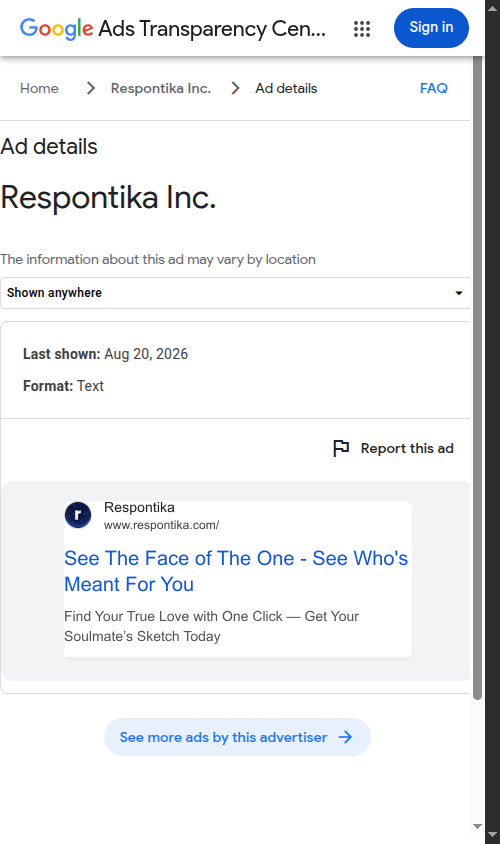
Their live August creatives sell our exact product. Headlines: “End The Guessing In Love”, “See Your Love Life Clearly”, “Love Clarity Starts Here”, “See The Face of The One”, “Soulmate Sketch Try Now”. Descriptions repeat verbatim across creatives (“Find Out What Your Soulmate Looks Like According to Destiny” appears on at least three) — they test images and headlines against a fixed description, which is disciplined variable isolation, not a spray.
- The hook is the face, not the reading. Every headline promises seeing. The mechanic is visual reveal, never “reading” or “insight”.
- Curiosity framing, zero crisis framing. Independent confirmation that the category converts on curiosity, which is exactly our own Soulmate Sketch read.
- The obscured face is the whole visual system — a blurred silhouette in a locket, a “?” in a portrait frame, a covered face on parchment. The open loop is drawn, not written.
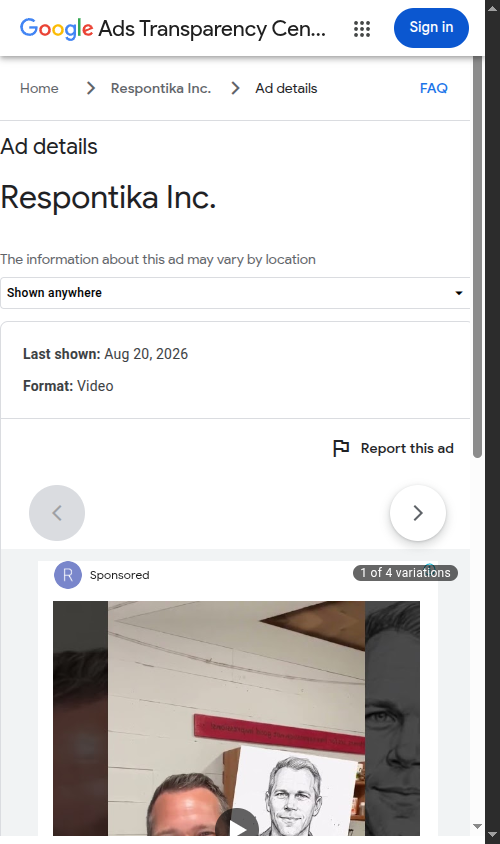
- They recycle vertical UGC video stills into GDN display frames, and they personalize the mock result inside the ad itself (“Loren, your wedding with James will be on March 21, 2026”) — a fabricated proof asset shown pre-click.
- “According to Destiny” is doing compliance work, framing the output as fate rather than a prediction claim.
In March 2026 they ran search ads to dedicated landing pages /soulmate/drawing and
/soulmate/sketch; both now return genuine 404s. The two live August search ads point at the root
domain instead. They abandoned the dedicated-LP structure and collapsed everything into the single quiz funnel.
Method note worth keeping: every keyword estimator reports zero paid keywords for
respontika.com (with a geico.com control proving the field populates). Yet ATC proves search ads
are serving today. ATC is the ground truth for whether a competitor buys search; DataForSEO is the
ground truth for which keywords at scale. A keyword tool alone would have reported “no Google
ads at all” — wrong by 452 creatives.
Organic — their SERP is a churn readout
~44 ranked keywords, ~1,200 visits/month equivalent (estimate), 43 referring domains. Almost all position-1 rankings are their own brand terms. The signal that matters:
| Keyword | Vol/mo | Pos |
|---|---|---|
| respontika astrology | 1,300 | 1 |
| respontika cancel subscription | 880 | 2 |
| respontika reviews | 320 | 8 |
| respontika astrology cancel subscription | 210 | 2 |
| respontika login | 210 | 1 |
| respontika soulmate sketch | 140 | 2 |
| is respontika legit | 110 | 13 |
| respontika cancel subscription refund | 70 | 2 |
| respontika unsubscribe | 50 | 1 |
| how to cancel respontika | 40 | 2 |
Add the cancellation cluster and it comes to ~1,250 searches/month of pure exit intent against 1,300/mo for their main brand term. Roughly one cancellation search for every brand search, and it is publicly visible. Google has also clustered them with the recurring-billing complaint cohort — their keyword neighbourhood is populated by other “cancel subscription” queries for unrelated brands.
Reputation and exposure
| Metric | Value |
|---|---|
| TrustScore | 3.4 (displayed as 3.5 stars) |
| Total reviews | 838 |
| 5-star | 364 (43.4%) |
| 4-star / 3-star / 2-star | 54 (6.4%) / 30 (3.6%) / 8 (1.0%) |
| 1-star | 382 (45.6%) |
| Profile claimed / paying Trustpilot customer | Yes / Yes |
| Reply rate to negative reviews | 97.4% |
| Trustpilot ad rating | Suppressed — “unavailable due to a breach of guidelines” |
| Homepage claim | “Rating based on 100+ reviews — 4.8” |
The distribution is a barbell: 45.6% one-star against 43.4% five-star with only 11% in between. A genuine mixed-quality service produces a middle. This near-empty 2/3/4-star band is the signature of solicited five-star reviews sitting on top of an organic one-star complaint stream. See it live on Trustpilot.
BBB has posted a Pattern of Complaints alert on the Austin TX profile (file opened 2025-07-07, not accredited, not rated, did not respond to BBB's advertising-review inquiry). That is not a customer opinion — it is BBB's own finding that complaint volume and type form a pattern the business has not resolved. Two independent adjudicators have now flagged this operator.
The complaint mechanism, identical across ten countries
- Ad on YouTube / Instagram / Facebook promises a soulmate sketch for $1 / £1 / €1.
- Payment often taken via Apple Pay — one tap, minimal disclosure surface.
- Buyer is enrolled in a 7-day trial that converts to WEEKLY billing, not monthly as most assumed.
- Rebill amounts reported: $10, $14.50, $14.99, $29.99, $39.99, £5.99, £12.99, €9.90.
- Login frequently fails — account not recognised, password-reset email never arrives — so the self-serve cancellation path named in the Terms is unreachable.
- Support replies are scripted and refuse refunds, citing the policy.
- Buyers escalate to card replacement, bank disputes, chargebacks, the CFPB, and Google Play removal requests.
Note item 5 against Terms that place the burden entirely on the user (“It is your responsibility to track trial end dates”). If login is broken, that duty is impossible to discharge. Broken cancellation is the accelerant, not the rebill itself.
Note also a separate failure: several reviewers never received the sketch at all. The deliverable failure and the billing failure are two different problems, and fixing the billing would not fix the product.
“I purchased the ‘soulmate sketch’ for $1, just for fun, and never agreed to any subscription. Yet after checking my credit card bill a few weeks later, I discovered I had been charged $10 every week for a subscription I never signed up for or authorized. When I contacted customer support and asked for a refund, they refused.” — AT, 2025-10-04
“The website forces account creation and then blocks cancellation: my login details were not recognised, password reset does not work, and cancellation requests go unanswered.” — GB, 2025-09-25
Observed entry prices in the wild span $0.50 / $0.99 / $1.00 / £1 / €1 with rebills from $10 to $39.99 at weekly, monthly and unspecified intervals Buyer reports, not transacted by us. That spread is itself evidence of aggressive multivariate price testing, consistent with the VWO install and the price-variant URL paths.
The 2026-08-22 monthly capture closes a gap in this evidence. The stated-weekly reports ($10, $14.50) map cleanly onto arms A and B. The $29.99 and $39.99 reports never had a matching captured ladder — and arm C is one: a US-served equivalent of CA$39.99/month lands almost exactly there. Those complaints are most likely the monthly arm reaching US buyers, not mystery pricing.
Versus TryAstro — fully independent operators
Checked four ways (page IDs, landing domains, creative style, corporate identity) plus a full
infrastructure diff (registrar, nameservers, A records, MX, SPF, site-verification tokens). No
overlap at any layer. The only connection is keyword adjacency: tryastro's /help page
ranks position 25–49 for “respontika soulmate” — TryAstro capturing a competitor's brand
traffic, not shared ownership. Residual uncertainty: a common media buyer or affiliate network behind both
cannot be excluded from public data, and nothing observed suggests one.
| TryAstro | Respontika / Staroly | Us (Soulmate Sketch) | |
|---|---|---|---|
| Quiz | 44 questions, 7 sections | 16 questions | Intake quiz → prompt chain |
| Biometric gate | Mandatory face scan | None | None |
| Front end | $1 PWYW bait (to $13.67) | $5 or CA$1.00 for a 7-day trial | $11.11 one-time + bumps |
| Back end | $49.99/mo ambush + 3-OTO gauntlet | $14.50/wk (Staroly, no upsells) or CA$9.99/wk + $10.99 upsell and countdown downsell (native) | OTO ladder, transparent recurring shown in 3 places |
| Consent legalese | Self-contradictory (opt-in vs auto-renew in one bundle) | Tighter, but visually buried | Displayed, not buried |
| Age | 4.5 months | ~3.5 years | — |
| Posture | Scaling hard on Meta video | Post-dark-period relaunch | — |
Ours is the third architecture and the most chargeback-resistant of the three. Worth noting that TryAstro's Terms go out of their way to promise no recurring charge — they appear to be deliberately positioning against exactly Respontika's failure mode, even while their own checkout fine print contradicts it.
Takeaways for our lane
- They own the exact product name. Buyers searching our product name will find their complaint pile. Worth knowing before we scale brand-term spend.
- Their deliverable is the weak point. Text, not a portrait, and often nothing at all. An actually-drawn, actually-delivered portrait is a genuine differentiator, and their 838-review complaint pile is free proof that the demand is real and unmet.
- Test one no-VO, text-only cut against our current format. The format is the hypothesis, not the script.
- Audit our own portal cancel path. A working, obvious, one-click cancel is cheap insurance against the exact failure mode that produced their BBB alert.
- If we disclose AI, the disclosure and the persona must agree. Their disclosure is real and prominent and they still take the hit, because the persona cards oversell what the fine print disclaims.
- Watch Staroly, not just Respontika. Same operator, same machine, clean brand, no complaint history attached yet. If the Respontika name becomes unusable, Staroly is the continuation.
- ⭐ They solved LTV with a content backend, not a higher sketch price. Across three sketch arms the entry never moves above CA$1–$5. The 28-day Challenge is a CA$9.99–CA$29.99 term subscription for a four-module course, sold to people already on the list. That is the compliant half of their model and the most portable finding in this recon: a term-billed content product fits our existing Upsell Checkout v2 rail better than another one-time OTO does, because the rail already does one-tap charges against a saved card.
Open threads
- Staroly currency ambiguity — a bare
$on the arm carrying 55% of modelled volume. Resolving it moves the mid-case revenue model by ~20% (~$600k/yr). Highest-value open item on this page. - Arm C steps 27–28 are DOM-sourced, not live-walked. The monthly arm's real post-purchase path is unconfirmed.
- Whether the Challenge product is actually sold into the sketch list, and through which channel, is unconfirmed — no on-funnel cross-sell exists.
- Whether Spiritika appears in the footer of the USD and EU sketch arms is unknown; the dual-entity footer was observed only on the Challenge arm, from a Canadian session.
- Delaware registry check for “Respontika Inc.” is UNREACHABLE, not negative — the query method failed its own known-good control, so no inference is available. Needs a browser-driven session or a paid source.
- 33 of 83 Meta actives unparsed (near-certain duplicates). 3 of 5 live video assets and 1 of 5 statics not visually analysed.
Paywall variants of the remaining funnel arms (— both captured live 2026-08-22, see arms C and D. Prices on arms B–D were captured in CAD from a Canadian session — the USD, UK and EU arms are still not captured, and complaint reports cite $10 / $14.99 / $29.99 / $39.99 / £12.99 / €9.90 across ten countries. Staroly's own reputation profile not examined.monthly-50c,/funnels/main) uncaptured- Ad copy for the 380 responsive display units not captured — their assets load async; only the 71 archived-image creatives are directly readable. The 8 read are a sample, not a census.
- Spiritika's shareholders are not in the free Cyprus record. Statement descriptor and payment processors unknown without a live test purchase — none was made.
- ATC field
13read as region count is inferred from its distribution only Unverified.
Arm B — native weekly walkthrough
29 screenshots ·respontika.com/funnels/soulmate/weekly — no redirect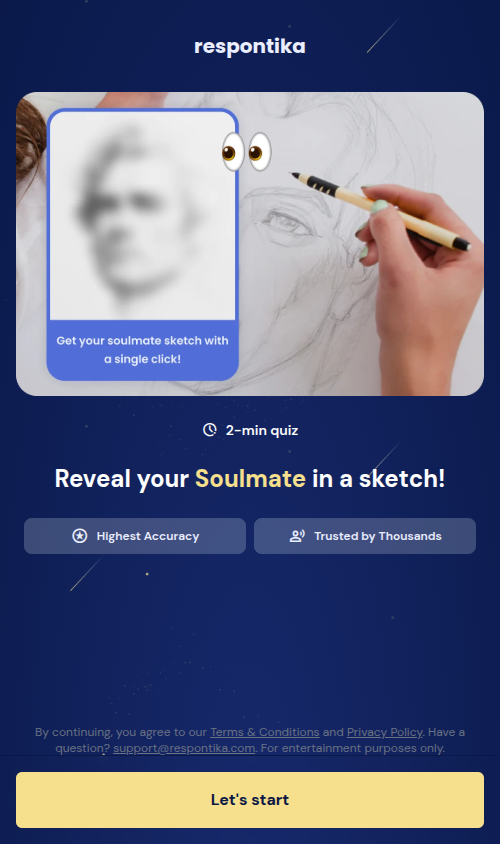 step 01 landing
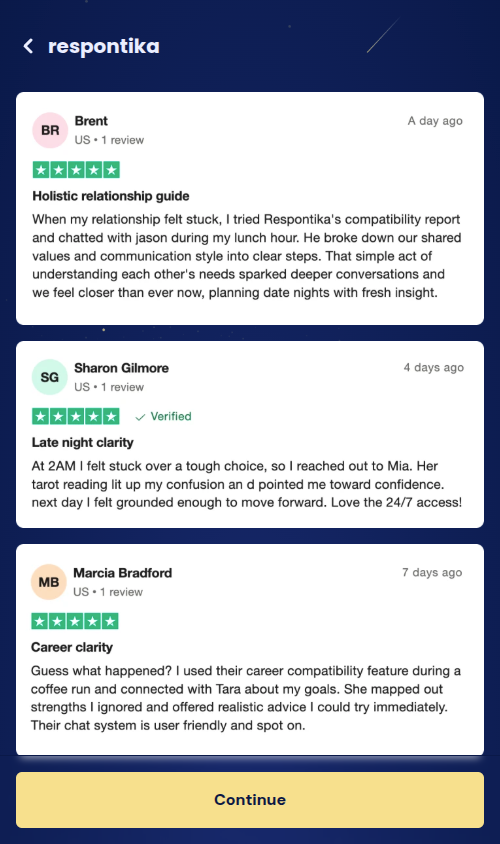 step 02 social proof
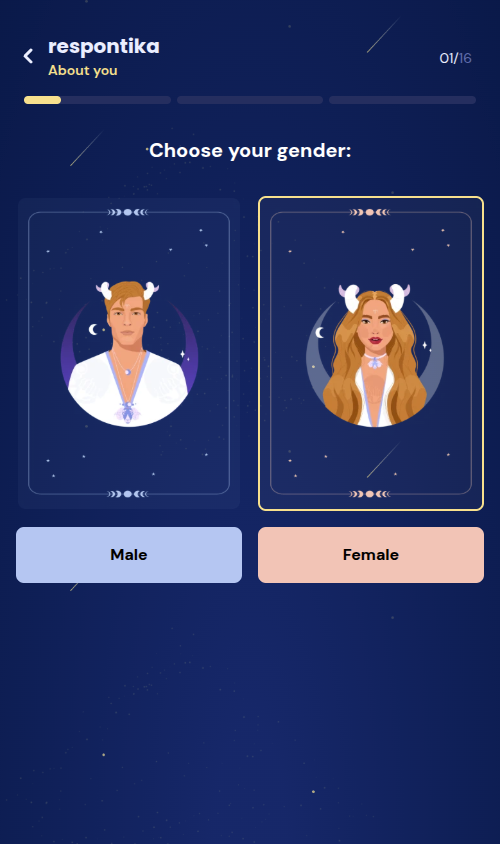 step 03 q01 gender
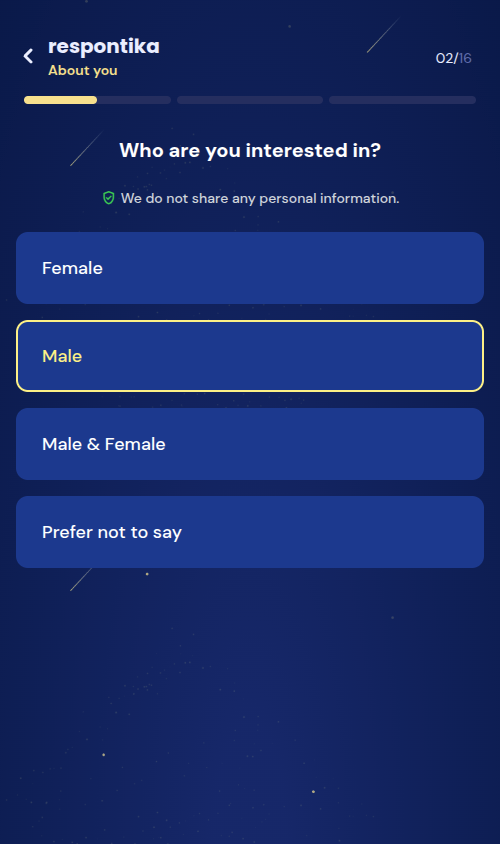 step 04 q02 interested in
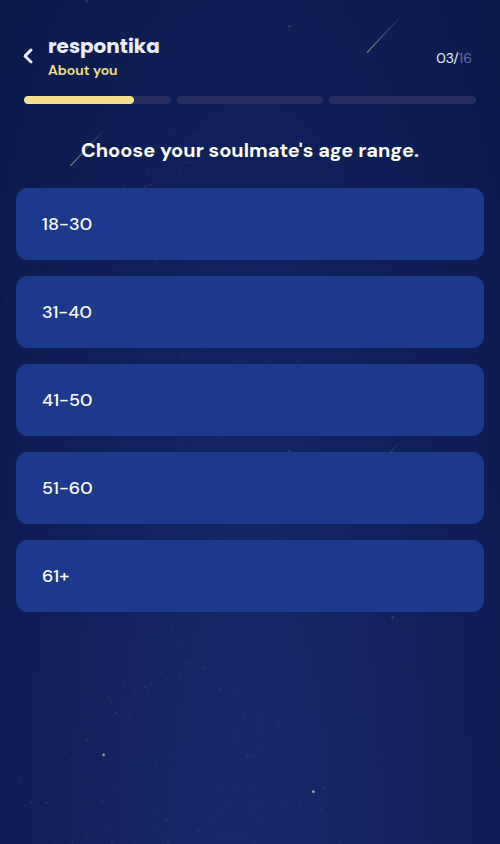 step 05 q03 soulmate age
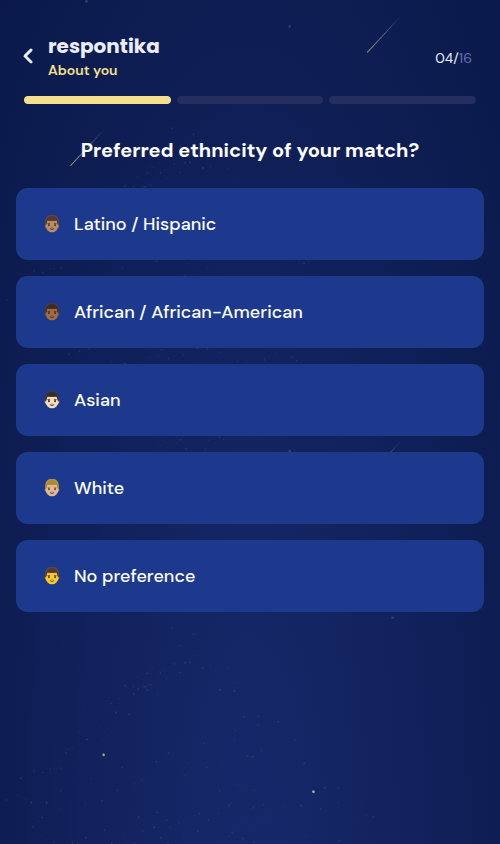 step 06 q04 ethnicity
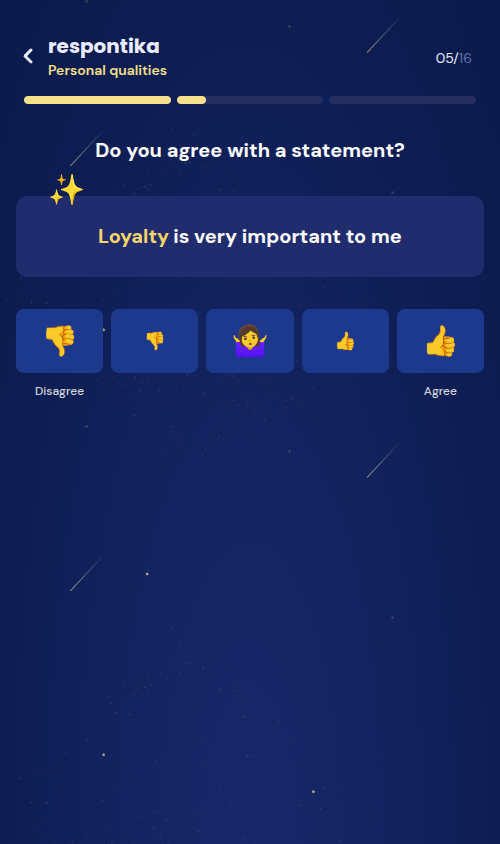 step 07 q05 loyalty
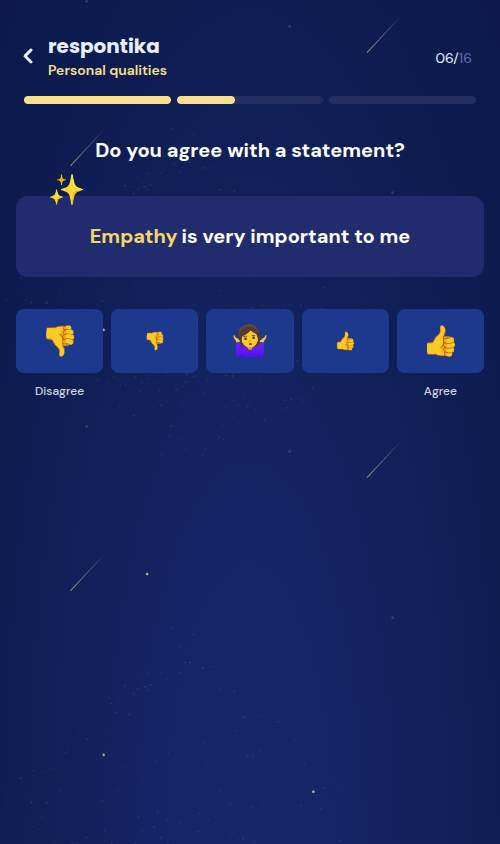 step 08 q06 empathy
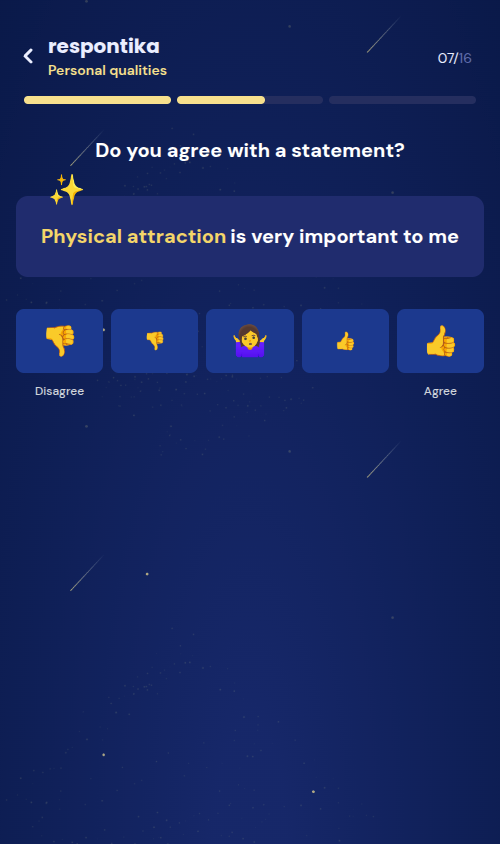 step 09 q07 physical attraction
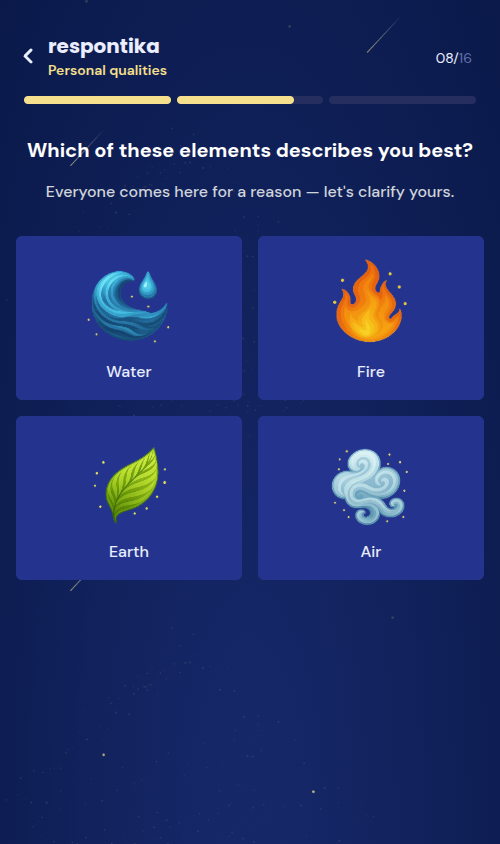 step 10 q08 element
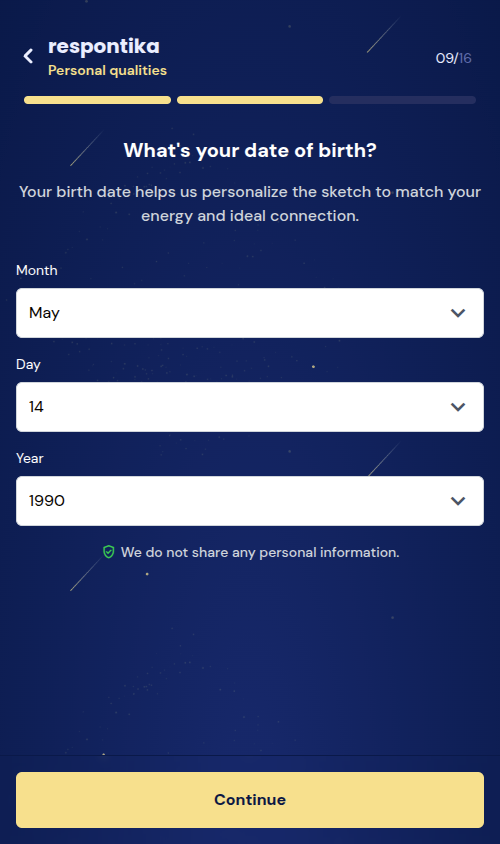 step 11 q09 dob
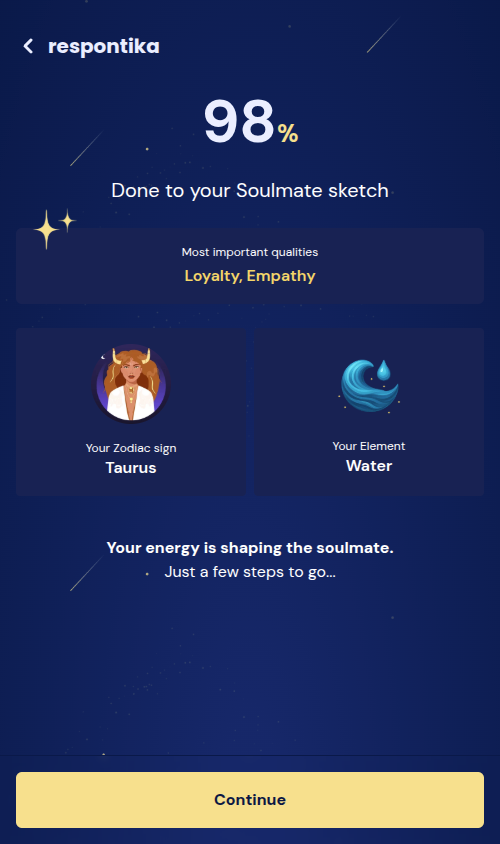 step 12 interstitial 98pct
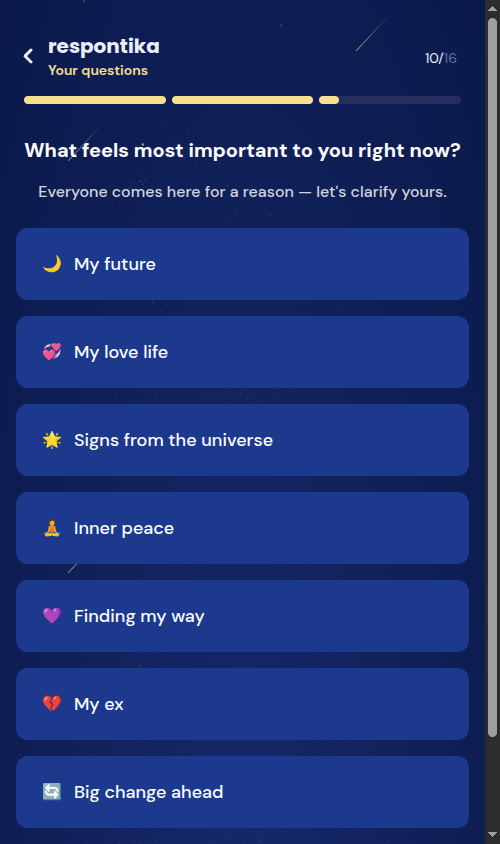 step 13 q10 important now
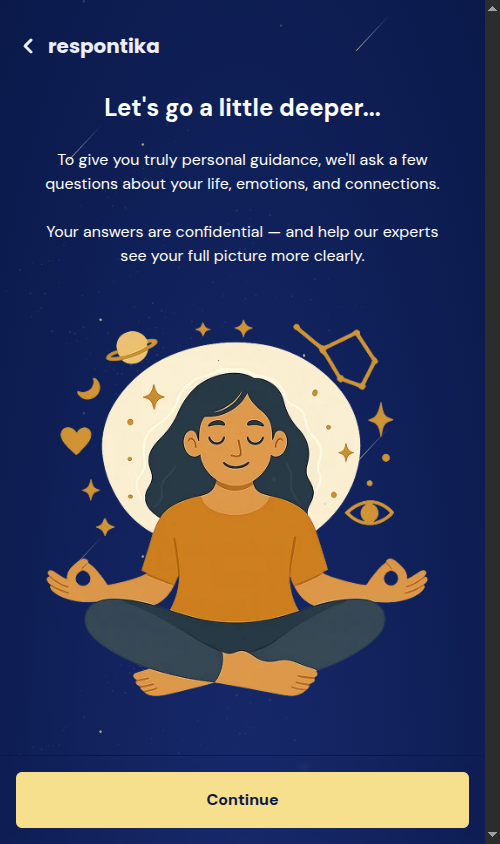 step 14 interstitial deeper
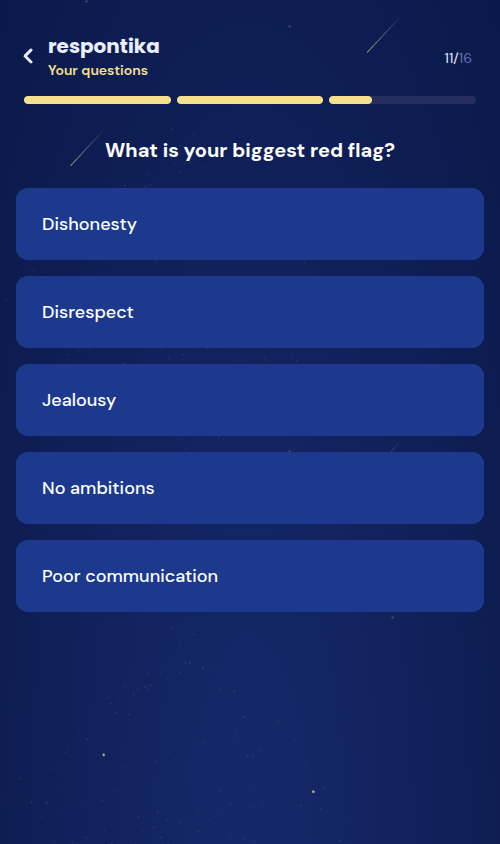 step 15 q11 red flag
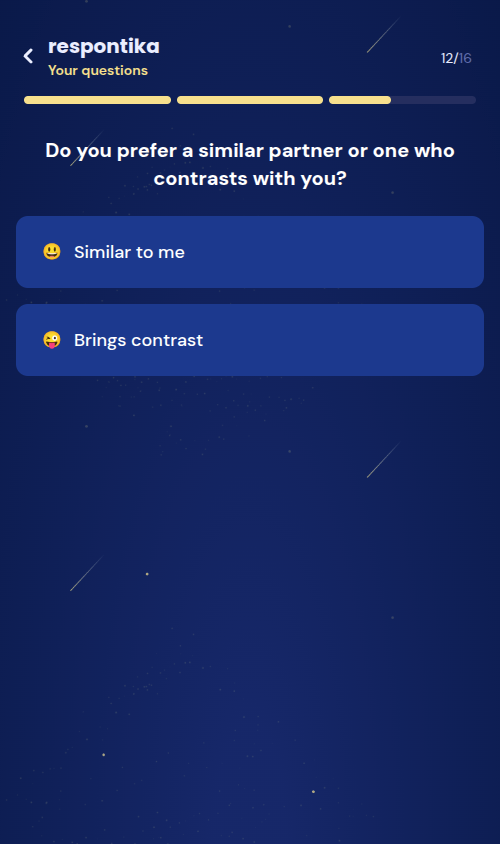 step 16 q12 similar contrast
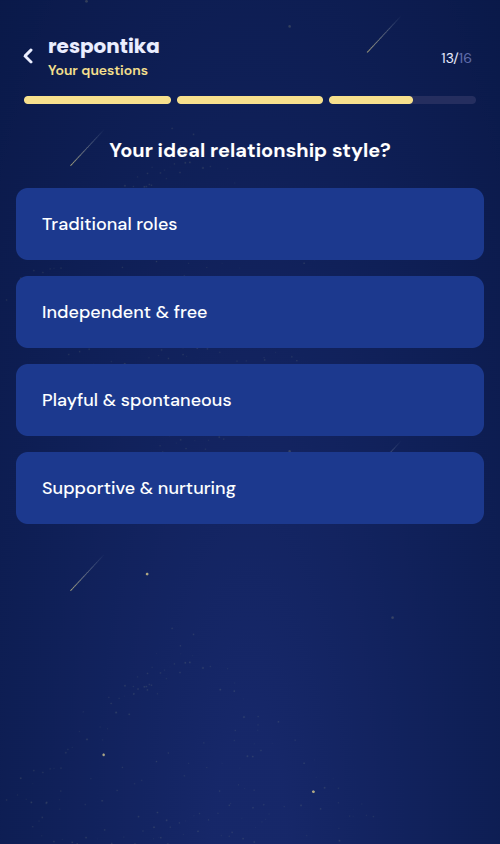 step 17 q13 relationship style
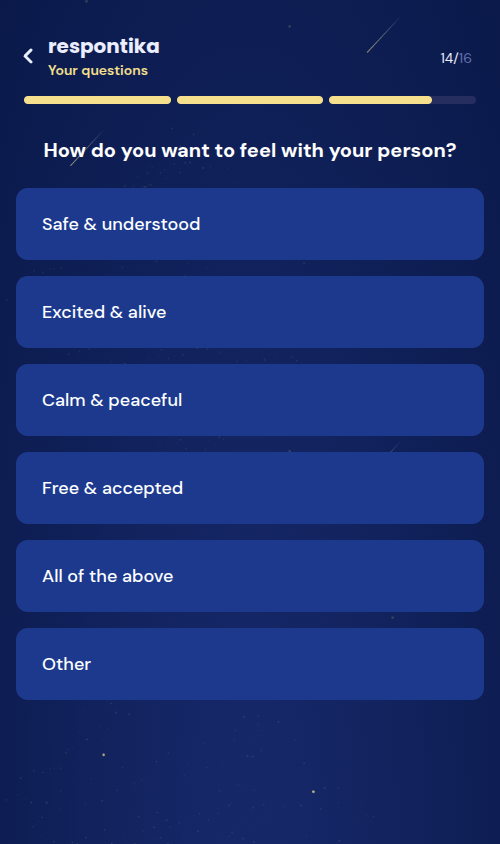 step 18 q14 feel
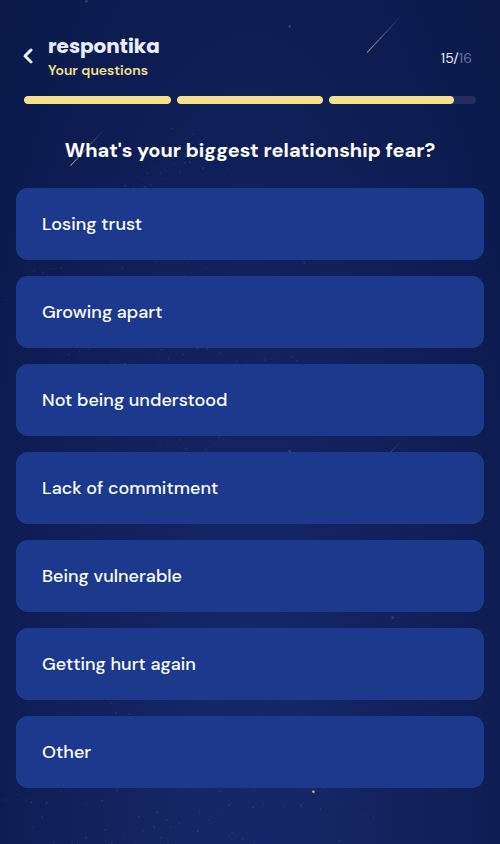 step 19 q15 fear
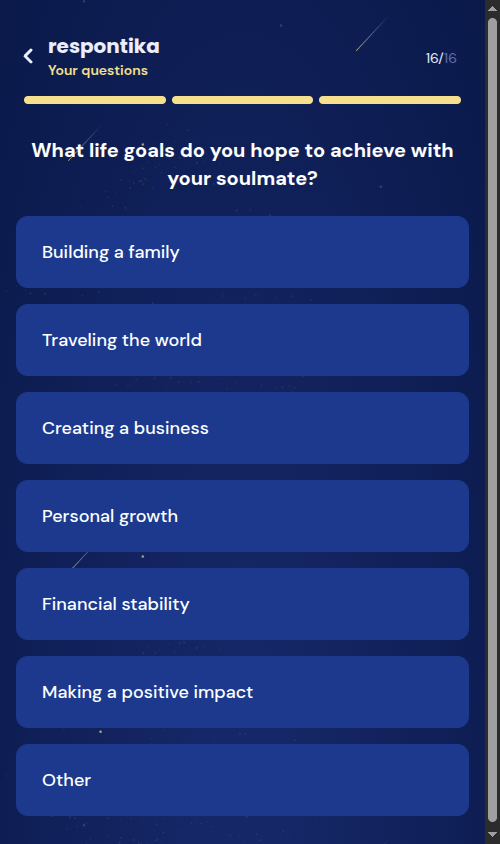 step 20 q16 life goals
 step 21 loader
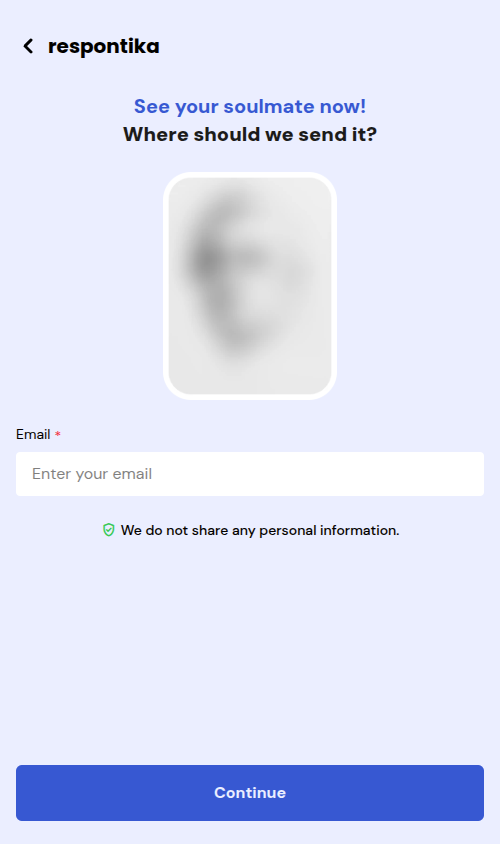 step 22 email capture
 step 23 promo code
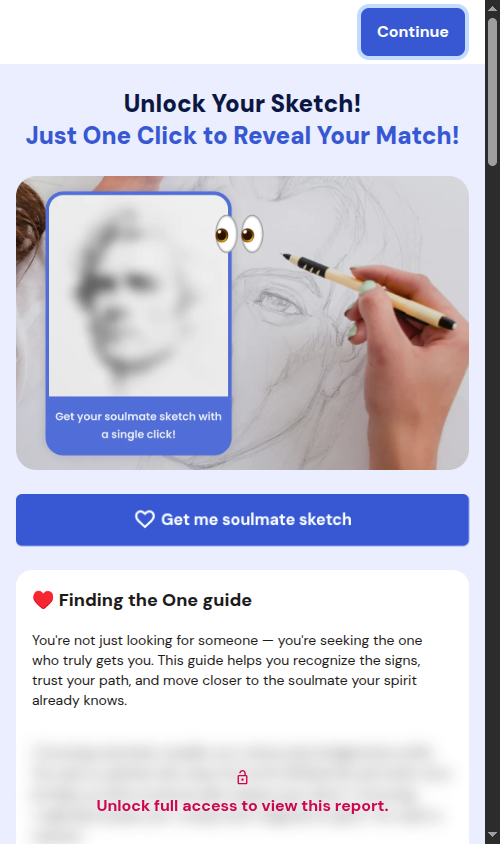 step 24 paywall a
 step 24 paywall full
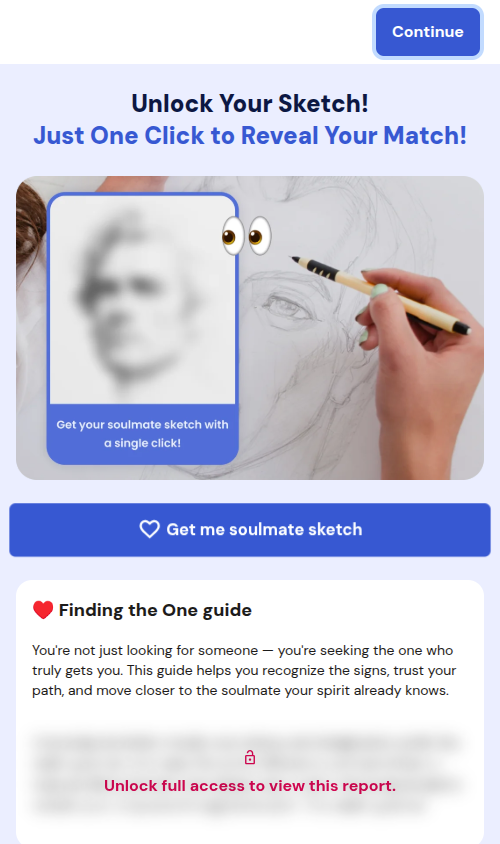 step 24 paywall top header
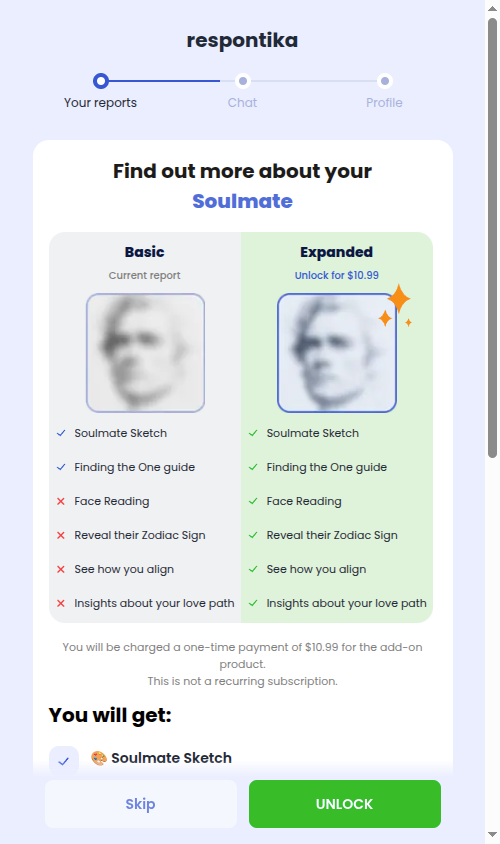 step 25 direct upsell a
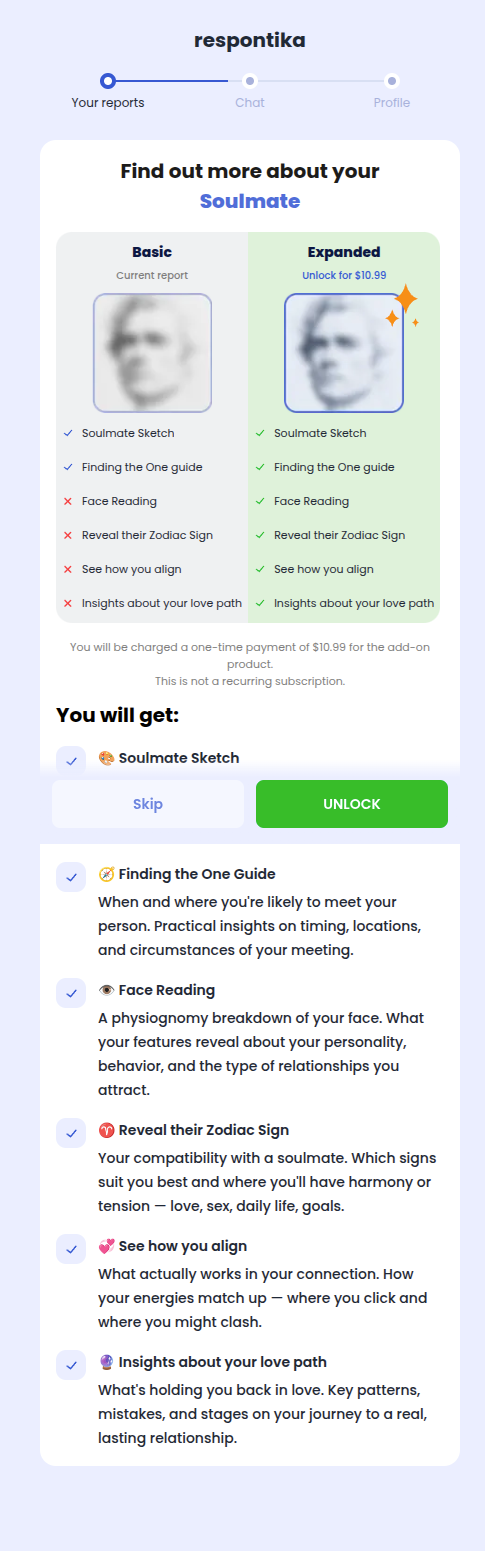 step 25 direct upsell full
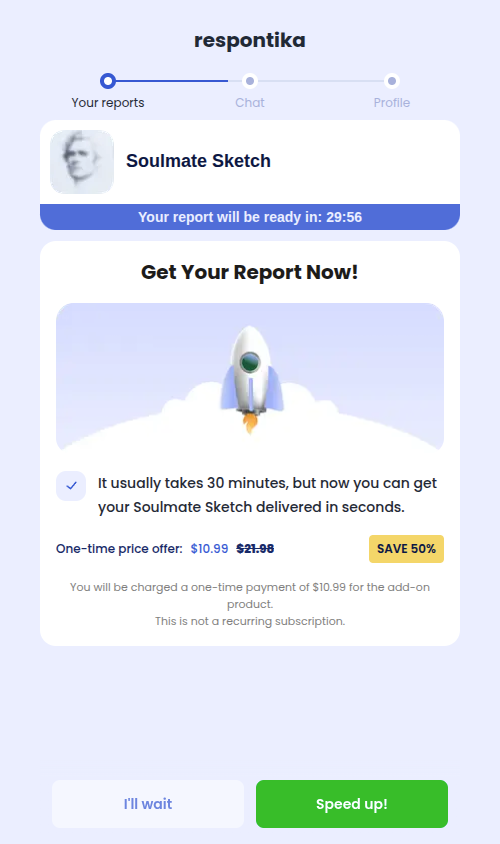 step 26 decline speedup downsell
Arm C — native monthly arm (monthly-50c)
28 screenshots · captured live 2026-08-22The same 16-question quiz template as arm B, screen for screen — same element
question, same personalization summary, same loader, same email gate, no photo gate. The variable being
tested is the paywall, not the quiz. Ladder: CA$1.00 for 7 days (billed as
two transactions of $0.40 and $0.60) → CA$39.99/month until cancelled,
coupon RESPONTIKA97 auto-applied, descriptor respontika.com, 30-day guarantee.
Step 25–26 show the card-entry modal carrying the retention line
“91% of users stay with us after the initial 7-day period.”
Consent text, verbatim: “…you authorize us to charge an amount of CA$1.00, which will be processed consecutively as two separate transactions in the amounts of $0.40 and $0.60. Upon expiration of the 7-day trial period, unless canceled beforehand, your selected subscription automatically starts as a monthly plan. A promotional discount will apply, and you will be charged CA$39.99 for the first monthly plan. Starting from the second monthly plan, the full price of CA$39.99 per month will apply… The payments will be listed on your bill as respontika.com.”
Steps 27 and 28 are amber for a reason. They were sourced from the DOM via a leftover
session, not walked live on this arm. They confirm the shared /upsells/soulmate ($10.99) and
/upsells/timer ($10.99, “SAVE 50%” from $21.98) routes still exist and are
reachable — they do not prove those routes fire on the monthly arm's own
post-purchase path.
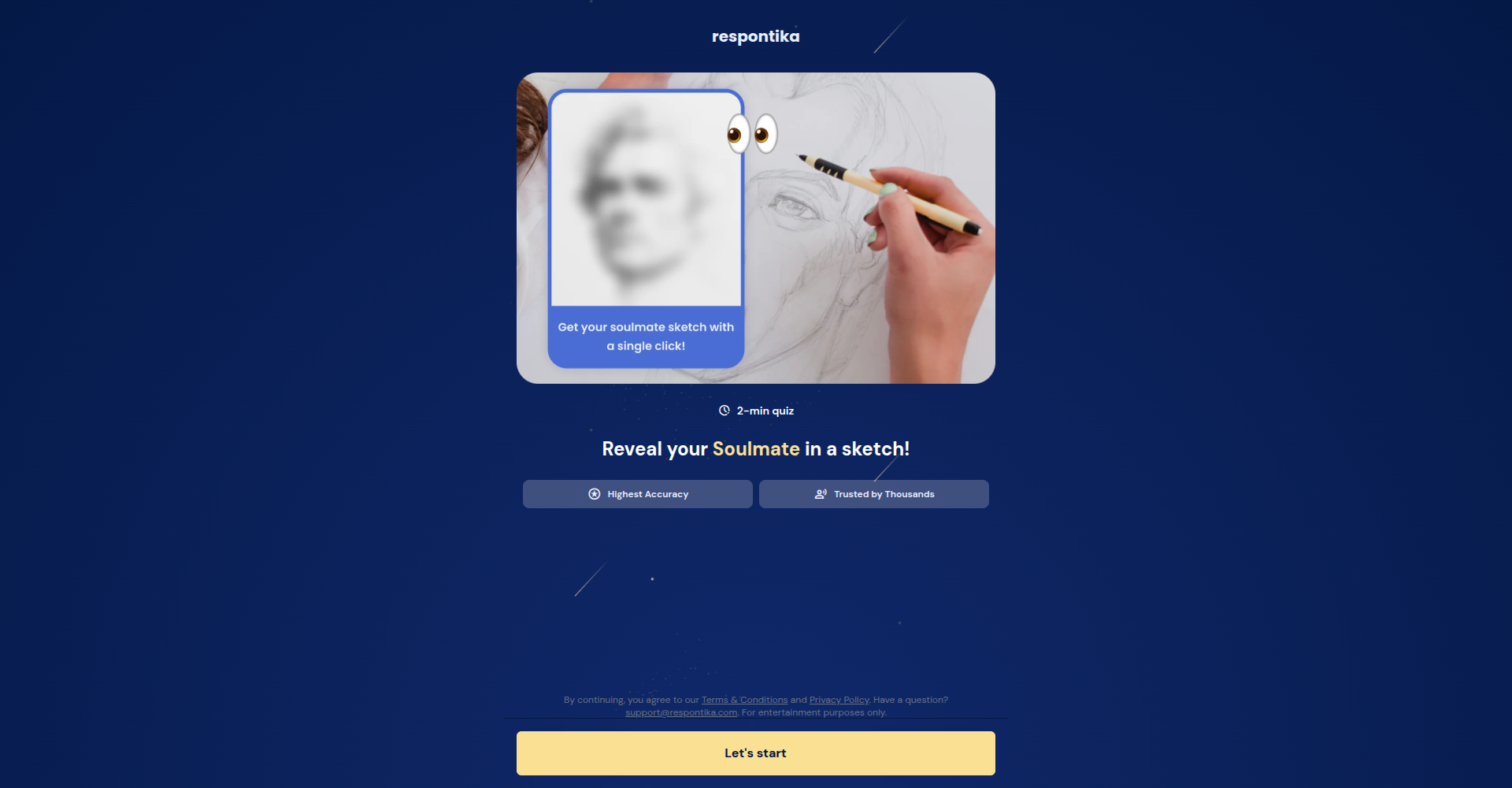 landing
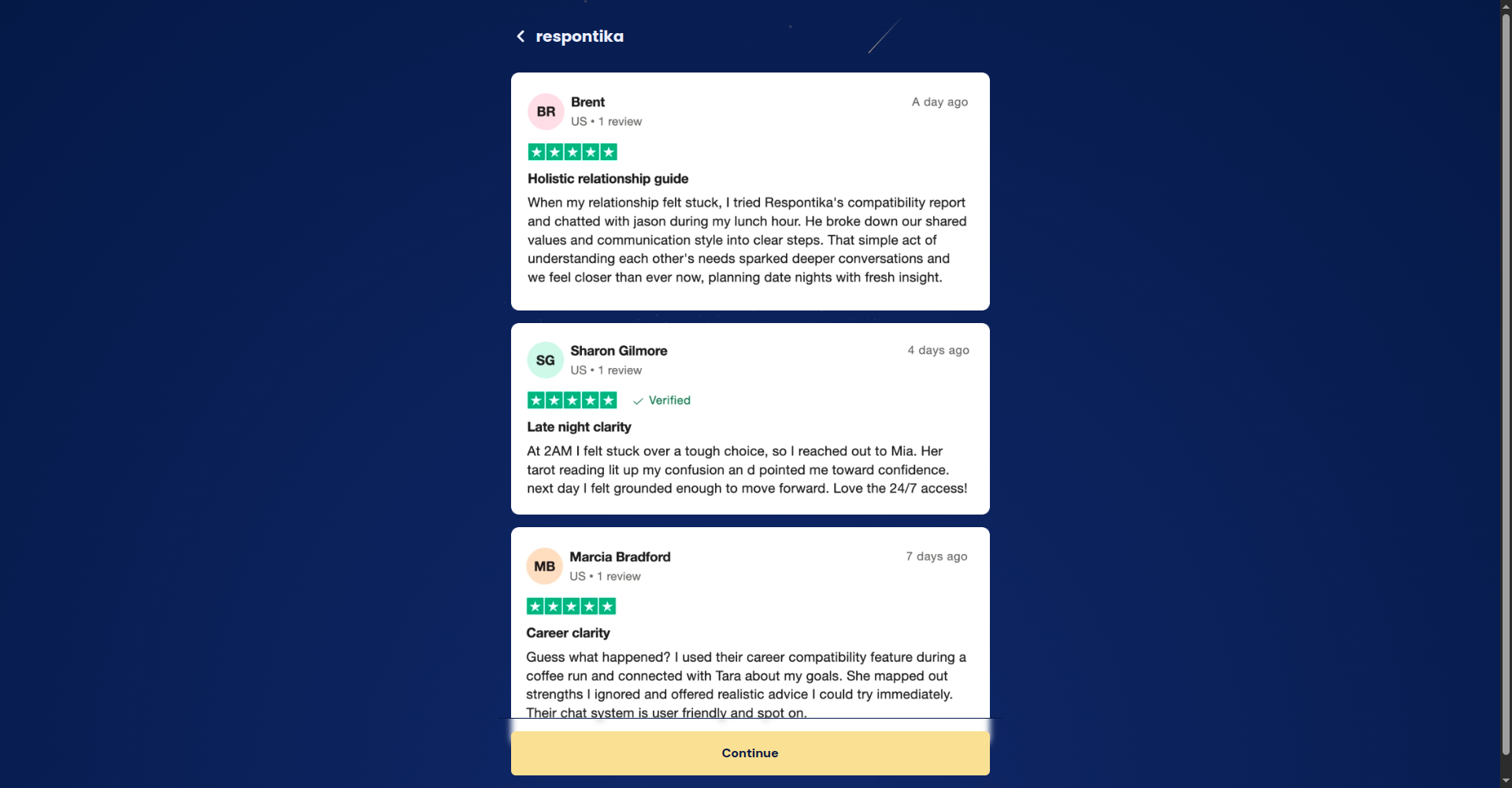 reviews
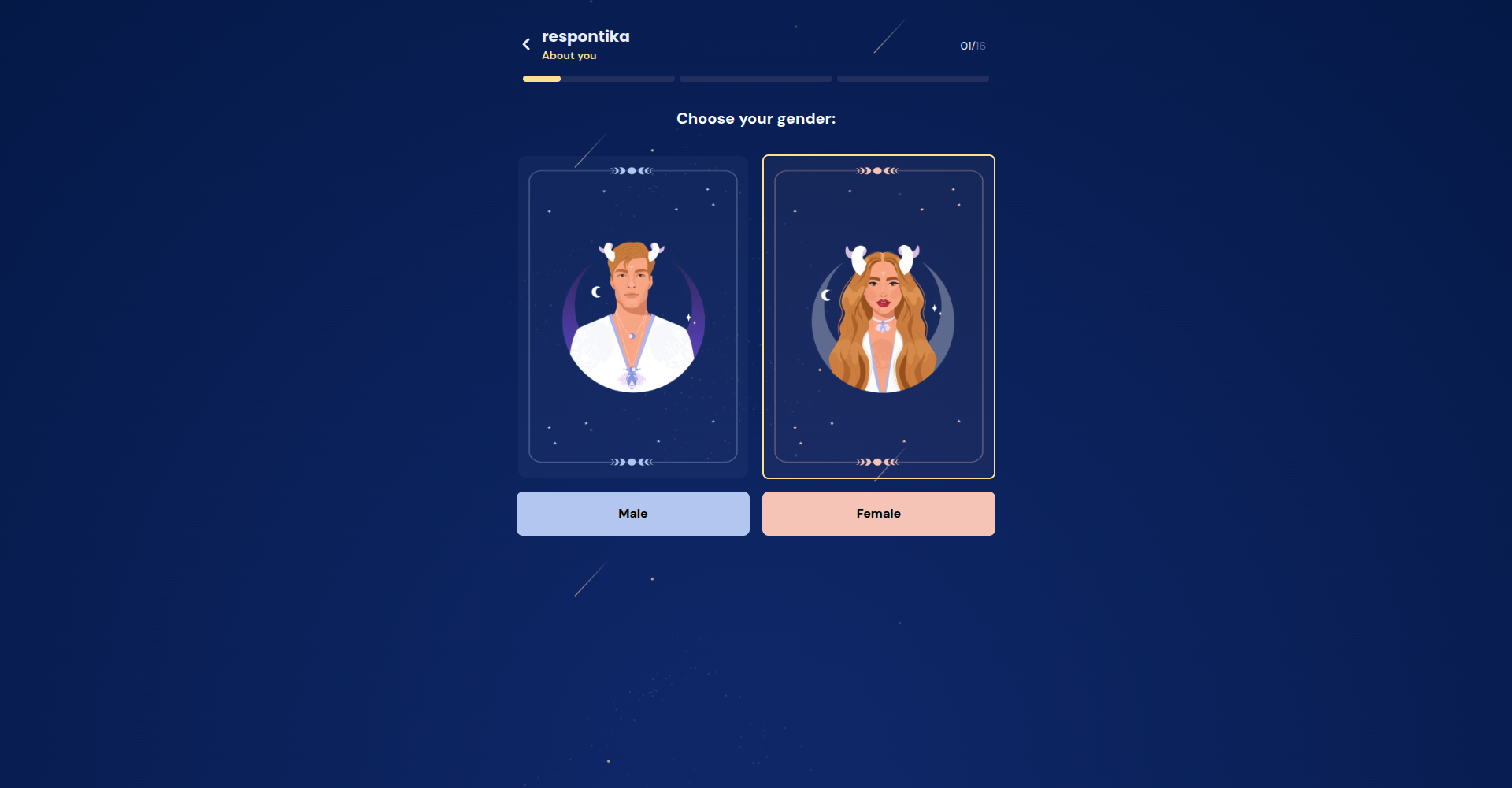 q01of16 gender
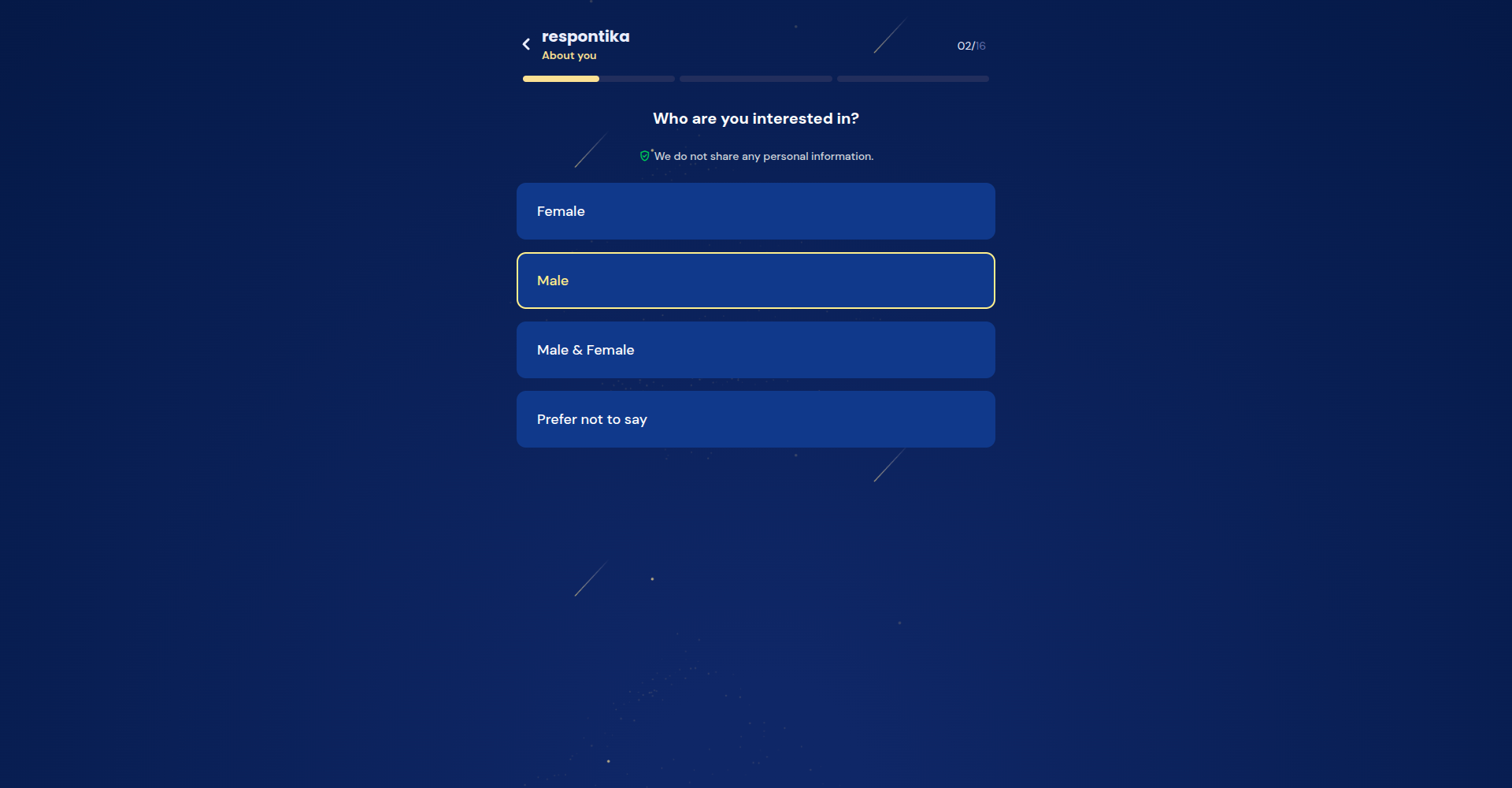 q02of16 interested in
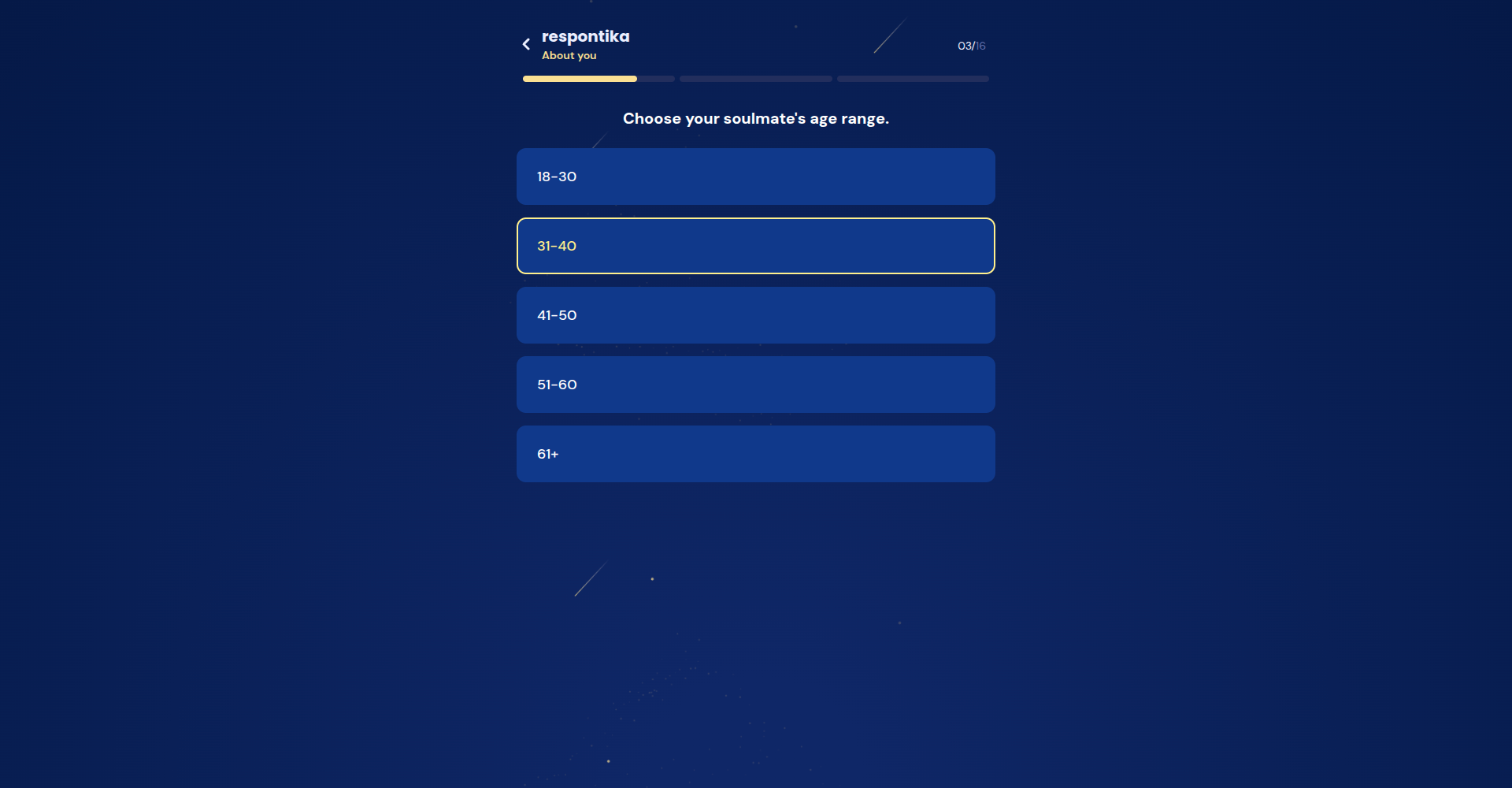 q03of16 soulmate age
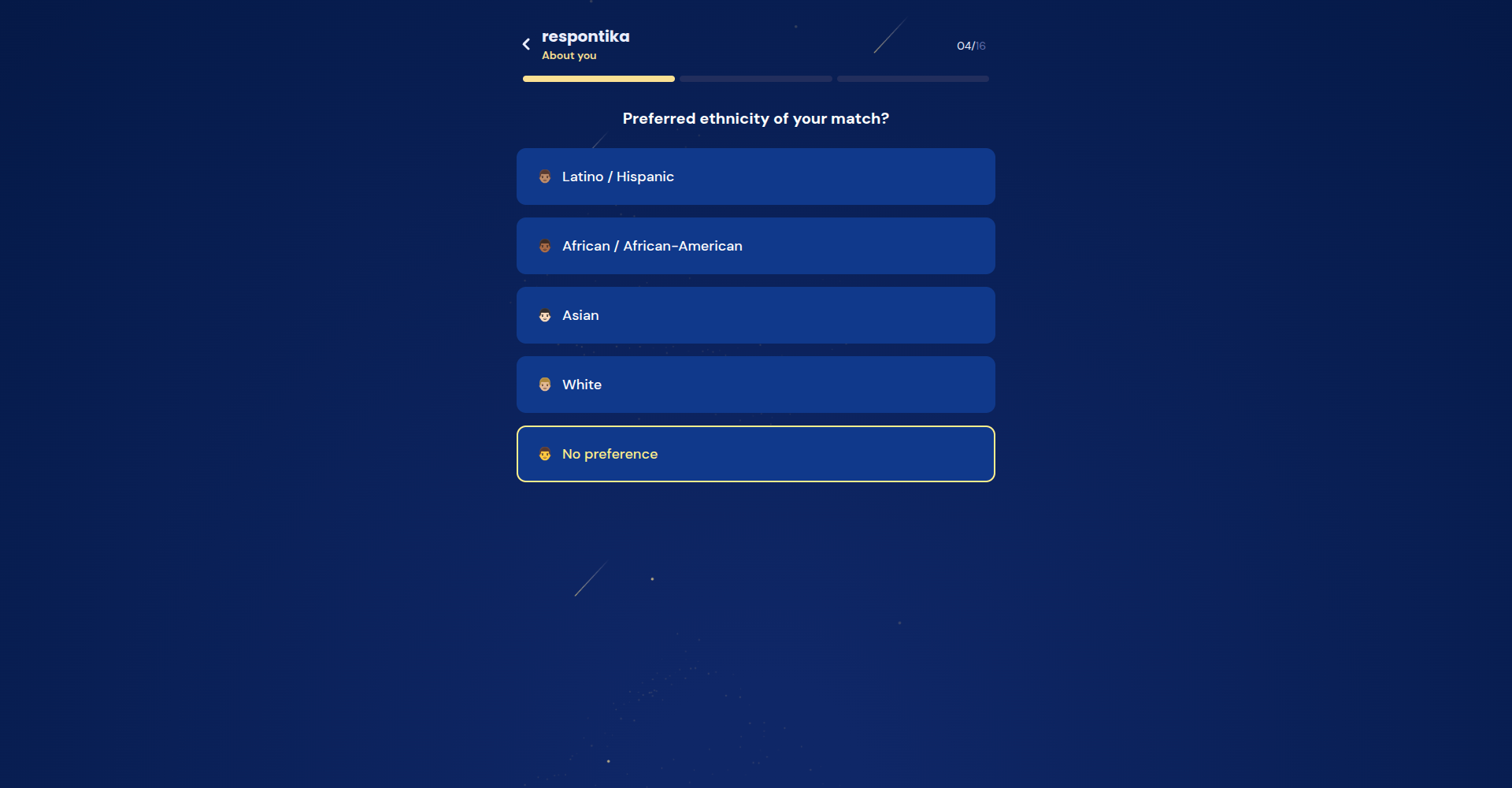 q04of16 ethnicity
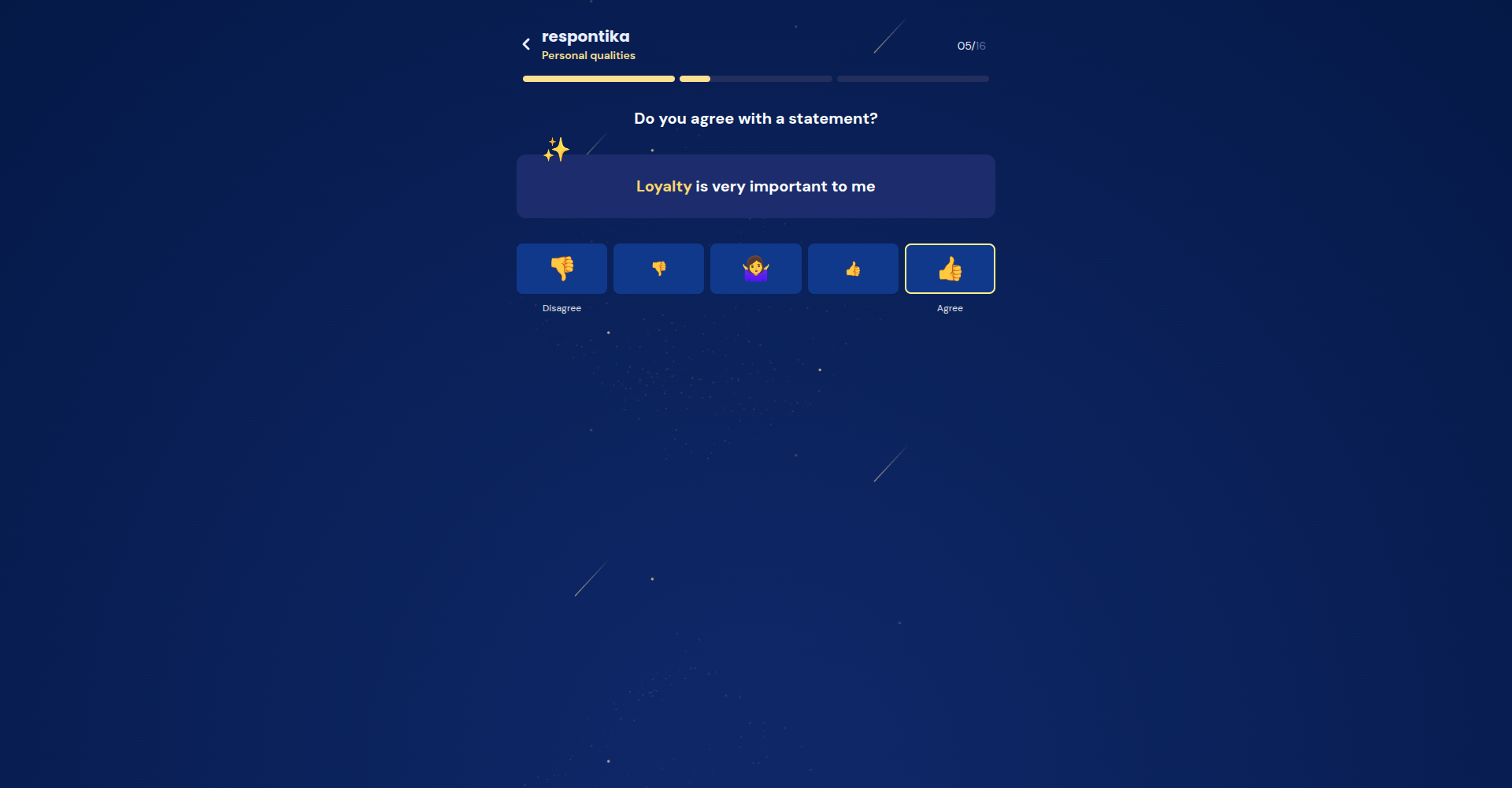 q05of16 loyalty
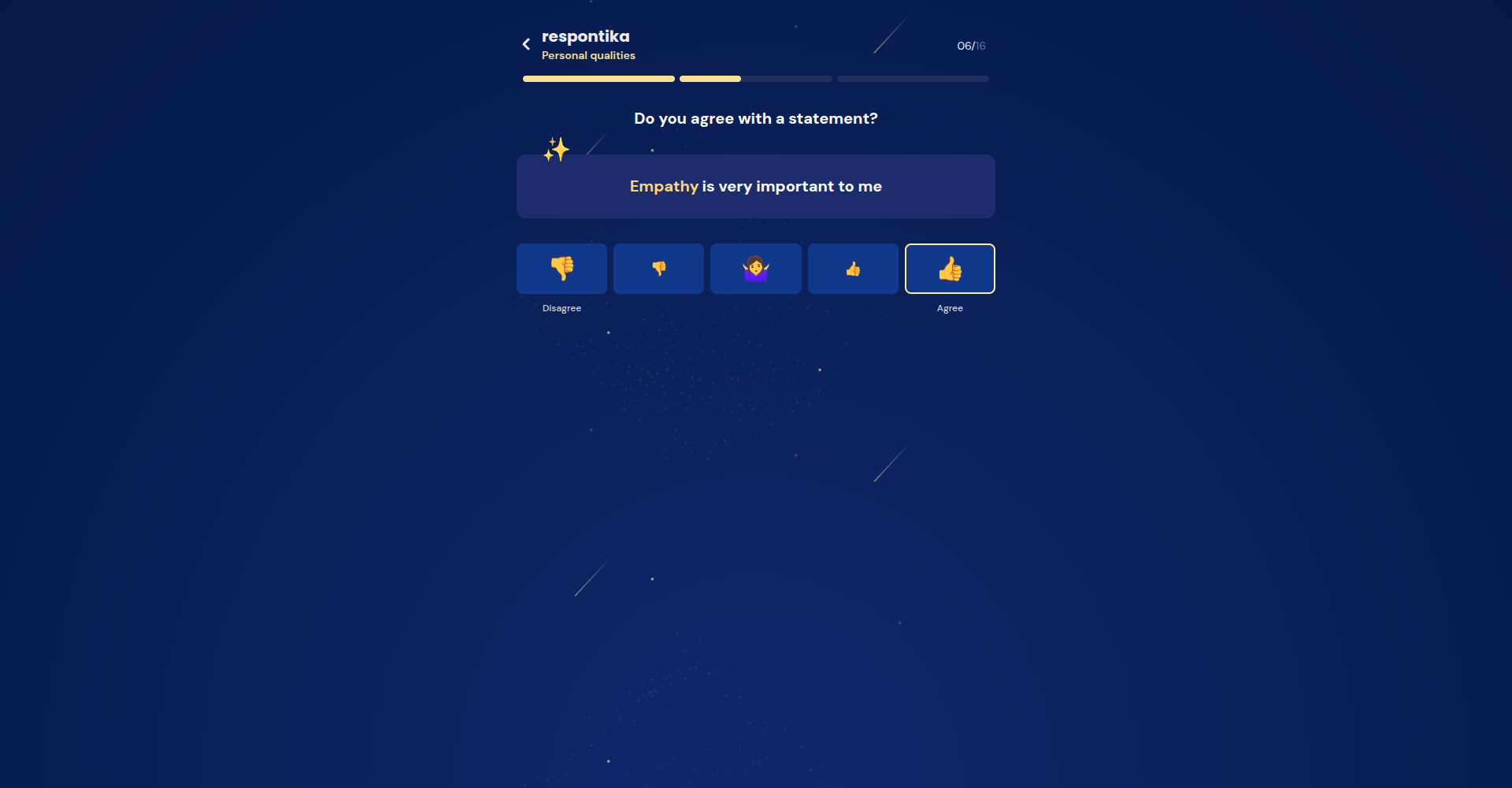 q06of16 empathy
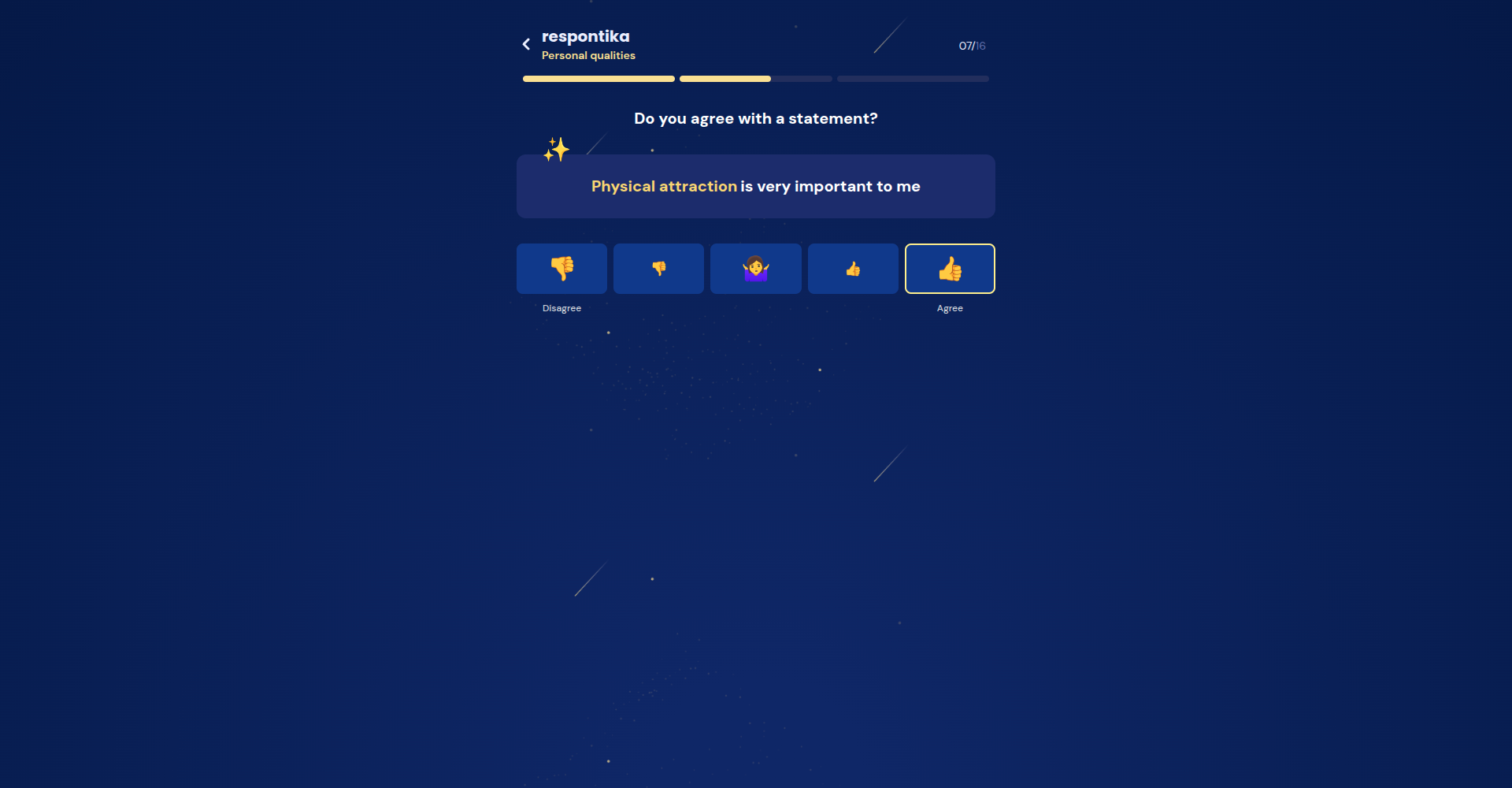 q07of16 physical attraction
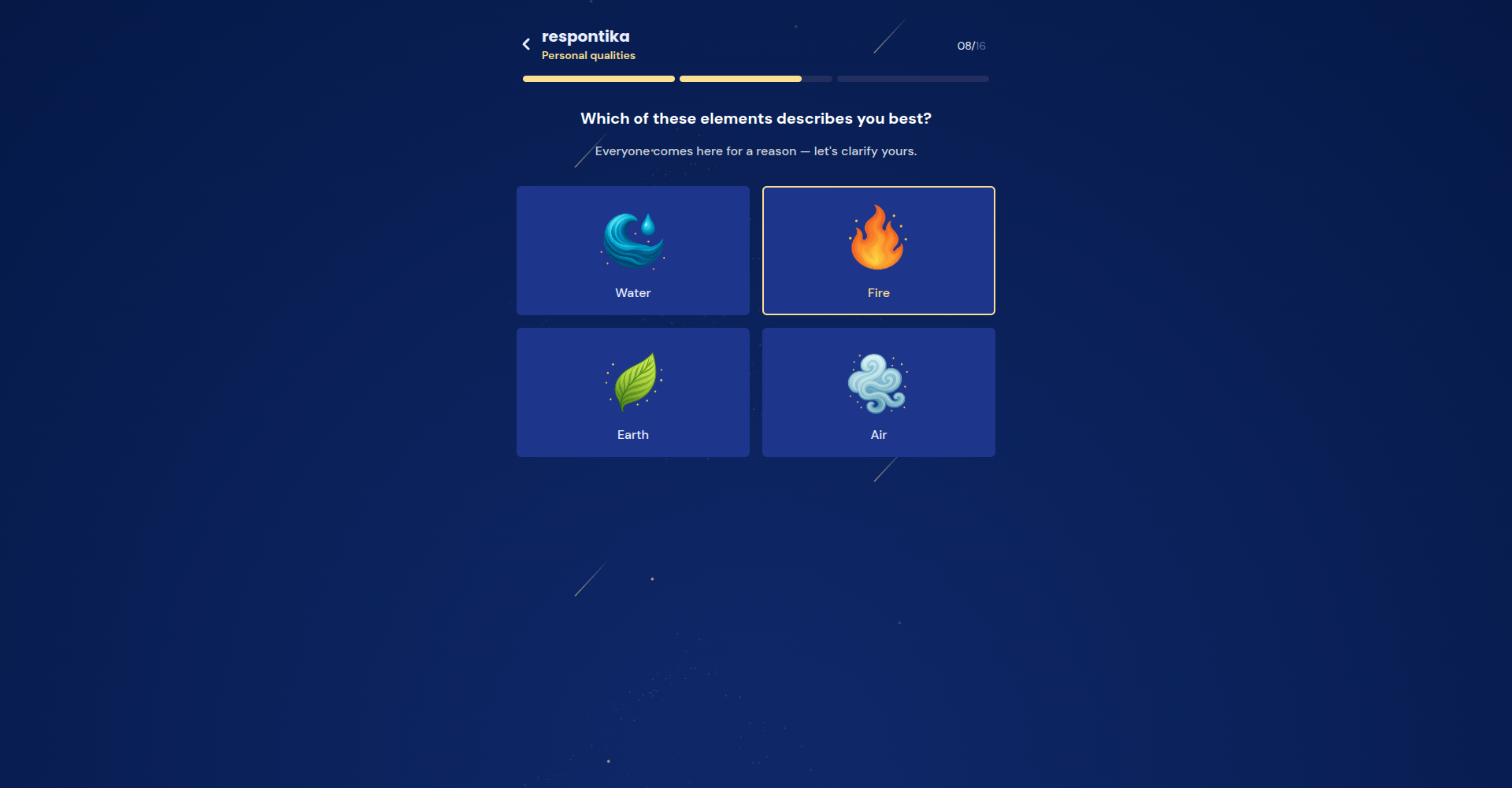 q08of16 element
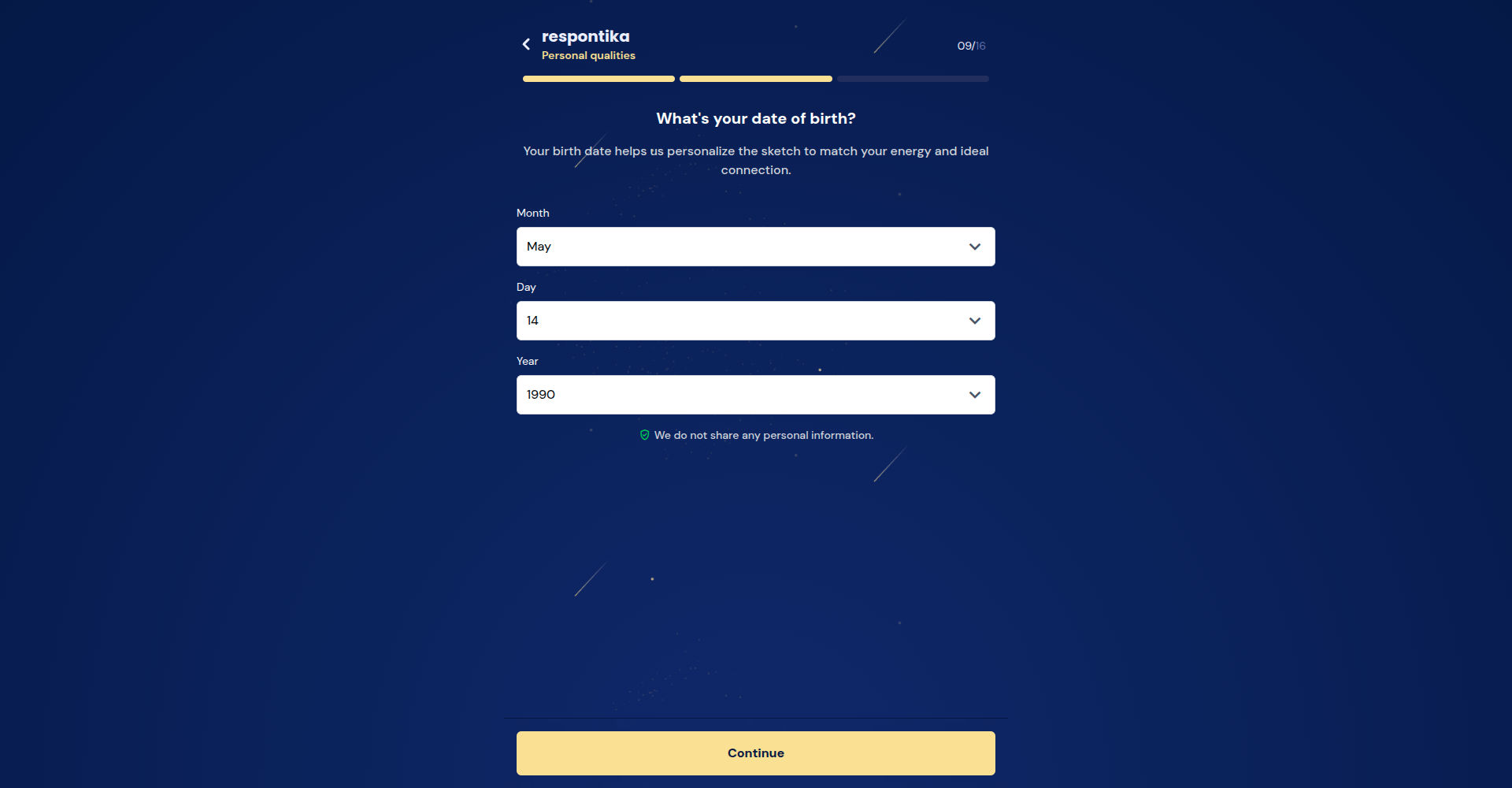 q09of16 dob
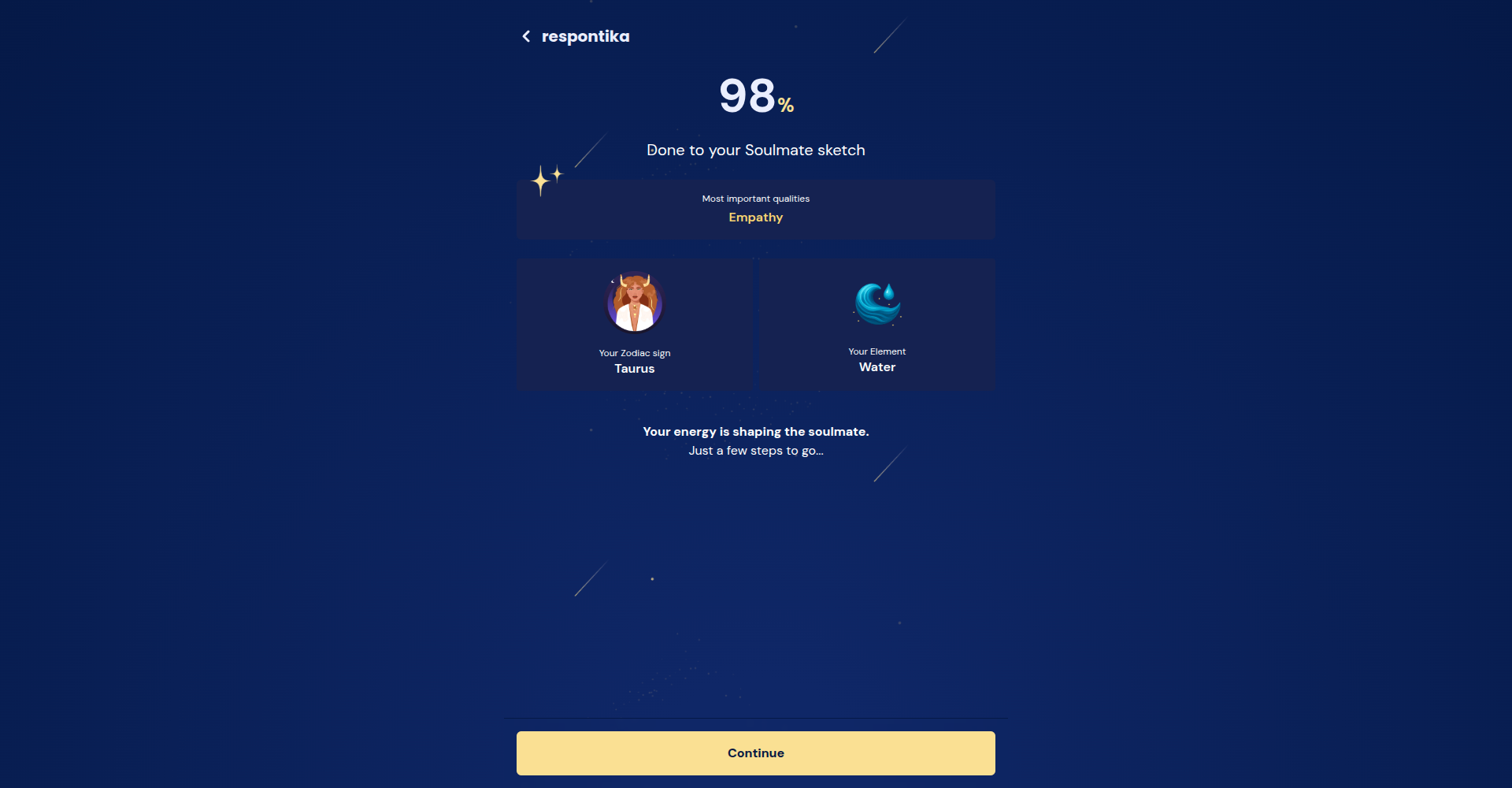 personalization summary
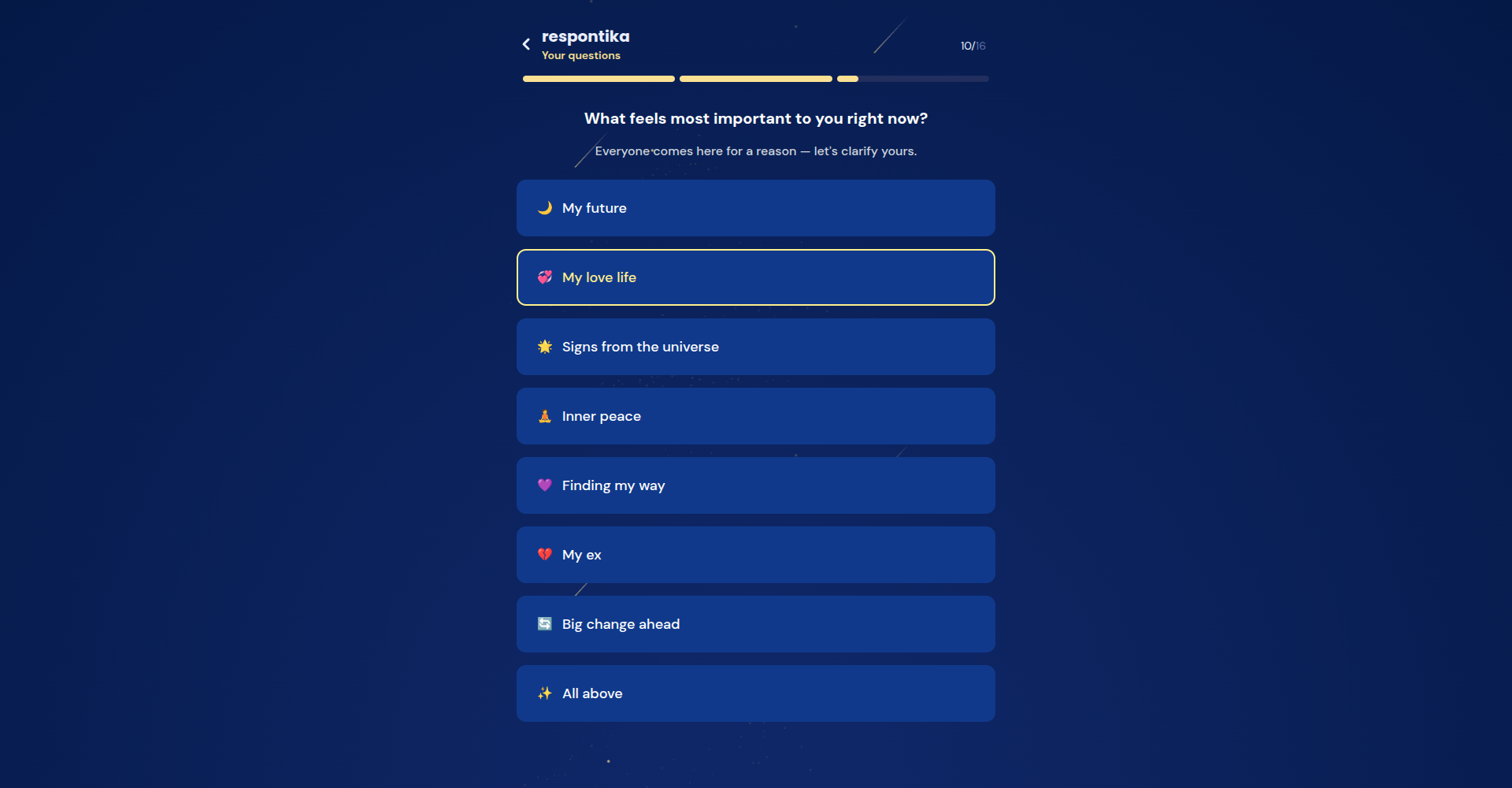 q10of16 important now
 interstitial deeper
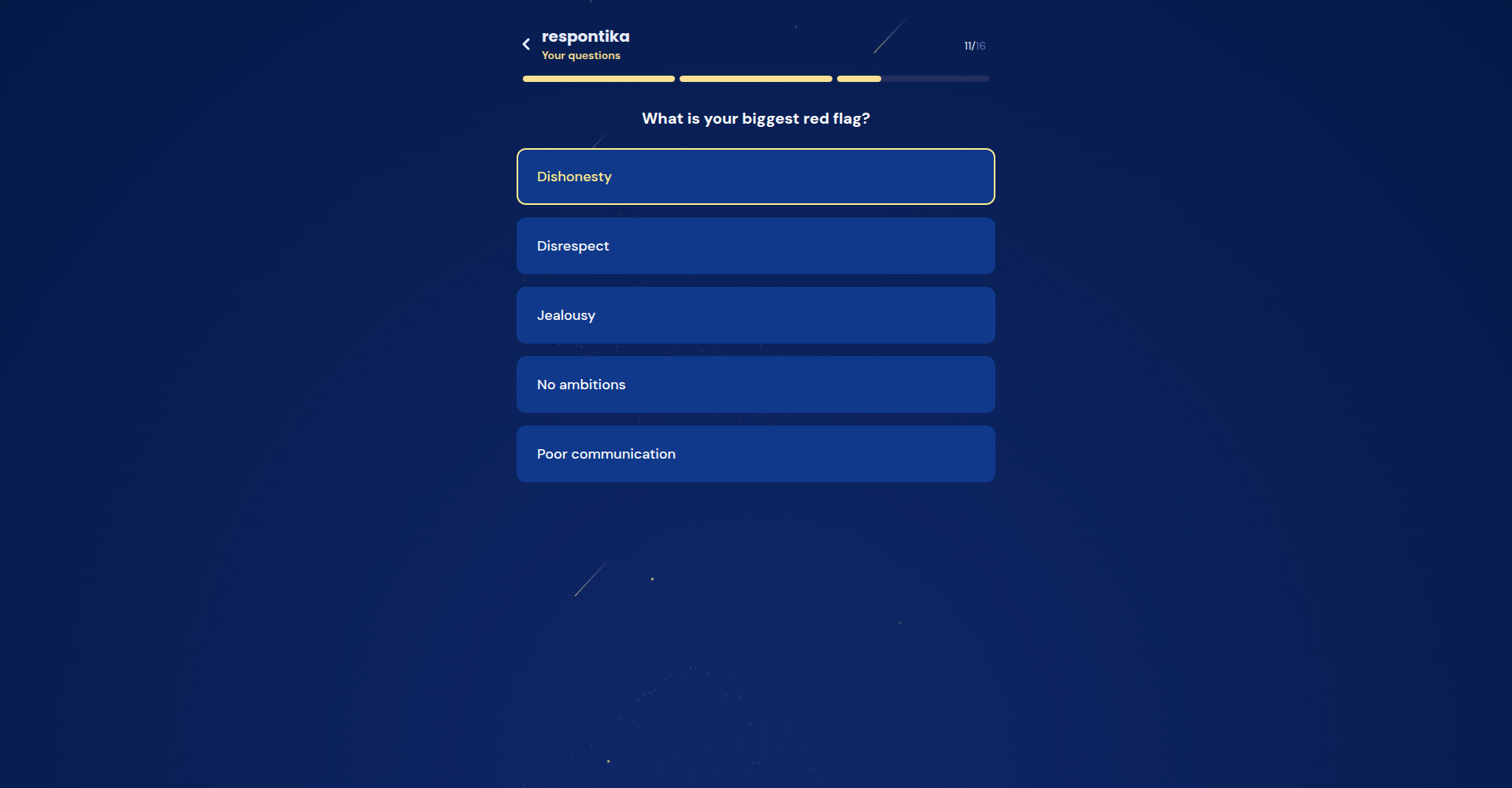 q11of16 red flag
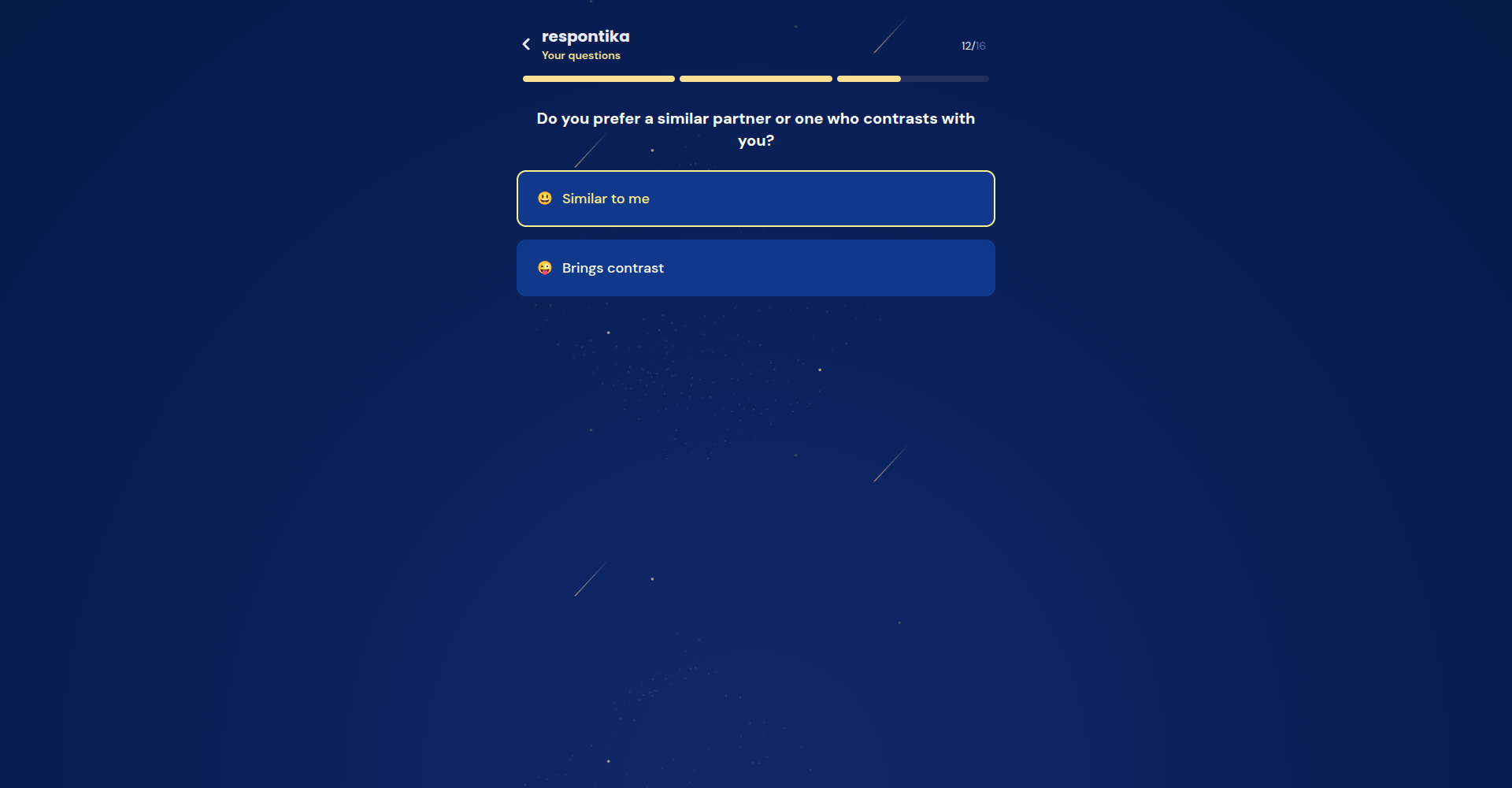 q12of16 similar or contrast
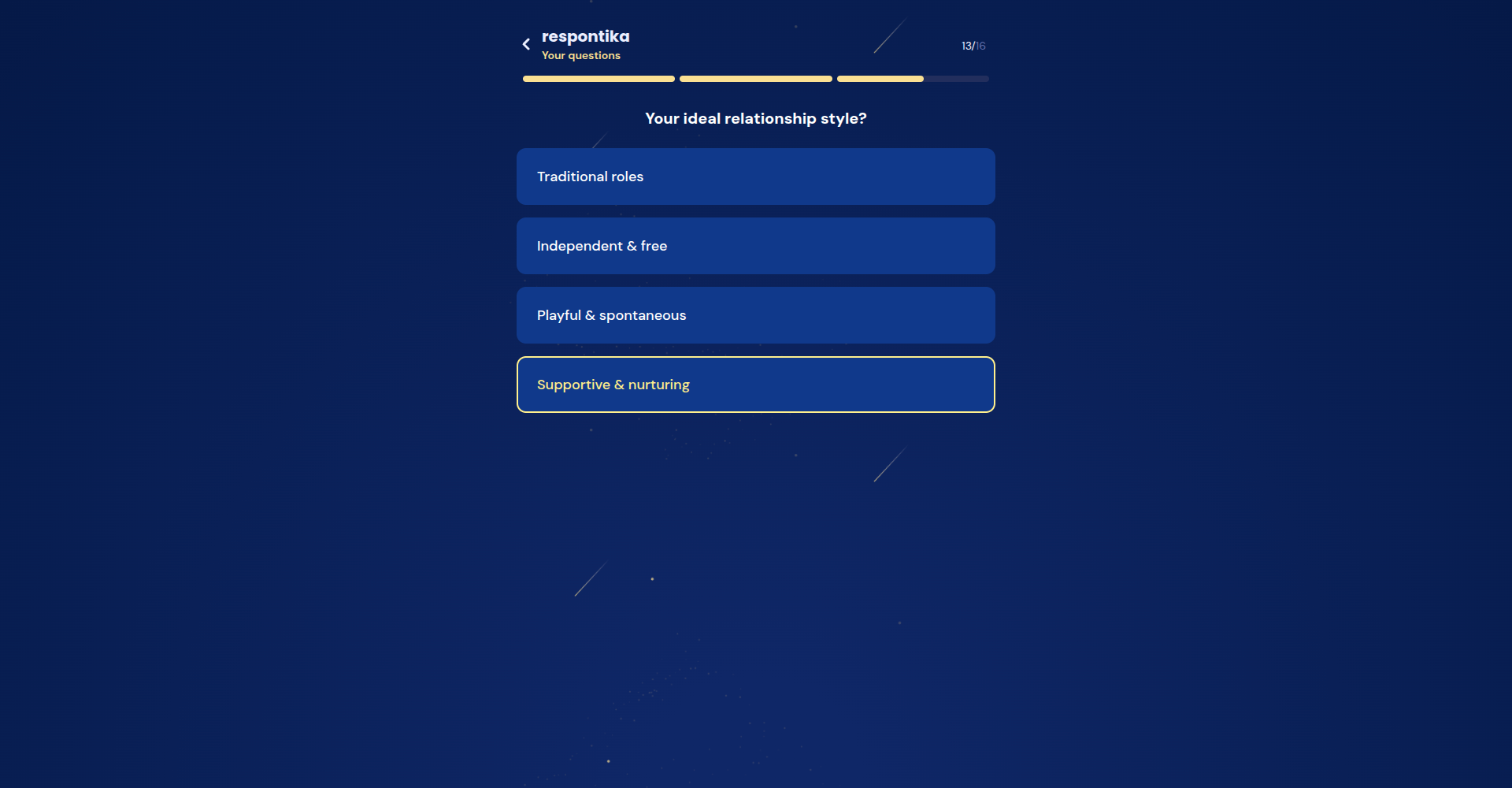 q13of16 relationship style
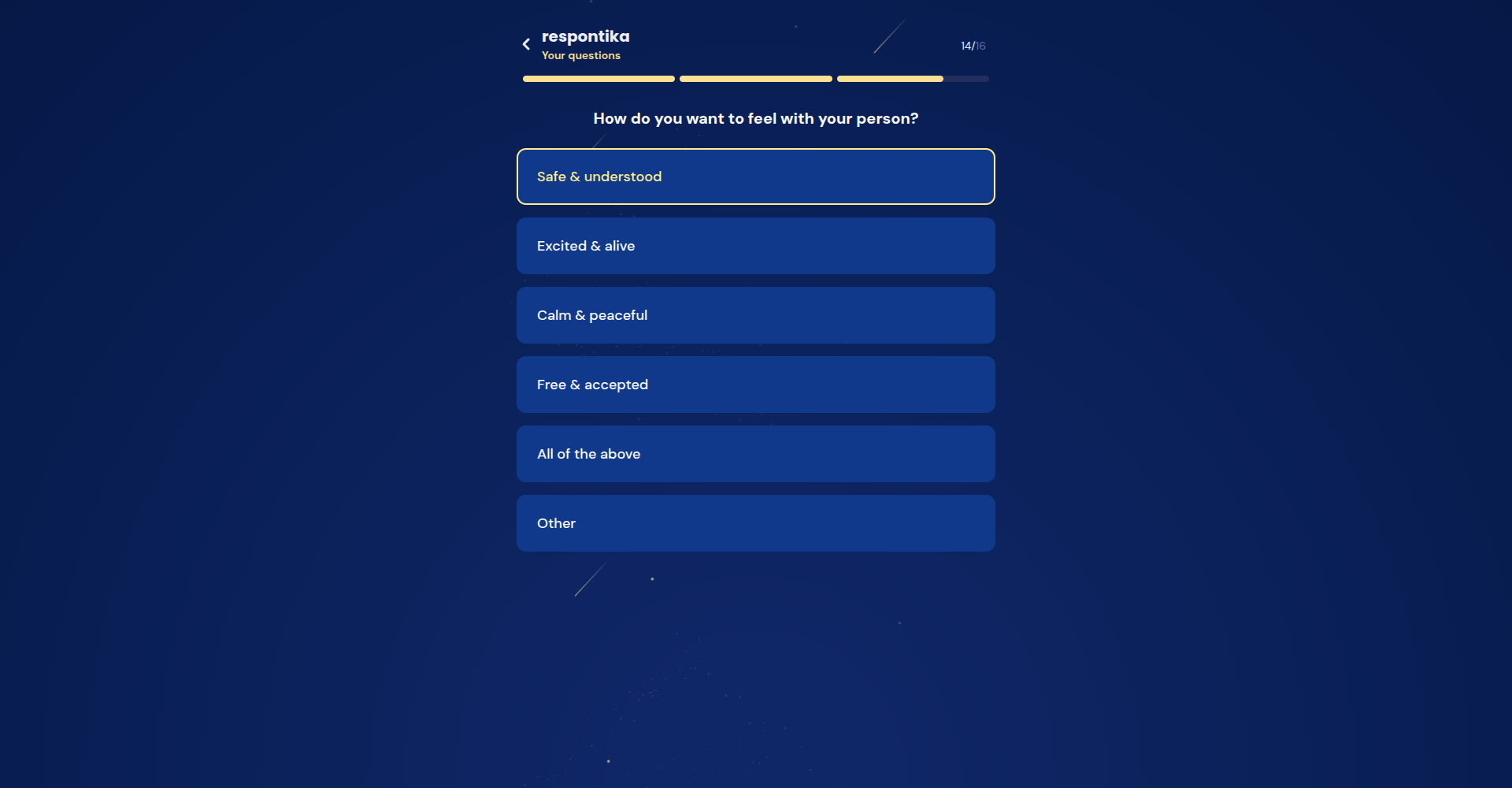 q14of16 how want to feel
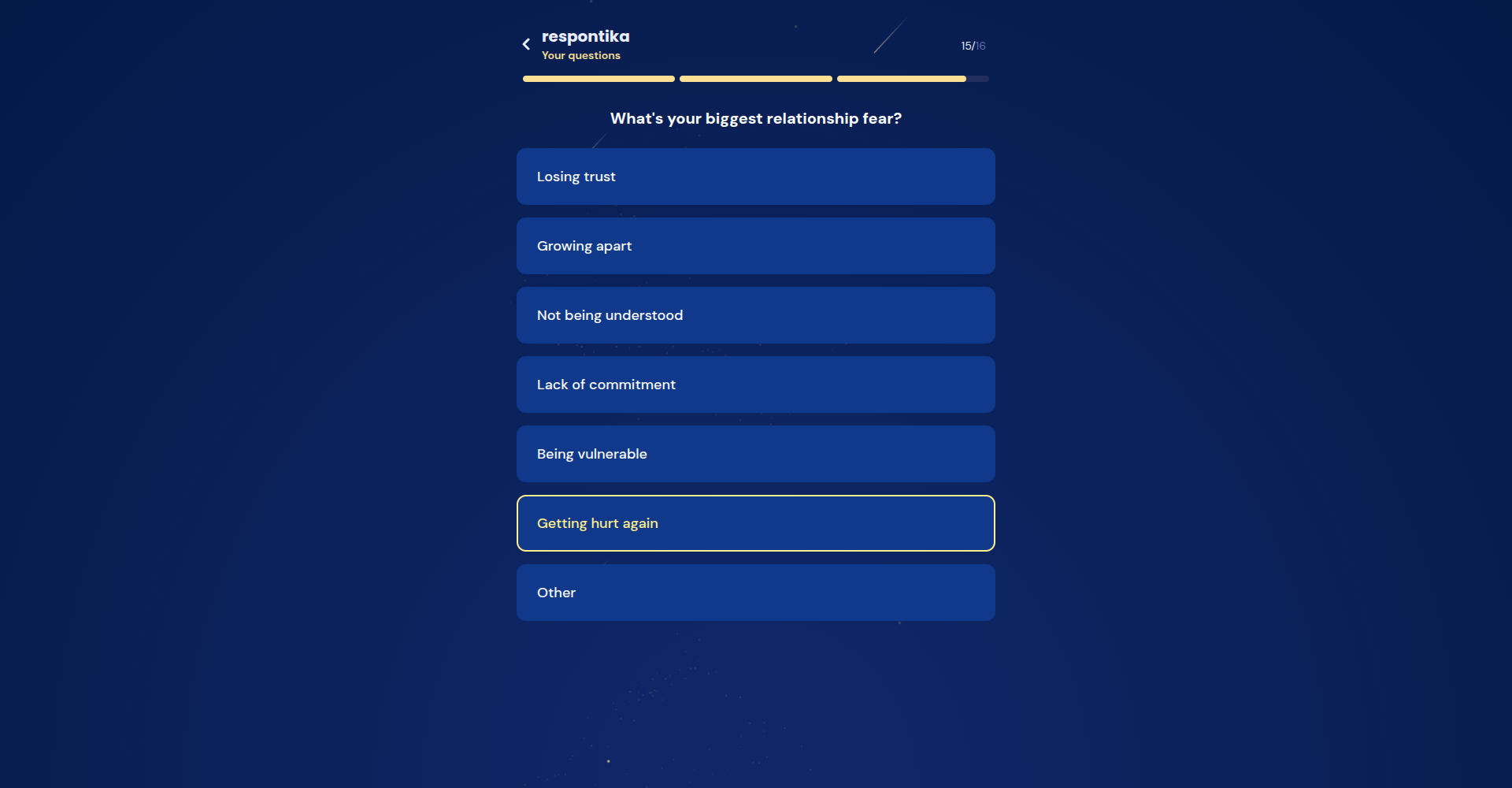 q15of16 biggest fear
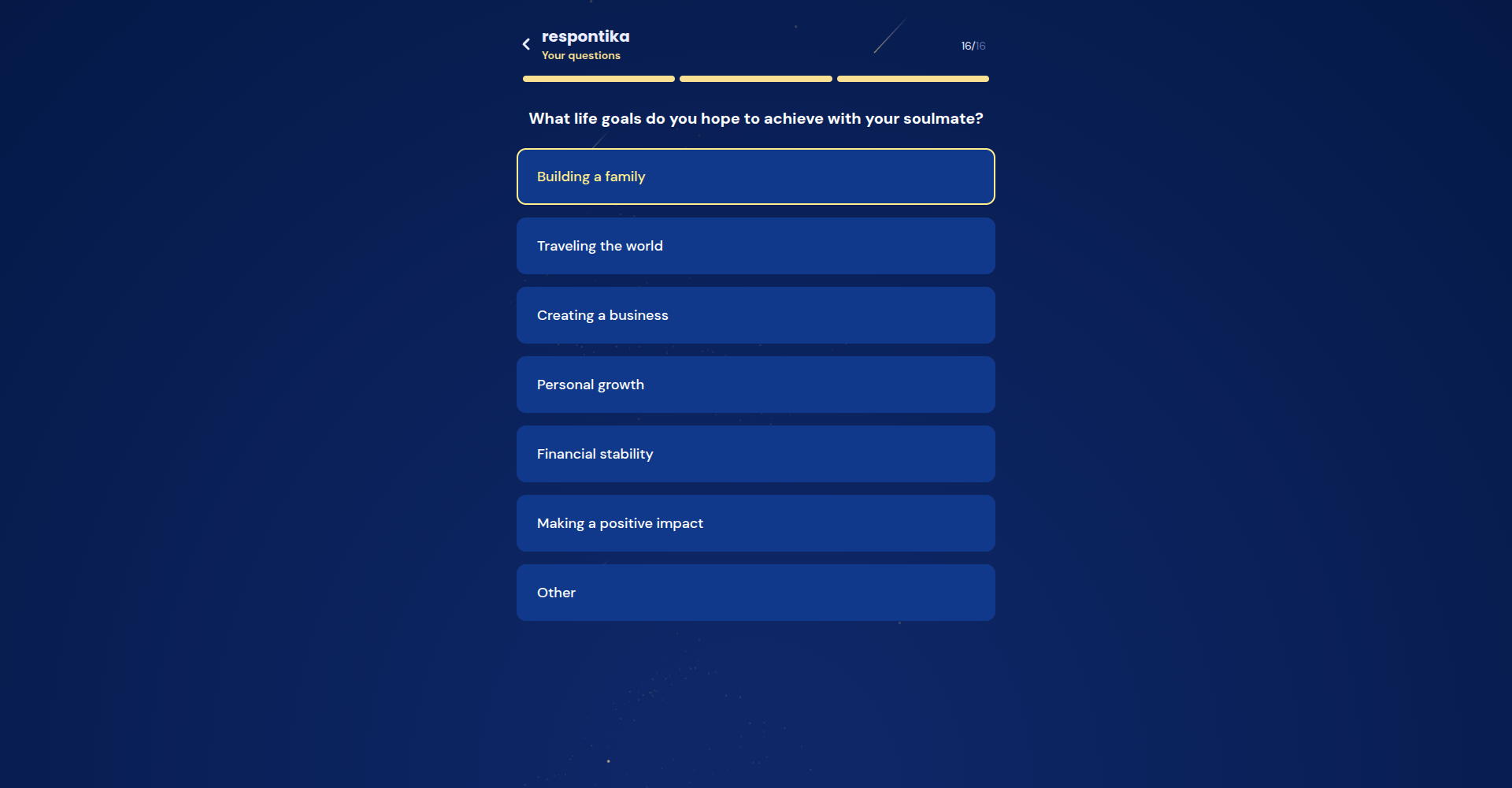 q16of16 life goals
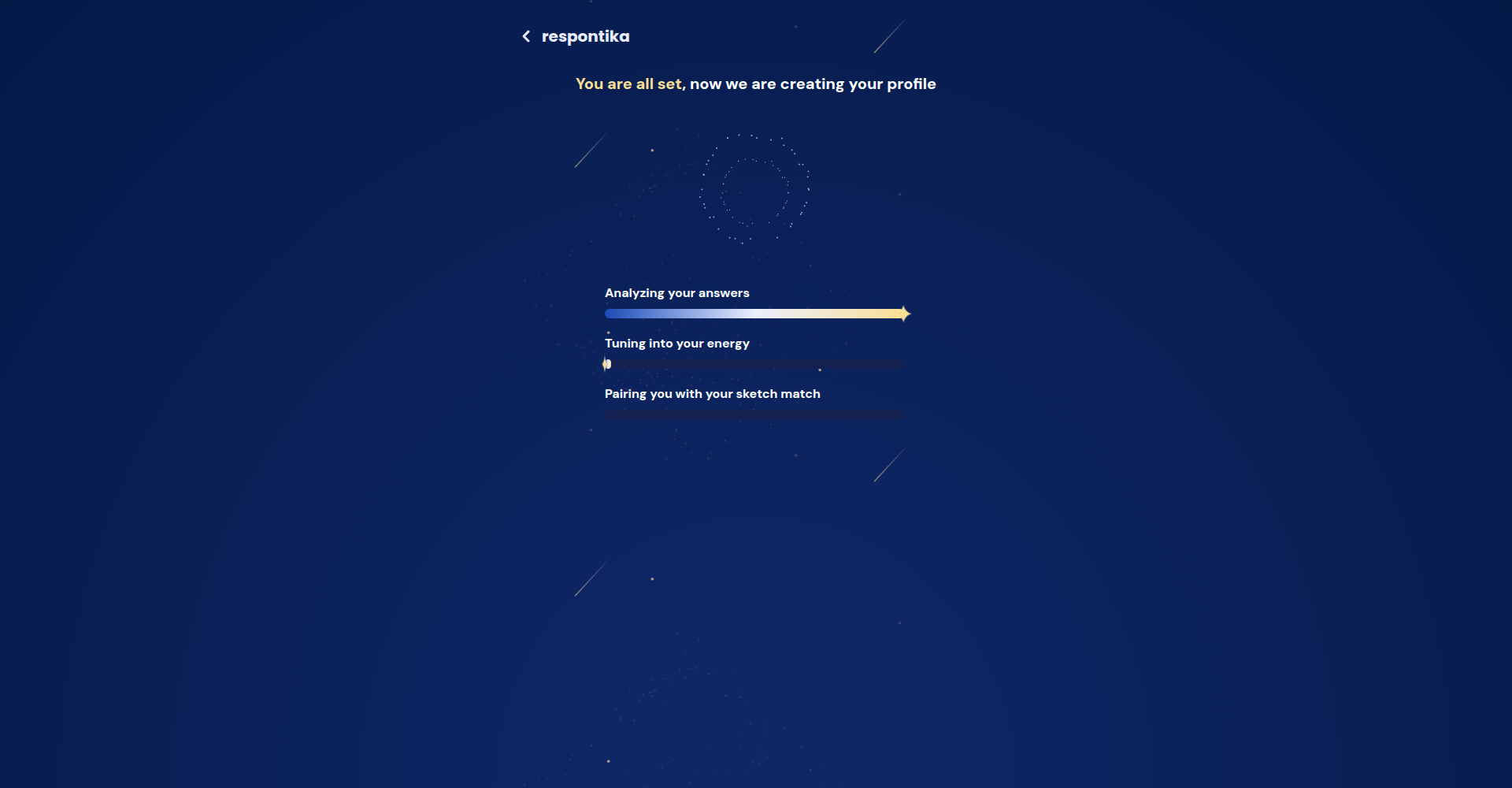 loader profile
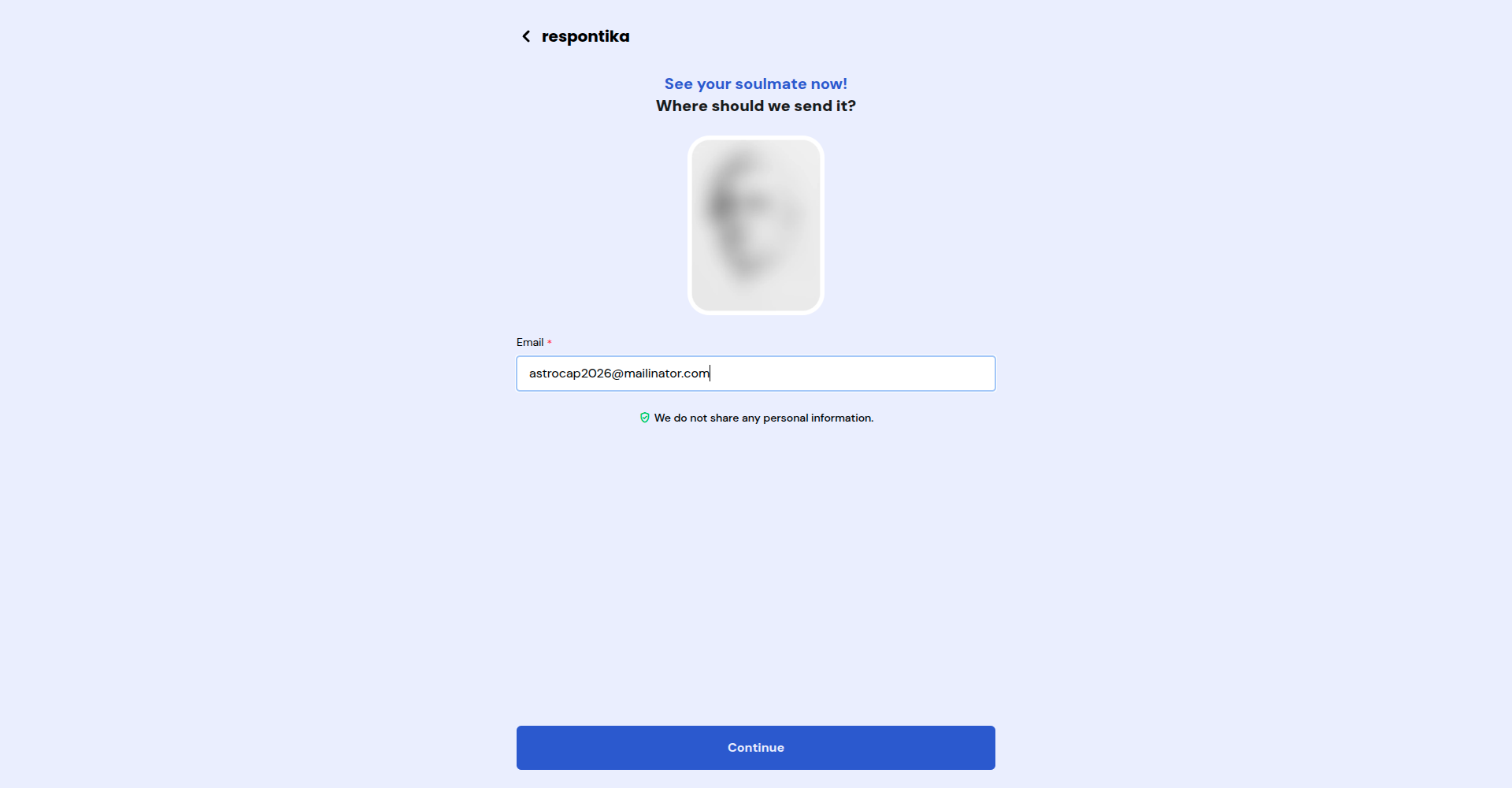 email capture
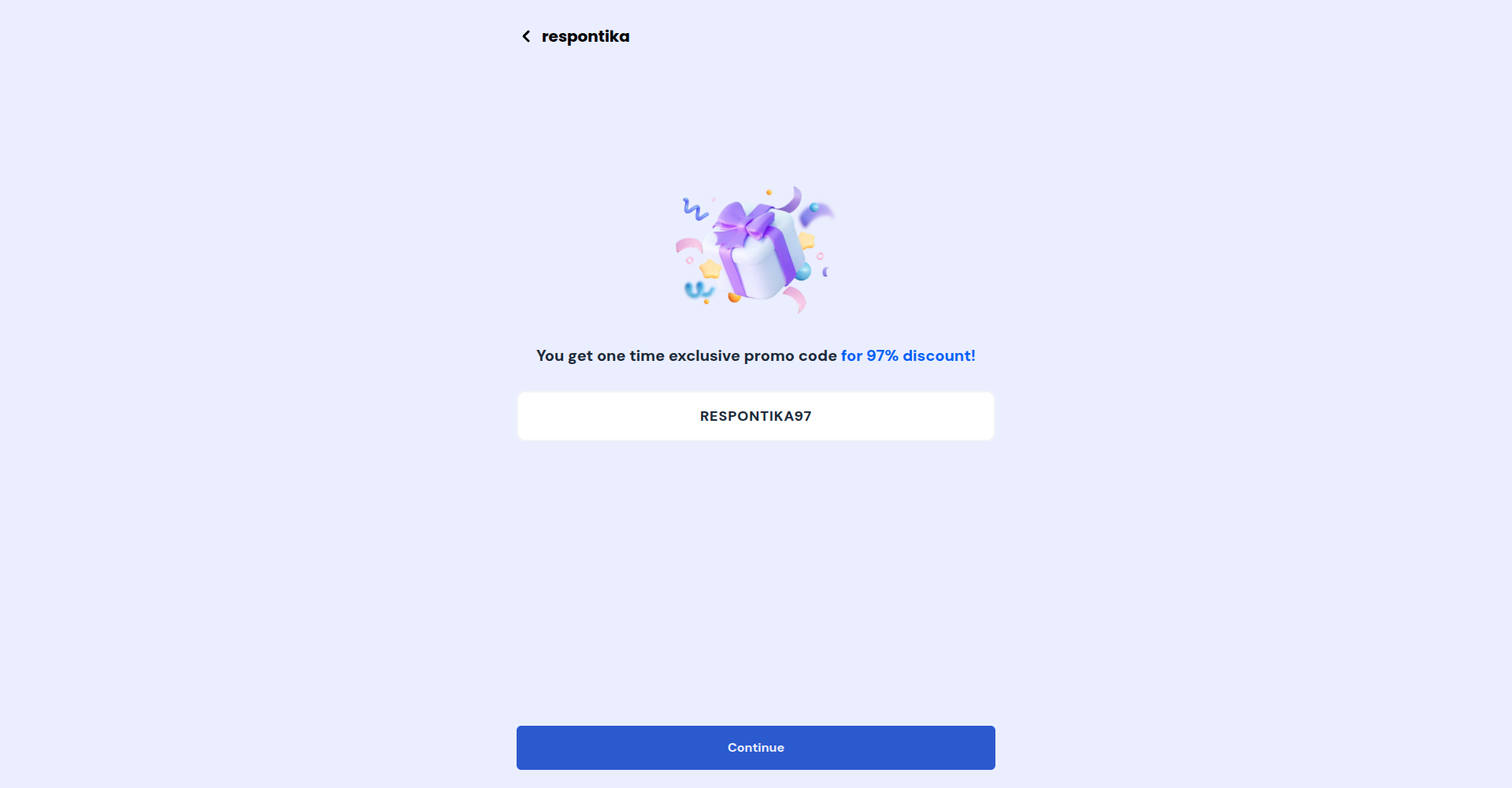 promo code 97pct
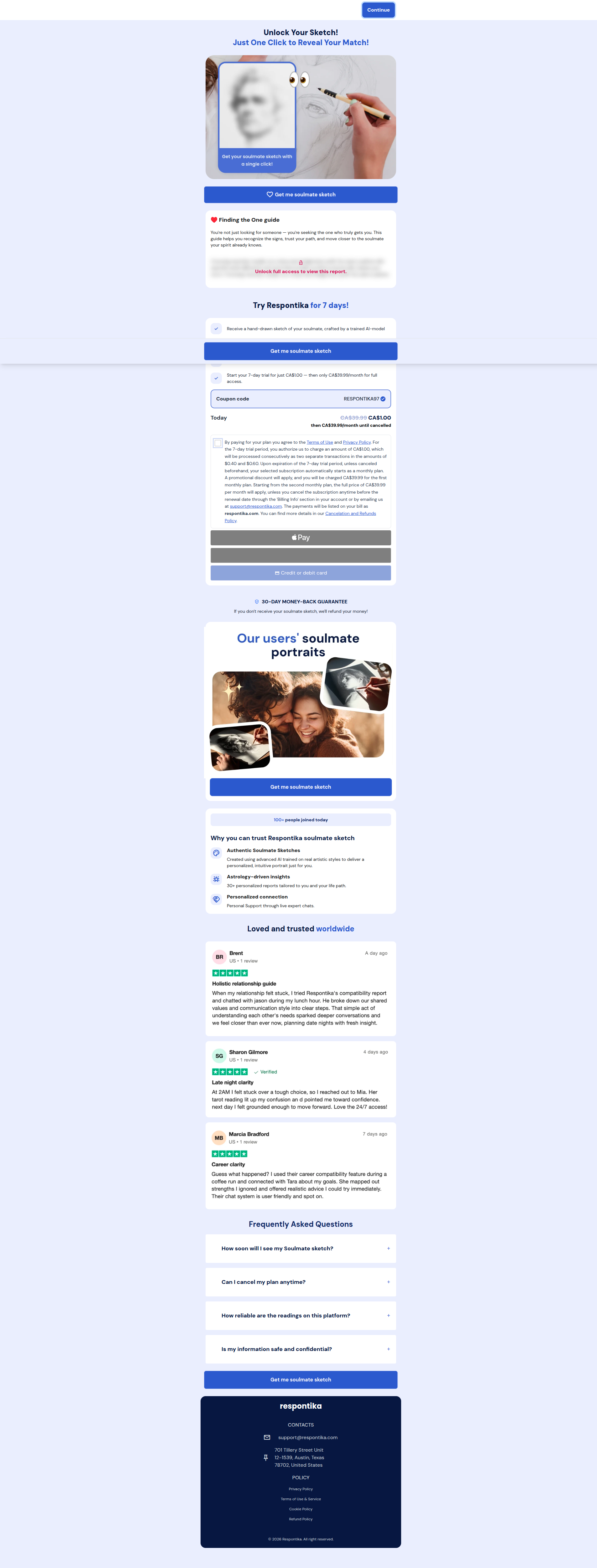 paywall full
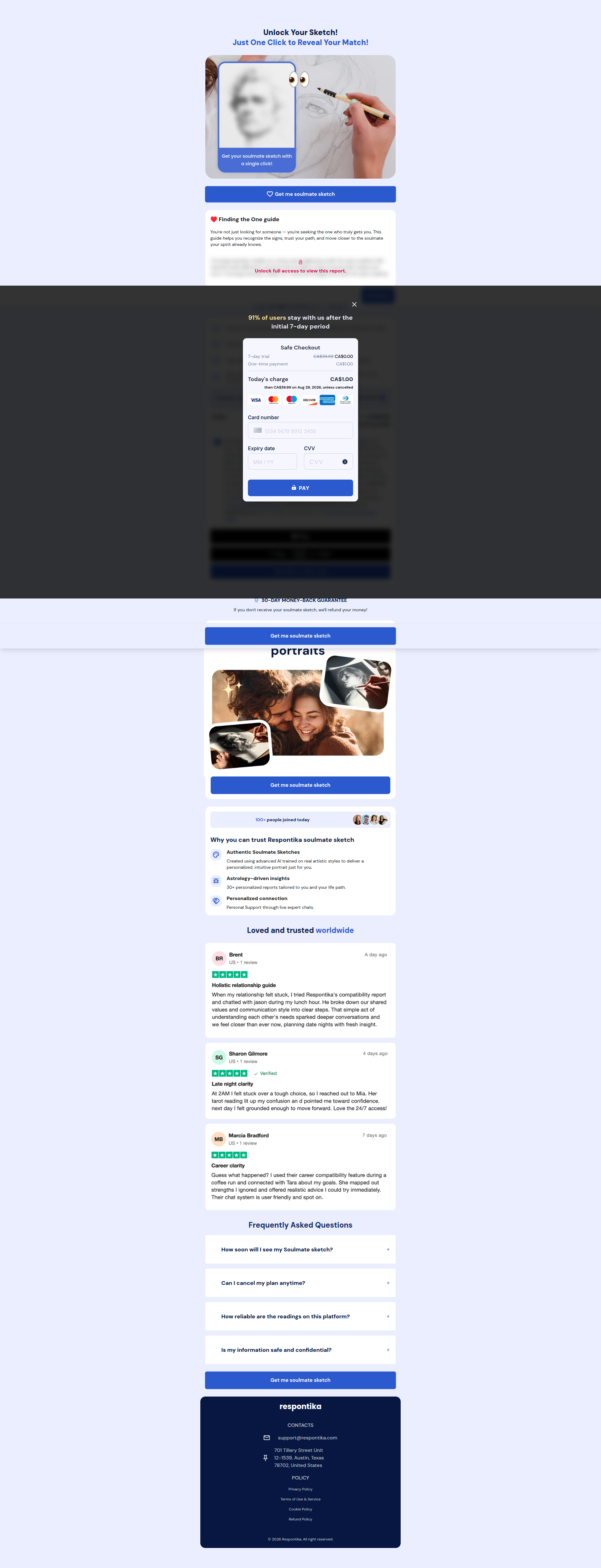 card entry fullpage
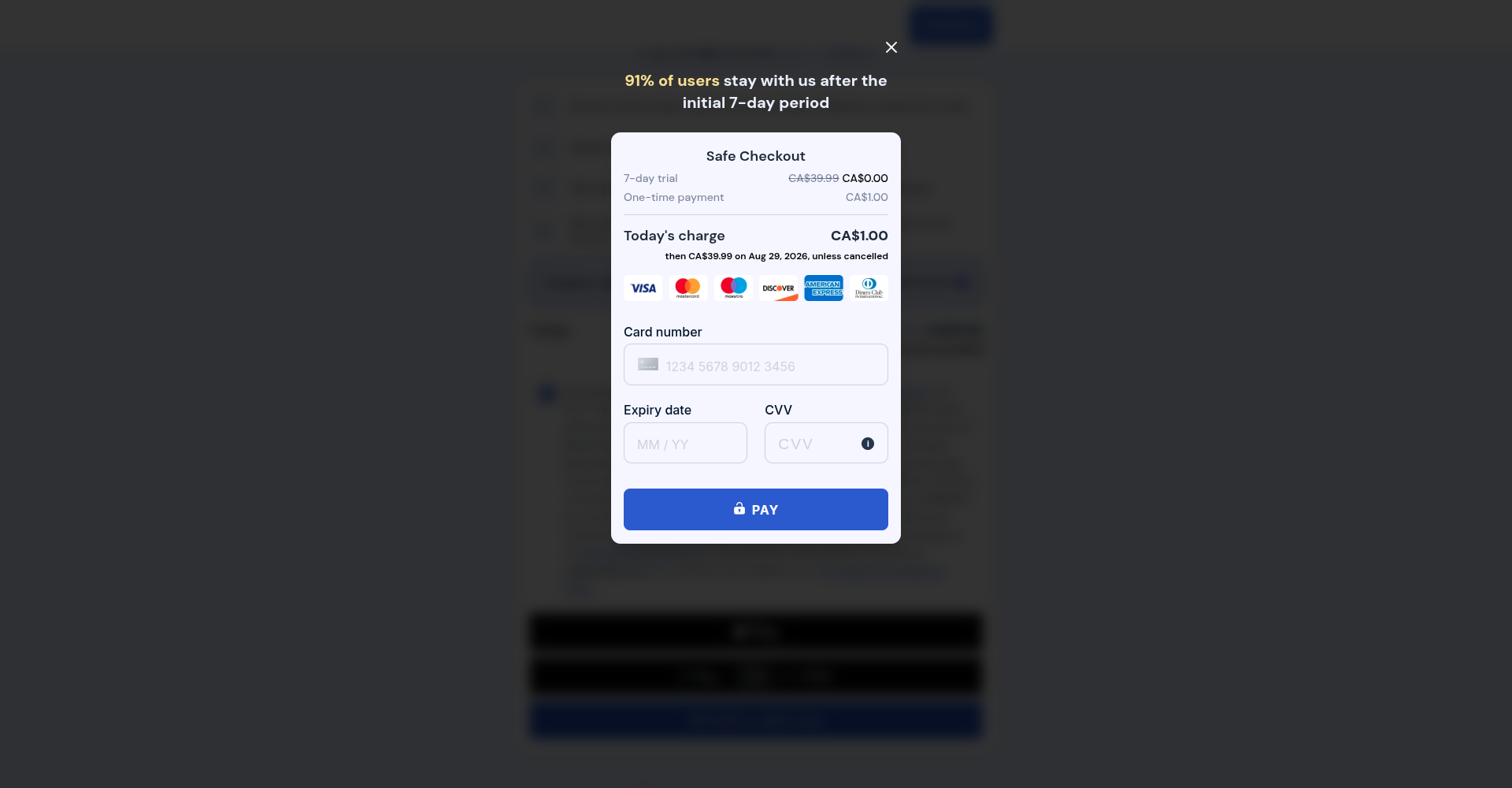 card entry viewport
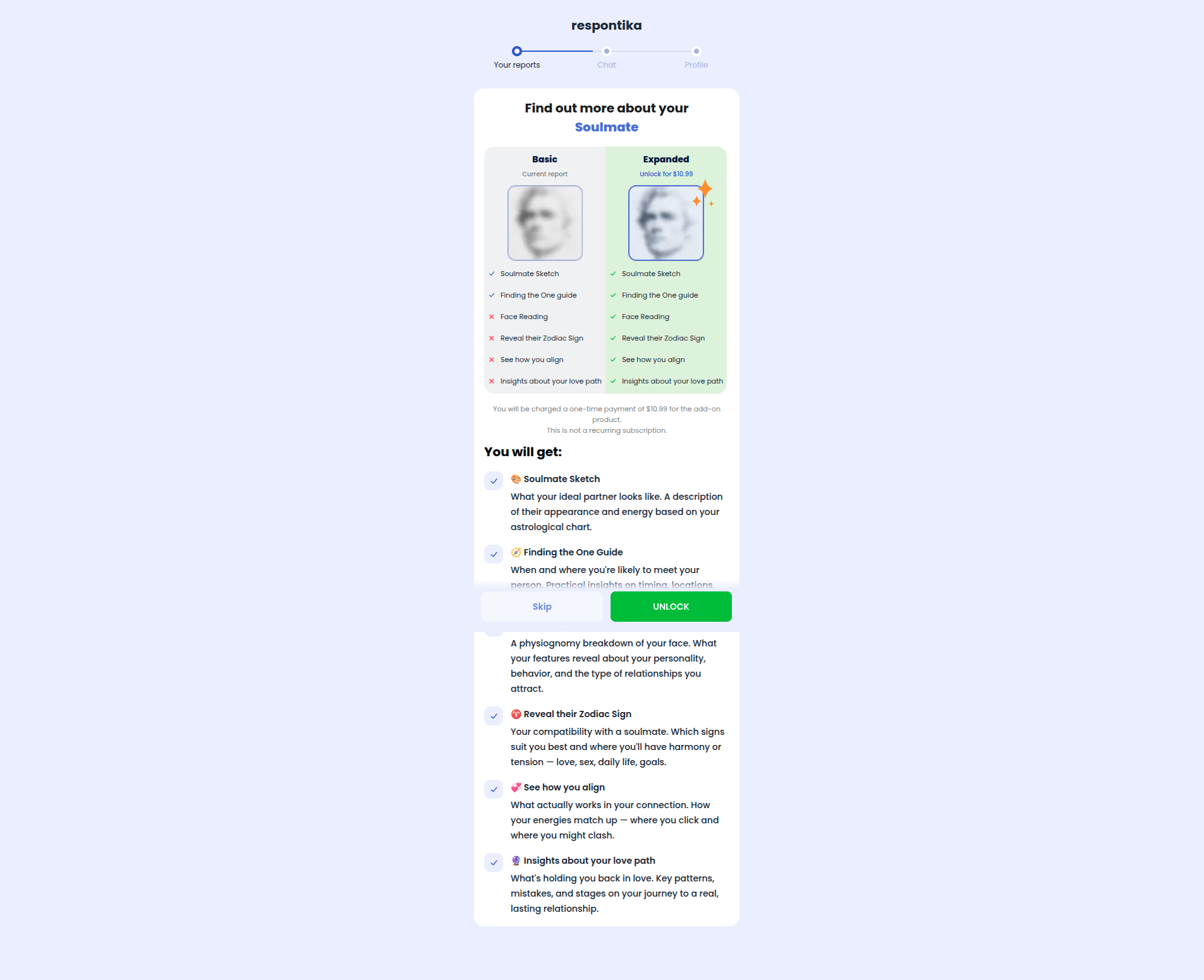 upsell soulmateNot live-verified
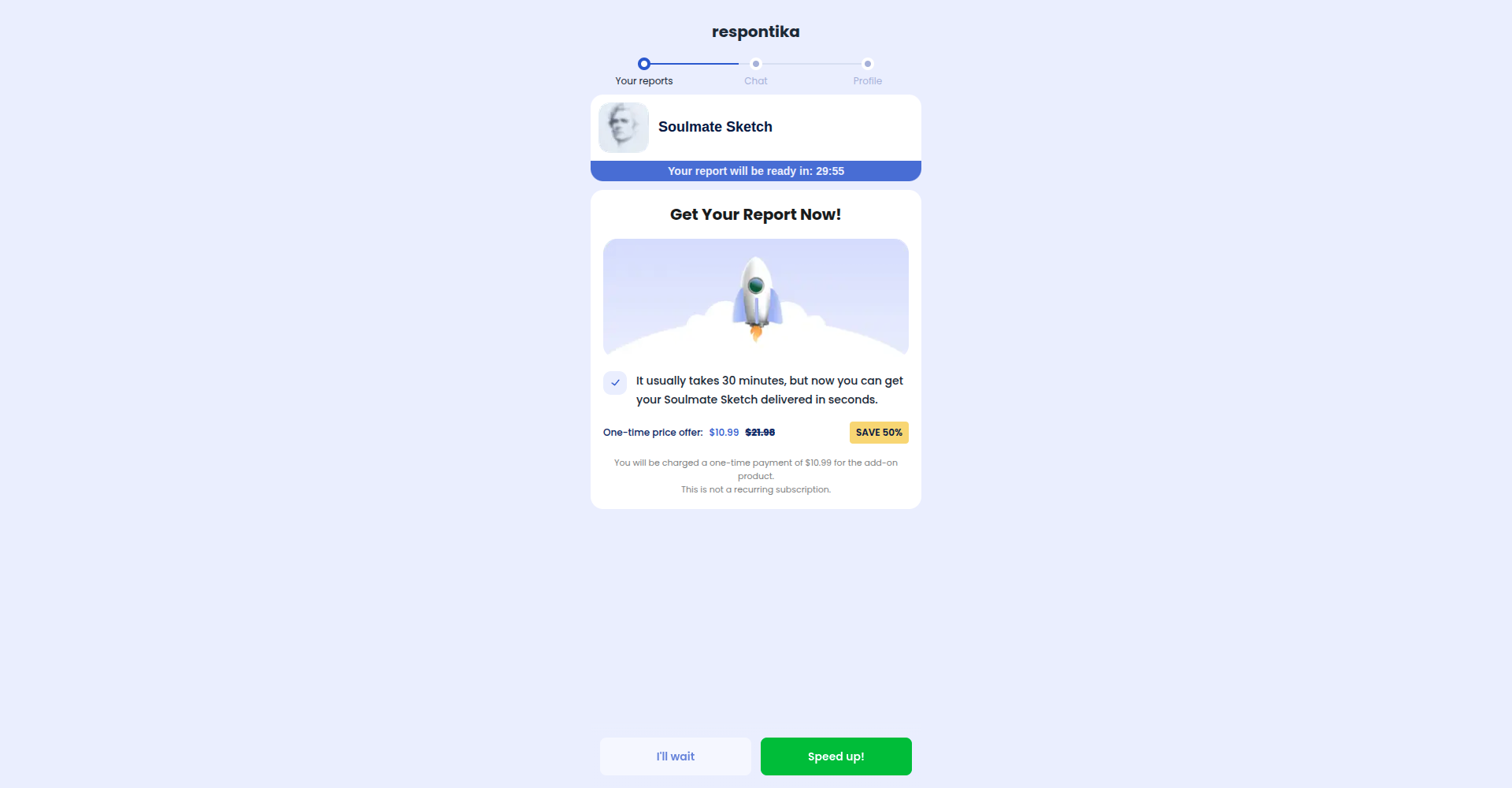 upsell timerNot live-verified
Arm D — 28-Day Challenge backend (/funnels/main)
15 screenshots · captured live 2026-08-22 · different productNot a sketch funnel. This arm sells an astrology/ritual self-improvement course in four weekly modules (week 1 = “Foundations and Mindfulness”) — their retention and LTV backend. The quiz is 6 questions instead of 16, with no interstitials, no fake-progress screen and no photo gate: a qualification form, not a sunk-cost machine. Ladder: no trial, direct subscription at CA$9.99 / 1 month, CA$19.99 / 3 months (pre-selected default, “Most Popular”, struck from CA$29.97) or CA$29.99 / 6 months (struck from CA$59.94, “Save 50%”), auto-renewing per term.
Consent text, verbatim (3-month default): “By paying for your plan you agree to the Terms of Use and Privacy Policy, and that you will automatically be charged CA$19.99 every 3-months, unless you cancel your subscription before the renewal date through the ‘Billing Info’ section in your account or by emailing us at support@respontika.com. The payment will be listed on your bill as respontika.com.”
Two details to look for in the shots. step-07 is marked CROSSREF because the
personalization card inside this non-sketch funnel still says “Done to your Soulmate sketch”
and “Palm reading goal” — shared template, never proofread. And the footer on
step-10 discloses both Respontika Inc. and Spiritika Limited, where the sketch
arms name only Respontika Inc.
 landing
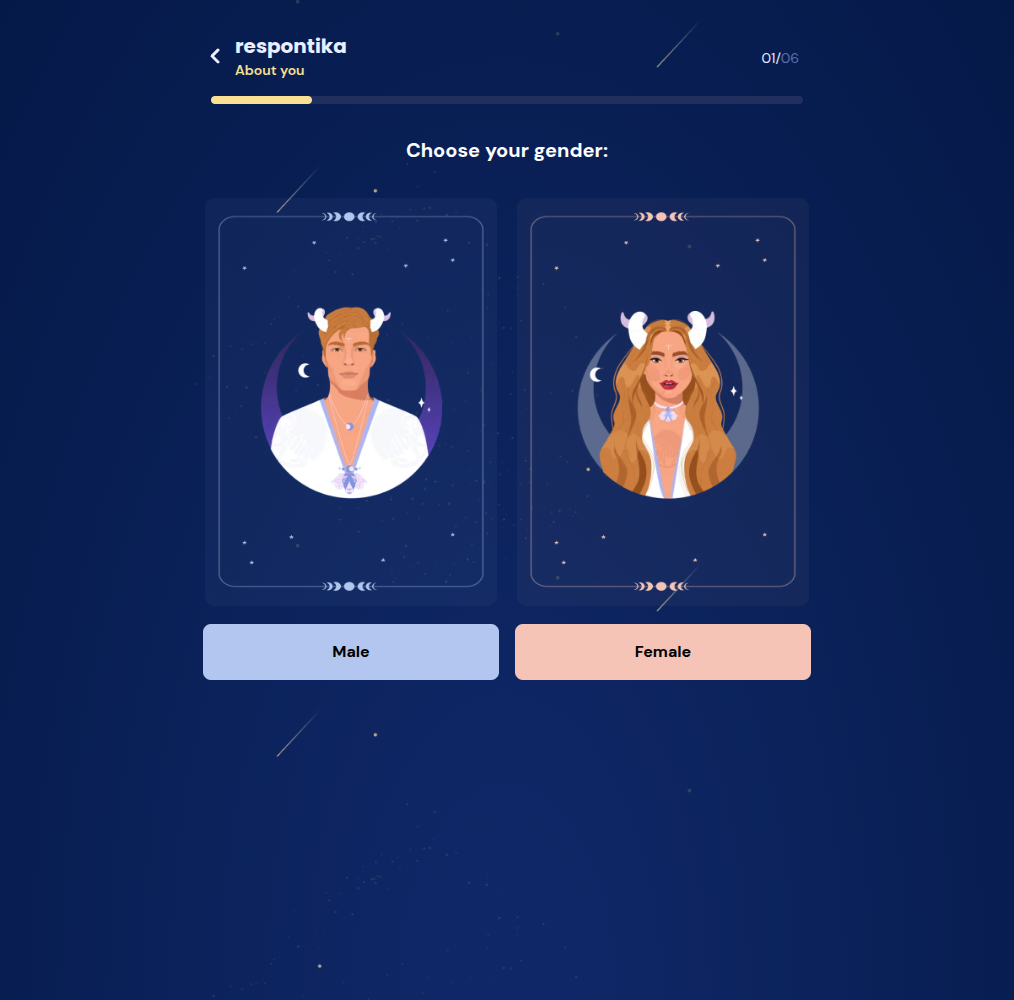 q01of06 gender
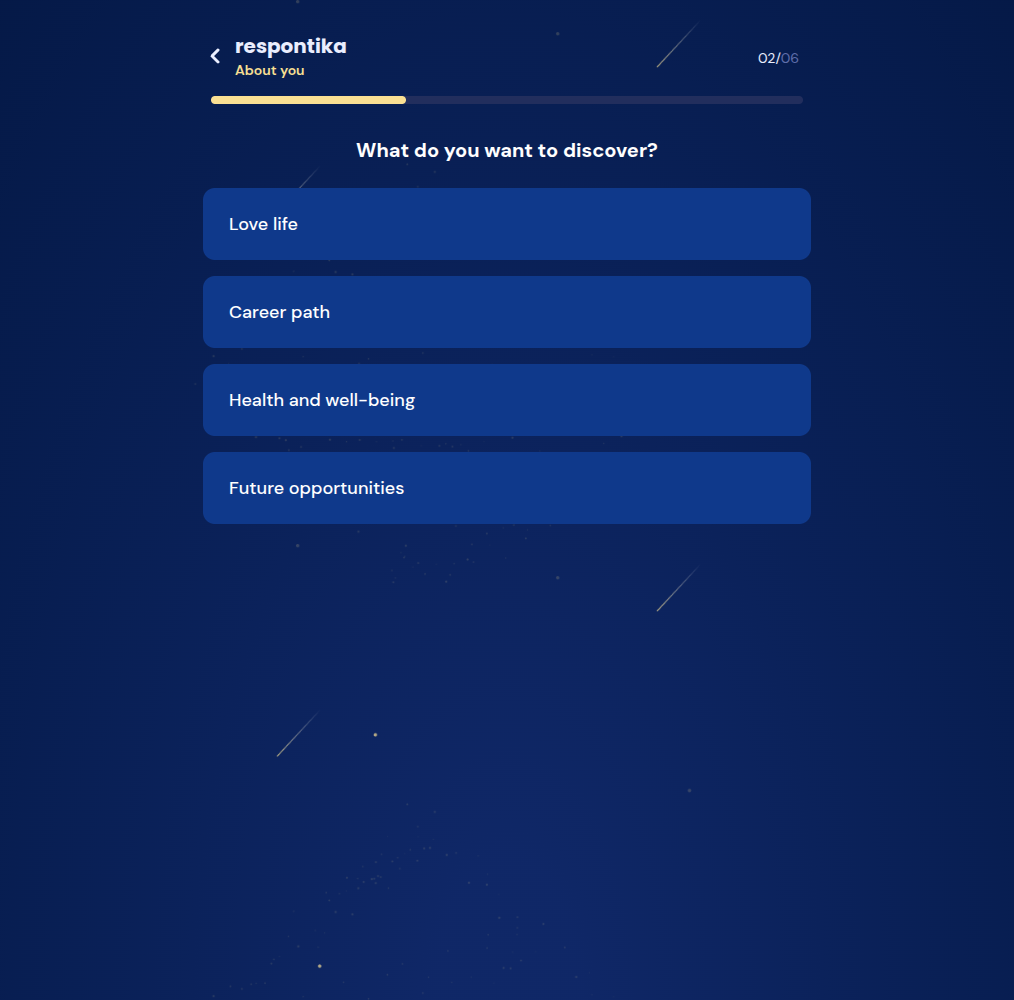 q02of06 discover
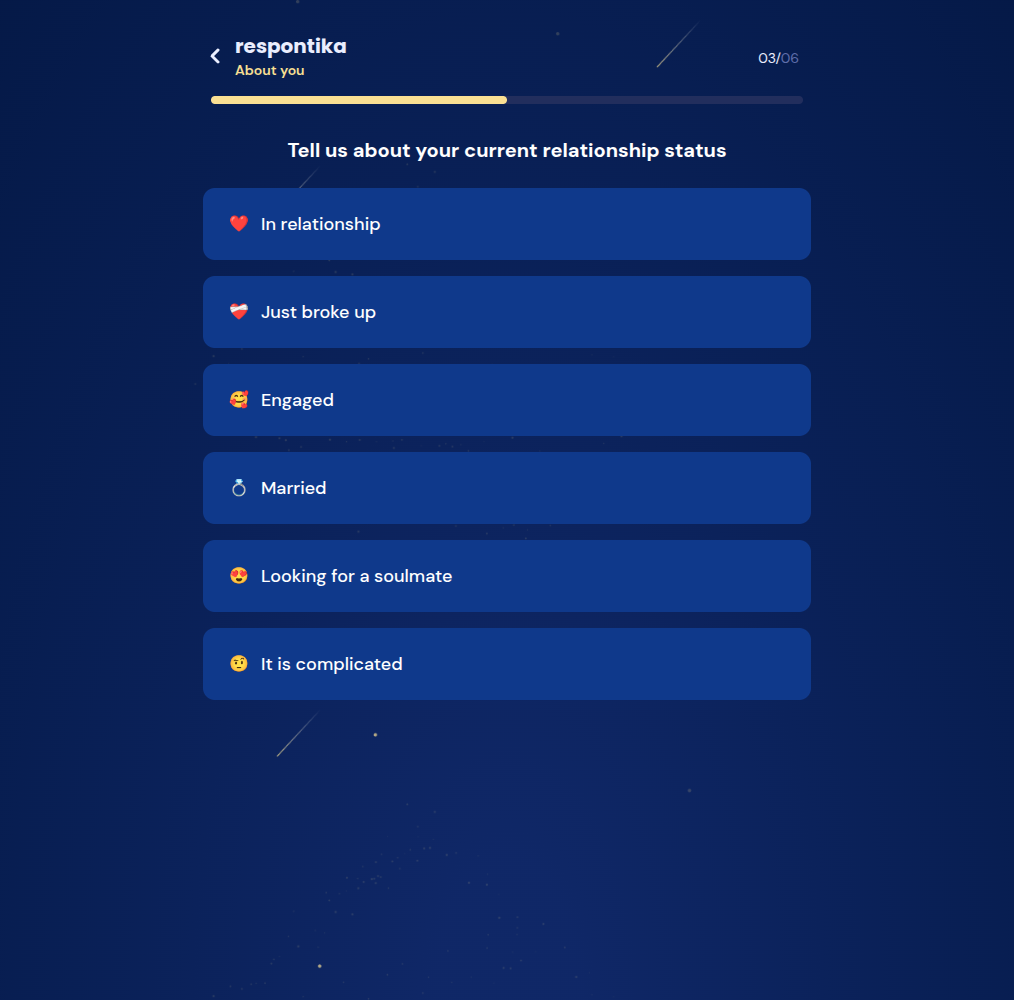 q03of06 relationship status
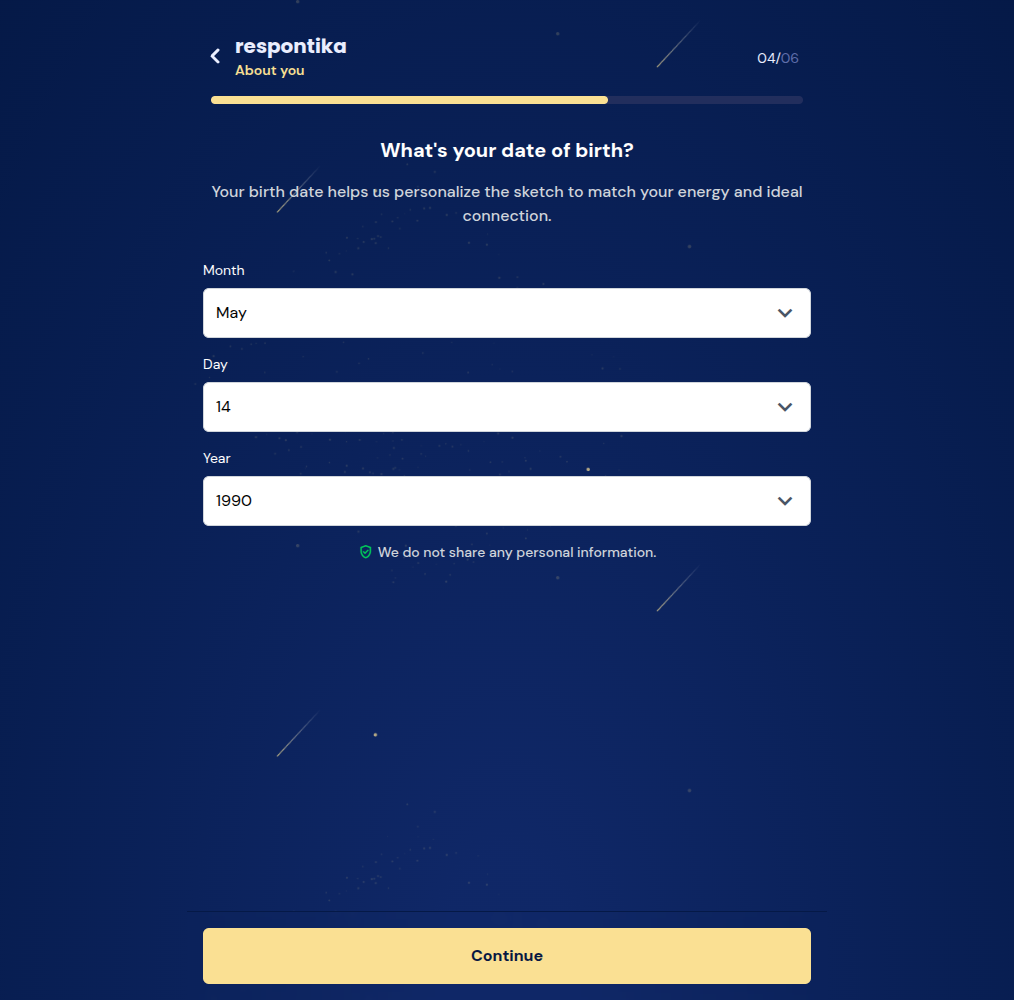 q04of06 dob
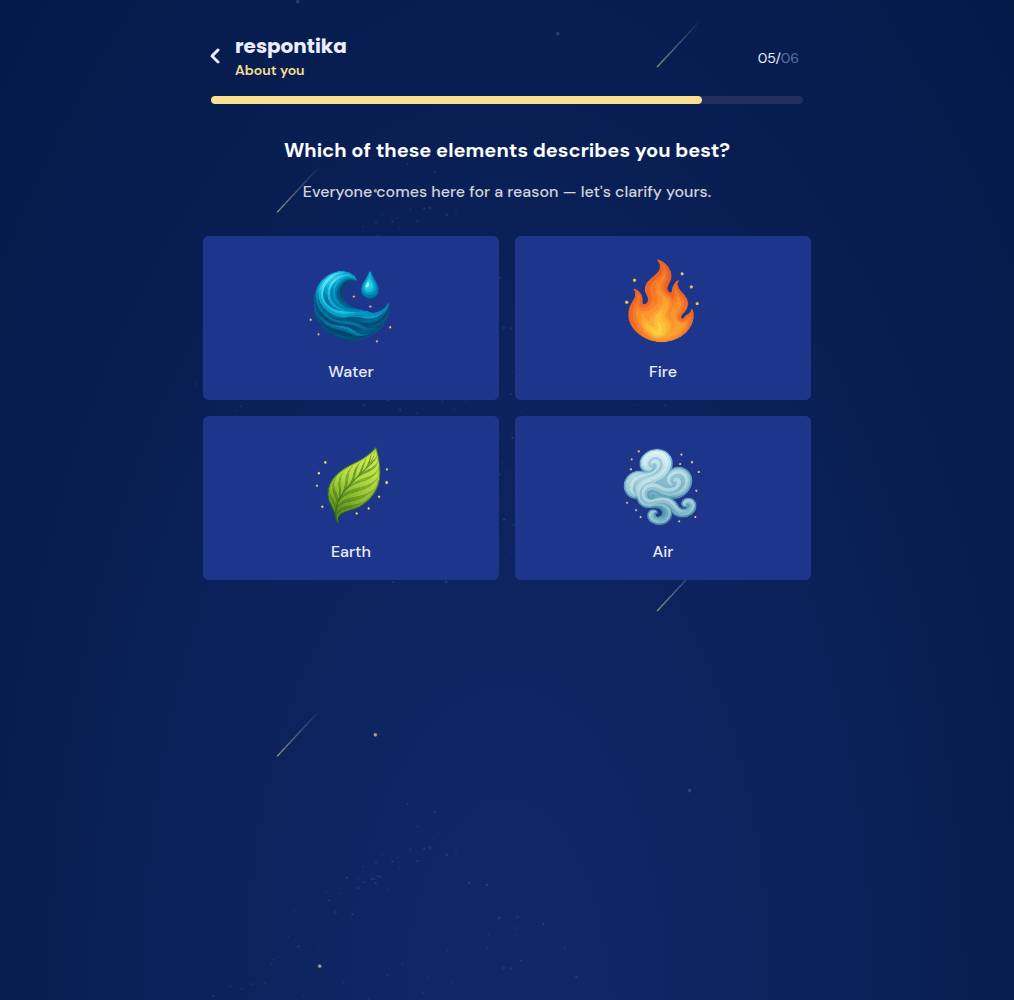 q05of06 element
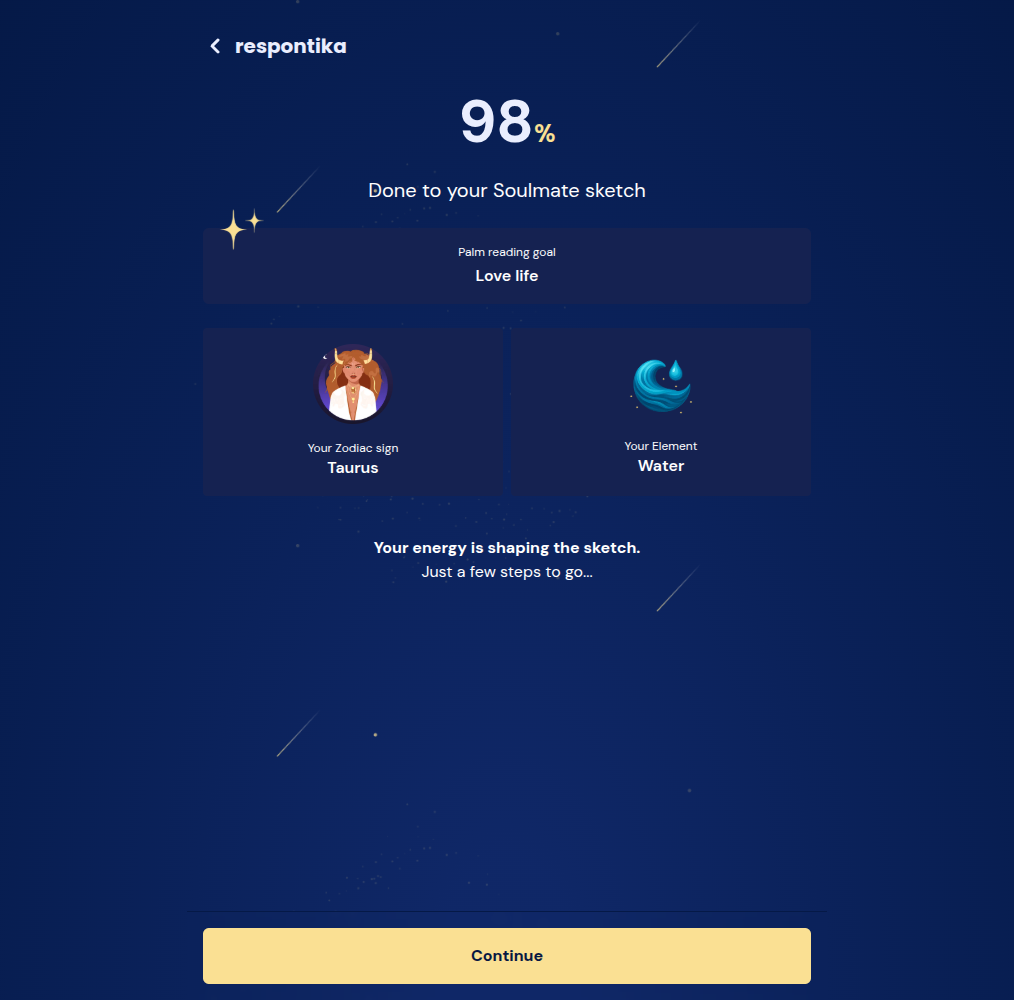 personalization summary CROSSREF
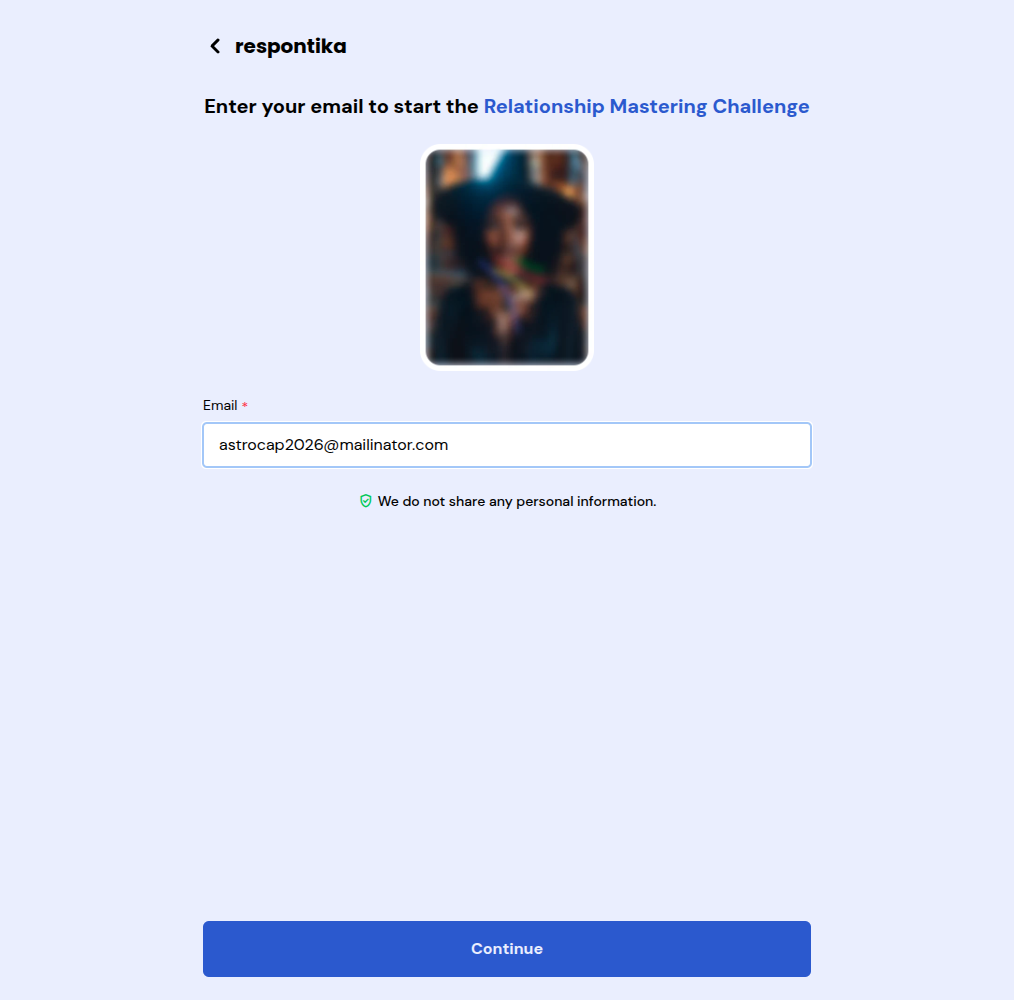 email capture
 loader reading
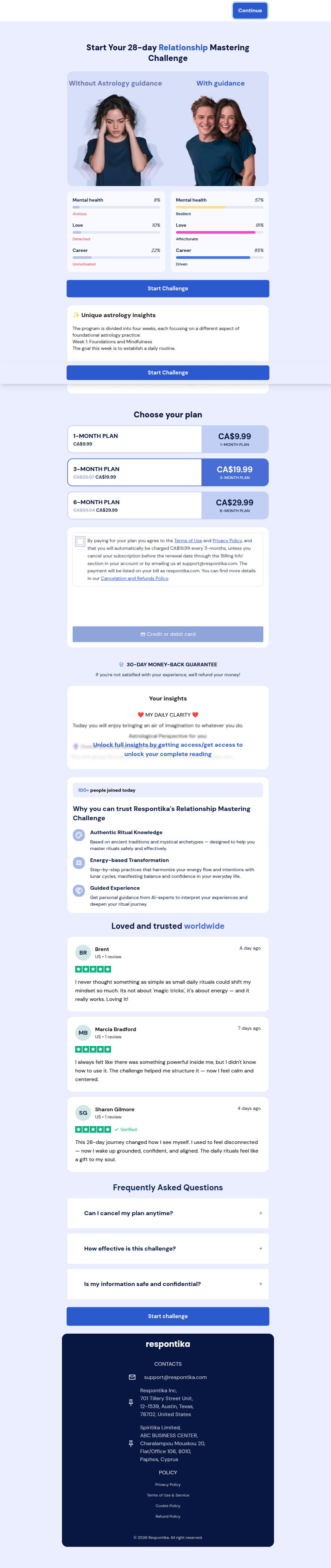 paywall full
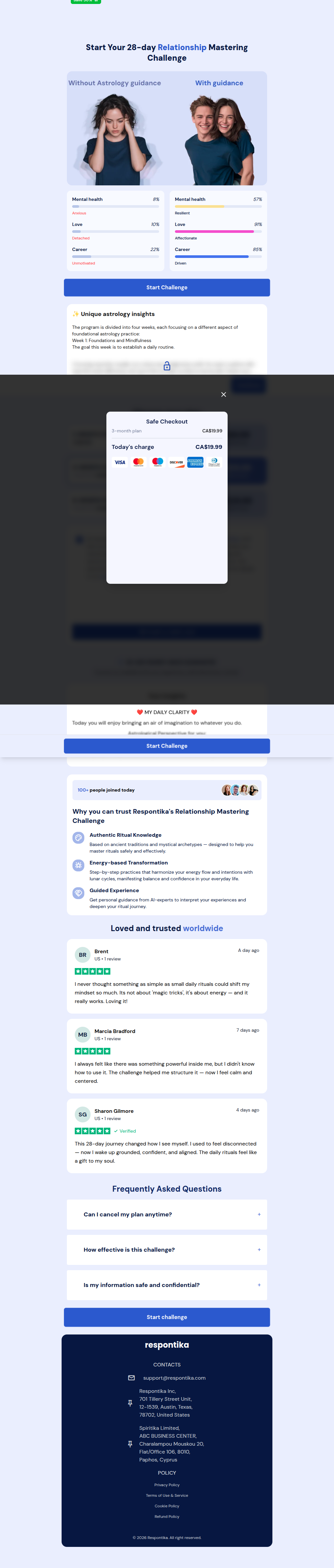 card entry fullpage
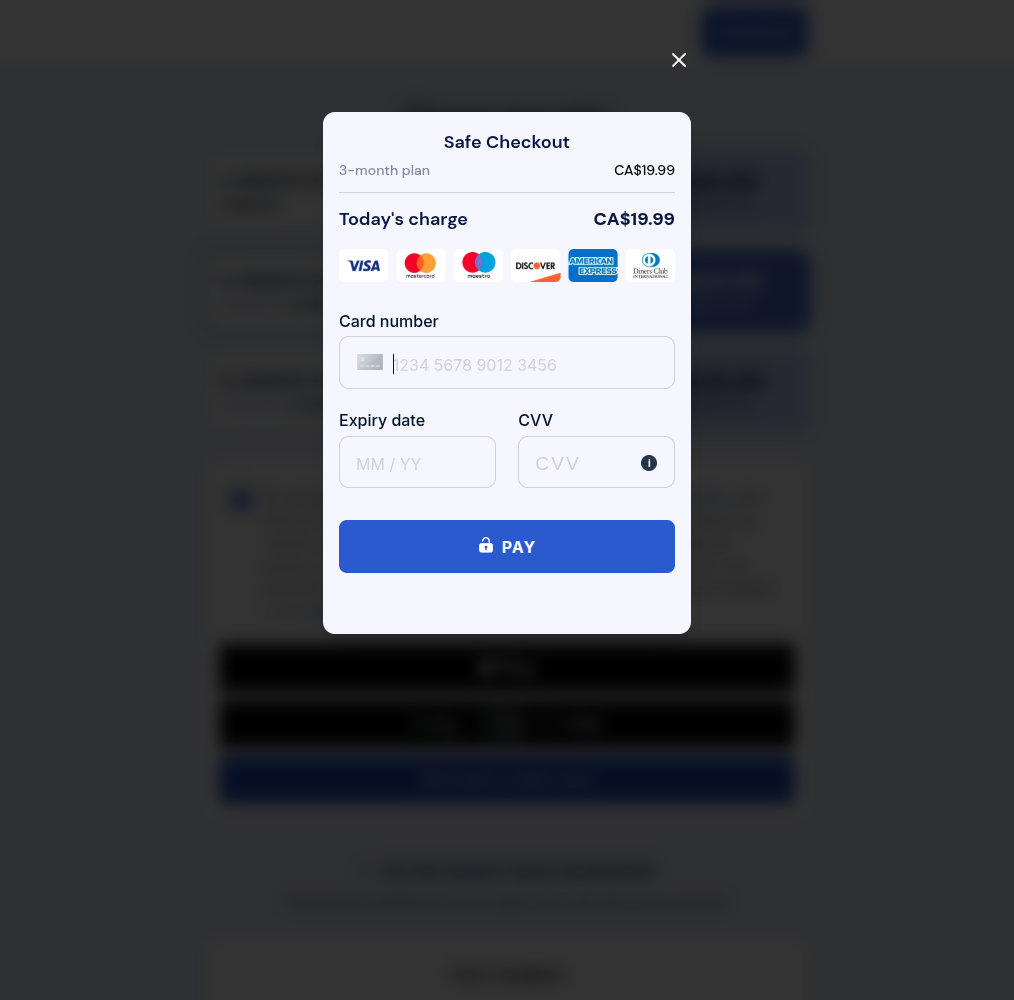 card entry viewport
 plan select check
 plan 1month selected
 plan 6month selected
Arm A — Staroly walkthrough (Meta ad path)
23 screenshots ·/funnels/sketch-3p → staroly.com onboarding · counter-verifiedThis set was re-captured on 2026-08-21 after two earlier attempts produced wrong-tab and step-shifted images. Filenames are now verified against the quiz's own “n / 16” progress counter, so the step order and the screen labels below can be trusted Counter-verified
 landing intro
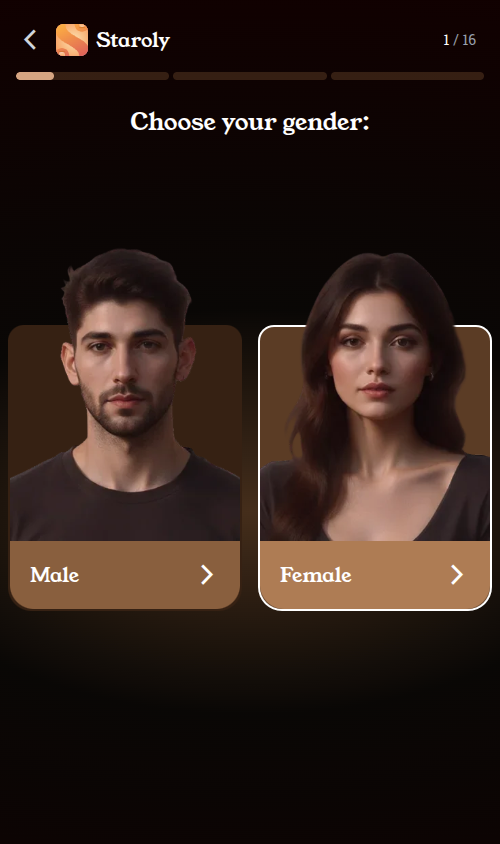 q01of16 gender
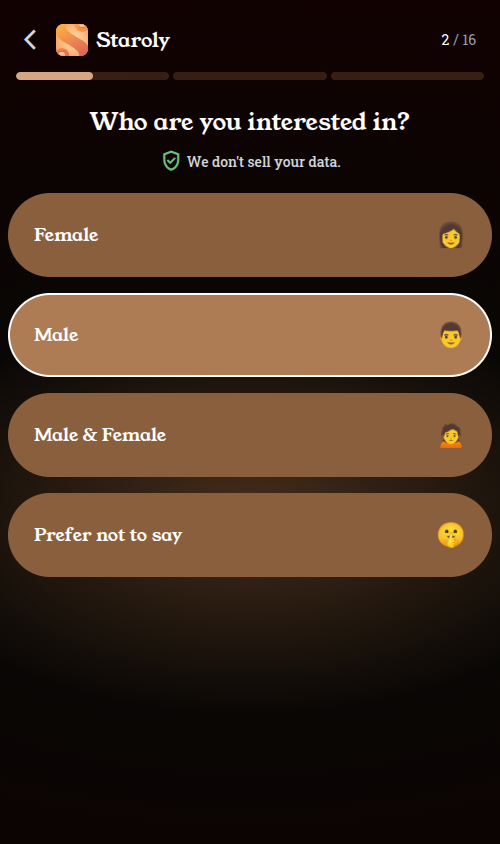 q02of16 interested in
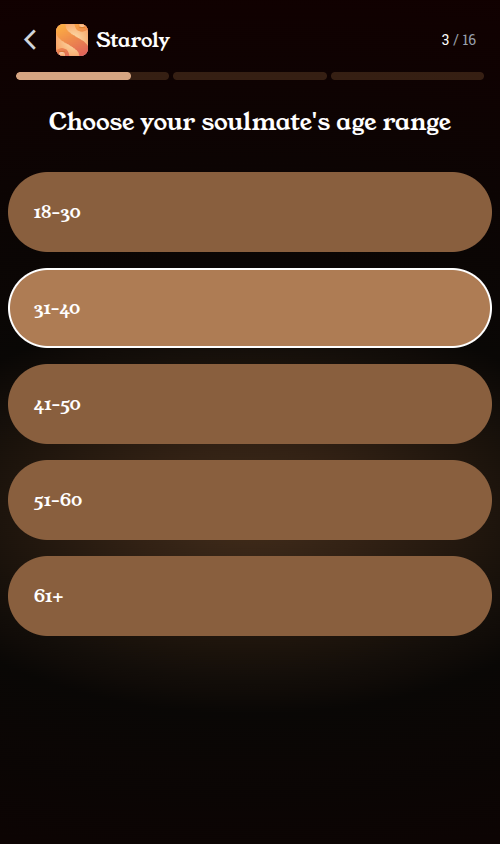 q03of16 soulmate age
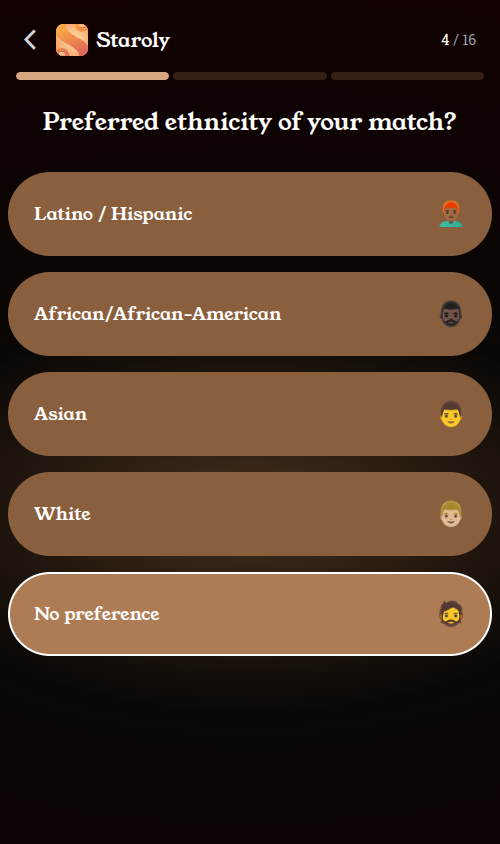 q04of16 ethnicity
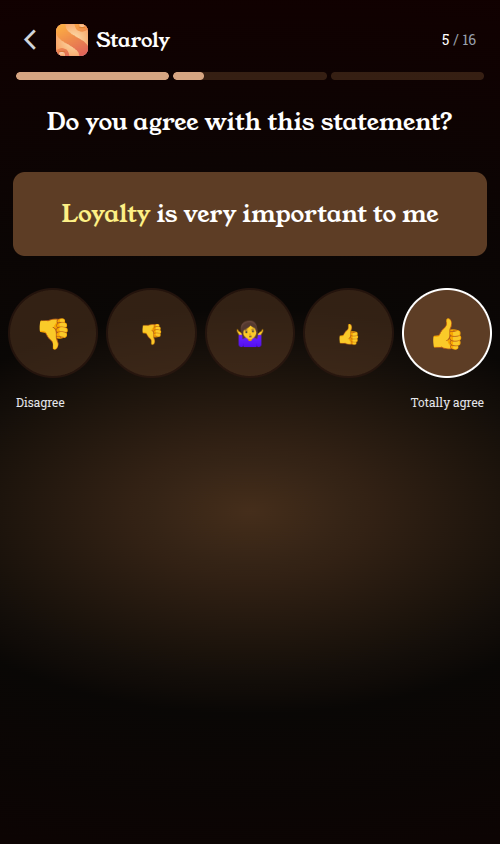 q05of16 loyalty
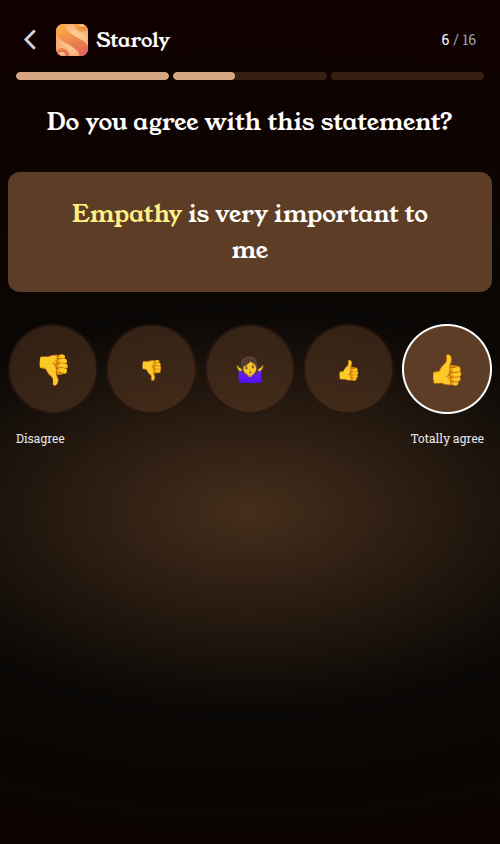 q06of16 empathy
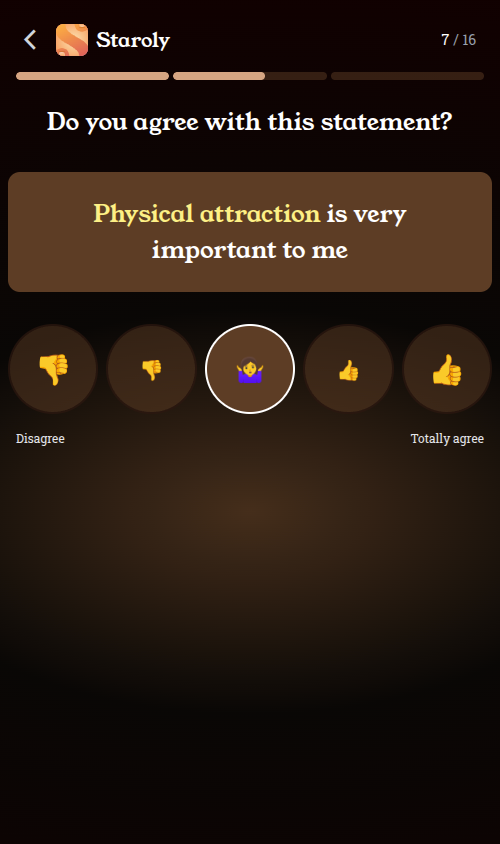 q07of16 physical attraction
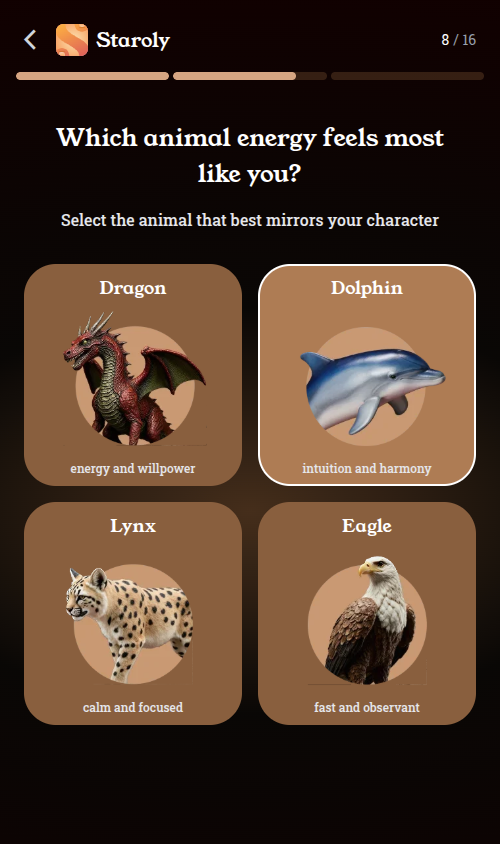 q08of16 animal energy
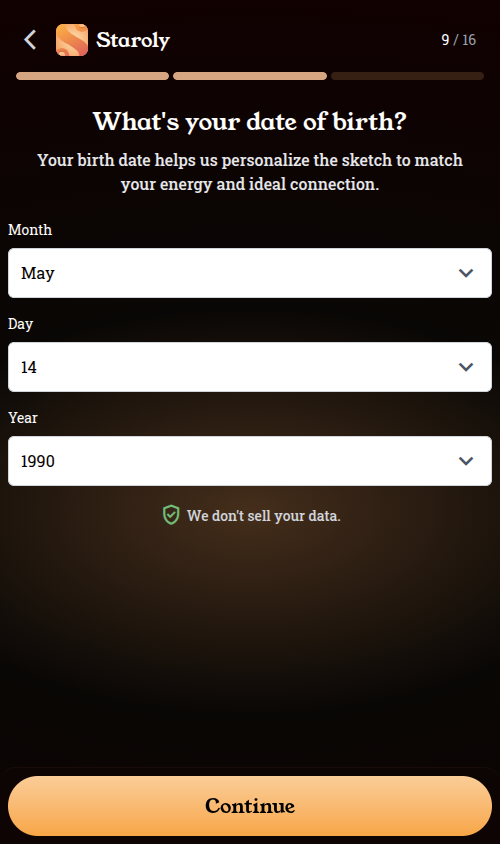 q09of16 dob
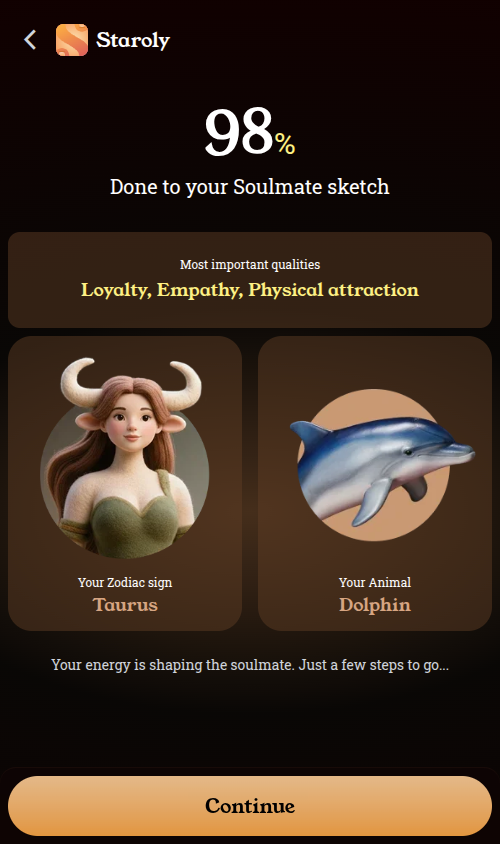 interstitial 98pct summary
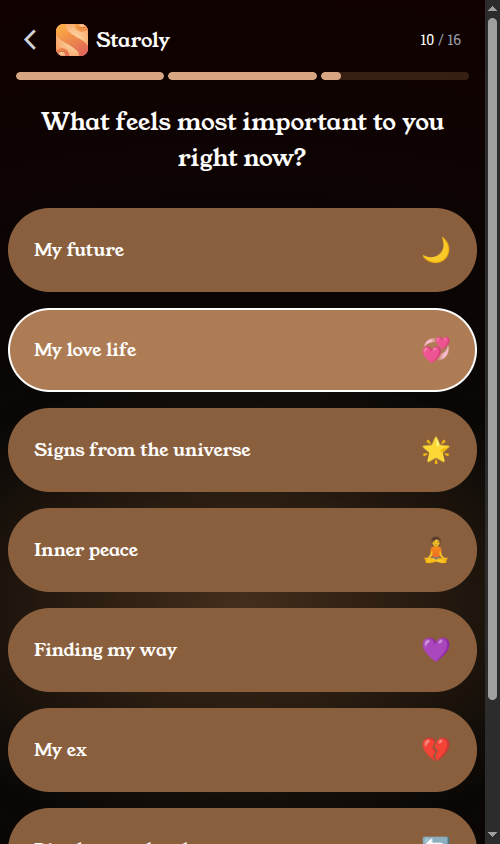 q10of16 most important now
 interstitial lets go deeper
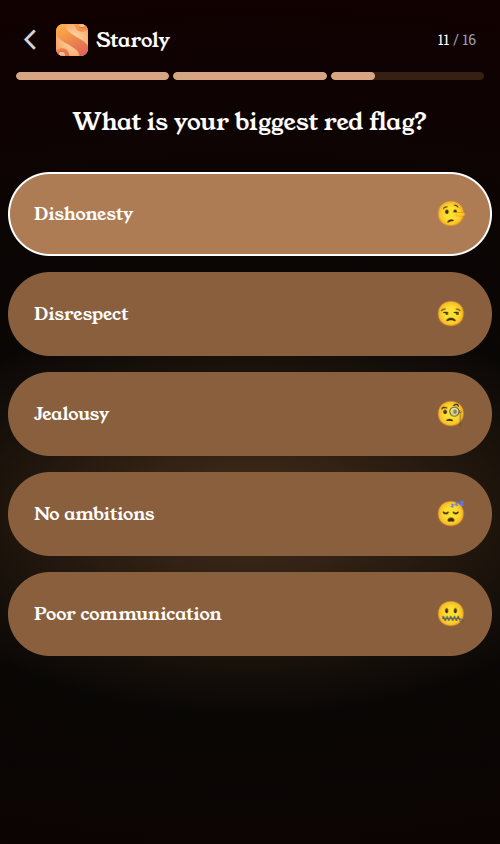 q11of16 red flag
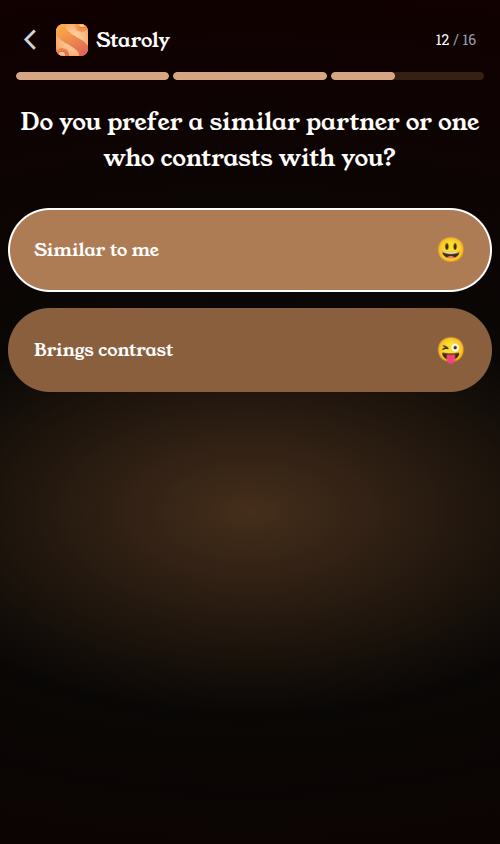 q12of16 similar or contrast
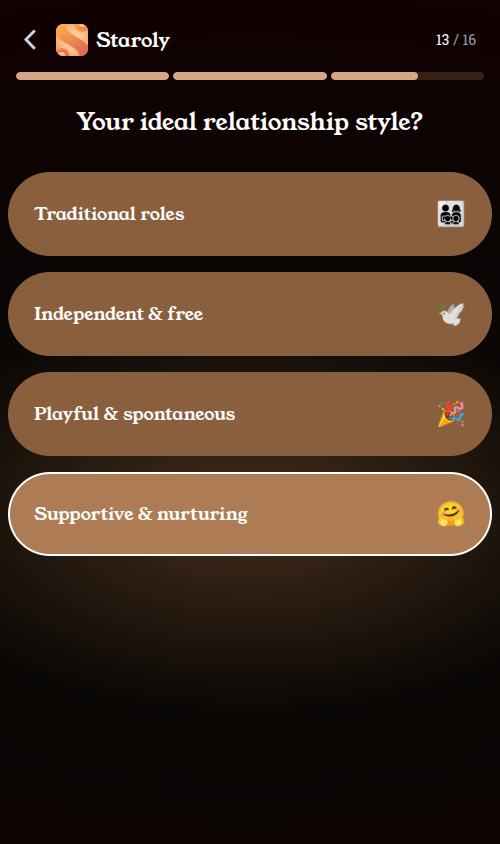 q13of16 relationship style
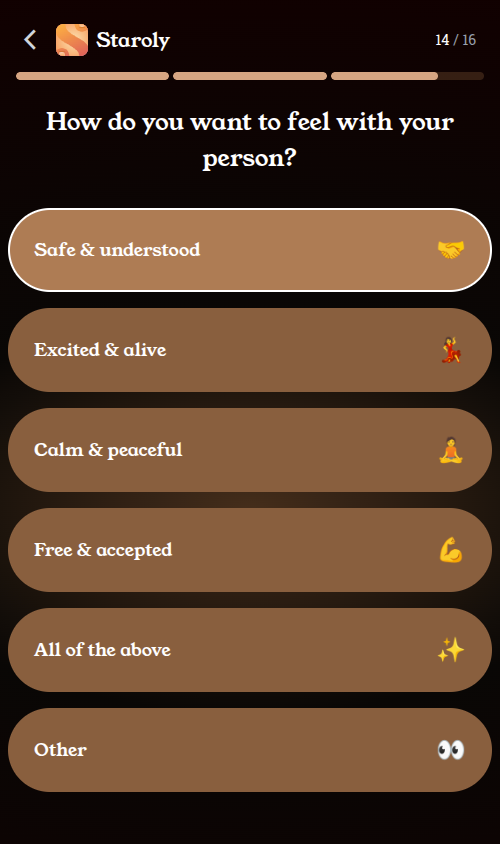 q14of16 how want to feel
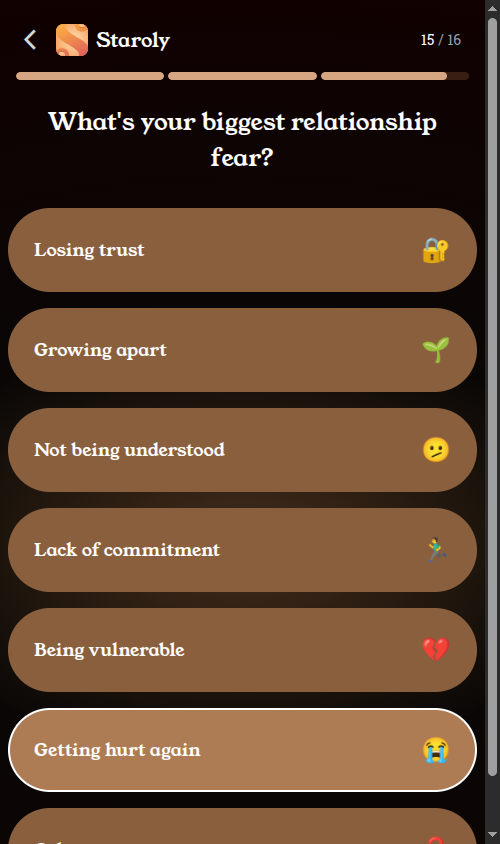 q15of16 biggest fear
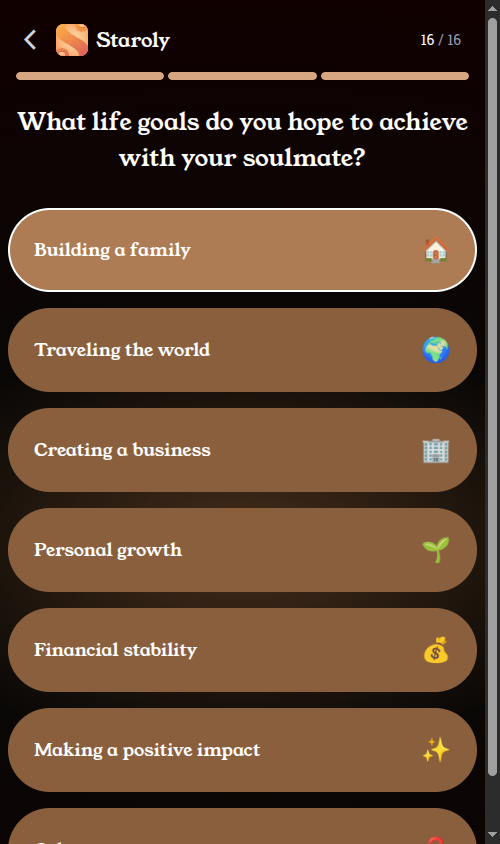 q16of16 life goals
 loader creating profile
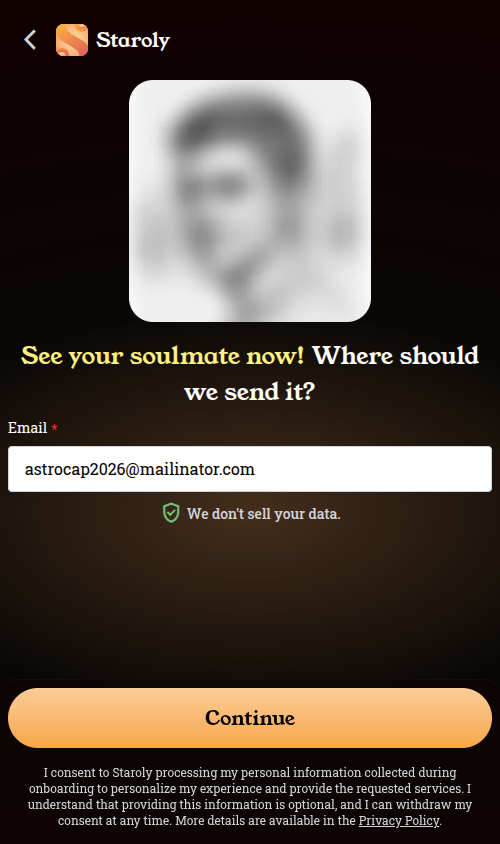 email capture
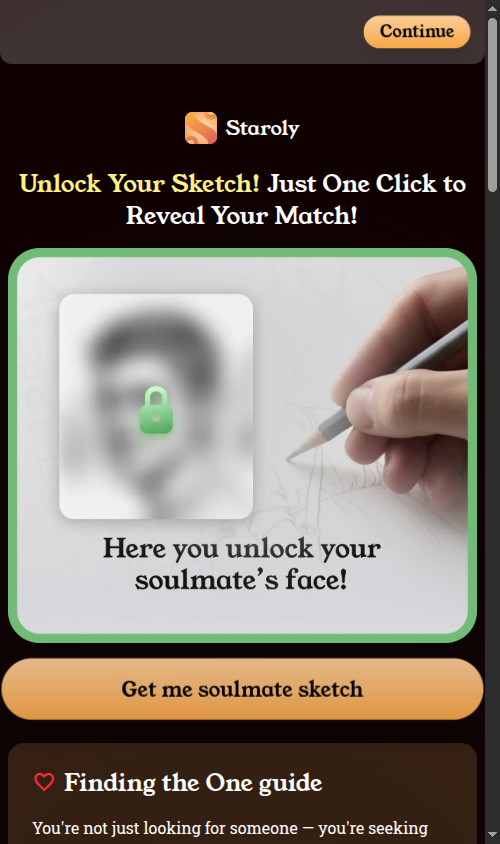 paywall a
 paywall full
Meta ad statics
4 creatives pulled from the Ad Library static 01 see your soulmates face
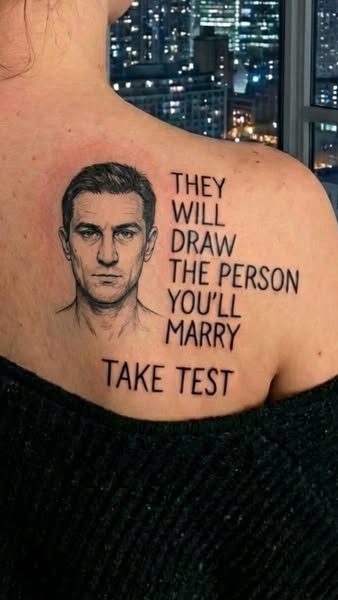 static 02 tattoo theyll draw the person youll marry
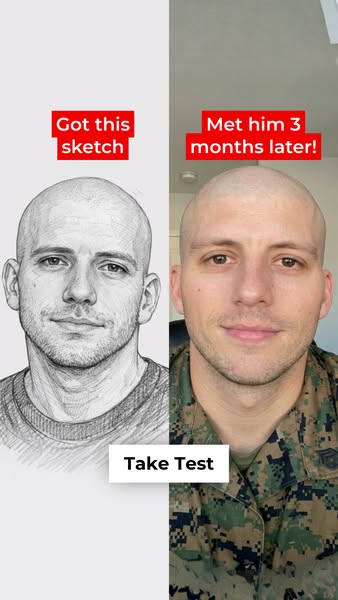 static 03 split got this sketch met him 3 months later
 static 04 locket check your soulmate face
Google creatives
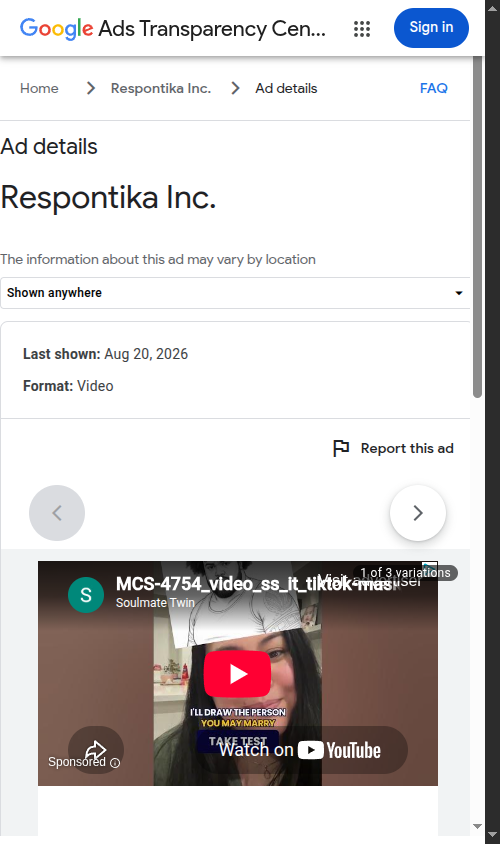
8 creatives pulled from the ad-image archiveRead directly from tpc.googlesyndication.com. creative-img-01 and
-02 are the two live search text ads; -03 to -06 are display and
app-install units; -07 and -08 are the retired March 2026 search ads pointing at the
now-404 /soulmate/drawing and /soulmate/sketch landing pages.
 creative img 01
 creative img 02
 creative img 03
 creative img 04
 creative img 05
 creative img 06
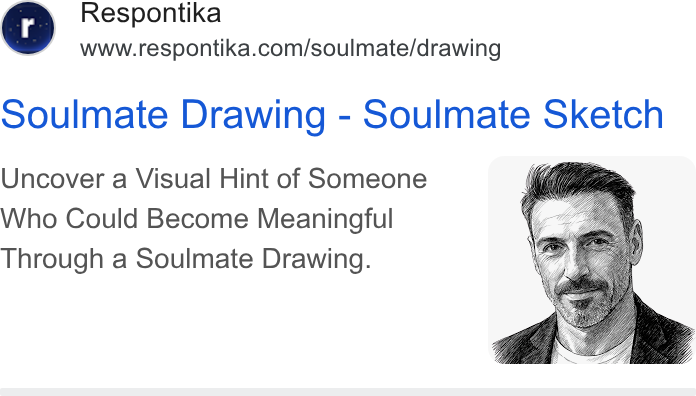 creative img 07
 creative img 08
Ads Transparency captures
8 screenshots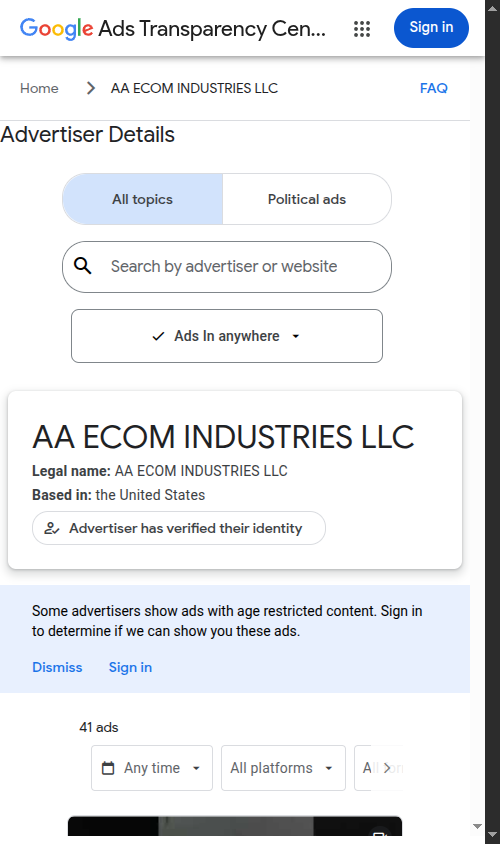
Brand 03 · captured 2026-08-22/23AppNebula / Nebula
Verdict. The category leader, and the cautionary tale — not the model. Nebula is one product line inside Genesis Tech (Ukrainian conglomerate; ultimate parent Arbor Mundi Ltd, BVI; formerly d/b/a Matar Trade & Invest Limited, voluntarily liquidated 2026-01-23 — four months before the FTC filed). It is the first competitor for which we hold measured revenue rather than deduced estimates: the complaint pleads $37.4M from US consumers via PayPal for Nebula alone (Jan 2023–Jun 2025), which is 35% of $106.1M across the group's five products, against roughly $250M global for those five and about $700M in total PayPal volume in the twelve months to Sept 2025.
Three findings define the takeaway. First: enforcement changed what they show some
users, not what they built — the pleaded trialChoice screen, its guilt-line, 105 named
flow variants selected by a split_id cookie, a four-rung trial ladder against two recurring
prices, and a countdown whose expiry raises the price are all still in production.
Second: their own customers draw the line for us — the sketch funnel scores
1.5 / 5 on Trustpilot while the app scores 4.3 / 5, same operator.
Customers do not hate the product; they hate how they were charged for it. Third: the
mechanism is ownership of the payment rail itself — Genesis co-CEO Vasily Ulianov is the
majority shareholder of the payment services provider behind every one of the defendants' merchant
accounts. That is what makes “open fresh merchant accounts to evade fraud monitoring”
possible, and it is not a capability an ordinary operator can replicate or needs to.
The strategic conclusion is stronger than “the FTC is dragging the category toward us.” The leader's deceptive machinery survived a federal asset freeze intact because the incentives and the infrastructure that built it are still in place. Being clean by construction is not a posture they can switch on. It is our structural advantage — and their own review data prices it at 1.5 versus 4.3.
default_flow_old_paywall. Bucketing looks cookie-driven, not growthbook.{sign} soulmate ×12. Competition 0.00–0.01. Nebula is absent from it — they built compatibility, not soulmate.@appnebula does not exist; @asknebula = 4 followers / 0 videos. 100% paid, zero organic surface where the demand lives.The FTC case — docket, money, and the compliance floor it sets
Full docket pulled 2026-08-23 from CourtListener: 37 PDFs, ten of them substantive (177 pages). The Cyprus entities that own Nebula defaulted. Obrio Ltd., Spiritual Nebula Ltd., GM Unicorn Corp. Ltd. and director Skianis filed nothing, retained no counsel, and appeared at neither the June 18 nor the July 2 hearing; the preliminary injunction against them was entered unopposed on 2026-07-02 (Dkt 44). Only the US-facing Delaware shells and the five US-resident individuals lawyered up (Kronenberger Rosenfeld) and stipulated — and stipulating bought them no softer conduct terms: the prohibited-conduct language in both orders is word-for-word identical. It kept them out of a contested ruling, nothing more. No receiver was sought or appointed (confirmed by direct search across the complaint, TRO and both PIs). Next dates: CMC statement due 2026-08-25, initial case management conference 2026-09-01 (Oakland, videoconference); the 07-02 hearing transcript becomes free on 2026-10-13.
Yolo Brothers pleads ignorance of the funnel it billed for. Its Answer (Dkt 49, 2026-07-30) admits the Delaware entities “were Delaware corporations used for US payment processing for US customers” and that Yolo Brothers “resold subscription offers to consumers in the United States” — then answers “lack knowledge or information sufficient to admit or deny” to every substantive Nebula funnel allegation (¶¶114–130: the quiz, the fake analysis, the name-your-price page, the $45/30d ladder, the cancellation failures, the $37.4M). The defense strategy is to sever the US billing shells from the Cyprus operators.
Revenue by product — US consumers, PayPal only Measured — FTC complaint
| Product | Entity family | Period | US PayPal revenue | $/month |
|---|---|---|---|---|
| Nebula | Obrio / Spiritual Nebula / GM Unicorn / Yolo Brothers | Jan 2023 – Jun 2025 | $37.4M | ~$1.25M |
| Amo (MadMuscles, Harna, Unimeal) | AmoMedia / Amoapps / AmoApp Inc. | Jan 2023 – Jun 2025 | $32.7M | ~$1.09M |
| Wisey | Koflimin / Growthmind Labs | Jan 2023 – Aug 2025 | $15.4M | ~$0.48M |
| Lumi | Bramol / Evertech | Dec 2023 – Jun 2025 | $14.1M | ~$0.74M |
| PDF Guru + PDF Master | Gurudocs | Mar 2023 – Aug 2025 | $6.5M | ~$0.22M |
| Total — 5 products, US, PayPal | $106.1M |
Card volume is additional and nowhere stated. US PayPal is roughly 42% of the five products' ~$250M global revenue. The astrology funnel out-earns the fitness, productivity, fashion and PDF lines individually. The house price shape across all five verticals is identical: a sub-$20 — often sub-$2 — entry converting to $40–$60/month. PDF Guru's $0.99 entry carries the highest recurring at $49.99/mo.
The dispute-suppression script (¶110, pleaded on Lumi but a group-level technique) is a do-not-copy with high diagnostic value — it is what a processor-pressured operator in this niche does under stress:
“Kindly note that the dispute process may take up to 20 days. However, if you cancel the dispute in PayPal, we are committed to processing a refund instantly and you will receive your funds within 72 hours.” — and the FTC pleads the other half: “Lumi frequently continues to refuse refunds even after the PayPal disputes are closed.”
The compliance floor — now the enforced standard for the category
Identical language in all three orders, and note the scope: “any goods or services” — not just subscriptions, not just astrology. The three bans are: disclose all material terms clearly and conspicuously; obtain express informed consent before charging; provide simple mechanisms to stop recurring charges. The court's eight-part “Clearly and Conspicuously” definition is what to hold our own pages against. Three elements matter most:
- Element 4 — unavoidable. “In any communication using an Interactive Electronic Medium… the disclosure must be UNAVOIDABLE.” Our SS Bump 2 rule (transparent recurring in three places) already satisfies this.
- Element 7 — uncontradicted. “Must not be contradicted or mitigated by, or inconsistent with, anything else in the communication.” This is the element Nebula actually failed. Their fine print was already ROSCA-shaped in March 2026; what broke it was burying that text under a name-your-price screen and contradicting it on the payment form with “You will be charged only $5.” Correct disclosure text does not cure a contradicting page.
- Element 8 — measured against the TARGETED audience. If the practice targets a specific group, “reasonable consumers” means members of that group. Our avatars are by design emotionally activated. A disclosure a calm shopper would notice is not automatically clear and conspicuous to the audience we deliberately target. This raises our bar above the generic standard, not to it.
The count worth auditing ourselves against is V: can a customer stop a recurring charge from inside our portal, without emailing anyone? That is the count the FTC pleads hardest and the one Nebula most obviously fails.
Still paywalled and cheap. Dkt 8's 19 attachments — the FTC investigator's declaration, both exhibit volumes (~43 annotated funnel screenshots, of which Figs. D.1–D.6 are the complete Nebula flow), and 14 consumer-witness declarations — are $35.00 total on PACER and nobody has bought them into RECAP. PACER waives quarterly charges of $30 or less, so the $9.00 slice (investigator declaration + both exhibit volumes) is effectively free; the full set is not. Not purchased.
The company — a BVI parent over a Cyprus / Delaware shell stack
The “AppNebula is OBRIO” read is correct but incomplete. Obrio is the app developer of record; the money and merchant accounts run through a separate stack. The FTC's own words: “The Cyprus companies market to U.S. consumers and access U.S. payment processing through counterparts incorporated in Delaware.”
| Layer | Entity | Jurisdiction | Role |
|---|---|---|---|
| Ultimate parent | Arbor Mundi Limited | BVI | Parent of the Cyprus defendants. Not itself a defendant. |
| Former holding entity | Matar Trade & Invest Limited | BVI | Genesis Tech was its d/b/a until Jan 2026. Dissolved 2026-01-23 after voluntary liquidation — four months before the FTC filed. |
| Enterprise brand | Genesis Tech | Ukraine (Kyiv) | The pleaded “common enterprise.” Co-CEOs Mnogoletny + Ulianov. |
| App developer | Obrio Limited (ΗΕ 409949) | Cyprus | Listed Nebula developer. Was BLECANO LIMITED, renamed 2 days after incorporation. Defaulted. |
| Marketing | Spiritual Nebula Limited (ΗΕ 465326) | Cyprus | Distributes the negative-option offerings. Current App Store seller. Defaulted. |
| Google Ads entity | GM Unicorn Corporation Ltd. | Cyprus | Verified Google advertiser AR02282798894762950657; also distributes Nebula. Defaulted. |
| US merchant | Yolo Brothers Inc. | Delaware | US selling entity, Nevada place of business. Sole owner Rostyslav Ivanitsa. Stipulated to the PI. |
| Data-controller footer | Beku Limited Not in FTC complaint | Hong Kong | Named on the funnel & privacy policy. Deduced off-the-shelf HK shell from the same playbook. |
The Skianis mechanism. Stamatis Skianis is director of all Cyprus defendants and, per the complaint (¶19), “director and/or secretary of over 100 other companies registered in Cyprus… manages… merchant account relationships… communicating with PayPal, for example, to appeal account limitations.” The nominee-director layer whose job is opening and defending merchant accounts — the same shell-proliferation the FTC pleads: “continually register new companies and open fresh merchant accounts to avoid fraud monitoring programs” — made possible because the group's co-CEO owns the processor. Four legal identities span one funnel: the Terms name nobody, the Privacy Policy names Beku (HK), the Money-Back Policy names Spiritual Nebula (CY), Google bills as GM Unicorn (CY), and the statement reads Yolo Brothers.
The funnel — live-walked 2026-08-23, no payment made
Walked on appnebula.co/soulmate-sketch/prelanding (female persona, real-inbox session).
Paywall, price ladder and consent reached and documented; the card screen was blocked by a client-side
bug (below), not a hard-rule stop. A second pass the same night read the page's own funnel-builder config
and resolved client state — which is where the real architecture is.
- Subscription-first from screen one. Prelanding subhead: “Take this quiz to enroll in and personalize your Nebula subscription” — unlike Respontika's reveal-first framing. Hero reuses a palm-scanner visual from Nebula's palmistry line.
- 15-question quiz, one continuous section, two answer-reactive affirmation interstitials. No face/palm-scan gate despite the palm-scanner art.
- A genuinely engineered DOB input: an iOS-style 3D scroll-wheel built on CSS 3D
transforms that responds only to
TouchEventmomentum physics — ignoring click, pointer and wheel events. More anti-automation cost than either prior competitor's flat dropdowns. - Server-side email allowlist gate — stricter than any prior teardown. A real-time validate call rejected a disposable domain, an RFC-reserved domain, and a real custom-domain business address — all in 8 milliseconds, too fast for a live MX lookup. Deduced to be a local allowlist of major consumer providers (Gmail/Yahoo/Outlook/iCloud). Neither Respontika nor TryAstro validates email at all.
The paywall we were served Live-captured 2026-08-23
No price-choice screen appeared — straight to a single fixed-price offer at
appnebula.co/soulmate-sketch/trialPayment. The primary CTA (“START MY
TRIAL”) names no dollar amount; the breakdown sits only in the fine print. No countdown
timer. Named renewal date, explicit recurring amount, three cancel channels — a genuinely
ROSCA-shaped disclosure, and a bucket assignment, not a reform.
“By clicking ‘START MY TRIAL’, you agree to enroll in an automatically renewing subscription. You will pay $13.67 today for the first 7 days, then unless you cancel before 2026-08-30, you’ll automatically be charged $49.99 every 30 days. To avoid future charges, you must cancel before your next subscription renewal date. Cancel by visiting your account settings at Manage Subscription, emailing support@asknebula.com, or calling +15047388774. See Subscription Terms.” — verbatim consent text, trialPayment page
What is actually in the config — the screen the FTC pleaded is still there Config-confirmed · not live-verified on screen
One call the page makes for itself returns the entire soulmate-sketch funnel definition —
every tier, every upsell, every consent variant in every language, and 105 distinct named flow
configurations. The default_flow screen sequence runs
onboarding → trialChoice → trialPayment → upsellsSplit → upsells. Screen
trialChoice (screenType: TRIAL_CHOICE_PALMISTRY_V2) is the price-choice mechanic,
and its config reads, verbatim:
Title: “Choose a price that feels right for you” · section label “Choose a trial price” · CTA button “See my sketch”
The guilt-line: “This option will help us support those who need to select the lowest trial prices!”
That is a price-anchoring screen that frames the cheapest option as being for people who need it,
so a self-respecting user avoids the lowest, most honest price. It is a direct match for what the FTC
pleaded. And it is not a leftover: the Internet Archive captured Nebula's funnel-builder
config on 2026-06-08 — four days after the TRO and the asset freeze — still
carrying the identical guilt-line string (×8), the “GET MY RESULTS” pay
button (×14), timeUpOffers (×11),
secret_discount (×42), and the opening of the exact disclosure pleaded
at ¶118 — “You are enrolling in monthly subscription to NEBULA service”
— ×10. The price-choice screen survives too, retitled to
“Choose a Trial Price” (×8). Every count here was re-run against the
archived bytes, not carried over. The capture is re-fetchable:
http://web.archive.org/web/20260608165147/https://gateway-c.appnebula.co/api/v7/gateway/funnel-builder/external/funnels?funnel_link=%2Fastrocartography-discovery&flow_name=&language=en
— confirmed live 2026-08-23: HTTP 200, 292,629 bytes,application/json
Read this evidence for exactly what it is. That 2026-06-08
capture is the astrocartography-discovery funnel, not soulmate-sketch.
It proves the pleaded machinery was still deployed platform-wide four days into the asset freeze. It
is not a same-funnel before/after, and it does not establish that soulmate-sketch
specifically went unchanged across the filing.
The archived diff — with sourcing labels, and what cannot be sourced at all
🟢 PRIMARY = archived production artifact, timestamped and re-fetchable · 🟡 LIVE = our own session, one variant, not archived · 🔴 UNSOURCED = the FTC's characterization in prose, not a captured artifact.
| Element | Before | Source | After | Source |
|---|---|---|---|---|
| Price-choice screen | exists — screen 27 of 37, “Choose a price that feels right for you” | 🟢 config 2026-03-22 | still exists, retitled “Choose a Trial Price” (×8) | 🟢 config 2026-06-08, post-TRO |
| Guilt-line | present ×21 | 🟢 2026-03-22 | identical string, unchanged ×8 | 🟢 2026-06-08 |
| Pay-button text | “GET MY RESULTS” ×19 | 🟢 2026-03-22 | “GET MY RESULTS” ×14 | 🟢 2026-06-08 |
| Consent / fine print | 3 variants, all already ROSCA-shaped | 🟢 2026-03-22 | 2 variants; ¶118 opening ×10 | 🟢 2026-06-08 |
Countdown-raises-price (timeUpOffers) | ×176 | 🟢 2026-03-22 | ×11 | 🟢 2026-06-08 |
secret_discount tier | ×470 | 🟢 2026-03-22 | ×42 | 🟢 2026-06-08 |
| Statement descriptor | appnebula.co (×44) and a “Nebula-branded descriptor” (×14) | 🟢 2026-03-22 | “Nebula-branded descriptor” (×14) | 🟢 2026-06-08 |
| Flow variants (A/B buckets) | 8 named | 🟢 2026-03-22 | 105 named | 🟡 live 2026-08-23 |
| Cancel channels | “cancel in settings” only | 🟢 config text | 3 channels incl. phone | 🟡 live 2026-08-23 |
| Trial price | $5 worked example, name-your-price | 🔴 FTC prose only (¶117–118) | $13.67 fixed | 🟡 live 2026-08-23 |
| Recurring price | $45 / 30 days | 🔴 FTC prose only (¶118) | $49.99 / 30 days | 🟡 live 2026-08-23 |
Read the last two rows as the weak line they are. The price change is the one claim in
this teardown with no primary source on either end. The archived configs carry offer
names and resolve the numbers from a separate pricing call the crawler never made — a regex
for $nn.nn across all five archived configs returns zero matches, re-run and
confirmed. The “before” is the FTC's prose; the “after” is one live session.
Do not quote the $5 → $45 versus $13.67 → $49.99 shift as a measured change.
The harder limit: no same-funnel before/after of the paywall exists at all. Across the
entire Internet Archive there is not one capture of any paywall or price-choice page dated after the
FTC filing — all 31 captures of */trialChoice and
*/trialPayment across every Nebula funnel predate 2026-06-02. The reason is structural:
crawlers reach prelanding because it is ad-linked and shared, and essentially never reach a
paywall sitting 27 screens deep behind a quiz. What rescued this pass is that the crawler did capture the
funnel-builder config API responses — five of them, four pre-filing and one
post-freeze.
⭐ The consent text before and after — and the one transferable lesson
What the FTC pleaded as the inadequate disclosure (complaint ¶118, describing pre-suit conduct):
“You are enrolling in monthly subscription to NEBULA service. By clicking ‘Get my reading’, you agree that if you don't cancel prior to the end of the 7-day trial for $5 you will automatically be charged $45 every 30 days until you cancel in settings. The charge will appear on your bill as NEBULA. Learn more about cancellation and refund policy in Subscription policy.”
What was still in their production config on 2026-06-08, four days after the TRO and asset
freeze (key trialDisclaimer):
“You are enrolling in monthly subscription to NEBULA service. By continuing you agree that if you don't cancel prior to the end of the 7-day trial for the {{selectedOfferTrialPriceWithCurrencySymbol}}, you will automatically be charged {{selectedOfferPriceWithCurrencySymbol}} every 30 days until you cancel in settings. The charge will appear on your bill as appnebula.co. Learn more about cancellation and refund policy in Subscription policy”
Same sentence, same structure, same closing link label. Three changes only: the button
phrase moved from “Get my reading” to “continuing”, the two hardcoded prices became
template variables, and the descriptor changed from NEBULA to appnebula.co. The
disclosure the FTC sued over was still deployed, essentially intact, four days into the asset freeze. And
the pre-filing config carried three disclaimer variants that were already ROSCA-shaped in their
wording — naming the trial length, the auto-renewal, the recurring amount, the descriptor and
the cancellation route.
⭐ The single most actionable finding in this teardown for our own funnel design. Their fine-print wording was never the weak point — it was saying the right things in March and it is saying them still. The FTC's theory is about placement and contradiction: burying that text underneath a name-your-price screen, then contradicting it on the payment form with “You will be charged only $5.” That maps exactly onto element 7 of the court's Clear-and-Conspicuous test — a disclosure must not be contradicted or mitigated by anything else in the communication.
“Correct disclosure text does not cure a contradicting page.”
The practical consequence: auditing our recurring disclosures by reading the disclosure is not sufficient and never was. The audit has to read the whole page the disclosure sits in and hunt for the element that contradicts it — a “one-time” badge, a “today only” line, a total that omits the recurring charge, a button naming a smaller number than the one about to be charged. Nebula's fine print would pass a wording review. It failed anyway.
Correction to the earlier lane, noted explicitly rather than silently absorbed.
brand-company.md §4 recorded: “Checked and NOT found: no evidence of …
APPNEBULA.CO as descriptor strings.” That is wrong and is now
corrected. appnebula.co is a billing-descriptor string in their own production config
— ×44 in the 2026-03-22 capture and present again post-TRO. The group has run at least
four descriptor strings: NEBULA, appnebula.co, an unspecified
“Nebula-branded descriptor”, and Yolo Brothers on statements. Every one of them is a
name the buyer never saw on the page where she paid.
The ladder — four trial prices against two recurring prices
| Internal offer name | Trial | Recurring | Credits/mo | Source |
|---|---|---|---|---|
13_67_USD_7d_trial_30d_49_99_palm | $13.67 / 7d | $49.99 / 30d | 3,600 | live paywall + client state |
13_67_USD_7d_trial_30d_71_50_palm | $13.67 / 7d | $71.50 / 30d | 3,600 | timeUpOffers — never rendered |
1_USD_7d_trial_30d_20_99_secret_discount_tier_1 | $1.00 / 7d | $20.99 / 30d | 3,000 | pre-loaded in the browser — never rendered |
1_ / 5_ / 9_USD_7d_trial_30d_49_99_palm + …_71_50_palm | $1 / $5 / $9 | $49.99 or $71.50 | — | named in the config's offer arrays |
The countdown raises the price. timeUpOffers is a
separate named field from defaultOffers and discountOffer, and its recurring
prices are systematically higher — $71.50 against $49.99 for the US bucket, $60.50
against $49.99 for the CA-bucket $1/$5 tiers. Wait too long and the price goes up. Paired against
discountOffer, which moves the other way, this is a deliberate two-sided mechanic:
timer-expires-price-rises versus decline-price-falls. Neither was watched firing live.
The discount tier needs no round-trip. The fully-priced discountOffer
object is already sitting in the page's resolved client state alongside the offer we were shown —
revealing it is a pure front-end state swap, zero additional network call. Architecturally that is a
decline-recovery pattern worth copying (our Upsell v2 failure ladder) even though their use of it is not.
The same full / mid / secret-discount three-tier structure repeats across every upsell product
— Ultra Pack $29.99 / $14.99 / $7.99, tarot and palmistry $19.99 / $9.99 / $4.99, numerology
$14.99 / $7.99 / $3.99, consultation $35.00 with a $6.99 one-week fallback. This is a house-wide pricing
architecture, not a soulmate-sketch quirk.
105 variants, chosen by cookie — and a failed A/B fetch is not the explanation.
On the first walk, growthbook.nebulahoroscope.com CORS-failed on every load. On the
re-verification pass it returned 304 Not Modified — a real success — and we were
still routed straight to trialPayment with no trialChoice and no discount
tier. Identical routing under both conditions, with a nearly empty resolved feature-flag object and zero
experiment assignments. Bucketing is most plausibly decided by the split_id cookie already on
the session. The config names default_flow_old_paywall,
default_flow_new_paywall_v1, _v2, and one flow literally called
flow_1_ab_gs_ss_trial_choice_tier_value_2_jc_0426. Flow variants grew after
enforcement, not shrank: 8 named flows on 2026-03-22, 105 on 2026-08-23.
Three geo-conditional legal entities — and a mismatch on our own session
| Entity | Address | Applies to, per the config's own rule |
|---|---|---|
| Beku Limited | 14/F, China Hong Kong Tower, 8 Hennessy Road, Wan Chai, Hong Kong | locationLocale $in [CN, HK, SG] |
| Yolo Brothers Inc | 500 North Rainbow Blvd, Suite 300, Las Vegas, Nevada 89107 | locationLocale $in [US, PR, GU, VI, MP, AS, UM] |
| Spiritual Nebula Limited | 62 Athalassas Avenue, Mezzanine Floor, Strovolos, 2012 Nicosia, Cyprus | no condition — unconditional fallback, including Canada |
Our rendered paywall footer displayed Beku Limited (Hong Kong) — the entity the config restricts to CN/HK/SG — on a session that was Canadian by every other signal. By the vendor's own rule we should have seen Spiritual Nebula Limited. Either a front-end bug that renders the first array entry without evaluating the condition, or their geolocation misclassifying us; not distinguished. Either way it is an observed instance of a buyer shown a legal-entity disclosure that contradicts the vendor's own documented rule — a disclosure-accuracy defect independent of the pricing question.
The pre-FTC funnel map, and the checkout bug
The archived 2026-03-22 config yields the complete 37-screen pre-FTC flow. Two details
are worth more than the rest of the map: email is captured at screen 24, three screens before any
price is shown — they own the lead before the ask; and
additionalDiscount → trialPaymentWithDiscount is a built-in decline-recovery
ladder, the same shape as our Upsell v2 failure ladder, wired in at config level. The archive also
shows the deceptive screens are English-market-specific, verified by direct count against
the archived bytes: the Italian config carries 0 guilt-lines and 0
“GET MY RESULTS” while still shipping timeUpOffers ×11 and
secret_discount ×26; the Spanish config, 0 and 0 against
timeUpOffers ×16 and secret_discount ×41.
The pricing machinery ships everywhere; the guilt construction ships only in English
— which is where the FTC's jurisdiction lives.
The checkout bug. “START MY TRIAL” is visible, focusable and unobstructed
but never navigates — while a sibling “Manage Subscription” link on the same page clicks
fine. Reproduced on a fresh reload with growthbook resolving successfully, so a failed feature-flag fetch is
demonstrably not the sole cause. The card screen, the on-screen descriptor and the decline-path downsell
were never reached, and the discountOffer trigger remains untested. A genuine gap, not a
papered-over one.
Voice of customer — 1.5 versus 4.3, and what it costs them
The single most quotable finding in this teardown. Same operator, same underlying product, two Trustpilot profiles: appnebula.co — the sketch funnel, our exact product — scores 1.5 / 5 across 1,452 reviews, while asknebula.com, the app, scores 4.3 / 5 across 17,674. A 2.8-star gap on the same company. The difference is the billing surface. Customers do not hate the product. They hate how they were charged for it. Billing is the brand-destroying variable in this category, and it is the variable we already control.
The split, measured, with its denominator stated. 1,700 app-store reviews pulled (Apple US/GB/CA + Google Play US), deduplicated, then sliced to the 343 rated ≤2 stars. A keyword classifier left 74 unclassified; all 74 were read by hand. Result:
| Complaint category | Count | Share of 343 |
|---|---|---|
| Money — billing, subscription, cancellation, refund, scam, price | 305 | 88.9% |
| Product quality — generic reading, bad advisor, “it's AI” | 48 | 14.0% |
| Tech / UX only | 10 | 2.9% |
| Sketch never delivered / ad bait | 6 | 1.7% |
| Mis-rated (positive text left at 1–2 stars) | 7 | 2.0% |
Categories overlap, so shares exceed 100%. A 6.4 : 1 money-to-quality ratio. Trustpilot, classified the same way, lands independently in the same place (appnebula.co 92.4% money; asknebula.com 71.7%). Three corpora, one answer. This corrects the prior recon estimate of “~100% billing, ~0% quality” — quality is a real 14%, and it is mostly “the reading was generic” and “the advisor stalled to burn my credits,” not “the sketch was bad.”
The sketch-specific finding — this is the opening
79 of 1,700 reviews mention the sketch: 37 at 5★, 11 at 4★, 2 at 3★, 1 at 2★, 28 at 1★. Of those 28 one-star mentions, essentially all describe non-delivery or the rebill — “never delivered the sketch, which was the only reason to engage”, “ads are about a sketch you can never find on the app”, “I was then told I had to download the mobile app to access the sketch. After downloading the app, there was no sketch available anywhere.” Exactly one complaint in the entire corpus is about likeness. We deliver ours in a gated portal within 24 hours; that single operational fact neutralizes most of their one-star sketch corpus.
Delight is recognition, not beauty. The praise is never “what a nice drawing” — it is always “I know this face.” “I just knew the first second I saw the sketch” · “He looks like my guy I'm with right now. Only without the glasses.” · “My soul sketch was a little scary. It was on point.” The word buyers reach for is scary, and they mean it as praise. A face specific enough to read as someone beats a conventionally attractive one. And the written reading is the safety net: buyers repeatedly forgive a missed likeness when the description lands (“The physical sketch is off… but the love language is spot on!”). Invest in the text at least as heavily as the image. Honest framing outperforms overclaiming — “it does say I've yet to meet them but it will be soon. I am actually very intrigued now” — which matches our standing about-to-begin timeline directive.
Their advisor economics — the insider signal
“I get paid a whopping 30 cents a minute if… IF. It's not a free user.” · “Out of the 50 hours I have worked, without the sign on bonus, I made $40.” · “This week, after working 10 hours, I got $5.” — a working Nebula advisor, r/tarot
A gig marketplace at ~$0.30/min carrying a heavy free-user burden. Quality and consistency cannot hold at that rate. The same thread reports AI follow-up DMs (“when you get a DM after we stopped speaking hours later — that's not the advisor. That's AI”), and the per-minute meter turns their own product into the customer's adversary — “time-milking” is a distinct negative cluster. A consistent, well-written character voice on a flat-price deliverable is a durable advantage, not a nice-to-have. Notably, “is this AI” barely registers — 11 of 343 negatives (3.2%), and mostly as an explanation for a delivery failure. Do not over-invest in defending against it; invest in delivering.
Honest caveats. The 4.3 is partly a support artifact — the company replies to
100% of reviews and appears to solicit rating updates after refunding, and several 5-star
appnebula.co reviews contain outright complaints. A semantic near-duplicate check across 336 positives found
2 paraphrase pairs (1.2%), so treat the glossiest 5-star reviews with mild suspicion.
Sampling is recency-sorted (last 2–4 months, not lifetime; lifetime iOS average is 4.574 across
170,586 ratings). This corpus is post-purchase language — strong on what she says after
she pays, thin on “why I clicked.” The pre-purchase counterpart is the TikTok lane below. The
38-phrase customer language bank lives in recon/voice-of-customer.md §8.
TikTok — the pre-purchase lane
570 unique videos (359,037,564 plays) and 10,671 deduplicated comments, pulled 2026-08-23. This is the counterpart corpus to the reviews above: voice-of-customer is what she says after she pays, TikTok is what she says before. The two phrase banks share zero entries.
⭐ Proof invites debunking. Prediction invites claiming. The most actionable creative finding in the entire teardown — and it inverts the format the whole category defaults to. Split 8,325 substantive comments by the kind of video they sit under and one cluster dominates: claiming, a literal “I claim it.” But the average hides the finding. The concentration is the finding.
| Account | Content type | “claim” comments | Substantive comments | Claim rate |
|---|---|---|---|---|
| @witchofthebritish | tarot prediction | 171 | 322 | 53.1% |
| @crystaltarotfl | tarot prediction | 222 | 454 | 48.9% |
| @psychicerica68 | tarot prediction | 128 | 279 | 45.9% |
| @tinapsychic11 | sketch reveal | 0 | 1,049 | 0.0% |
| @intuitionart | sketch reveal | 0 | 354 | 0.0% |
| @daily.bible_verse_0 | sketch reveal | 0 | 440 | 0.0% |
Three accounts running your person is coming, here is when convert roughly half their comment section into an act of acceptance. Three accounts running here is the face, here is the proof convert zero — not a low number, zero, across 1,843 substantive comments. The mechanism: a prediction is an offer, and the comment section's job becomes accepting it. A proof is a falsifiable assertion, and its job becomes adjudicating it. Show a face and claim it is her soulmate and you have handed the audience a verdict to render. They render it.
“She is in love with him and described him to ChatGPT” — 164,012 likes. The single most-liked comment in the entire 10,671-comment corpus is a debunk, and it sits under a sketch reveal.
Behind it, the same reflex all the way down: “He just drew a generic white guy 😂” (86,209) · “fake or fake” (48,835) · “nah it's too good to be true” (15,192) · “The app has access to your device's gallery… nothing special” (5,029).
Synthesize this with the review finding and it becomes a design principle. The review corpus established that delight is recognition, not beauty — buyers never praise the drawing, they say “I just knew.” The TikTok corpus shows what recognition actually is behaviourally: recognition and claiming are the same act. She is not verifying a likeness against reality — she is deciding one. The corpus is full of people recognising a dad, a teacher, a best friend's brother, Jungkook. So the sketch does not have to be right. It has to be claimable. Hand her a face specific enough to decide on, then get out of the way while she decides.
Three things follow, and they cost a rewrite rather than a build:
lead ads with the prediction, not the proof (“he is closer than you think, and here is
when you meet”); add a claim beat after the reveal — not a share button, a
claiming button in her words (I claim it, claiming with positive energy,
so be it, I receive it); and never conclude for her —
“Do you recognise him?” beats “This is him.” Also unused by us:
1111/11:11 appears in 124 comments as a live participation trigger.
Honest limit, stated precisely. The claim concentration is real but narrow: 12.1% overall collapses to three accounts near 50% and everything else near zero. Read it as “the prediction format produces claiming,” never as “the sketch niche produces claiming.” And both comment scrapes hit their maxItems caps (8,000 and 7,000), so the merged corpus skews toward top-ranked, high-like comments. That is the right denominator for a claim about what gets upvoted — which is exactly what the debunking finding is about — but it is not a random sample of all commenters.
Nebula is organically absent — and the niche belongs to someone else entirely
Nebula holds 0.06% of the 359M plays in this corpus — two videos, 203,652 plays.
Profile lookups confirm it is not a sampling artifact: @appnebula does not exist;
@asknebula exists with 4 followers and 0 videos; @nebula has 11
followers and 0 videos. The operator that took $37.4M through one payment rail buys every single
impression and has no organic surface at all on the platform where its product's demand lives. That
is an exposure, not a strategy.
| Brand token in description | Videos | Plays |
|---|---|---|
| etsy | 30 | 31,333,667 |
| starla | 12 | 21,219,789 |
| astra | 7 | 18,004,221 |
| starcrossed | 2 | 3,133,647 |
| amuna | 1 | 3,721,497 |
| moyra | 10 | 990,787 |
| auraly | 10 | 170,846 |
| nebula | 2 | 203,652 |
Etsy is the largest named channel in the corpus, and not one of the four teardowns in this series
anticipated it — 31.3M plays of people buying soulmate sketches from individual Etsy sellers
(“I paid a Etsy witch to draw my soulmate here's how it went”, 3.16M plays). A
distribution surface, a price anchor and a competitor class we have never assessed. The dominant individual
operator is Tina Aldea (@tinapsychic11) — 59,509,470 plays from 15
videos on only 36,531 followers, converting through a bio link to
officialtinaaldea.com/soulmate; her top post at 22.5M plays is
“POV: you tried the sketch and now he's your boyfriend 👀💘”. The app layer works
entirely through seeded creators: @starla.app has 10,382 followers and
zero videos, all its reach coming from creators tagging #starla. Only 4 of 570
videos carry #promo and exactly 1 carries #ad, yet those 4 hold 15.4M plays —
undisclosed paid seeding at scale. Bio link is the near-universal conversion path (49 of 570
videos say “link in bio”; 3 use a comment-or-DM mechanic). And two free substitutes are eating
the bottom of the market: ChatGPT is repeatedly offered in comments as the free version, and CapCut templates
appear in 8 videos totalling 9.2M plays.
No voiceover — now evidenced twice, from opposite directions
Transcripts for the 16 highest-reach on-topic videos, with the four biggest silent ones re-run through AI transcription to separate “no captions” from “no speech”: 10 of 16 are silent even under AI transcription, 3 are music-only, 2 carry one spoken line, and exactly 1 of 16 is a full talking-head voiceover. Nebula's flagship paid ad is a talking-head voiceover — the gray-haired male artist, 28 seconds — and they bought 503 duplications of it. The format the market leader spent most heavily on is the format organic reach almost never rewards.
The organic hook shape, verbatim from the descriptions that earned the reach: “guys.. what the heck😅” (7.69M) · “am I crazy or does it look like @corey” (11.66M) · “WHO IS THIS MAN. #FINDHIM” (4.45M) · “I KNOW YOU SEE IT 😭” (2.11M) · “It was only $6 lol” (9.86M). First person, present tense, addressed to friends, stating confusion rather than a claim, ending on a question the viewer answers. Not one asserts the sketch is accurate — they ask, and the comment section does the work. Winners are cloned verbatim, not adapted: two creators ran a word-for-word identical script to 7,688,628 and 2,038,370 plays. And the one long-form talking head that worked captioned it “maybe it's ai maybe it's not but it sure was fun” — pre-conceding the objection bought affectionate comments instead of adversarial ones. Conceding uncertainty up front is the price of admission here, and it is cheaper than being adjudicated.
The trend is past peak — down 89%, and the peak was a filter
| Half (age-adjusted, n = 414) | Posts | Median plays | Mean plays |
|---|---|---|---|
| 2025-H1 | 75 | 1,017 | 1,043,999 |
| 2025-H2 (peak) | 112 | 107,551 | 1,650,245 |
| 2026-H1 | 57 | 11,758 | 400,499 |
Median reach per post fell 107,551 → 11,758 — an 89% drop — on roughly half the
posting volume. Decayed, not dead: 2026-H1 still produced a 7.6M-play video. And
the peak was driven by a native TikTok filter, not a product — 31 videos mentioning
“filter” carry 72,297,088 plays, 20% of all corpus reach from 5% of the videos,
and the single largest video in the corpus is @auraman880's “The soulmate pick filter☠️”
at 36.2M plays, which sells nothing and links nowhere. The commercial operators rode a native
effect; they did not create the demand. Treat TikTok as language and format truth, not as a growth
channel. Note too that #twinflame (93 uses) ranks above
#soulmatesketch (91) — the same vocabulary gap the Tier 2 SEO cluster identifies.
The “delulu” register — she wants permission, not persuasion
“This sounds too good to be true 🥹 but im delulu so letsgoooo” — 265 likes
“🤷 I can't get anymore delusional so I claim it” — 1,909 likes
“Since I am delulu ❤🥰 I claim it 😁” — 2,999 likes
“you lose aura points if it's over $20” — 2 likes
She does not believe it and she is buying anyway. Naming yourself delusional is the permission
structure that makes it safe to want the thing. This is not a skeptic to be converted — she
has priced in the risk and decided the hope is worth it. Copy that argues her into belief is solving a
problem she does not have; copy that gives her cover to enjoy it is doing the actual job. Two adjacent
registers: the For You page read as fate (“Is the universe telling me something?
Every time I open tiktok this is what I'm getting”) — she experiences ad delivery as a sign,
and it costs nothing to honour. And a price ceiling stated as social law rather than budget
— above $20 the purchase stops being cute and starts being embarrassing. Anchors from the wild:
“It was only $6 lol” (on a 9.86M-play video), “Is everyone seriously paying
$15 for the sketch. 😬”, against “I did the same thing but it cost $50…but she ended up
being right and now I'm engaged to him 🥰”. Our $11.11 sits comfortably inside the
tolerated band; Tina Aldea's $37–67 does not. Anything at or above $20 needs the outcome story
attached in the same breath. The full 44-phrase pre-purchase bank across five intent
clusters lives in recon/tiktok-intel.md §6 — zero of the 44 duplicate the
38-phrase post-purchase bank.
Method and owed. 570 unique videos from 36 API calls (ScrapeCreators,
deduplicated on aweme_id); 10,671 deduplicated comments from 2 Apify runs; 16
standard transcripts plus 4 AI-fallback; 39 profile lookups. Cost: 112 ScrapeCreators credits
(balance measured before and after) plus ≈$4.50 Apify. No browser used. Both Apify
runs hit their maxItems caps, so neither exhausted its video set, and the 570 videos came from search
ranking, which over-represents winners — every reach figure is “within this corpus,” never
platform-wide. Owed, most actionable first: song mining — 13 of the 16 organic winners
are carried by a trending song and get_tiktok_song_videos was never called. Then the three
operator checkout prices (all JavaScript-rendered, needs the browser lane), reply-level comments (both scrapes
ran includeReplies: false), and the Spanish lane (~570 comments and two 3M+ videos unmined).
Distribution
Meta: dark now. 0 of 89 archived ads active; latest flight ended 2026-07-29. Structure
is page-per-quiz-product (16 “Nebula: X” pages) plus a layer of
5 fake human-expert persona pages running the aggressive claims the brand pages avoid.
The sketch page renamed itself mid-campaign — page 803237582862346 ran as
“Soul Sketch” (27 ads) then “Indigo Rose”
(14 ads), same likes, same categories: identity laundering on a page with existing trust equity. Sketch
did not exist for Nebula before Dec 2025; it was 48% of ad count but only a third of duplication — a
bolted-on acquisition angle, tested eight months, then lapsed. Audience skewed younger than ours
(18–34 ≈ 77%), gender targeting “All” on every ad.
Crucial correction. The live volume leader in the sketch niche right now is TryAstro (20+ active variants), not Nebula. Other live operators surfaced: Nova Match, getyouroracle.com, AstroClub, hint.app (Selene Arden), skywhisper.app, “Your Soulmate Story.” A dark competitor is a poor pacing signal but an excellent creative library — mine Nebula's eight-month archive; pace against TryAstro.
Google: industrial scale. appnebula.co is a deliberate noindex zero; the organic
business lives on asknebula.com (~274k visits/mo, ~$666k/mo est. value).
One advertiser, GM UNICORN CORPORATION LIMITED, ~40K–100K ads;
13 search creatives ran continuously for ~34 months — proven evergreen winners.
Five live quiz funnels on one codebase, 29 locales. They rank #1 on their own cancellation
queries. The “soulmate sketch” SERP has zero paid ads (8,100/mo,
CPC $1.93) — open ground Nebula itself does not bid, though the absence is more likely a Google
category-policy constraint than an oversight. Bing: a live UET tag
(52008507) sits on every prelanding page.
The SEO moat — and the wedge they left open
Measured from a complete census, not a sample: DataForSEO returned 383 ranking pages whose ETV sums to exactly 273,806/mo, matching the domain total. Page families come from the live sitemap index (1,292 URLs, nine child sitemaps).
- The two domains are sealed, not merely separate.
asknebula.comcontains zero references toappnebula.coon any page fetched. The organic domain runs its own on-domain quiz at/flow/lp/simple-registration. Same company, two front doors that never touch — and a hard prerequisite for us: aggressive funnel copy and ranking content must not share a hostname. - The moat is much smaller than it looks. Of 1,292 URLs, 846 are psychic-advisor profile pages that earn essentially nothing — 18 of the 846 rank at all, for 19 ETV/mo combined. The real content estate is ~414 pages. Those profiles exist to stock money pages with named practitioners, not to attract traffic.
- Zodiac compatibility is 91 pages producing 38.8% of the entire domain (106,176 of 273,806 ETV/mo). Add the homepage and 92 URLs are 55.6% of everything.
- Hubs out-earn their children 3.5 : 1 per page — 2,389 ETV per sign hub against 691 per pair page. Build the 12 hubs before the 78 pairs.
- Internal linking is one mega-footer, not editorial craft. 123 of every page's ~130 internal links are an identical sitewide module. A top-earning pair page contains exactly one hand-placed link. Clone the footer module first — it is the mechanism.
- The template is rigid and cheap: ~950 body words, exactly 7 H2s in the same slot order, 17 images, no schema. Slot 2 is the whole trick — a hard compatibility percentage that converts an unanswerable question into a screenshottable number. Titles and meta descriptions are hand-written per page even though the body is templated.
- Two free differentiators they leave open: they run
FAQPageschema on hub pages but not on the blog posts that actually win the FAQ rankings, and their/{modality}-readingmoney pages have no H1 at all.
The open wedge: {sign} soulmate. All twelve terms
measured this run — 20,400 searches/month combined, keyword difficulty 0–4 on every one,
Google Ads competition 0.00–0.01. And Nebula does not hold it. They built
/zodiac-compatibility/{sign}, which targets compatibility — a different word
and a different intent. Their nearest asset, a soulmate-zodiac blog post, earns 84 ETV/mo;
their /soulmate-reading money page earns 163 ETV/mo. The category leader has a
25,661-keyword moat and is absent from the exact word our offer is named after. The intent match is the
point: someone typing “pisces soulmate” is in our CURIOSITY state, and the page terminates
naturally in our offer — the reading names the sign, the sketch shows the face. Scope honestly: a
credible starter cluster is 45 pages / ~59,000 words, 9–15 weeks of production, and
6–12 months to meaningful traffic, not weeks.
| Cluster | Ranking pages | ETV/mo | % of domain | #1 rankings |
|---|---|---|---|---|
| Angel numbers | 2 | 607 | 0.2% | 1 |
| Aura | 7 | 729 | 0.3% | 6 |
| “spiritual meaning of {animal/omen}” blog cluster | 53 | 31,522 | 11.5% | 162 |
| Zodiac compatibility | 91 | 106,176 | 38.8% | 18 |
Correction to the earlier lane. The prior read — that angel numbers and aura colors were their genuine wins — came from a 40-row keyword sample. The full census says those two clusters are 0.5% of the domain combined. The real #1-ranking engine is the animal and body-omen “spiritual meaning of…” blog cluster (hummingbird, raccoon, hawk, ladybug-with-no-spots, left-ear-itching): 162 of the domain's 292 first-position rankings, from 53 pages. The real volume engine is zodiac compatibility. The earlier advice — copy the tail, not the head — was directionally right and pointed at the wrong tail.
The AI-Overview caveat: volume is not clicks. Measured on
“twin flame vs soulmate” (5,400/mo, KD 0), an AI Overview sits at absolute position
1 and answers the question in full; the first organic result is at absolute position 3. Page 1
holds no commercial operator at all. Worse, the AI Overview for this category is actively hostile — it
opens by characterizing commercial psychic-sketch sites as an aggressive-upsell template mill, citing Reddit
and Quora. Plan for suppressed CTR on definition-shaped queries, put the commercial weight on the
quiz / tool / {sign} soulmate terms where the searcher wants an answer about herself, and
make the content genuinely good rather than a bridge page — a bridge page will neither rank nor
survive the summary.
Creative
The flagship VSL — the best asset in the sweep. Ad
1403995244642771, a 28-second split-screen proof video fronted by a gray-haired male artist
in his late 50s (the opposite of our Stella/Lara casting). Full transcript, verbatim:
“Believe it or not, I will draw the person you will marry. One of my clients asked for a refund. She thought the man I sketched looked like her neighbor, but it turned out he was her soulmate. Here is the sketch I created, and here is the man she eventually married. Just three weeks after receiving the sketch, she met him exactly the way I said she would. I can create the same kind of sketch for you, your destined soulmate. It might be someone you already know, or it could be the face you’re yet to meet, along with when and where it will happen.”
The structural move is the refund story as proof: the scam objection is voiced by a
customer inside the ad, then inverted into the strongest possible proof. It makes no outcome promise and
narrates one anecdote — compliance-safe and directly portable to Stella. And it is
independently confirmed by their own review corpus, where the highest-credibility
testimonial shape is the one that opens with the objection. The proof beat is three split-screen
sketch↔photo overlays across young, middle-aged and elderly couples, quietly widening the target. On
Google Ads Transparency the same hook now runs as a live evergreen static
(creative CR02612393319258390529, last shown 2026-08-22): headline “THIS WILL
GIVE GOOSEBUMPS. I WILL DRAW THE PERSON YOU’LL MARRY”, button
“TAKE TEST.” The RSA search ads (“Find Love Written in
Stars”, “Meet Your Soulmate Today”, shared description
“Discover who your soulmate is with a custom sketch in just few minutes”) land straight on the
soulmate-sketch prelanding.
Funnel walkthrough
31 screenshots ·appnebula.co/soulmate-sketch · no payment made step 01 prelanding full
 step 02 social proof
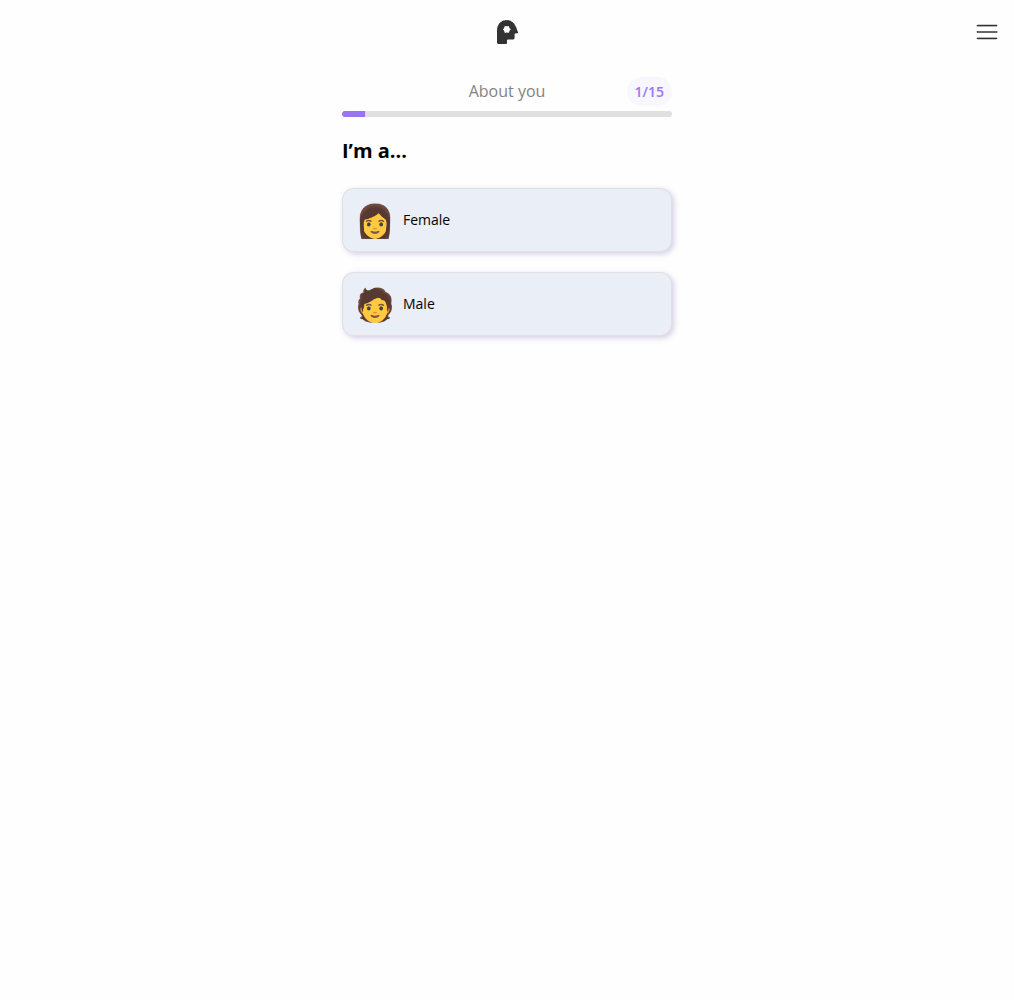 step 03 q01of15 gender
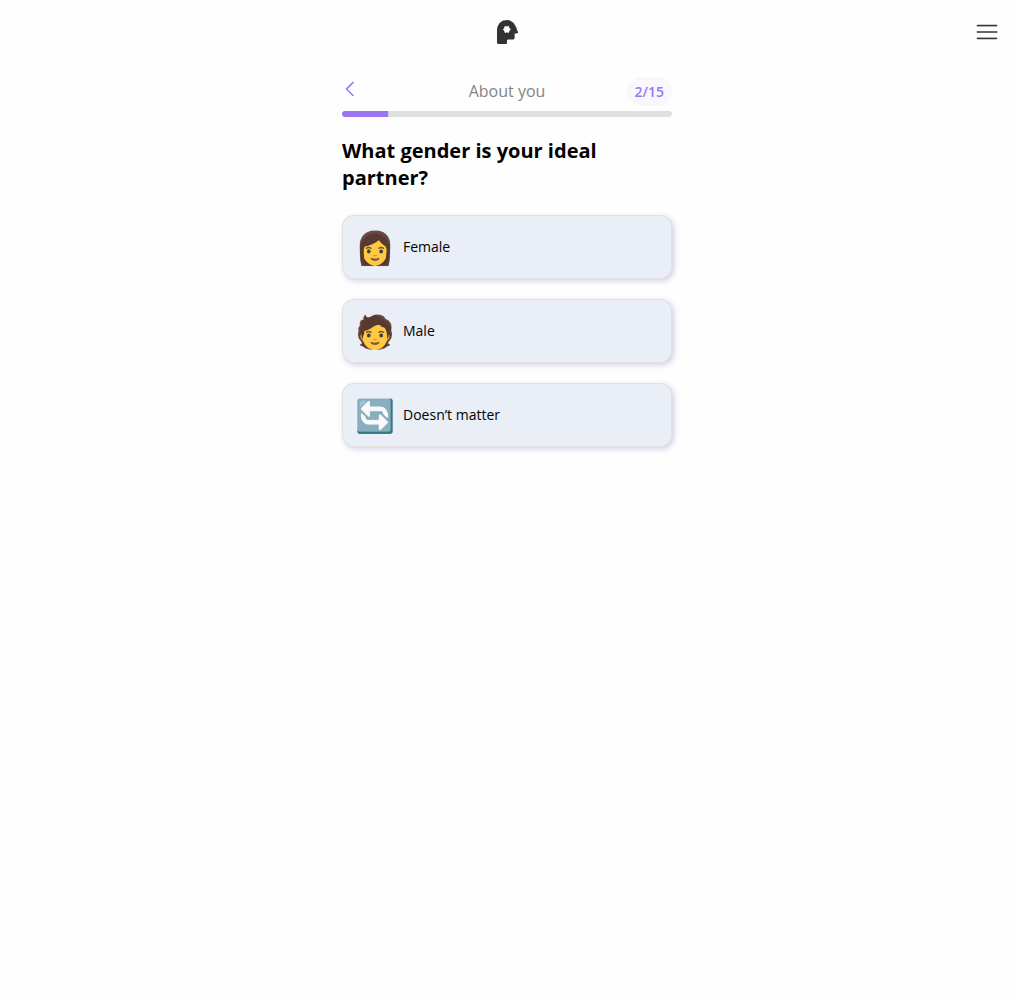 step 04 q02of15 partner gender
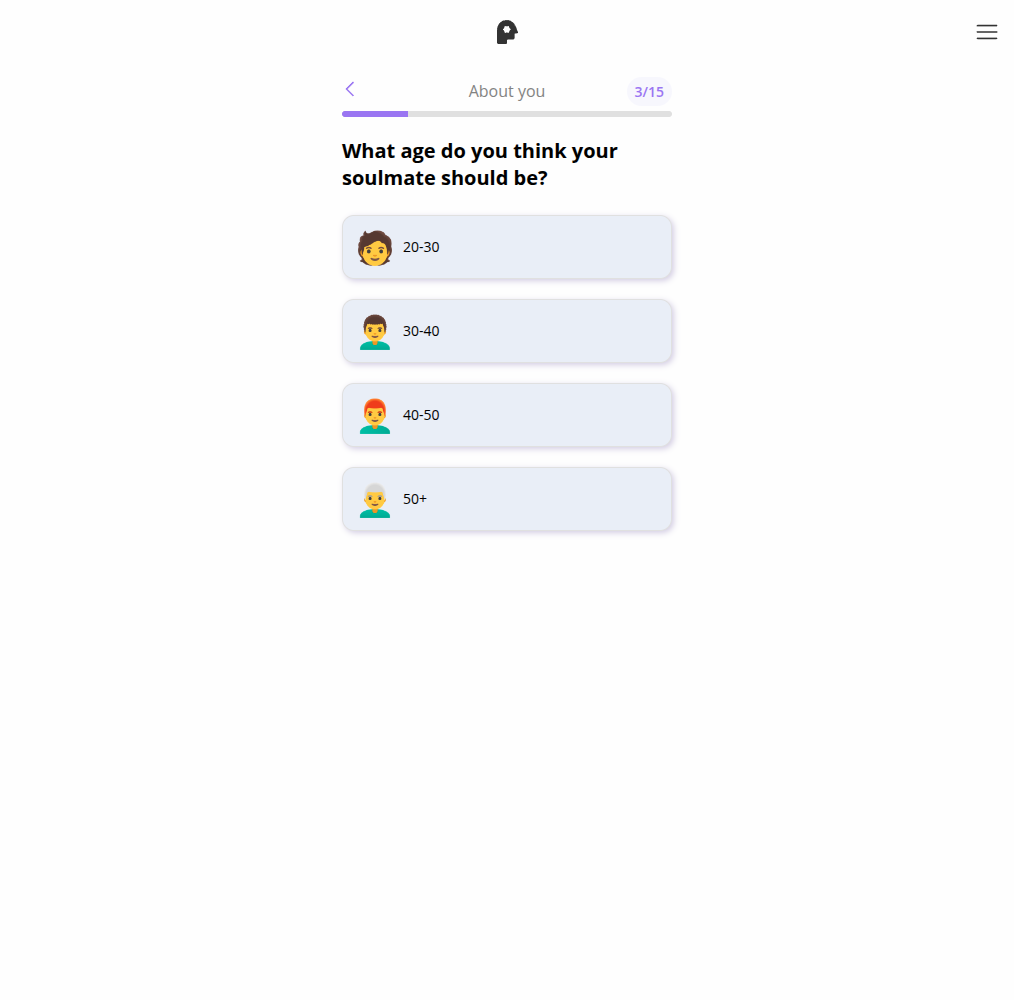 step 05 q03of15 partner age
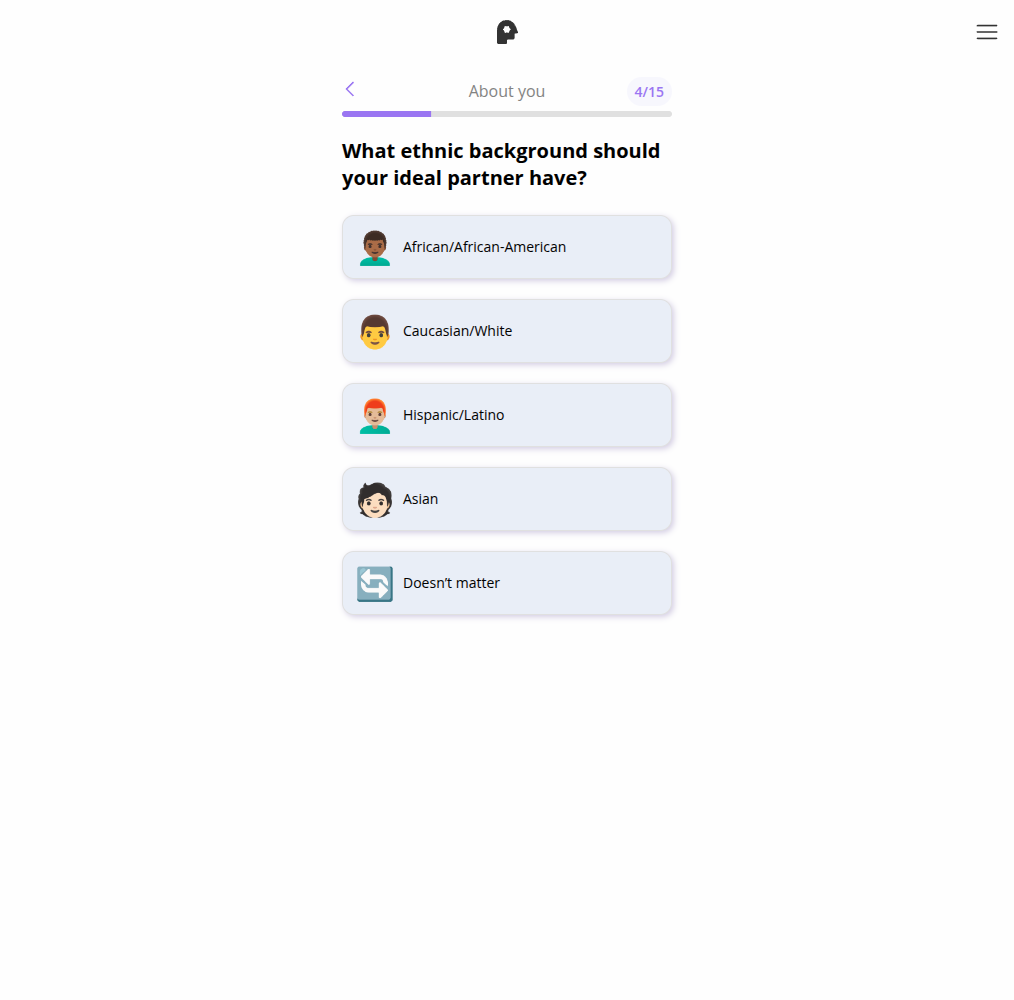 step 06 q04of15 ethnicity
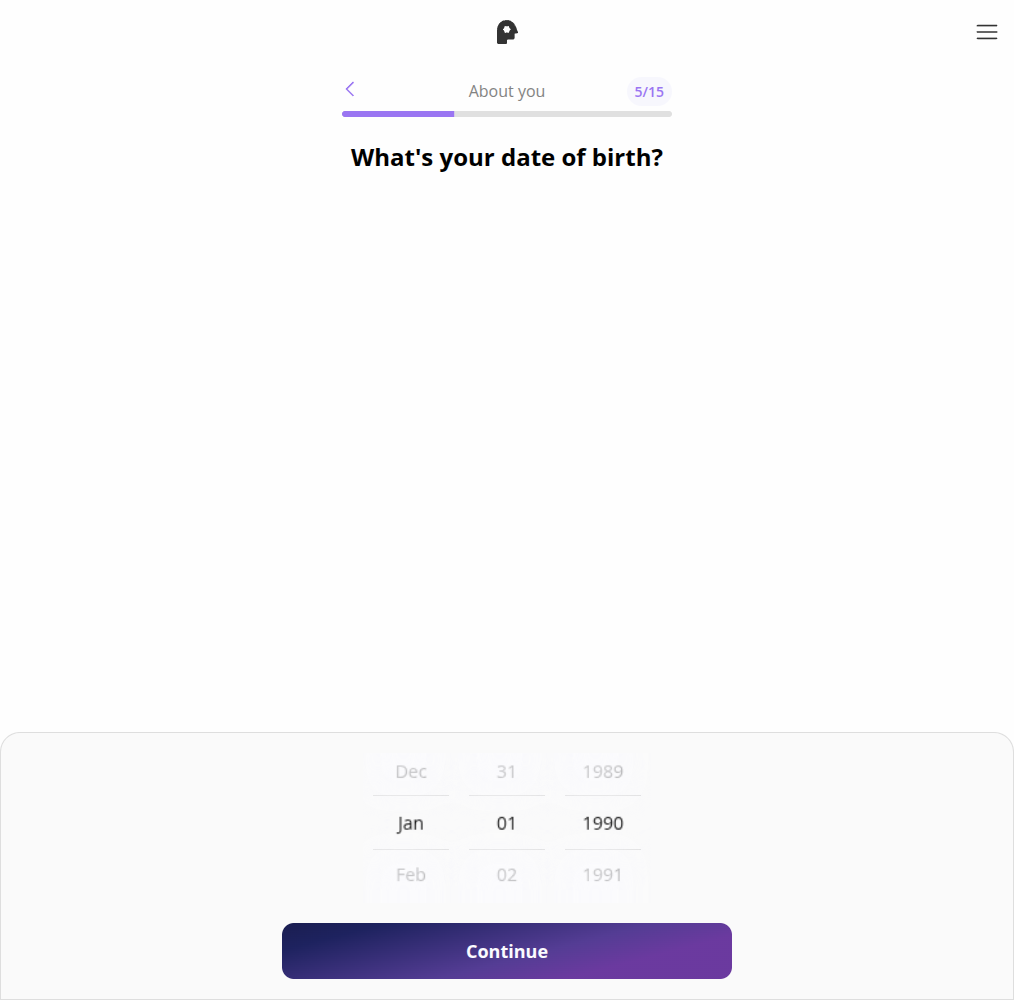 step 07 q05of15 dob picker initial
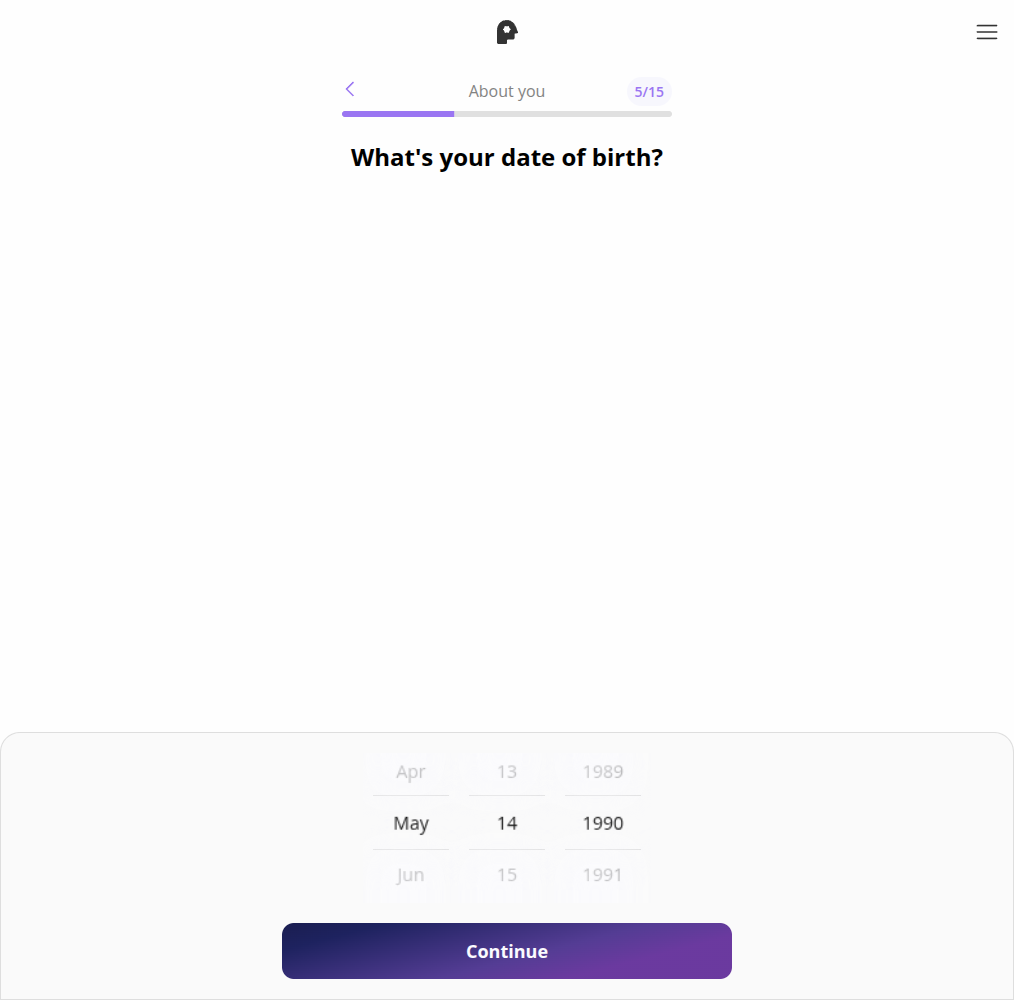 step 07 q05of15 dob set
 step 07b dob after drag test
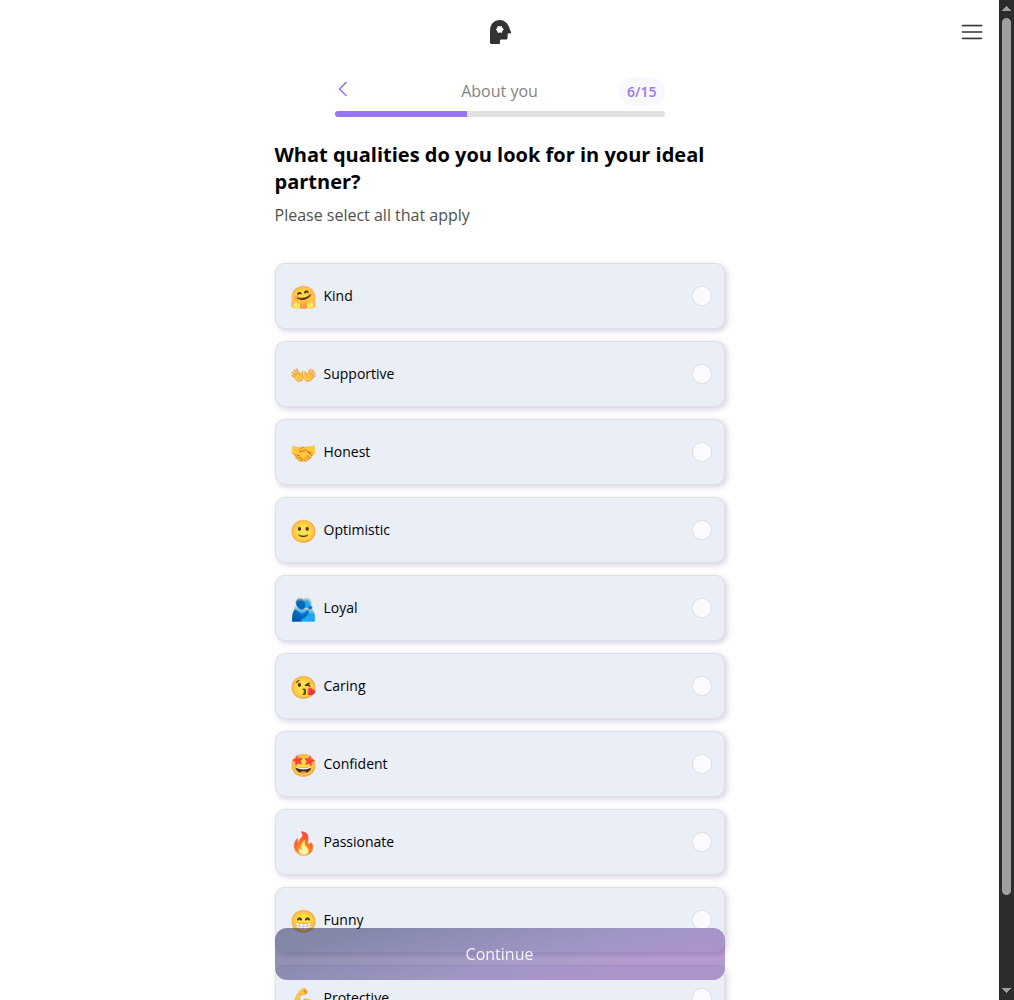 step 08 q06of15 qualities
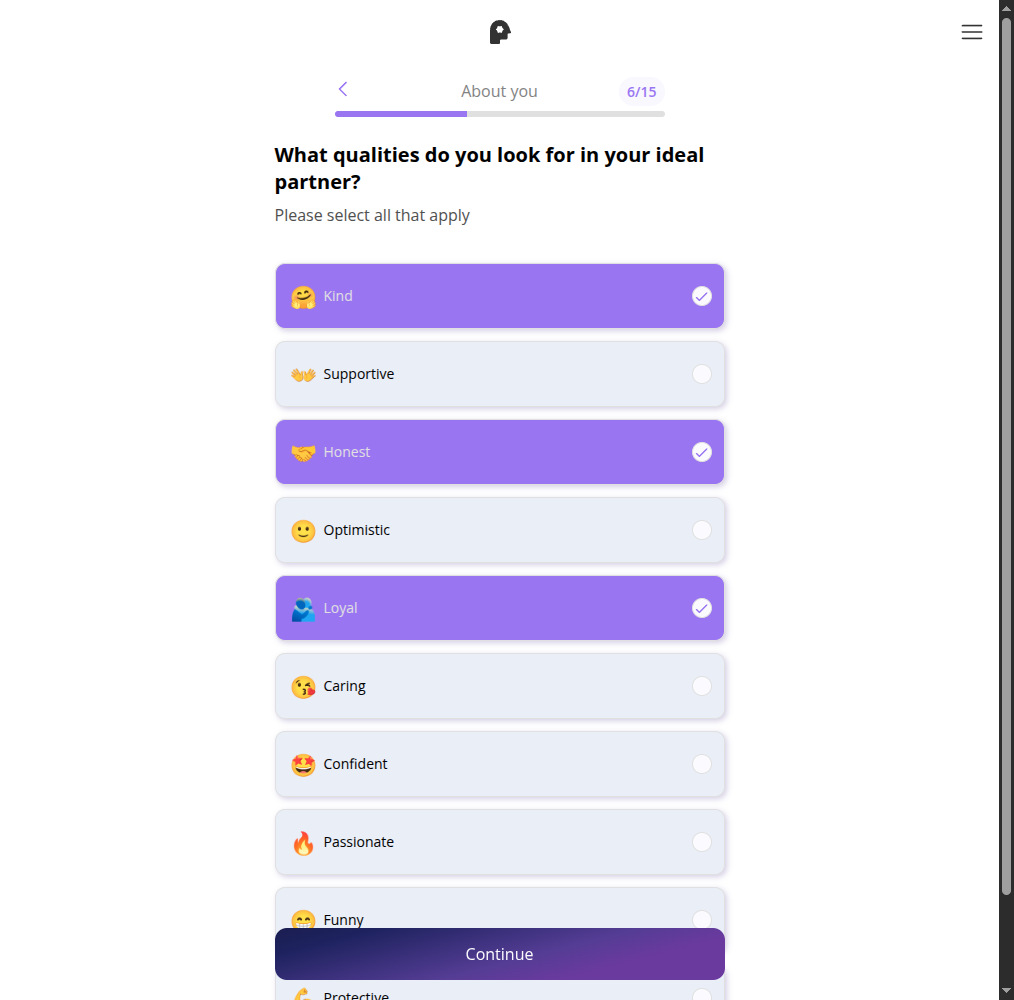 step 08b q06of15 qualities selected
 step 09 affirmation wellnoted
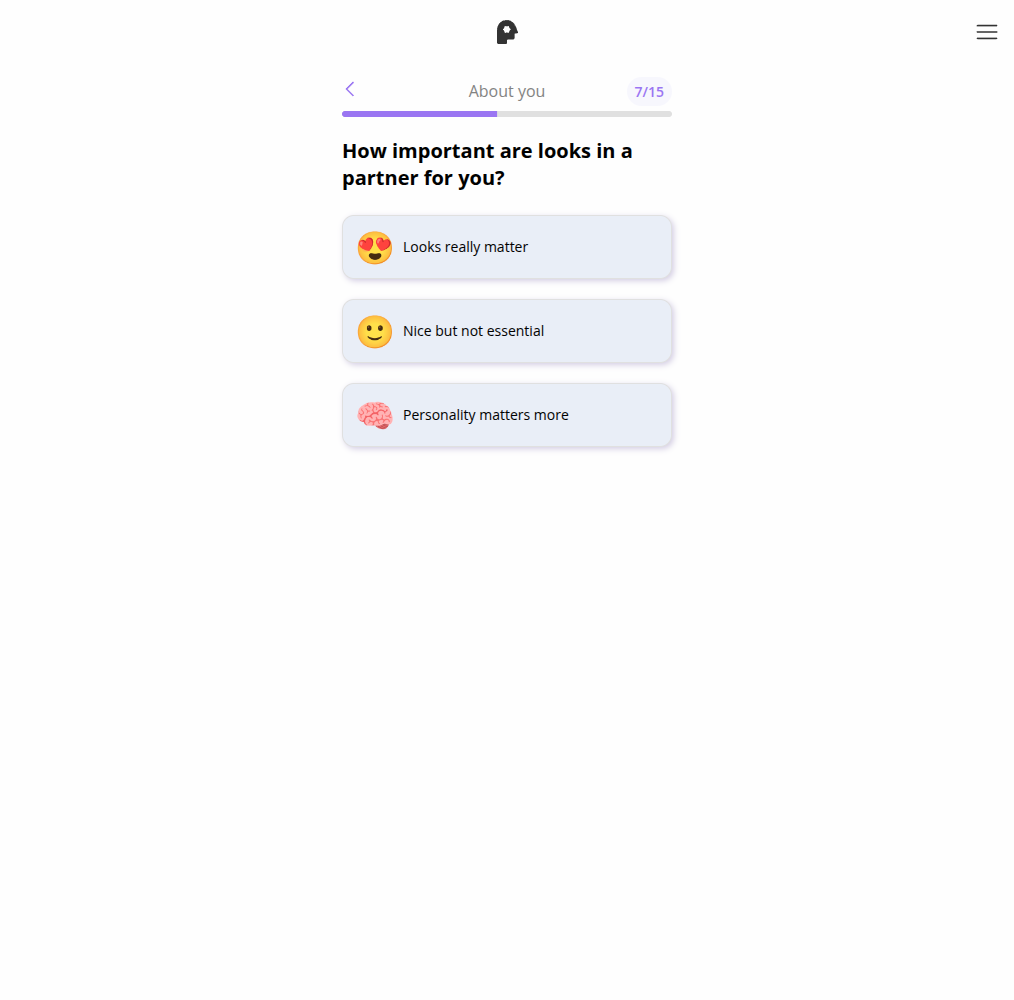 step 10 q07of15 looks importance
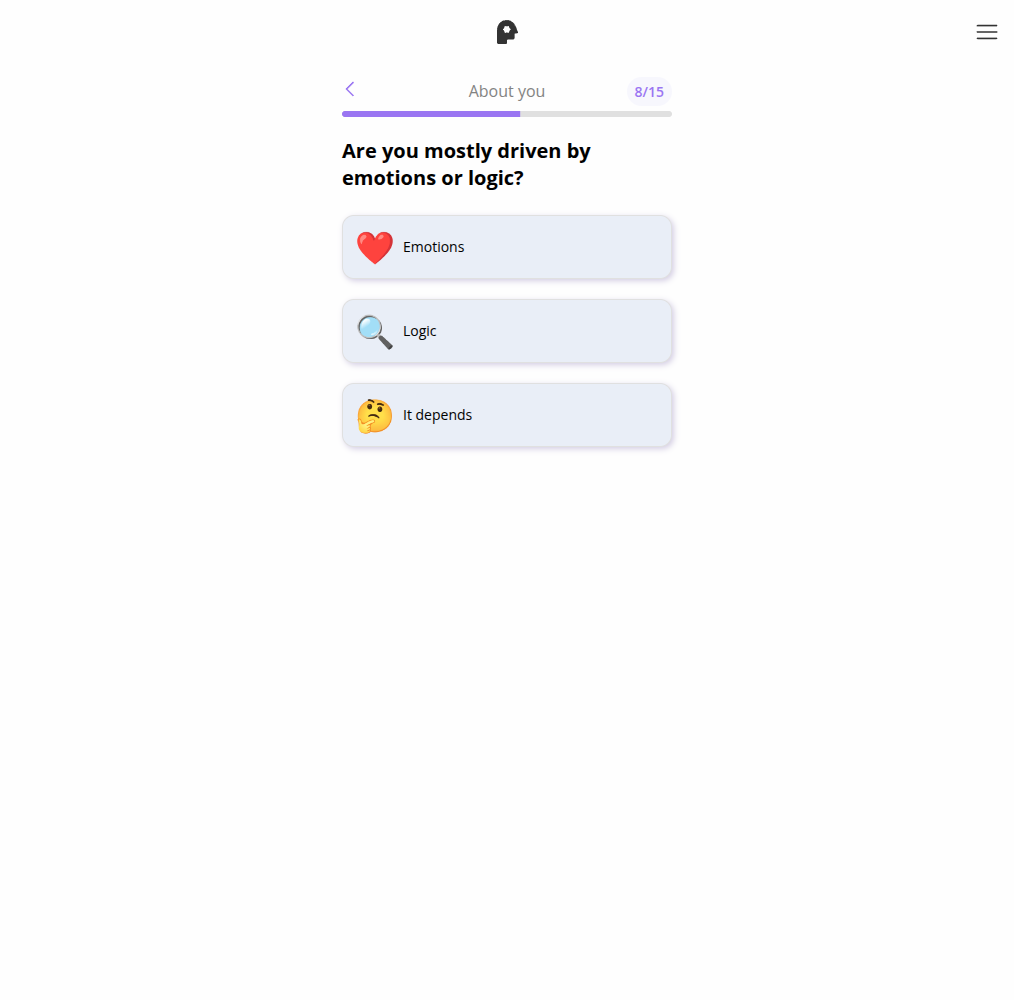 step 11 q08of15 emotions or logic
 step 12 affirmation balance
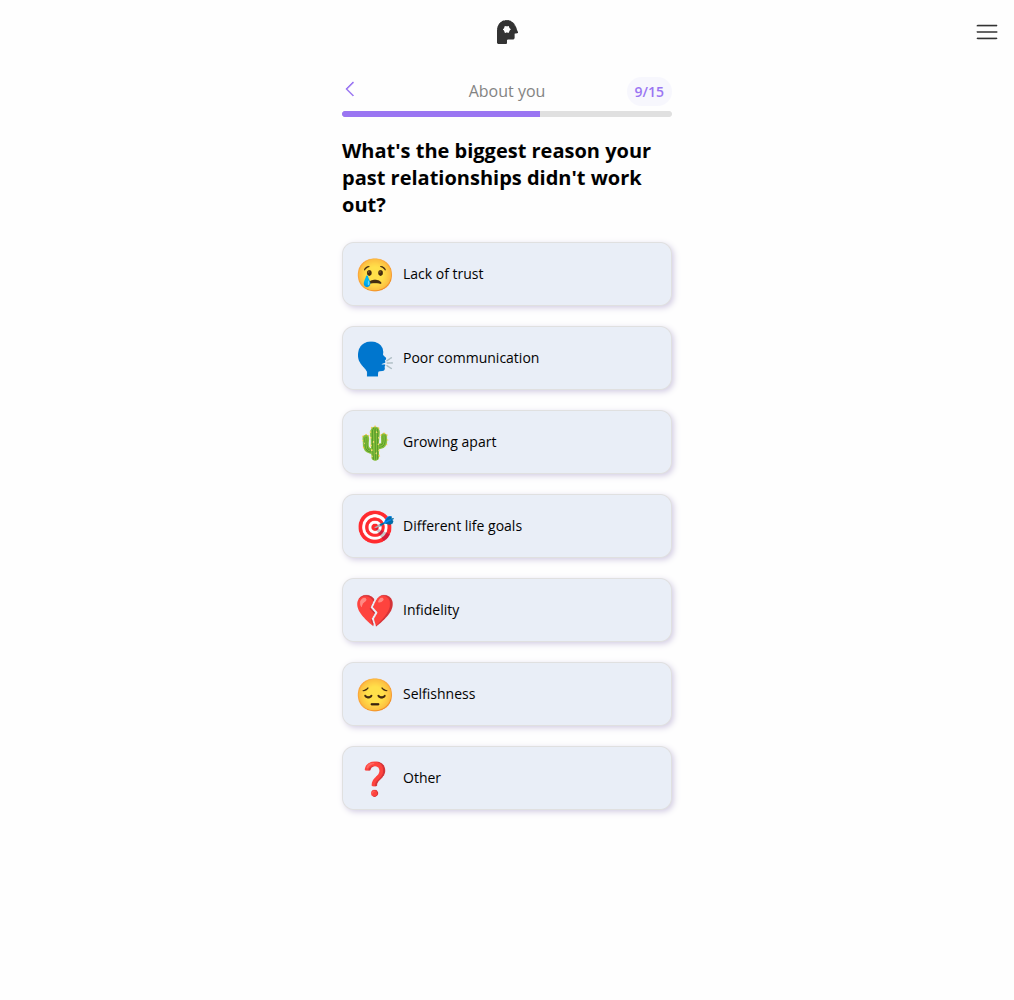 step 13 q09of15 why didnt work
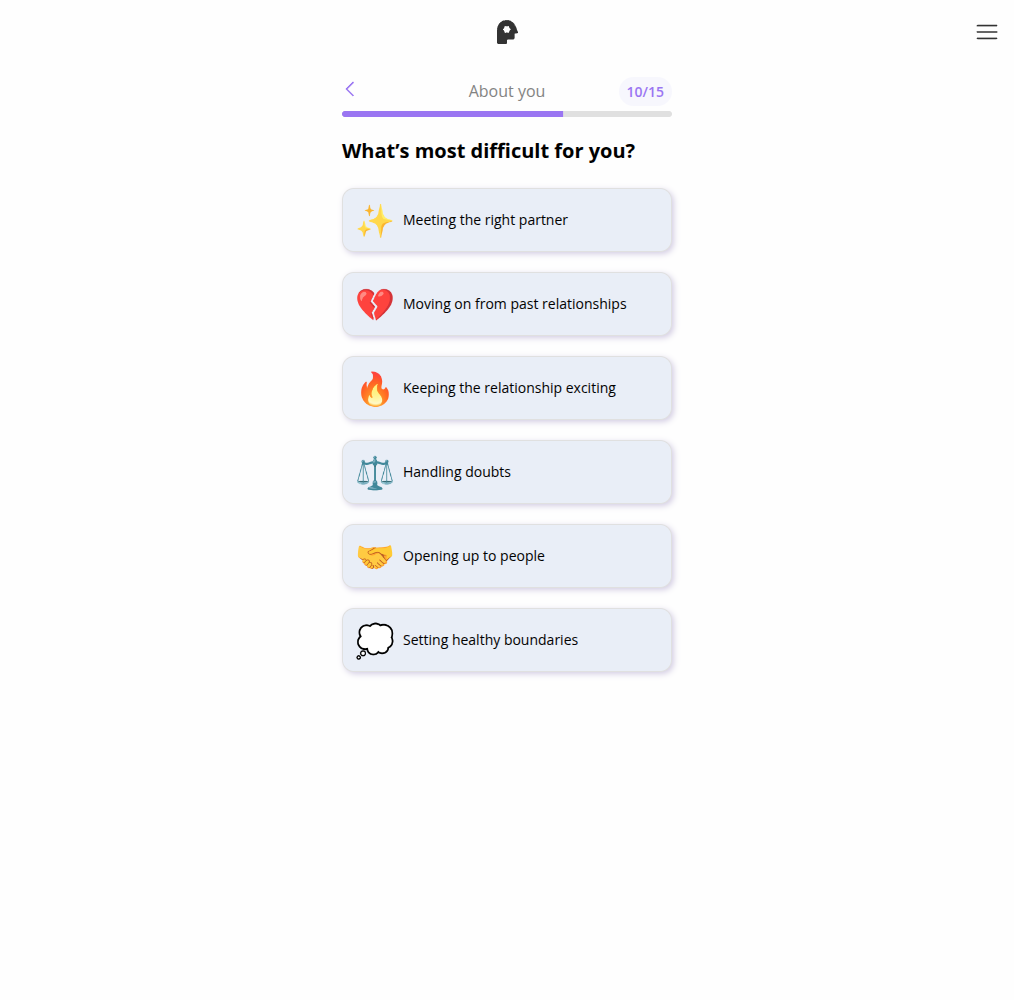 step 14 q10of15 most difficult
 step 15 affirmation struggle real
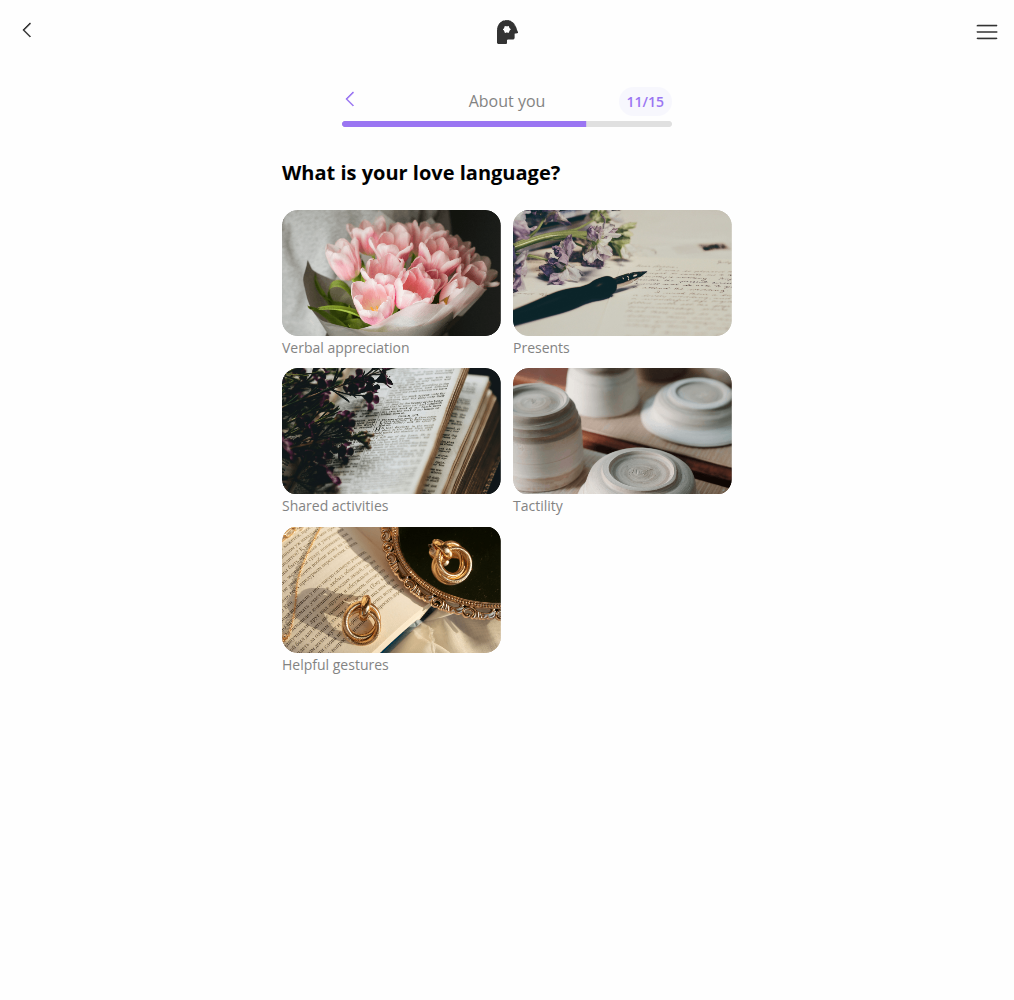 step 16 q11of15 love language
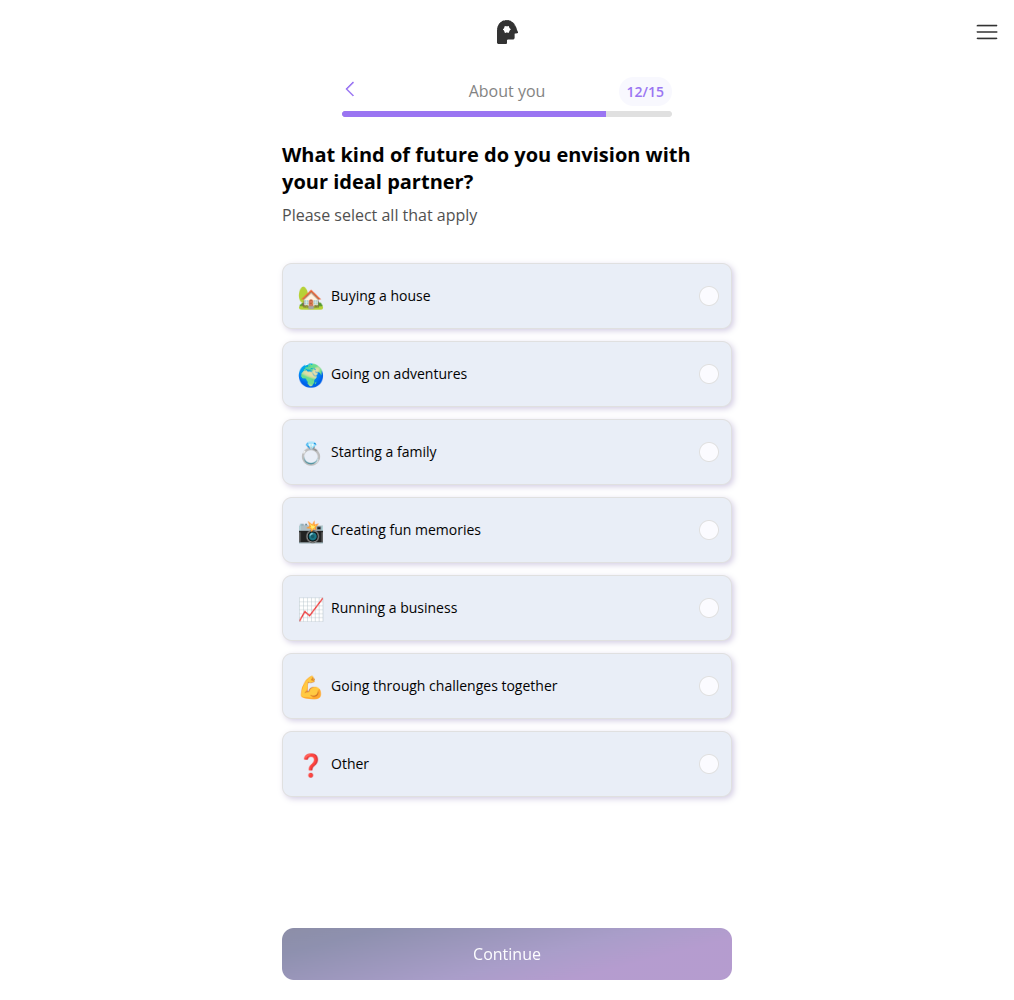 step 17 q12of15 future envision
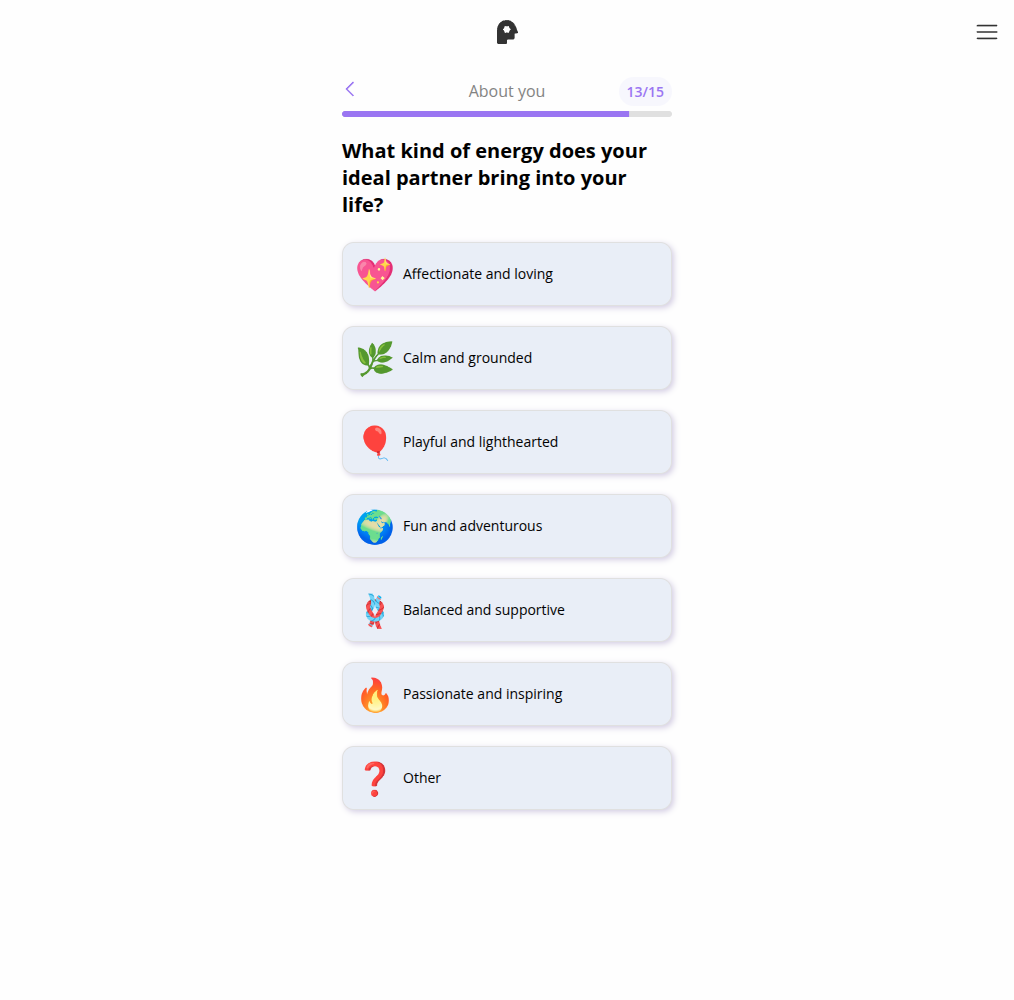 step 18 q13of15 energy
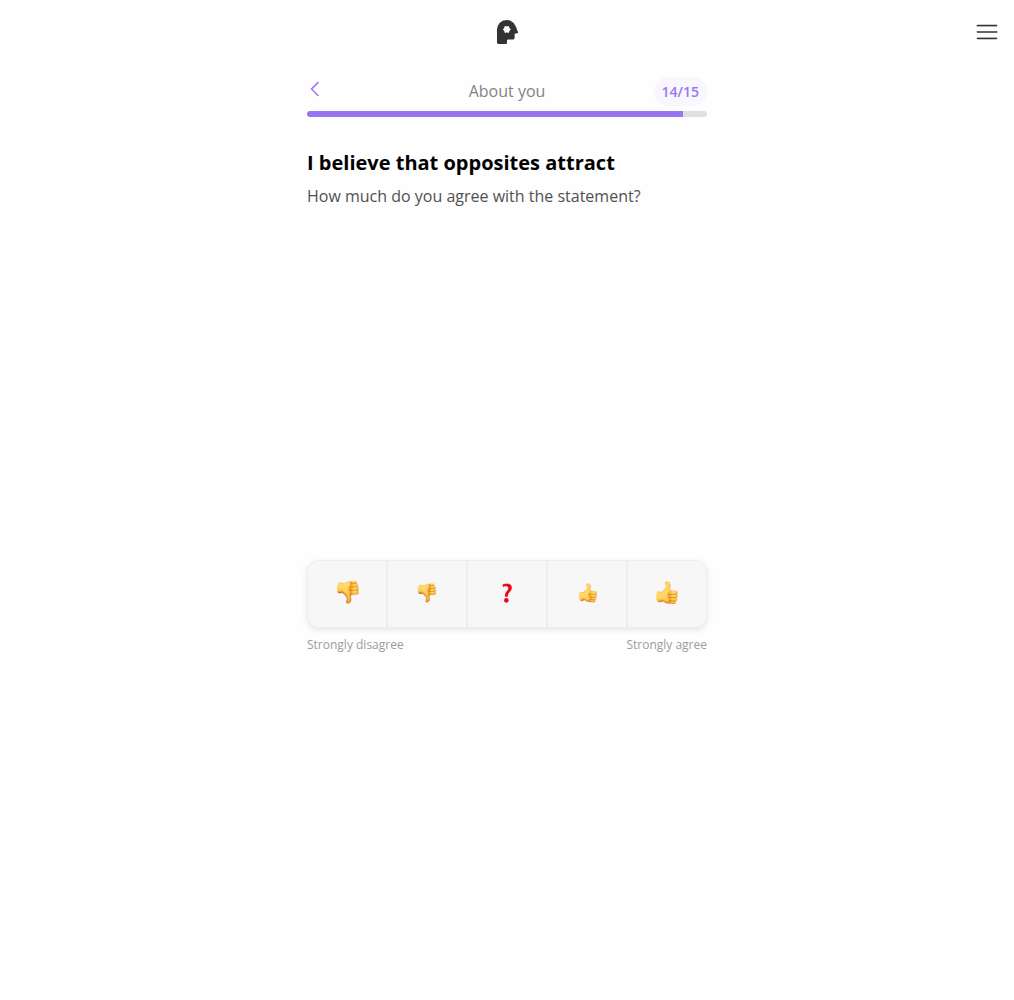 step 19 q14of15 opposites attract
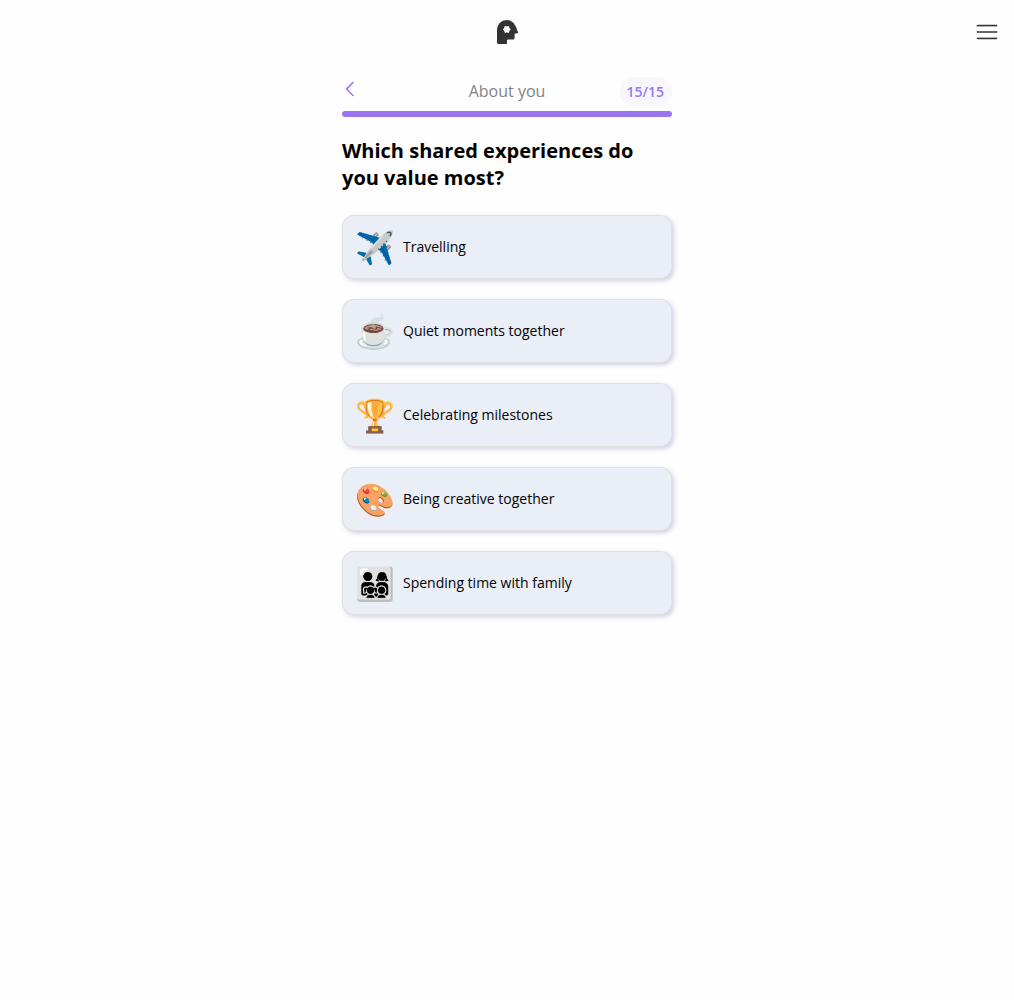 step 20 q15of15 shared experiences
 step 21 email capture
 step 21b email capture mediazip
 step 22 email mediazip rejected
 step 23 email marketing confirm
 step 24 loader onboarding
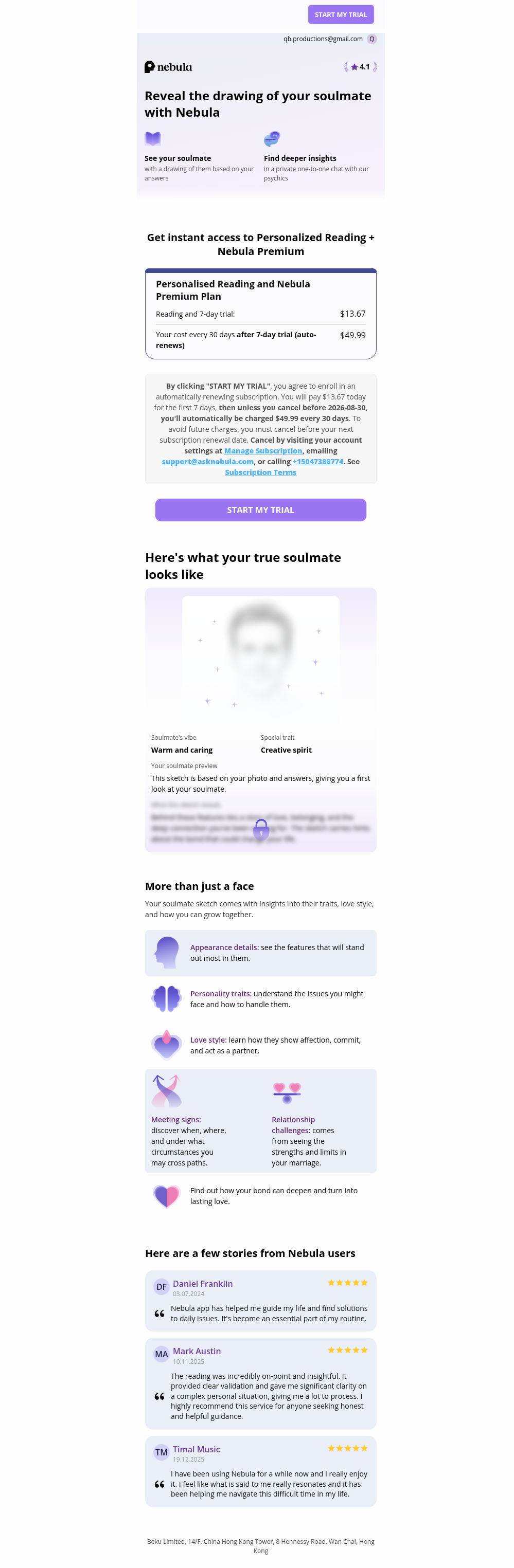 step 25 trialPayment full
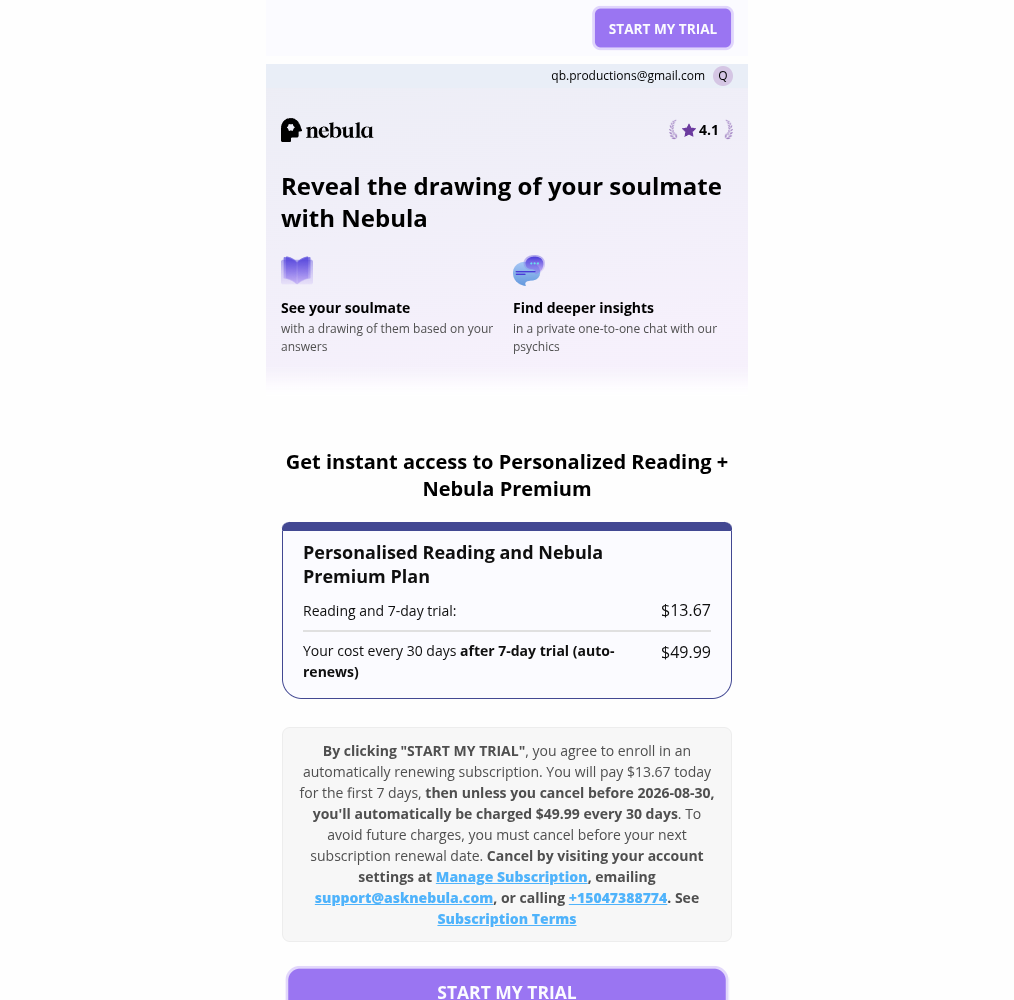 step 25b trialPayment viewport check
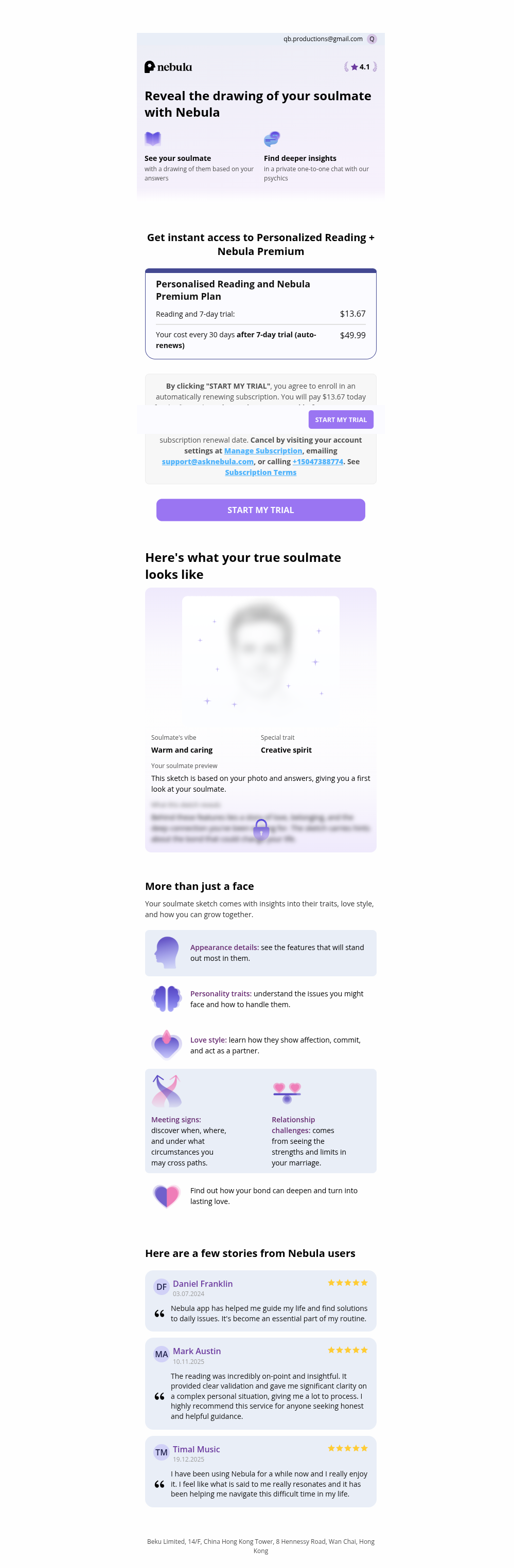 step 26 trialPayment 1440w full
Google Ads Transparency captures
6 screenshots · advertiser GM UNICORN CORPORATION LIMITED (~100K ads)Nebula is dark on Meta but running hard on Google. The evergreen static (creative CR02612393319258390529, last shown 2026-08-22) carries the headline “THIS WILL GIVE GOOSEBUMPS. I WILL DRAW THE PERSON YOU’LL MARRY” with a “TAKE TEST” button; the RSA search ads (“Find Love Written in Stars”, “Meet Your Soulmate Today”) land on appnebula.co/soulmate-sketch/prelanding.

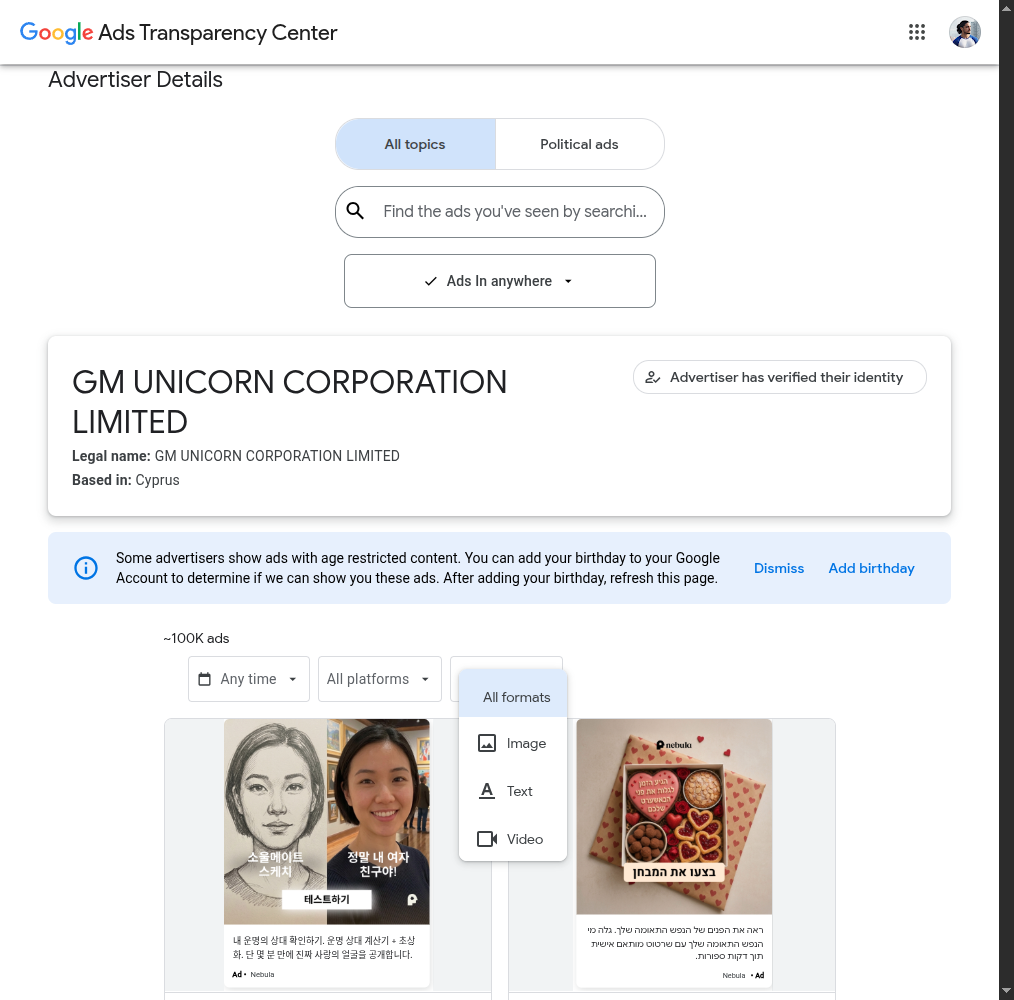
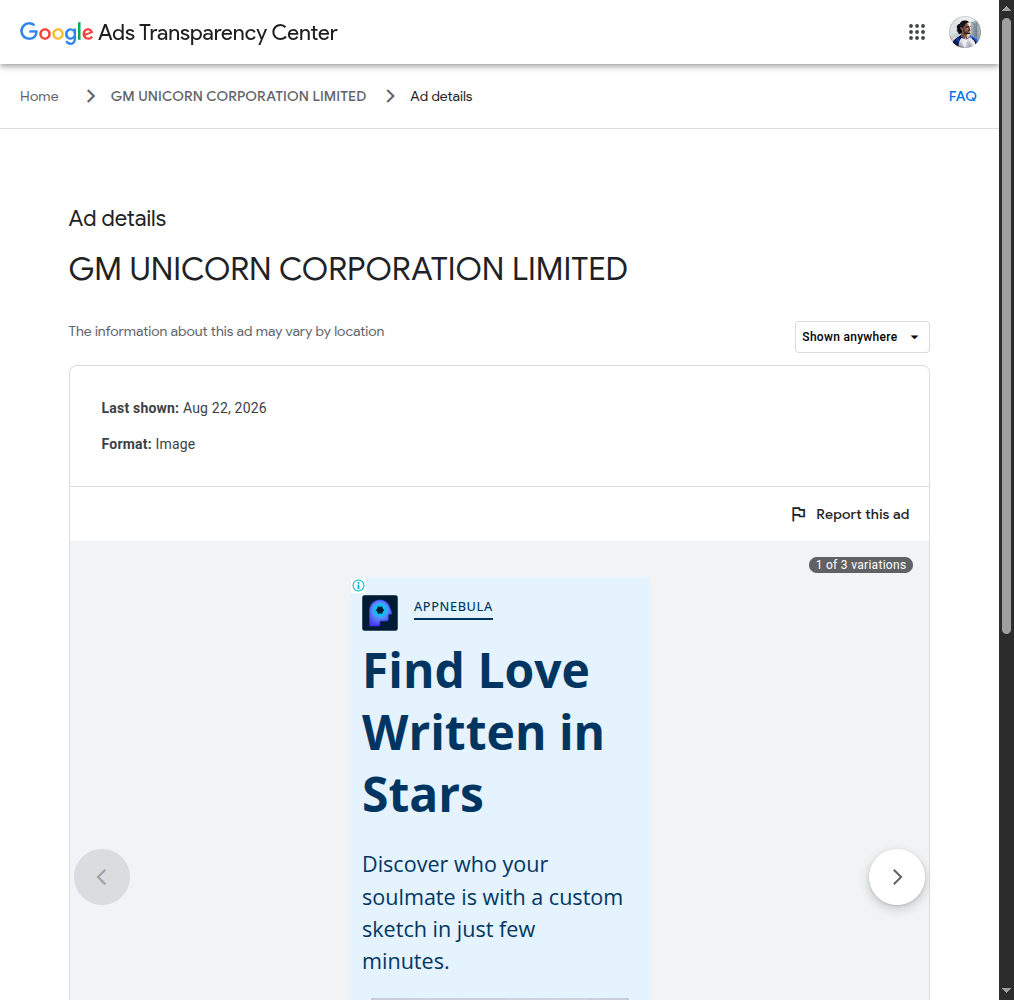
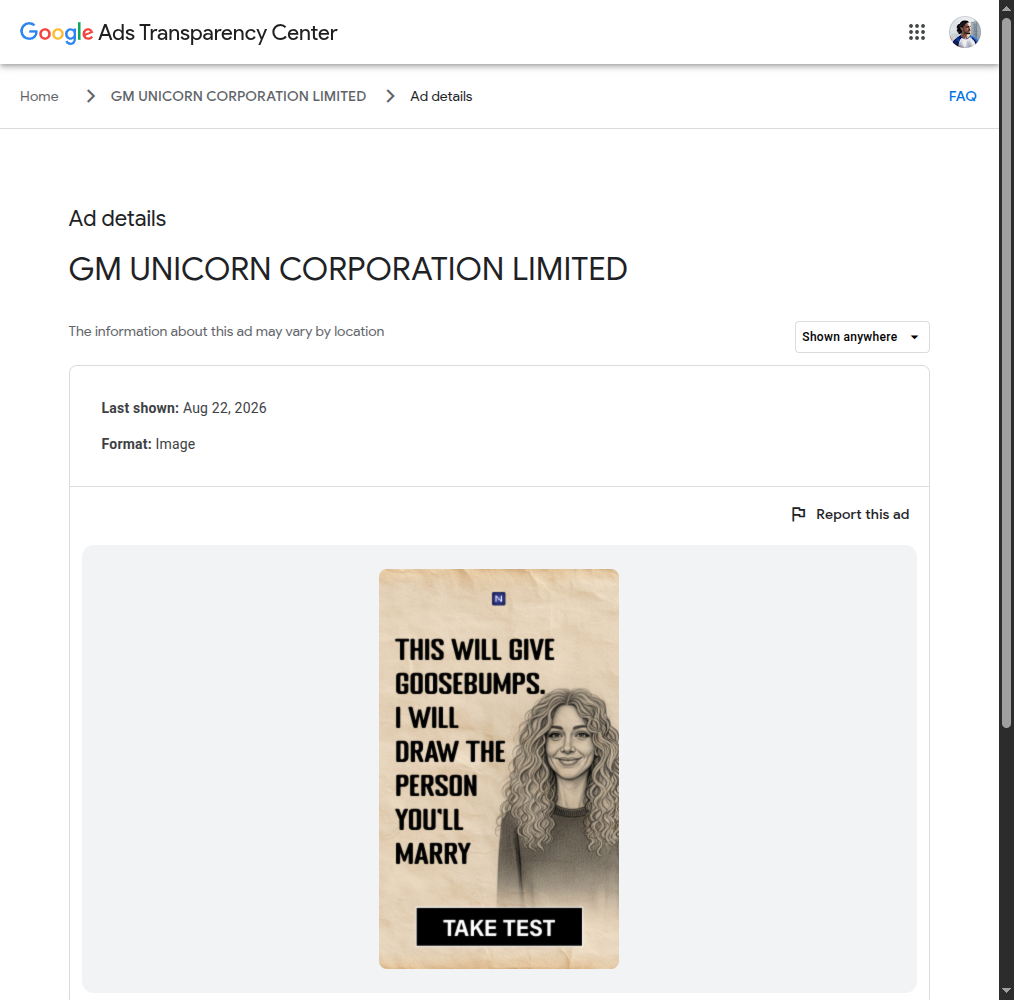
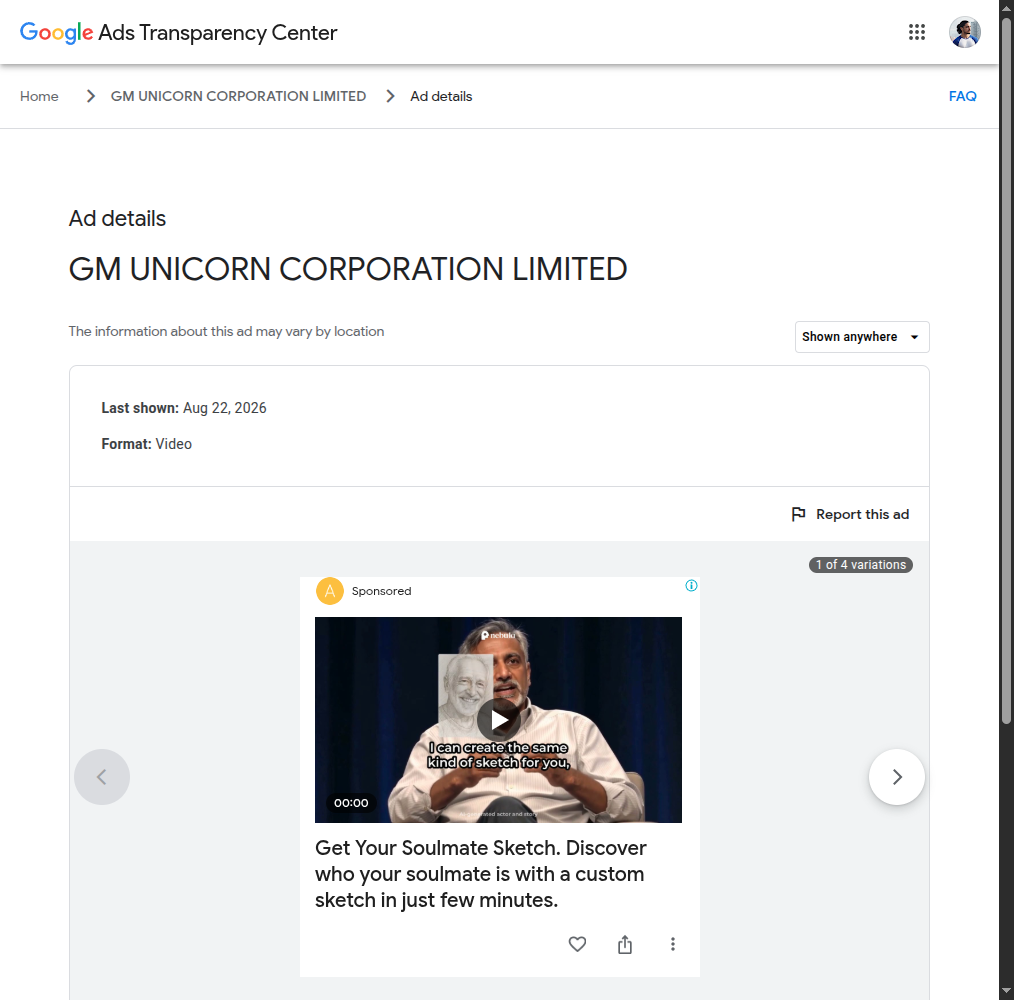
Lane 04 · captured 2026-08-23The App Layer — what Numina builds against
Verdict. The recurring revenue in this category lives in the app layer, and the leader’s app is thinner than its reputation. We got inside Nebula’s own product on a free account and walked it end to end, then pulled live App Store ratings and 67 store screenshots across nine apps. Nebula has no streaks, no gamification, no referral programme, no in-app content library, no reports catalogue and no pricing page. Its entire monetisation is one mechanic: a free birth chart that buys trust, followed by per-minute metered chat. The larger finding is the table below — satisfaction in this category tracks billing honesty, not feature count. The cleanest biller is the highest-rated app in the market, the operator that clawed back previously-free content is the lowest, and the revenue leader sits mid-pack despite the second-biggest install base.
Where satisfaction actually comes from
| App | Rating | Ratings (US) | IAP range (Play) | Model |
|---|---|---|---|---|
| CHANI | 4.92 | 57,446 | — | $11.99/mo flat subscription, human-written, markets itself as “AI-free” |
| Sanctuary | 4.80 | 44,122 | $19.99–$199.99 | $4.99 first 5 min, then per-minute readers ($7.99/min observed) |
| Co-Star | 4.79 | 205,561 | $0.99–$74.99 | Free core + premium reports, permanent SHOP tab |
| Purple Garden | 4.77 | 5,517 | $14.99–$35.99 | Per-minute psychics |
| AstroTalk | 4.74 | 17,797 | $3.49–$79.99 | Per-minute astrologer marketplace |
| Moonly | 4.64 | 31,387 | — | Subscription |
| Faladdin | 4.59 | 89,674 | $0.99–$149.99 | Subscription + credits |
| Nebula | 4.57 | 170,590 | $0.99–$299.99 | Credits + per-minute meter + auto-refill |
| The Pattern | 3.99 | 14,808 | $8.99–$83.99 | Subscription; paywalled previously-free audio |
US App Store ratings via the iTunes lookup API, 2026-08-23. In-app-purchase ranges from the Google Play listings the same day. Note Nebula’s $299.99 ceiling — the category monetises whales through large credit packs.
“AI-free” is a live selling proposition. The highest-rated app in the category puts “The #1 AI-free astrology app” on its store listing. We cannot claim it and must never imply a human is answering live. The counter is not to fight on that axis: CHANI’s quality is authored but sign-level generic — one daily horoscope per sign, nothing about her actual situation. Nebula personalises deeply but ships junk quality on abusive billing. The open position is authored voice + true individual personalisation + clean billing, and nobody occupies it. The hard requirement that follows: our generated readings must read like CHANI prose, never like a horoscope widget.
Inside Nebula’s app — logged-in walkthrough
30 screenshots · free account, no payment madeSignup through to the paywall, captured on a free account. The flow: four onboarding steps with no paywall at all, then a free zodiac profile (Sun, Moon, Ascendant, element, lucky numbers, affirmation) that exists purely to buy trust; the first paywall is metered, not step-gated — three free minutes on any advisor, then 40–50 credits per minute. A zero-credit account is offered exactly one SKU: “Welcome pack — 160 credits — $15.99 → $2.99”, checked out through a Solidgate iframe with no recurring-terms disclosure on the screen (auto-refill lives in a separate settings tab). When free time expires a 59-second countdown modal fires. Shot 17 is their fraud hard-stop delivered in-character as a message from the “psychic” — a pattern we will not copy.
 01 signup name
 02 signup dob
 03 forgot password sent
 04 experts home
 05 settings active offers
 06 paywall refill credits modal
 07 settings personal info
 08 settings auto refill
 09 settings notifications
 10 all psychics list
 11 advisor detail liam
 12 chat surface preintro
 13 chat connecting
 14 chat timer running
 15 chat first reply
 16 chat free time expired disabled input
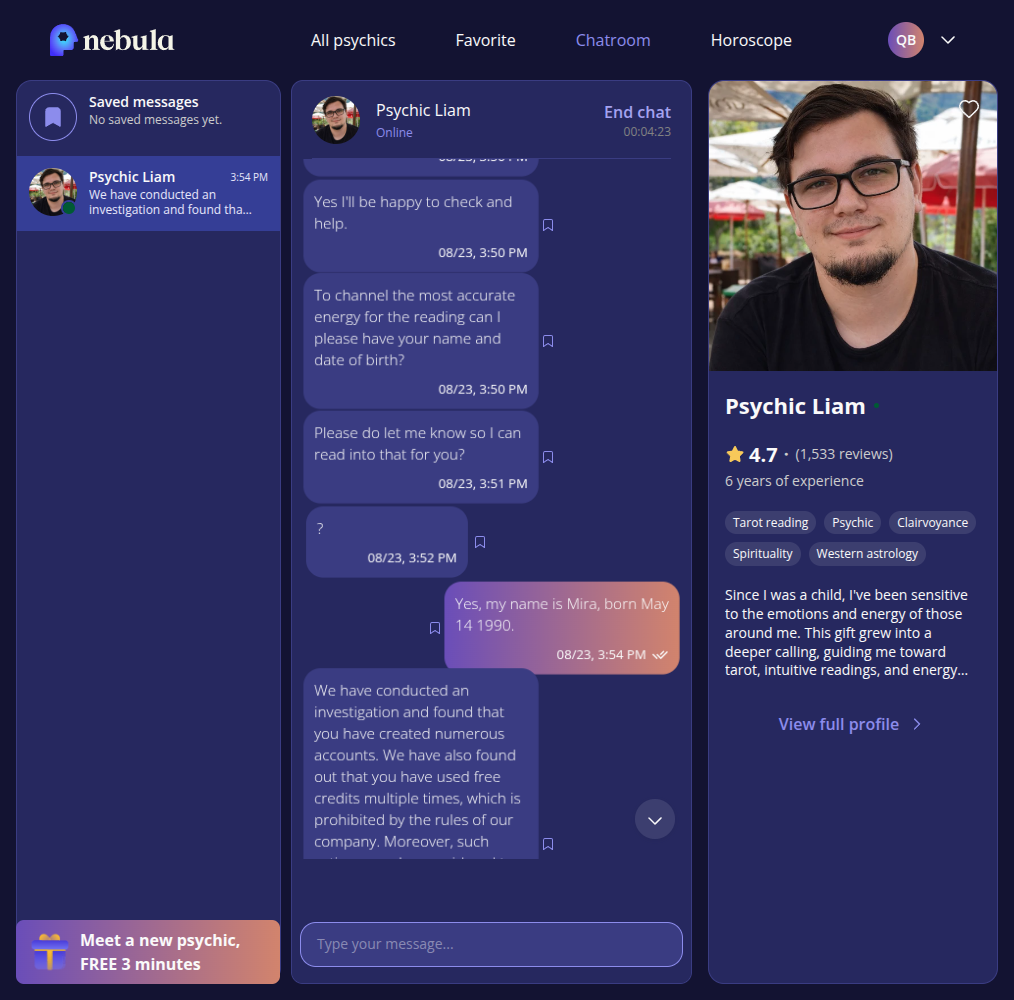 17 chat fraud detection hardstop
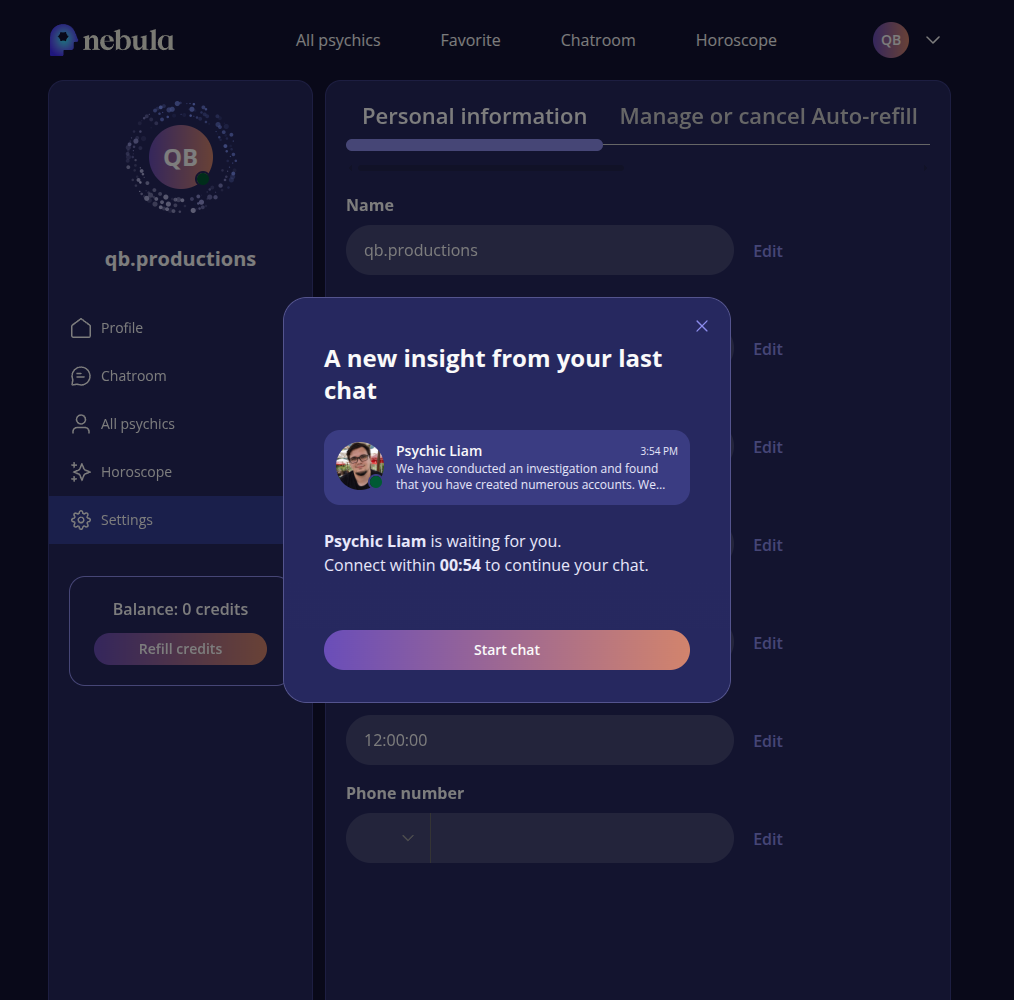 18 urgency countdown modal
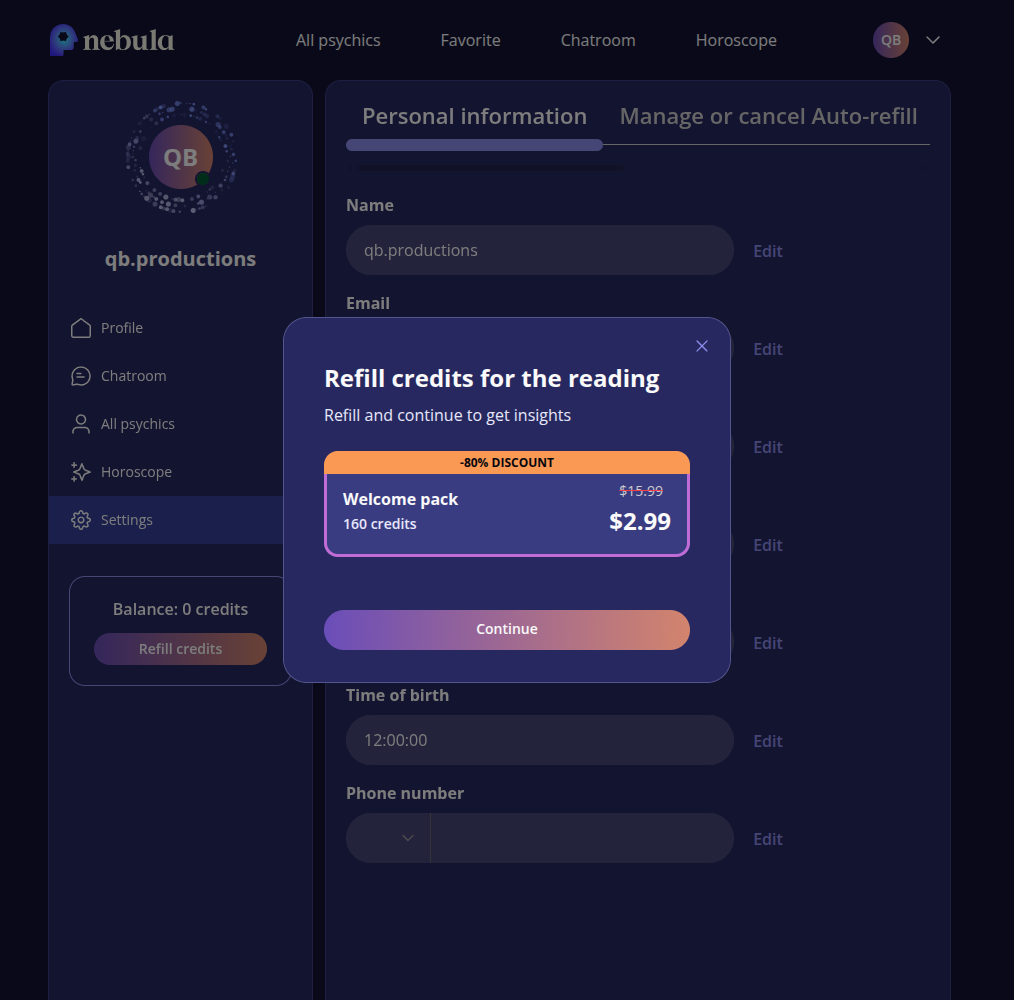 19 refill credits pack select
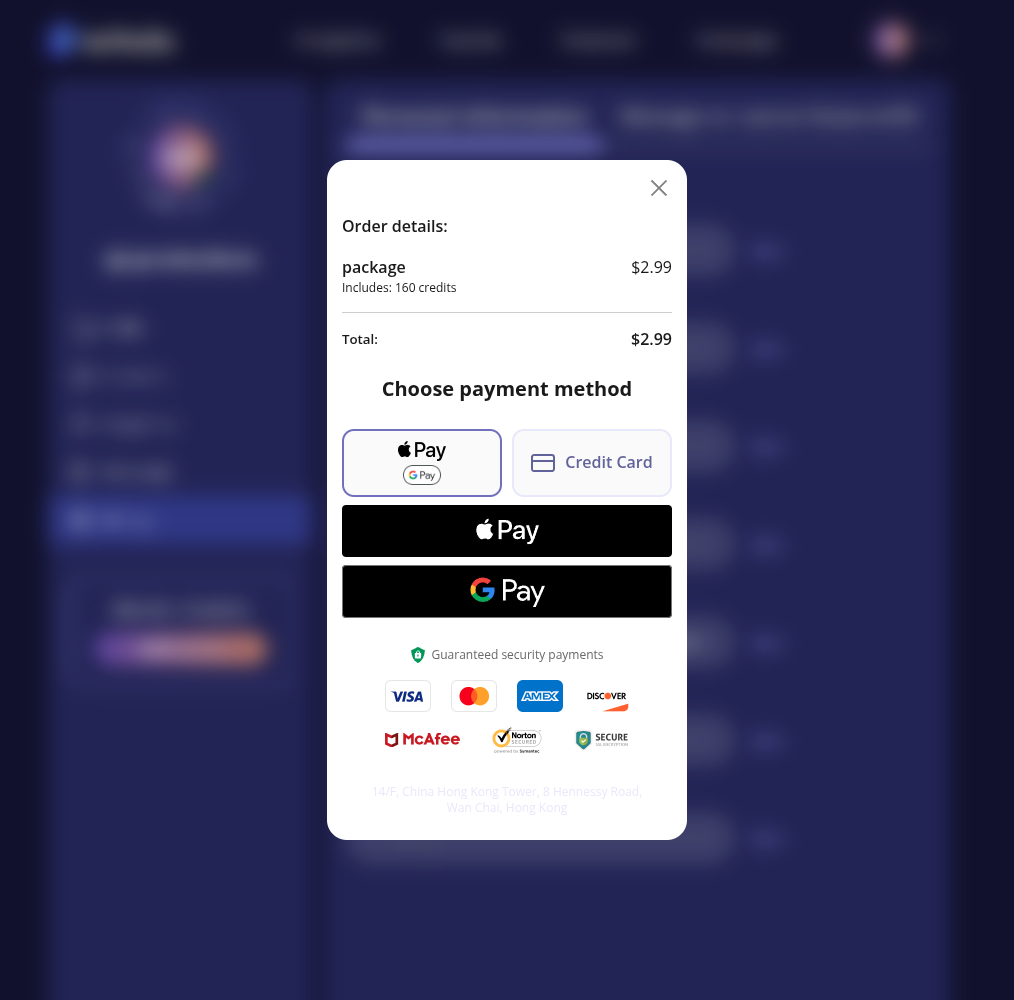 20 checkout payment method wallet
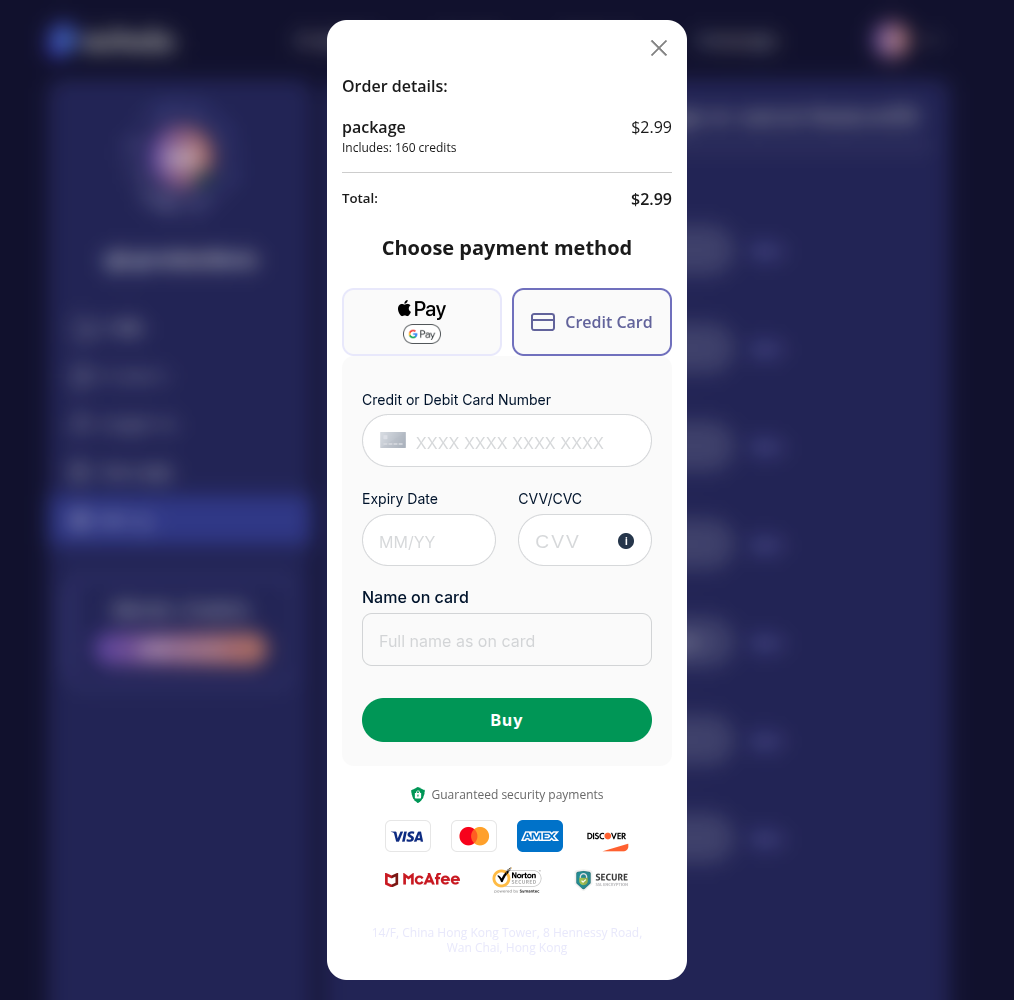 21 checkout credit card form
 22 horoscope daily today
 23 horoscope year tab free
 24 profile zodiac personalization
 25 favorite empty
 26 avatar dropdown menu
 27 faq expanded experts page
 28 notification special offers detail
 29 settings legal tab
 30 manage personal data delete
CHANI
8 screenshots · App Store listing · 4.92★ on 57,446 US ratings4.92★. Five tabs: HOME / GROW / ME / TRANSITS / AUDIO. Time-horizon segmentation (TODAY / THIS WEEK / THIS YEAR), a 15-minute weekly audio reading, a 28-day course, date-ranged forecast windows, and a store screenshot devoted entirely to its push-notification voice.
 01 birthchart ai free badge
 02 libra rising placement
 03 home daily horoscope tabs
 04 grow 28day course
 05 weekly audio journal meditation
 06 transits forecast windows
 shot 07
 08 push notification stack
Co-Star
5 screenshots · App Store listing · 4.79★ on 205,561 US ratings4.79★ on 206K ratings. Editorial monochrome, blunt one-line daily verdict, a hyper-specific Do / Don’t list, a real friends social graph with per-category compatibility, and commerce as a permanent tab.
Nebula — store listing
8 screenshots · App Store listing · 4.57★ on 170,590 US ratings4.57★. Blue-violet gradient and glossy 3D icons — the weakest identity of the top three. Note the “Your Compatibility Reading is ready” reveal, their re-engagement pattern.
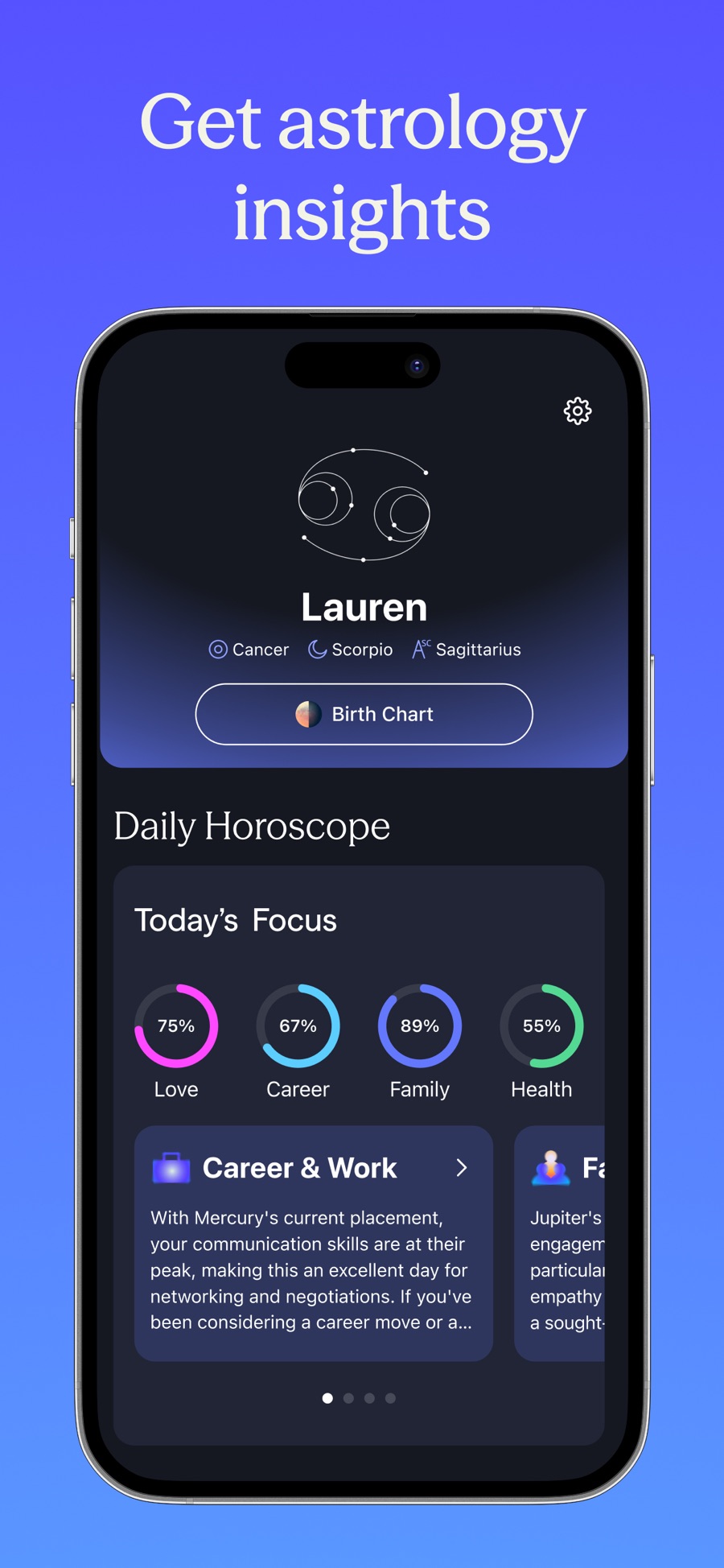
Sanctuary
5 screenshots · App Store listing · 4.80★ on 44,122 US ratings4.80★. The strongest per-minute advisor UX: “$4.99 for 5 minutes, a $25+ value” trial banner, reader cards carrying tenure and volume stats (readings delivered, year joined), twin Chat / Call CTAs.
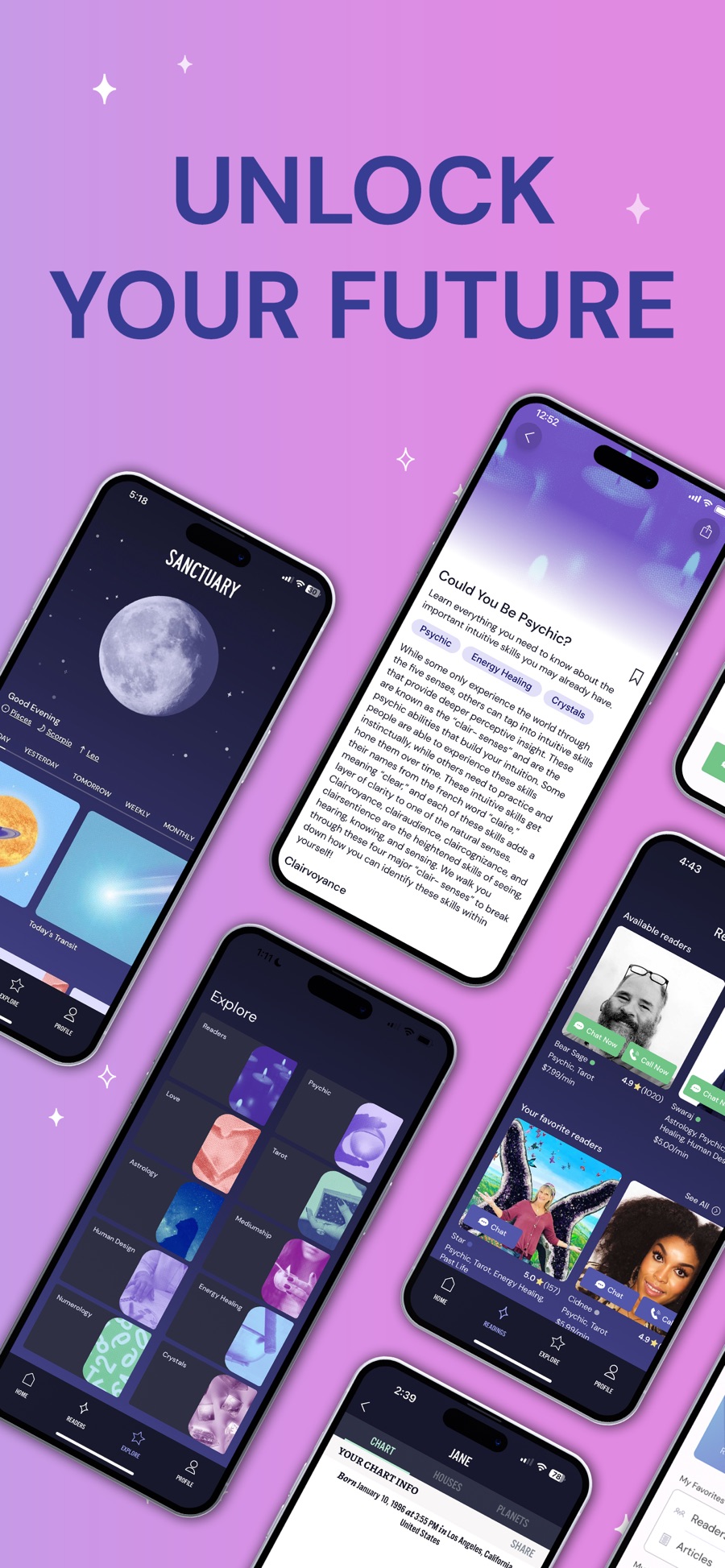
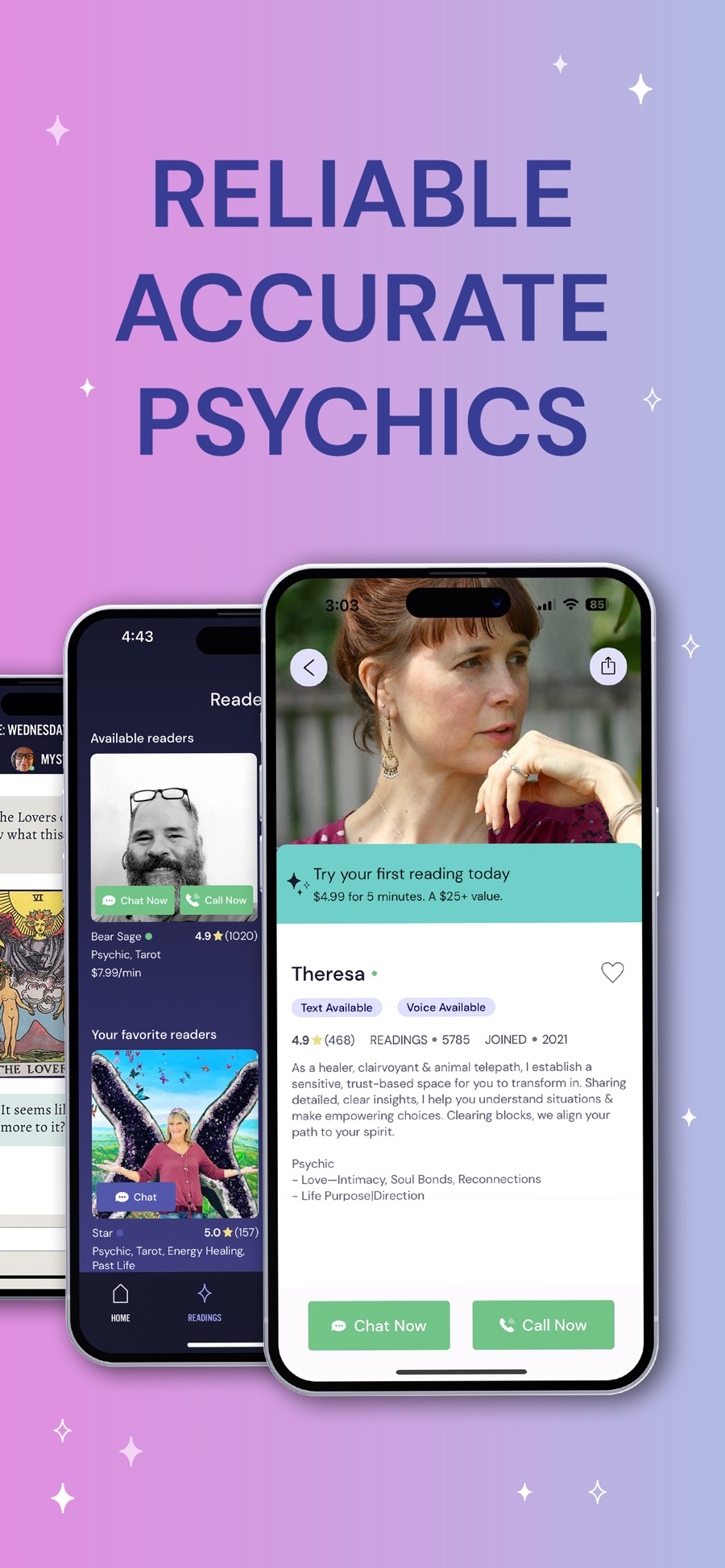
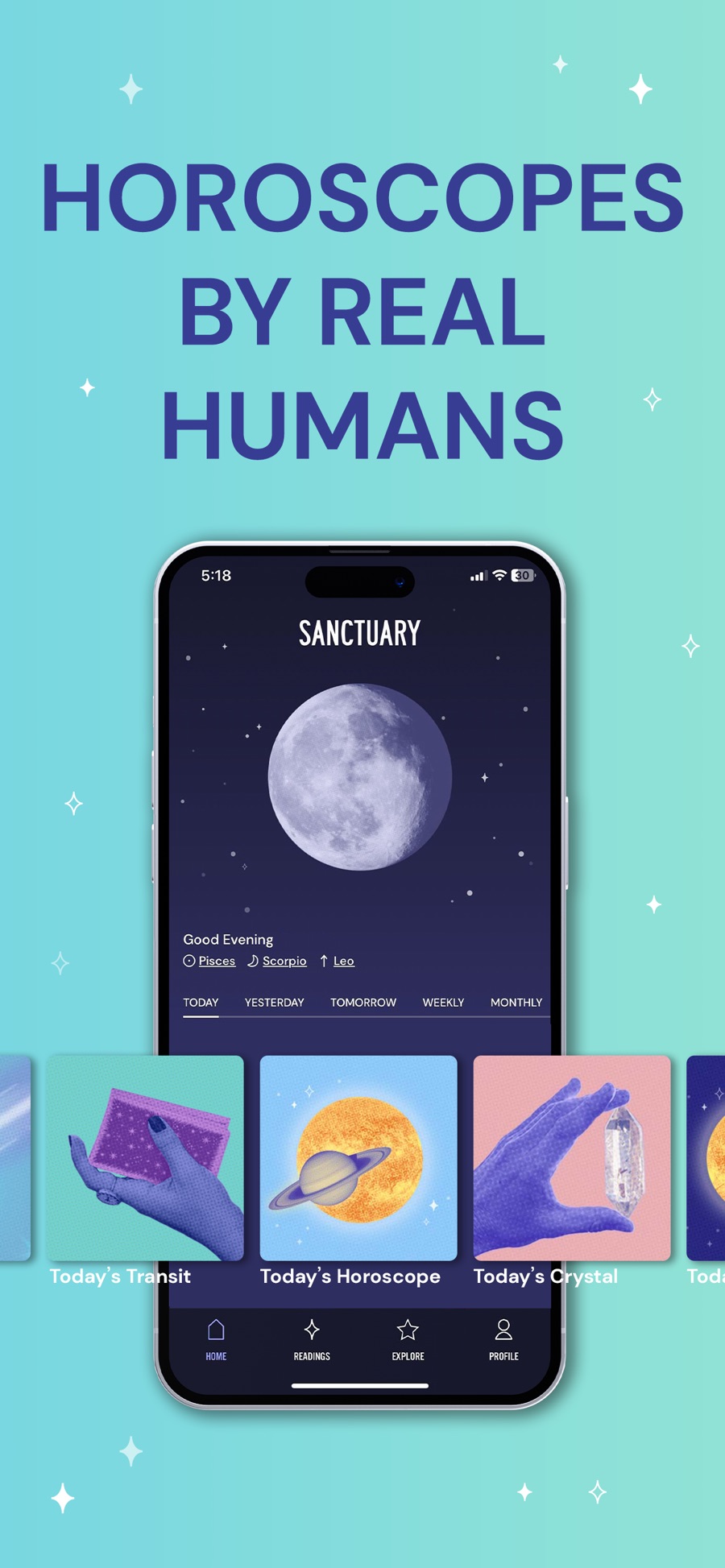
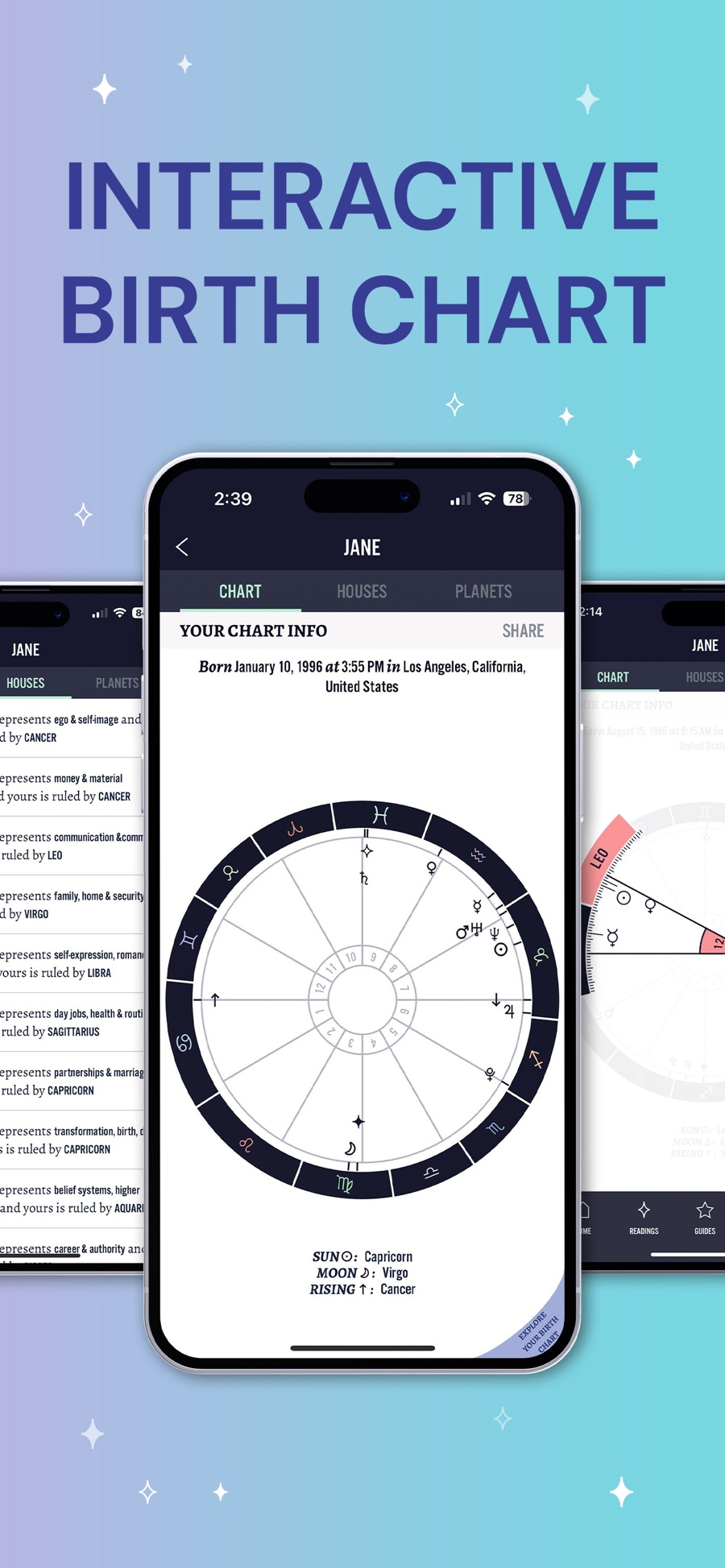
The Pattern
8 screenshots · App Store listing · 3.99★ on 14,808 US ratings3.99★ — the cautionary tale. Clean black-and-sans compatibility flow resolving to a SOULMATE verdict, but the rating fell after previously-free audio went behind a paywall.


Moonly
10 screenshots · App Store listing · 4.64★ on 31,387 US ratings4.64★. Moon-phase calendar as the daily spine, with a “Daily Activity” matrix rating today across twelve life areas.






AstroTalk
7 screenshots · App Store listing · 4.74★ on 17,797 US ratings4.74★. Live-astrologer marketplace at the largest scale in the category.

Purple Garden
8 screenshots · App Store listing · 4.77★ on 5,517 US ratings4.77★. Per-minute psychic marketplace.




Faladdin
8 screenshots · App Store listing · 4.59★ on 89,674 US ratings4.59★. Mass-market tarot and horoscope, subscription plus credits.



What Numina takes
- No dark-purple-galaxy aesthetic — both top-rated apps refuse it, and distinctive art direction is itself a rating driver.
- Push notifications are the product, not plumbing — event-triggered, specific, written in guide voice; this is the mobile app’s entire justification.
- Time-horizon IA (TODAY / THIS WEEK / THIS YEAR) maps exactly onto our daily card, weekly reading and monthly deep reading.
- Date-ranged personal forecast windows create calendar-anchored anticipation, and our arrival-timing windows are the same mechanic with a stronger hook.
- A 28-day course tab — validated twice over, by CHANI’s GROW and Respontika’s Challenge.
- Audio readings as a first-class format — we already own the character voices.
- Hyper-specific Do / Don’t daily output beats generic horoscope prose because it is concrete, screenshot-able and shareable.
- A compatibility or social layer is the only organic viral loop anyone in this category has.
- Archive access as a feature — our deliverable library already does this, so surface it as a benefit.
- Never claw back free content — The Pattern’s 3.99★ is what that mistake costs.
Lane 05 · captured 2026-08-24Native App Teardown — inside four competitor apps
Four competitor apps sideloaded onto a Play-certified Android 14 emulator and walked live as the same persona (Mira, 14 May 1990 09:15, New York). No purchase was made and no card was ever entered on any app. Where an app blocked us the blocker is stated, and the source of every substitute fact is named. This is the surface the web teardowns never exposed: the subscription paywalls, the badge and default logic, the cancel flows and the free-tier boundaries.
The finding that reframes everything. The Pattern has the cleanest, most honest paywall in the set — and the lowest rating, 3.99★. Nebula runs the dirtiest patterns — and leads the category on revenue. CHANI gives away the most — and holds the highest satisfaction score in the market, 4.92★. Pricing presentation is not what drives satisfaction. Two other things are. First, whether you took something back. The Pattern truncates the daily insight mid-article and puts seven padlocks on the user’s own personality reading. Its badges are honest, its tiers are fairly ordered, the cheapest is pre-selected — and none of that saved it. Users punish retraction, not price. Second, whether the billing is honest at the moment of charge. Nebula’s funnel scores 1.5 / 5 on Trustpilot while its app scores 4.3 / 5 — same product, same company. The gap is entirely billing.
For Numina: whatever is free at launch stays free forever, and the recurring terms are unmissable at the point of charge. Those two rules are worth more than any paywall optimisation we could run.
The four apps
| App | Rating | Walked | Verdict in one line |
|---|---|---|---|
| Nebula | 4.57★ (171k iOS) | Full — 84 shots | The revenue leader. Three monetisation lanes and the dirtiest patterns in the set. |
| CHANI | 4.92★ (57k iOS) | Partial — 15 shots, phone-OTP wall | Highest-rated in the category. Honest pricing, generous free tier. |
| Co-Star | 4.5★ Play / 4.79★ iOS | Partial — 31 shots, phone/Facebook wall | Gives real value before asking for anything. Growth-keyed identity. |
| The Pattern | 3.99★ (lowest) | Full — 98 shots | The most honest pricing table in the set — and the worst rating. |
The paywall table — all four, side by side
| Nebula | CHANI | Co-Star | The Pattern | |
|---|---|---|---|---|
| Model | 3 lanes: sub + per-min meter + one-time SKUs | 1 sub | one-time IAPs only (inferred) | 1 sub |
| Tiers | Weekly CA$10.99 / Monthly CA$33.99 / 3-mo CA$40.99 | $11.99/mo · $107.99/yr | $1.29–$98.99 “per item” | CA$14.99/mo · CA$39.99/q · CA$99.99/yr |
| Badge | “HOT DEAL” on the WORST value (weekly = CA$571/yr) | “25% off” — true | — | “BEST VALUE” + “POPULAR” — true |
| Default | pre-selects the expensive weekly | — | — | pre-selects the cheapest yearly |
| Free trial | none | 14-day (monthly) / 30-day (annual) | — | none |
| Price on button? | No — bare “Subscribe” | No | — | No — bare “Join Today” |
| Disclosure | Full, dynamic, above the button | “renews automatically, cancel anytime” | — | “Auto renews. Cancel anytime.” only, below the button, no ToS / Privacy / Restore links |
| Cancel | 6-slide “go find Google settings yourself”, no deep link | one-tap deep link to Play | — | (not reached) |
Not one of the four puts the price on the button. Every one of them ships a bare verb — “Subscribe”, “Join Today” — where the number should be. That is a free differentiator sitting unclaimed in the entire category, and it is also the FTC’s “clear and conspicuous” element the whole set is still failing.
Value before the wall — the sharpest divide
| App | What you get before handing over an account |
|---|---|
| Co-Star | Full chart plus three blunt personality verdicts, about 90 seconds, zero friction. |
| Nebula | About 15 profiling questions first, then a free zodiac profile, then the paywall. |
| CHANI | Nothing — account (name + phone + email + password) demanded before a single astrology question. |
| The Pattern | Nothing — the auth screen is frame one; six screens of extraction before any output. |
Co-Star’s reveal lands before any account exists, verbatim:
☉ Taurus ☽ Capricorn ↑ Cancer
Just wants to cuddle
Homebody
All or nothing, no in-between
“WE USE NASA DATA TO CALCULATE YOUR PLACEMENTS FOR HYPER-PERSONALIZED HOROSCOPES.”
Co-Star’s instant reveal is the single most transferable mechanic in the entire teardown. It earns belief before it asks. Port it directly into the Numina quiz→reveal bridge — and note that it pairs exactly with our existing rule that the face has to be claimable, not correct.
The do-not-copy list, with receipts.
- Nebula: “HOT DEAL” badge on the worst-value plan, pre-selected. The savings percentages are all accurate — the deception is entirely badge plus default. Weekly annualises to CA$571 against CA$164 quarterly.
- Nebula: the blur-gated quiz. Ten questions of user labour, then the answer itself is blurred behind $13.99 (anchored $38.99). No terms or disclosure text on that offer at all — while their subscription paywall is scrupulous. Compliance care applied only where regulators already looked.
- Nebula: a “cancel flow” that is six slides of instructions to leave the
app. No in-app cancel, and no
market://subscriptionsdeep link that Android has supported for years. - Nebula: fraud accusations delivered in-character as a message from the “psychic”.
- The Pattern: retraction. Truncating the daily read and padlocking the user’s own personality audio. The lowest rating in the set, earned.
- The Pattern: a dead-end lock — tapping a padlocked row does nothing at all. Reads as a bug, and generates “it used to work” reviews.
- The Pattern: pre-checked notification consent and a pre-checked marketing opt-in on the review screen.
Never, for us: retract anything that was free · badge or default a worse-value plan · blur an artifact she earned · make cancellation an instruction manual · pre-check consent · voice system or abuse messaging as a character · meter minutes.
Nebula — native walkthrough
84 screenshots · full walk · no payment madeThe revenue leader, walked end to end. Three parallel monetisation lanes run in one app: a Google Play subscription in CA$ (weekly CA$10.99 / monthly CA$33.99 / 3-month CA$40.99), a per-minute psychic marketplace in USD ($4.49–$4.99 per minute, framed as “3 minutes FREE then $4.99/min”), and one-time report SKUs at USD $13.99 anchored against $38.99. The subscription screen carries the “HOT DEAL” badge on the weekly plan — the worst value on the screen at CA$571 annualised — and pre-selects it, while every stated savings percentage is accurate. The “What is your Witch Type?” quiz runs ten questions and then blurs out the answer itself behind the $13.99 SKU, with no disclosure text anywhere on that offer. Cancellation is six instruction slides telling you to go find Google’s settings yourself, then it drops you back into Settings; there is no in-app cancel and no deep link. And the paywall footer names a merchant we had not seen anywhere in the FTC docket work: “Yolo Brothers Inc., 500 North Rainbow Blvd, Suite300, Las Vegas, Nevada 89107” — not Genesis Tech, not Obrio, not Spiritual Nebula Limited. Their disclosure paragraph is now genuinely ROSCA-shaped and sits above the button; the architecture around it was never fixed.
 01 welcome
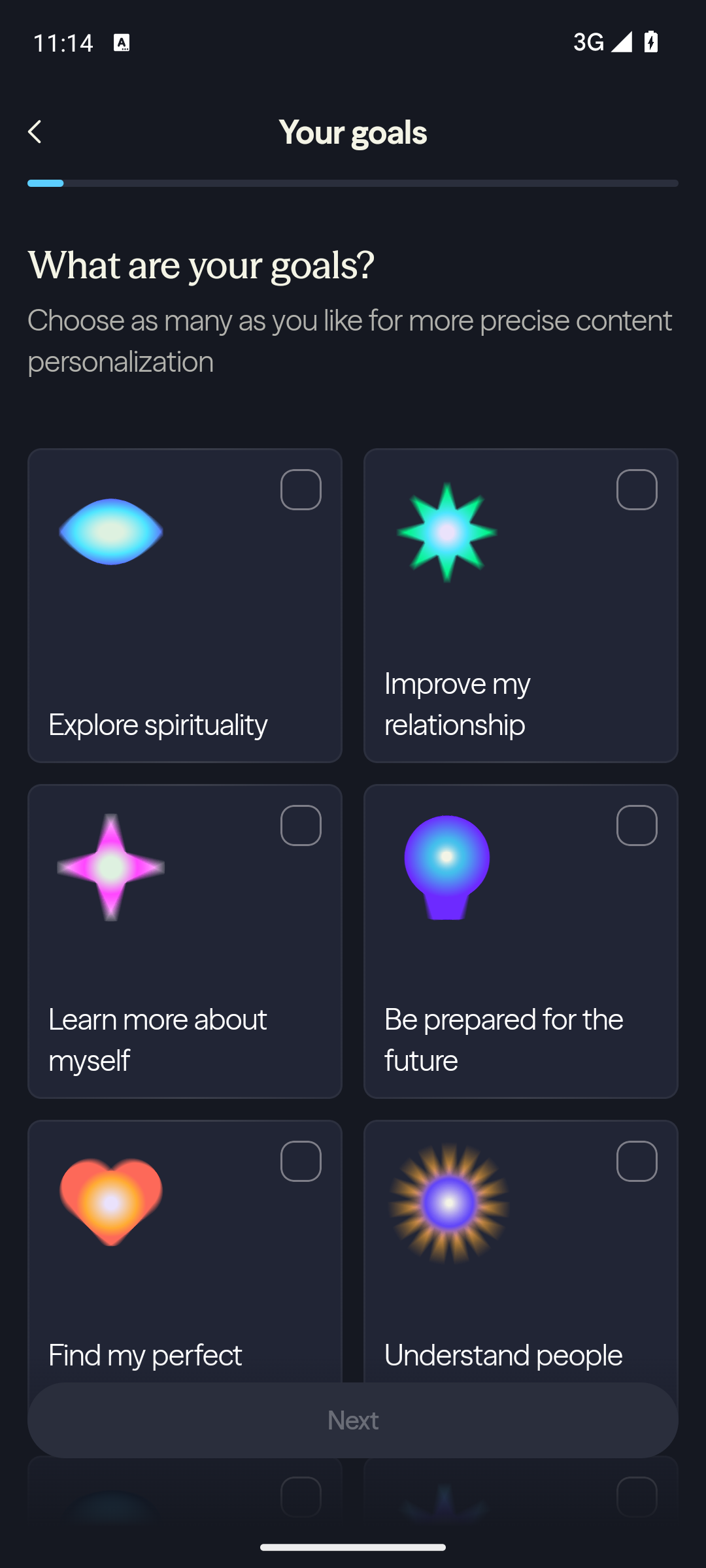 02 goals top
 02 onboard step1
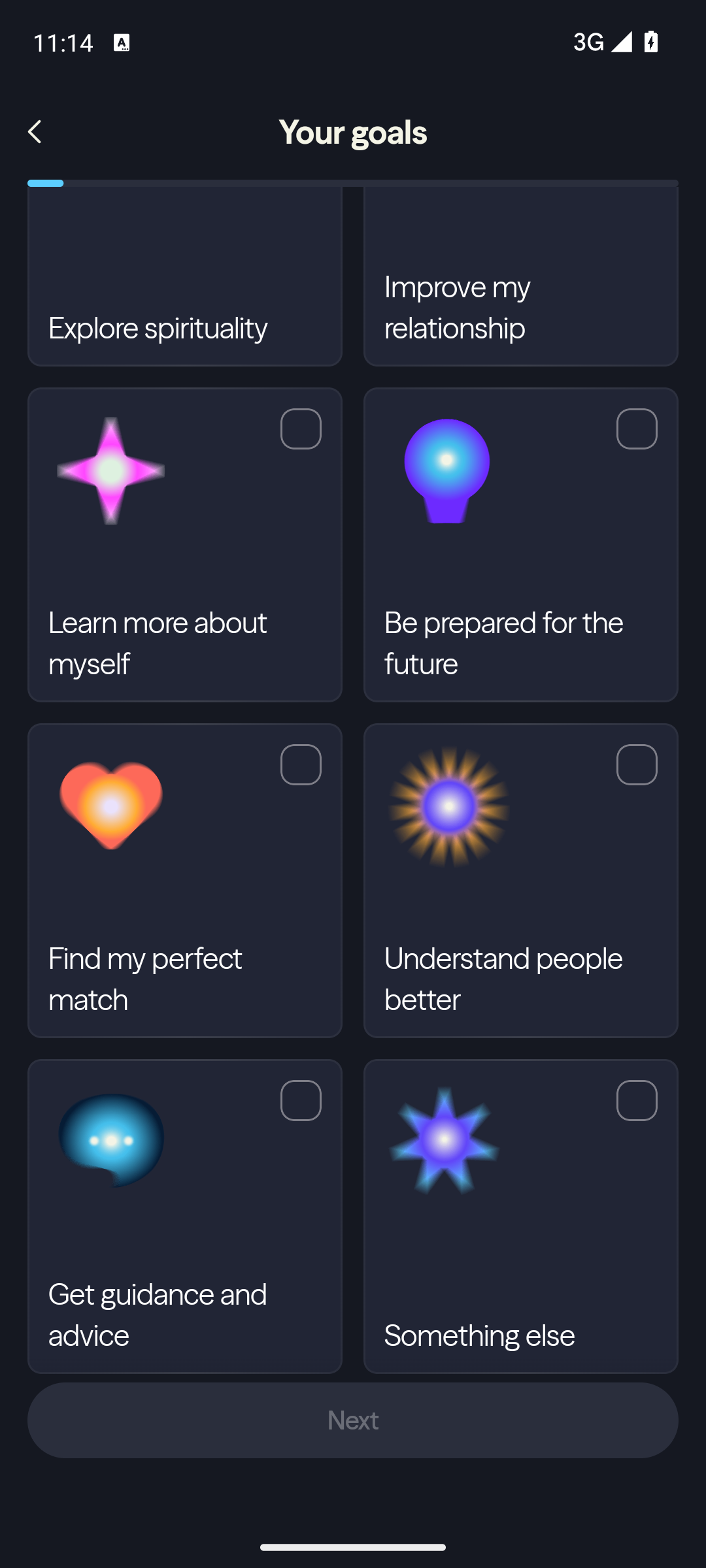 03 goals scrolled
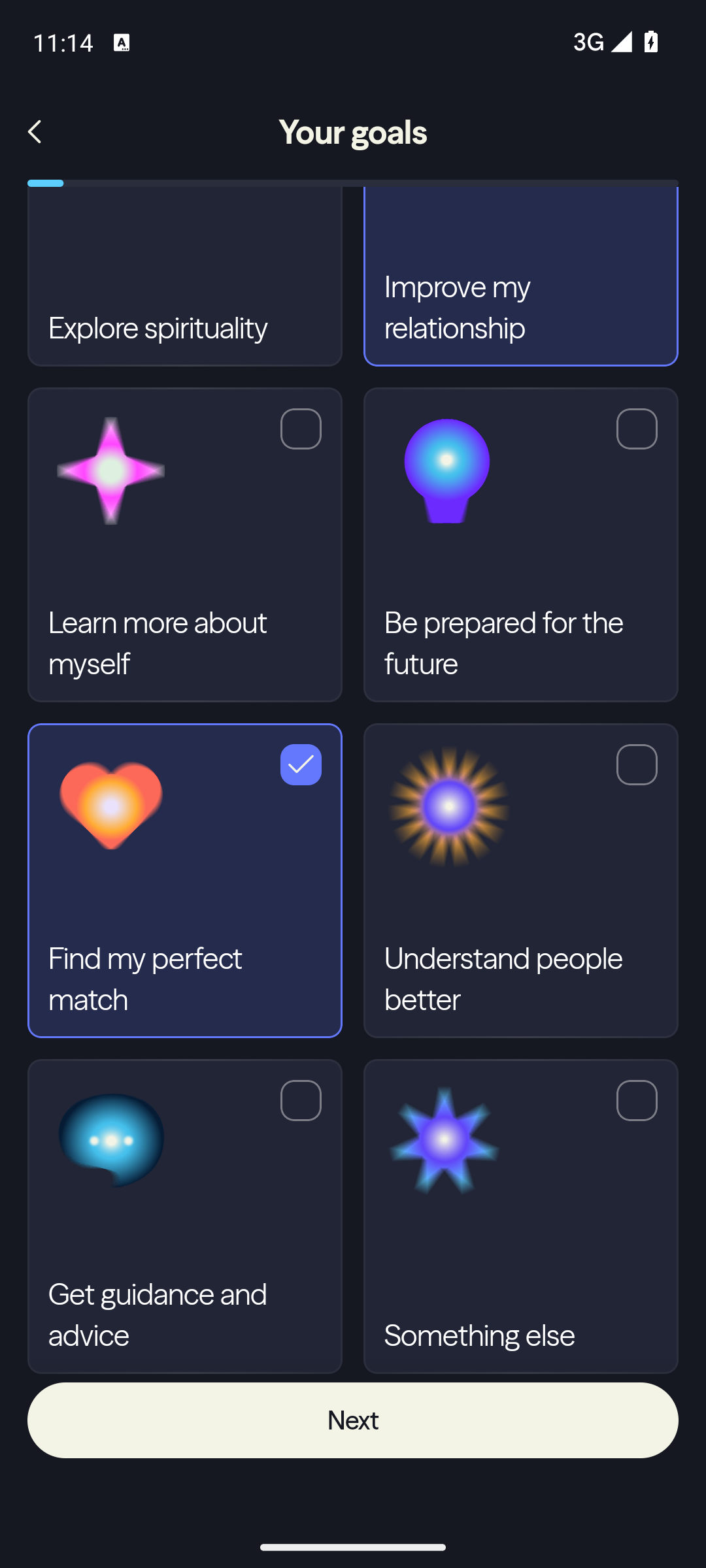 04 goals selected
 05 onboard
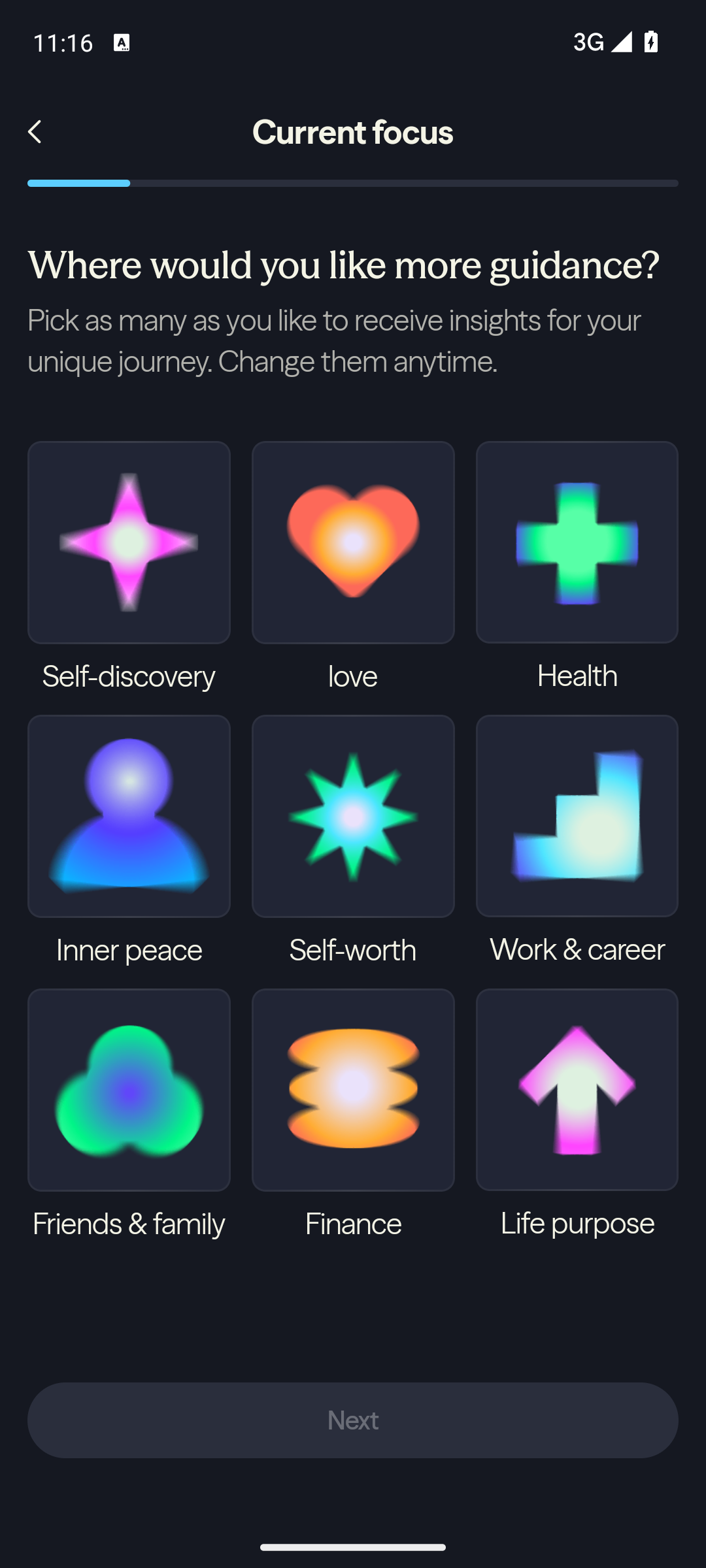 06 onboard
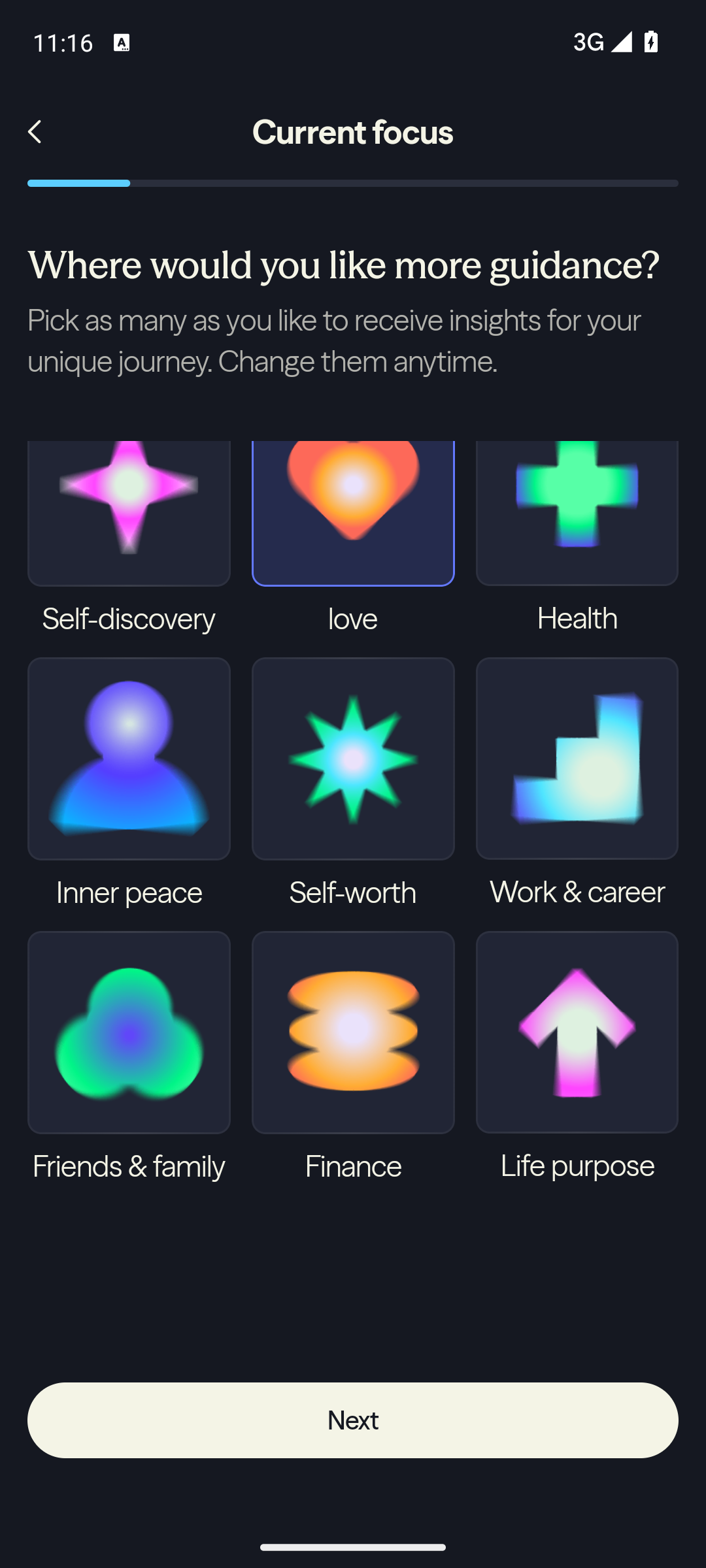 07 focus
 08 onboard
 09 onboard
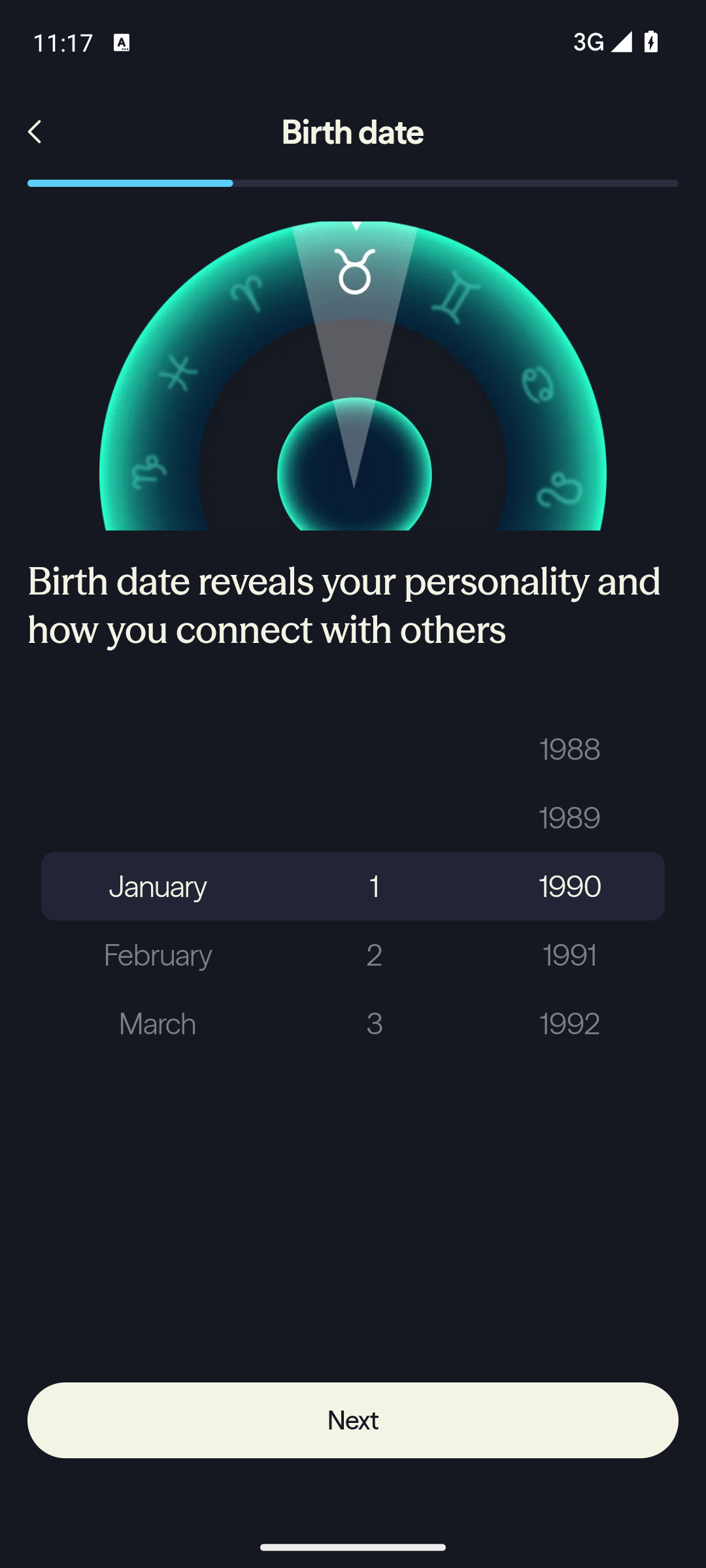 10 onboard
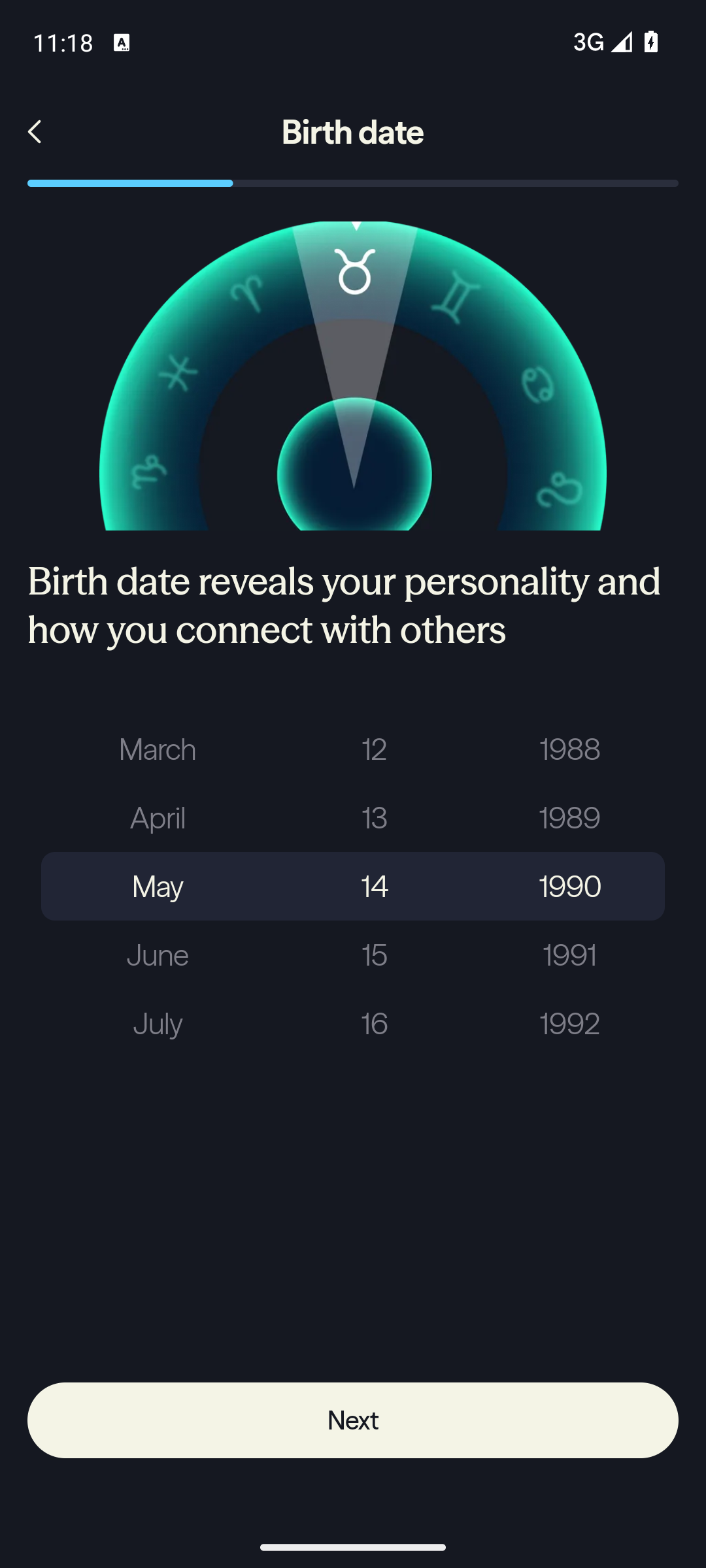 11 birthdate
 12 onboard
 13 onboard
 14 birthplace
 15 onboard
 16 onboard
 17 onboard
 18 name
 19 onboard
 20 onboard
 21 onboard
 22 onboard
 23 onboard
 24 push permission
 25 onboard
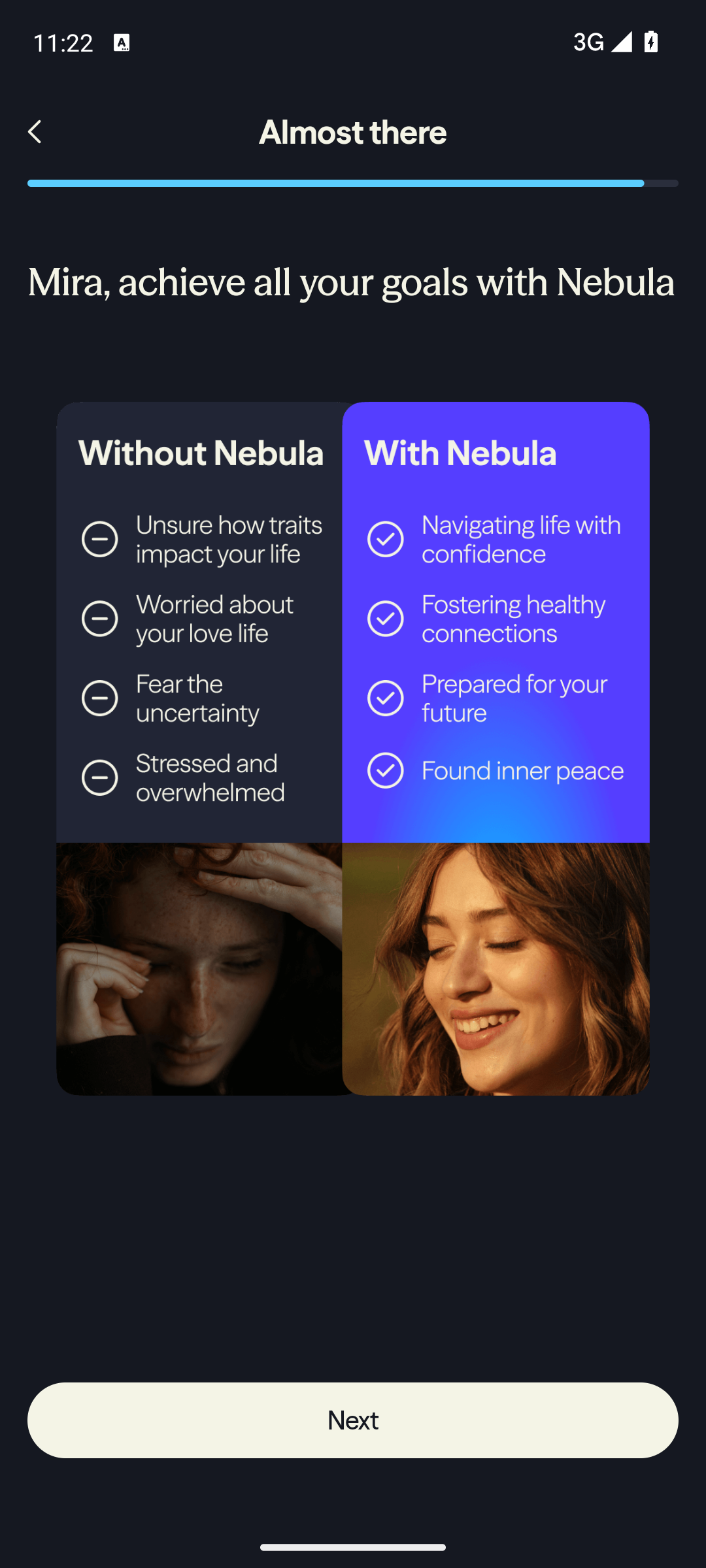 26 onboard
 27 onboard
 28 signup checked
 29 google signin
 30 post signin
 31 after signin
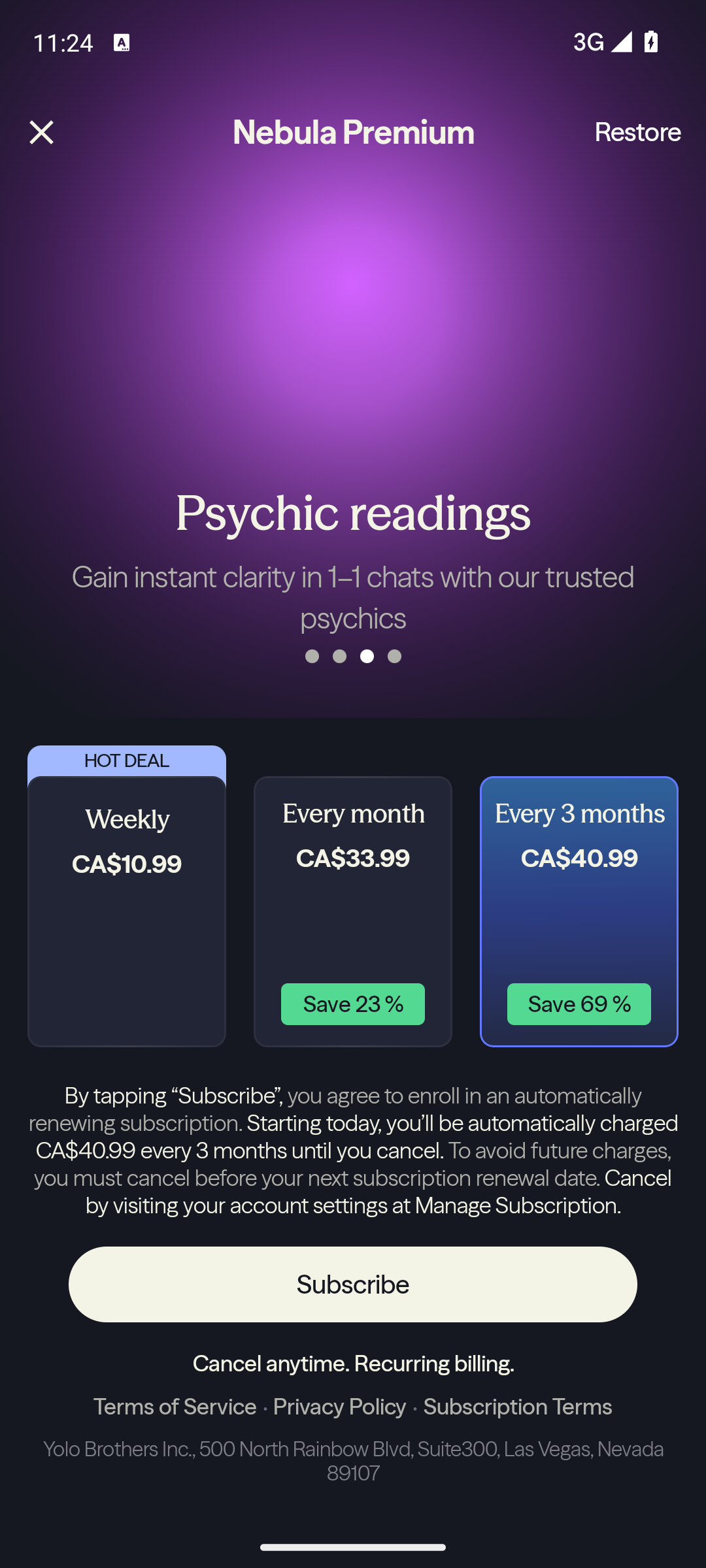 32 onboard
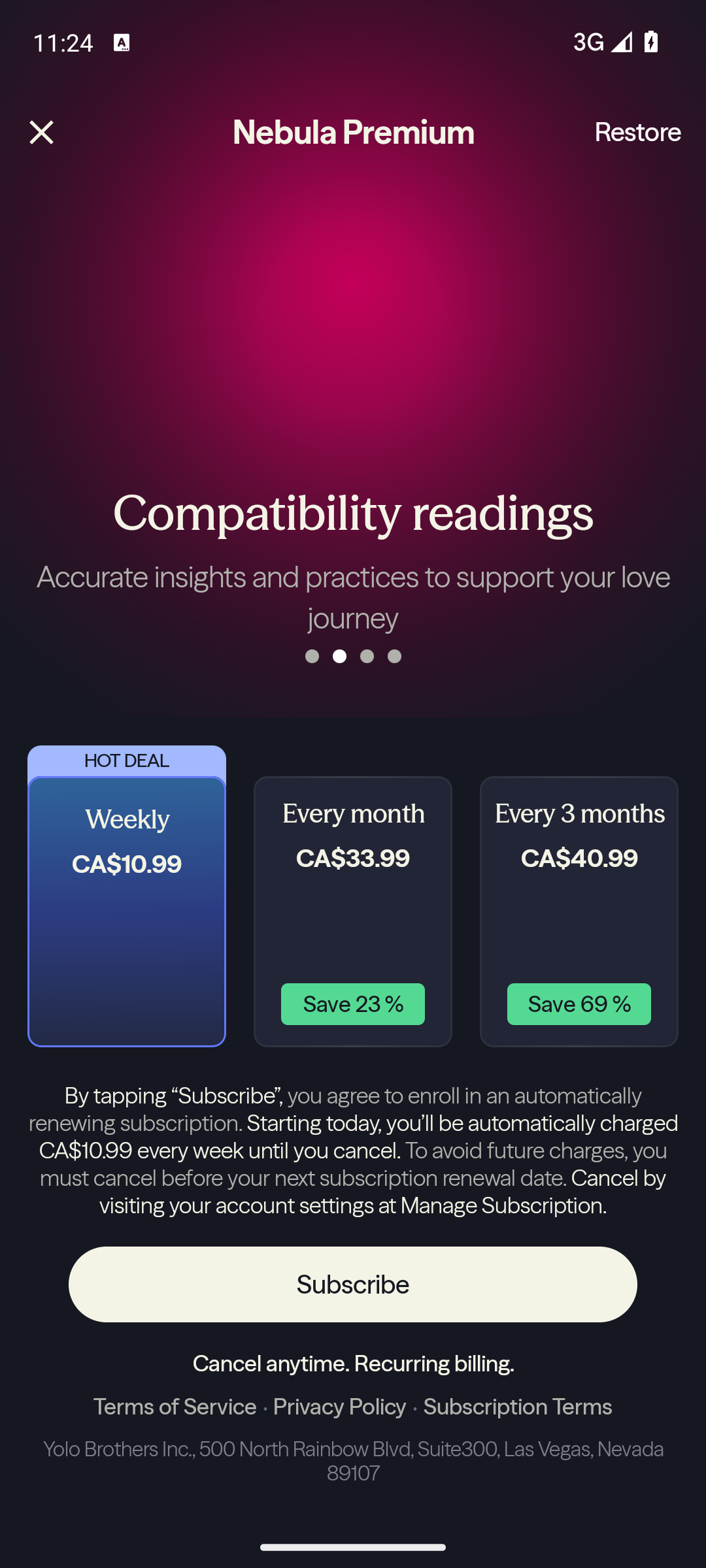 33 paywall weekly
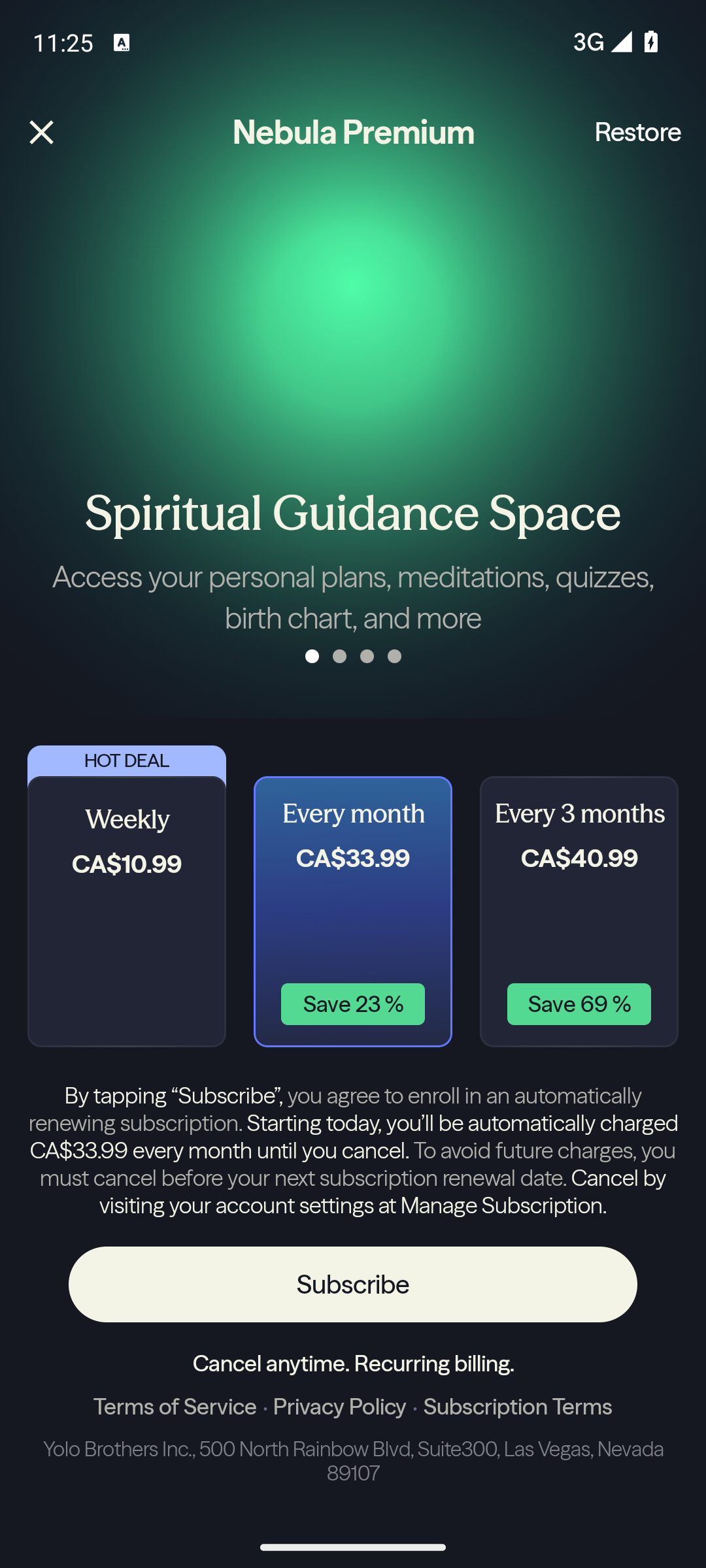 34 paywall monthly
 35 paywall close
 36 home today
 36 home
 37 home scroll1
 38 home scroll2
 39 free reading
 40 chat claimed
 41 chat idle
 41 chat question
 42 chat sent
 43 chat after send
 44 psychics tab
 45 psychics scroll
 46 compatibility
 47 chatroom
 48 oracle chat
 49 readings
 50 readings scroll
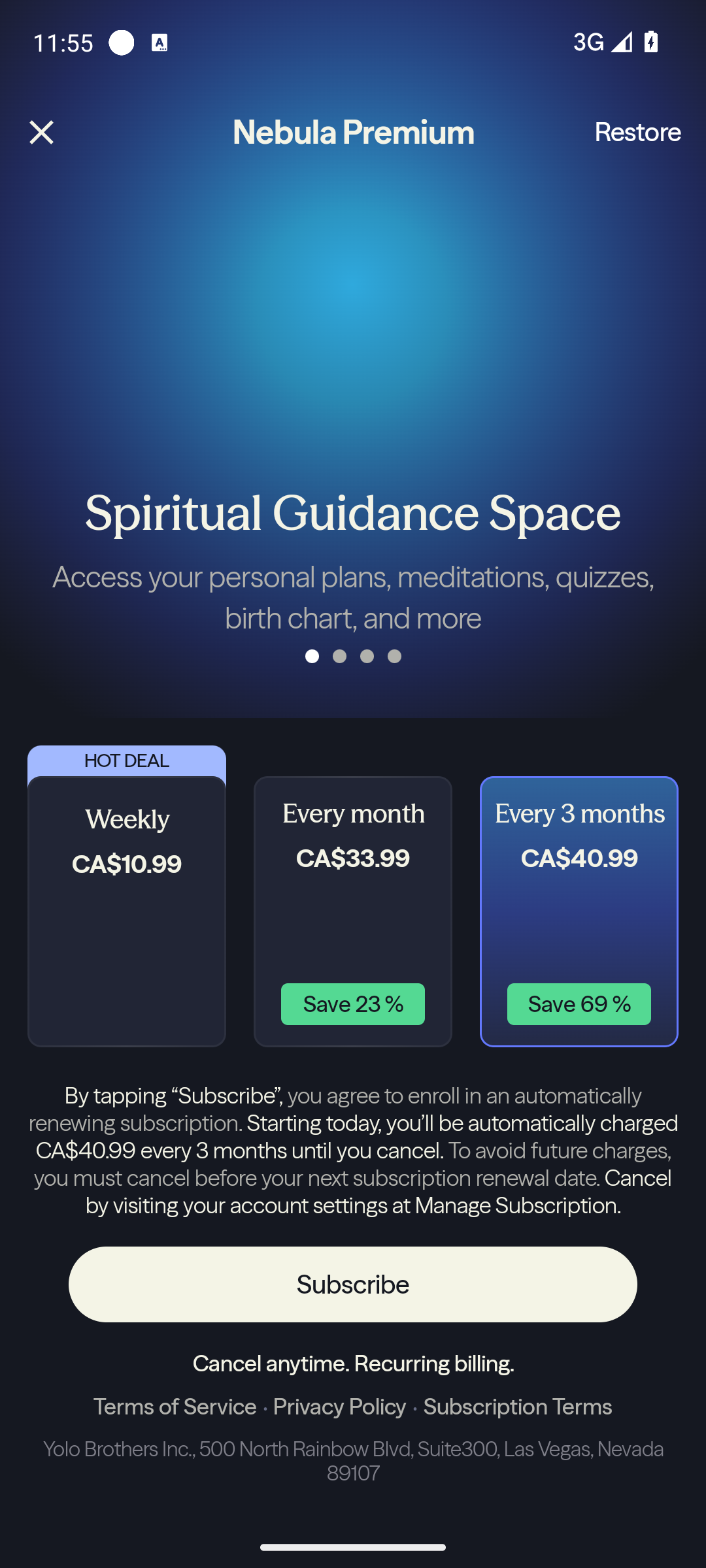 51 audio locked
 52 quiz
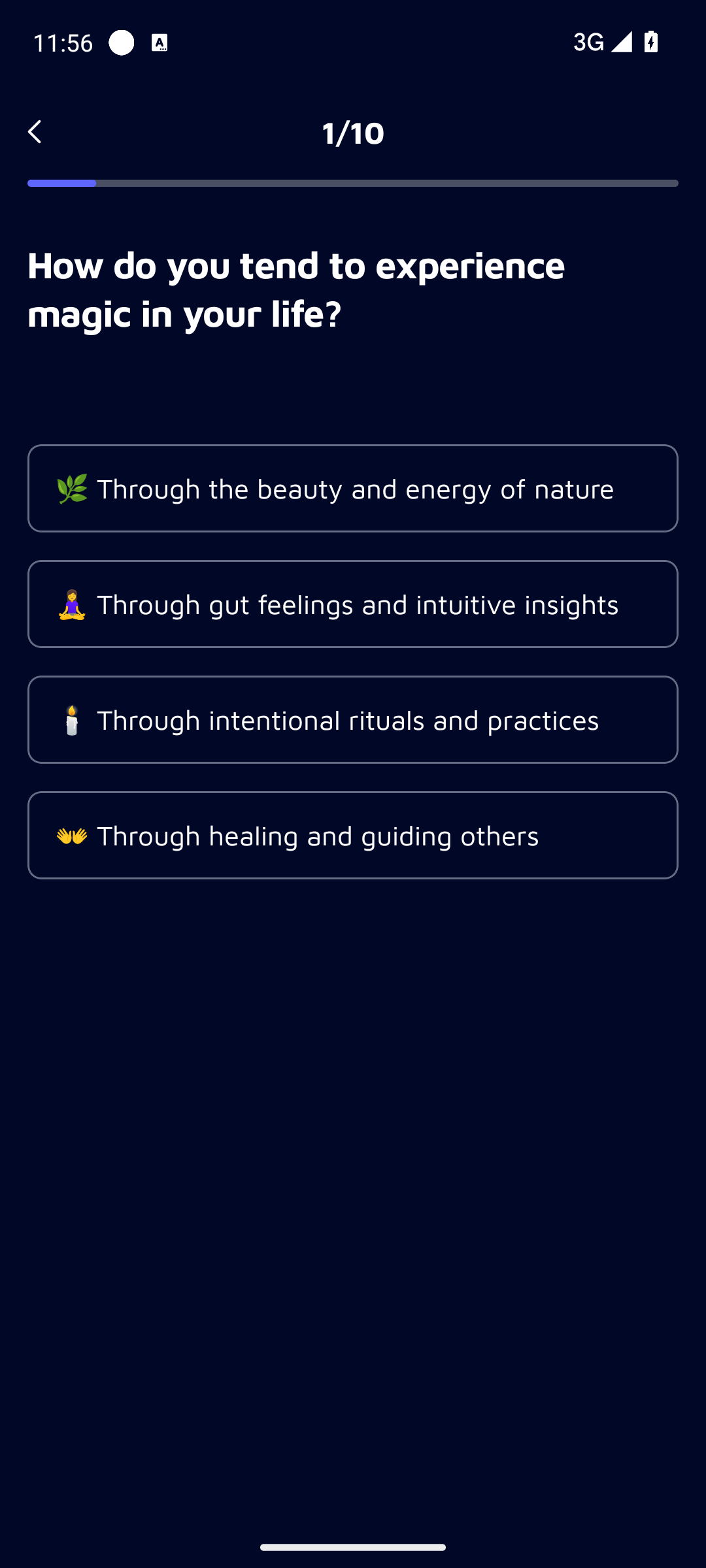 53 quiz q1
 54 quiz end
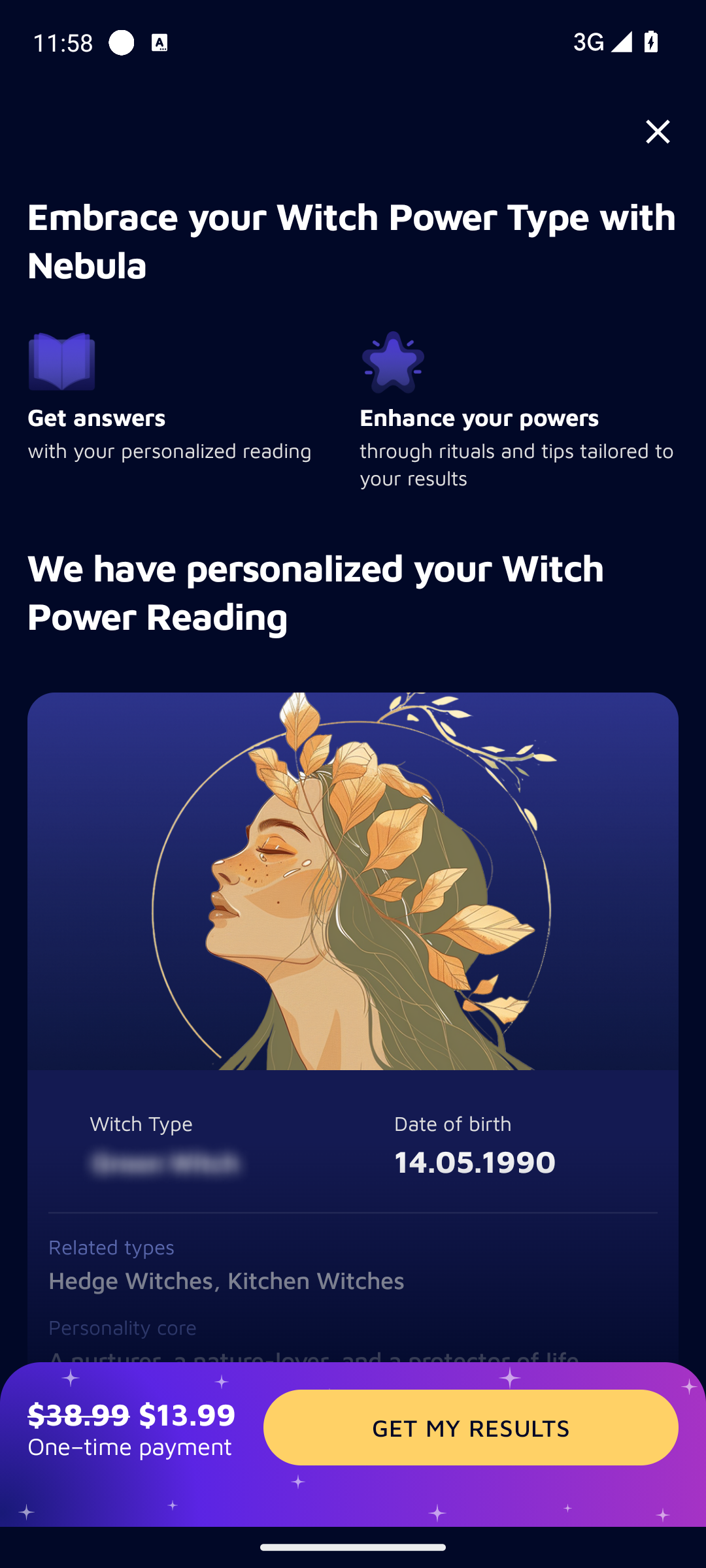 55 quiz result
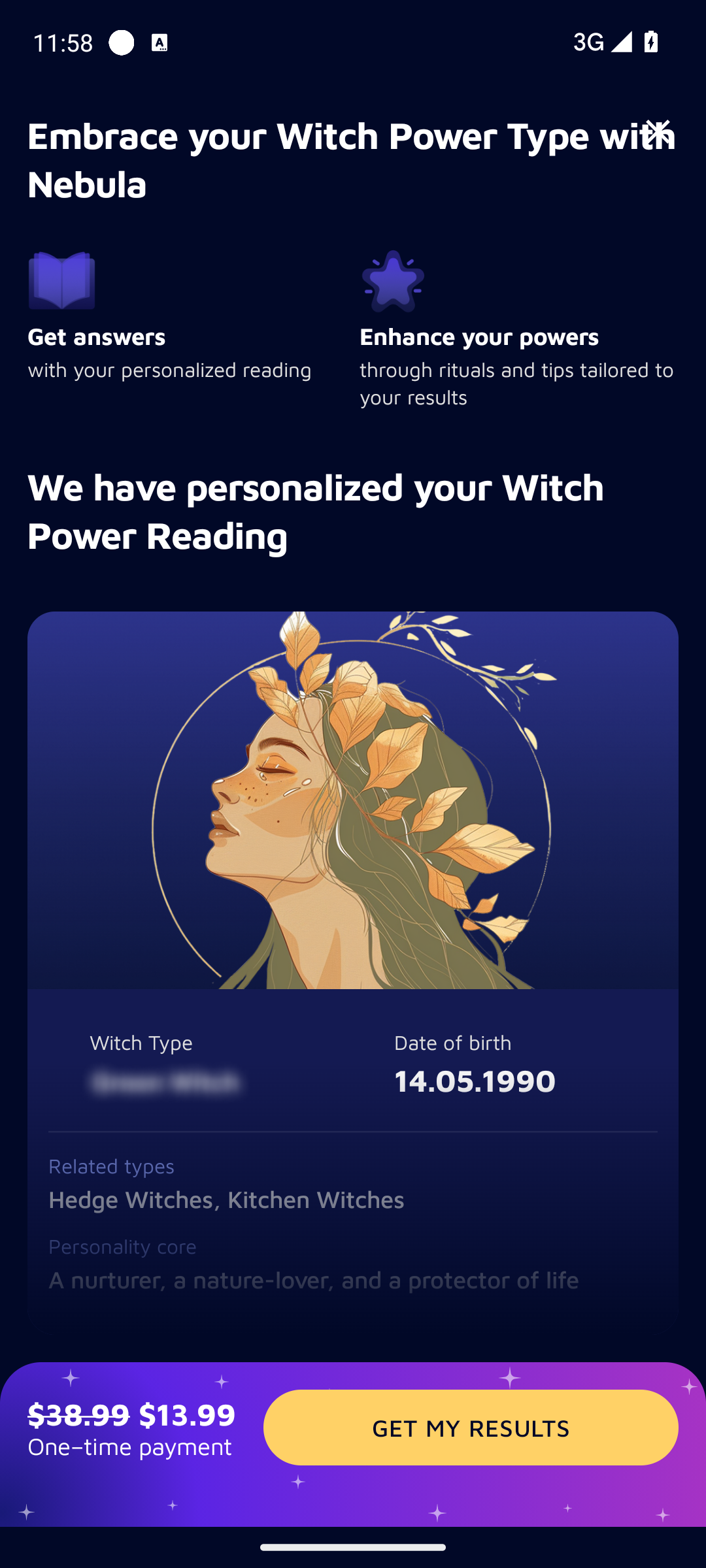 56 quiz paywall scroll
 57 today
 58 settings
 59 cancel flow
 60 cancel step1
 60 cancel step2
 60 cancel step3
 60 cancel step4
 60 cancel step5
 60 cancel step6
 60 cancel step7
 60 cancel step8
 62 account details
 63 home after relaunch
 64 birthchart
 65 birthchart result
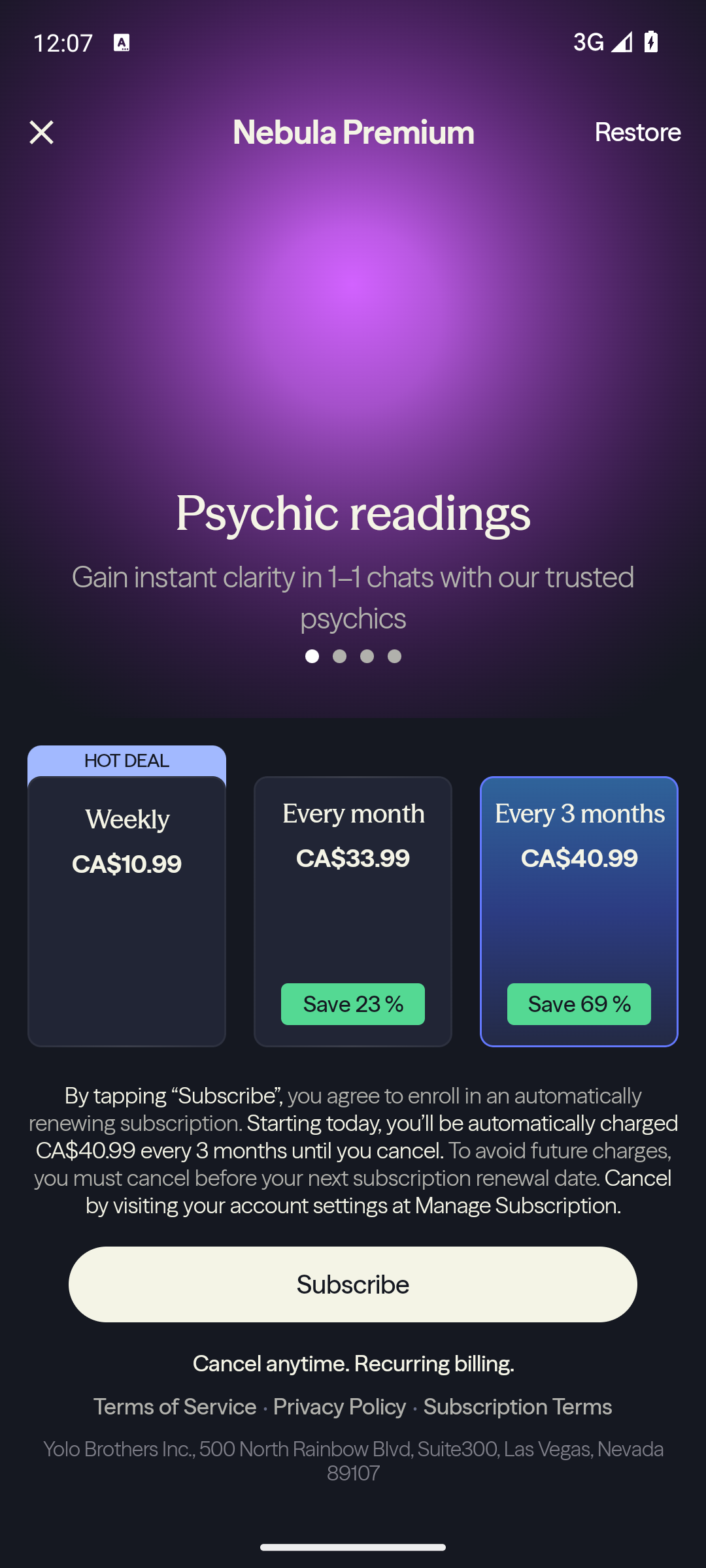 66 unlock reading
 67 compat
 68 compat partner
 69 compat add
 70 invite partner
 71 invite share
 72 paywall again
 73 play sheet
 74 back from play
 75 final state
The Pattern — native walkthrough
98 screenshots · full walk · v5.39.1, zero crashesThe cleanest pricing table in the set, attached to the lowest rating in the set. Go
Deeper+ shows yearly at CA$8.33 per month (BEST VALUE, pre-selected), quarterly at CA$13.33 (POPULAR), monthly
at CA$14.99 — the badges are true, the ordering is fair and the cheapest option is the default. It still
sits at 3.99★ while CHANI holds 4.92★, because of what it takes back: the daily insight is
truncated mid-article, with the CTA reading Go Deeper+ where every other astrology app
ships Read Insight, and the user’s own personality audio gives you chapter 1 then
seven padlocks on chapters 2 to 8 — 2:34 of a 39:45 reading of herself. Bonds are metered to
three per 24 hours, and tapping a padlocked row does nothing at all. The voice, though, is the closest register
in the set to what Numina should hit: the jargon lives in the labels, the psychology lives in the
prose, and every card ends on a question.
 01 launch
 02 signup methods
 03 email signup
 04 auth methods again
 05 google signin
 06 after google
 07 post google auth
 08 profile form filled
 09 birthdate picker
 10 birthdate set
 11 birthdate ok
 12 birthtime picker
 13 birthtime 0915am
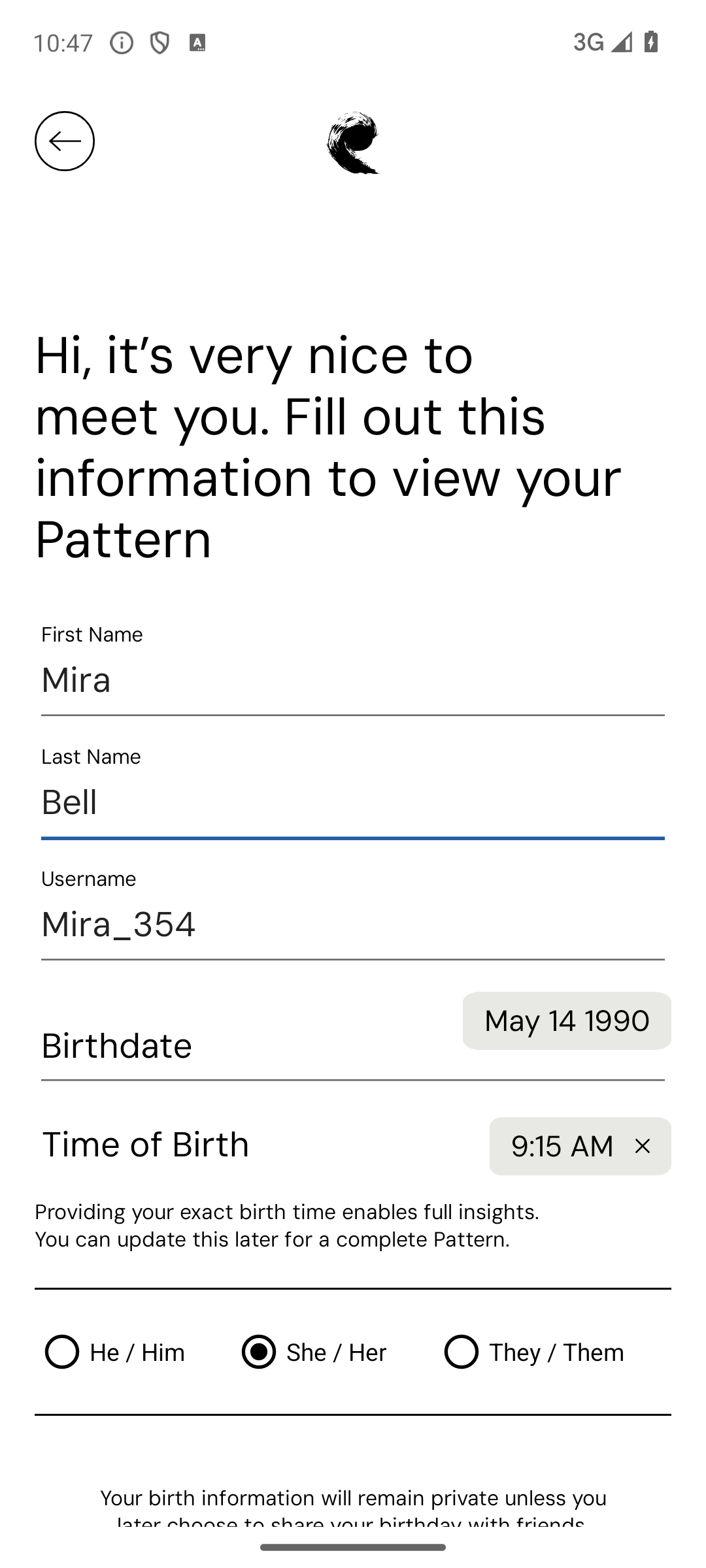 14 form complete
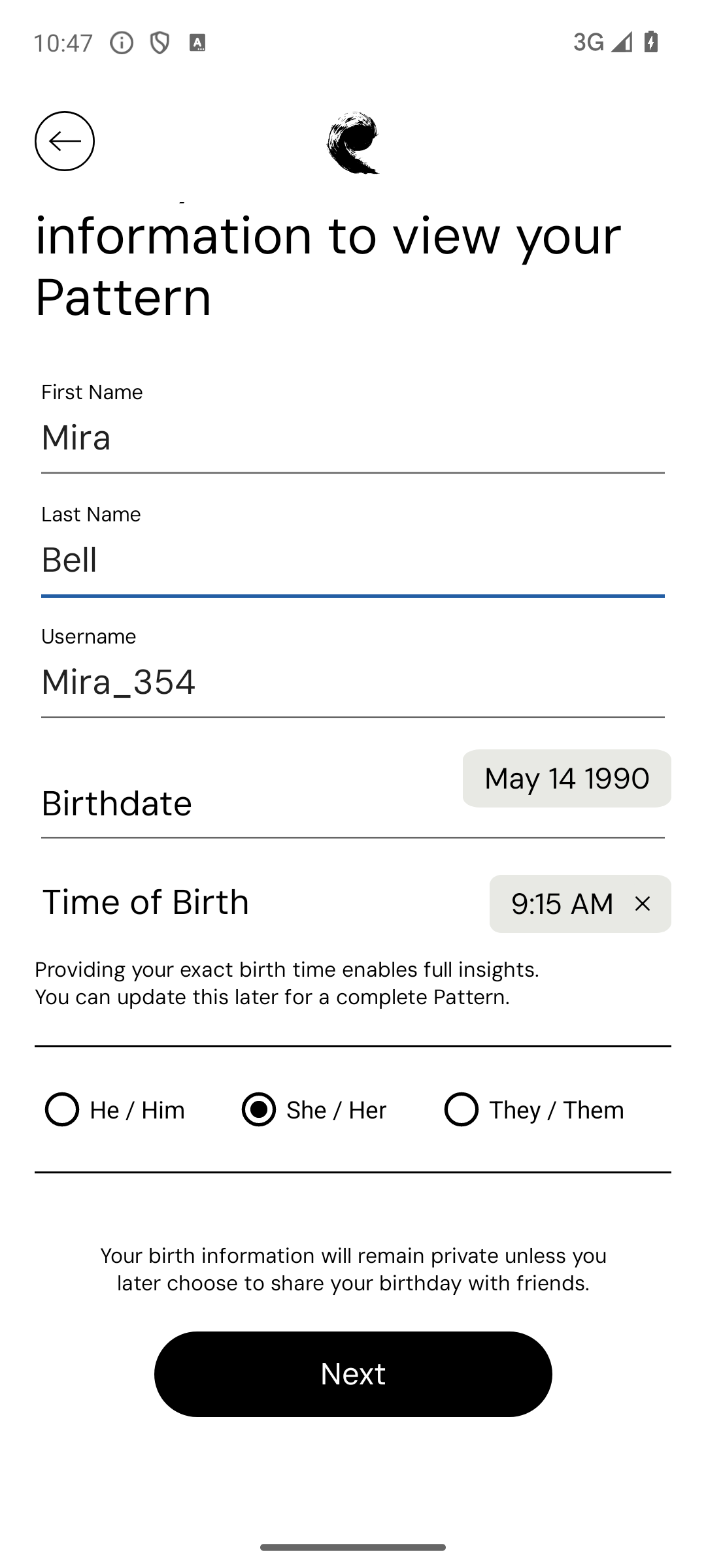 15 form scrolled
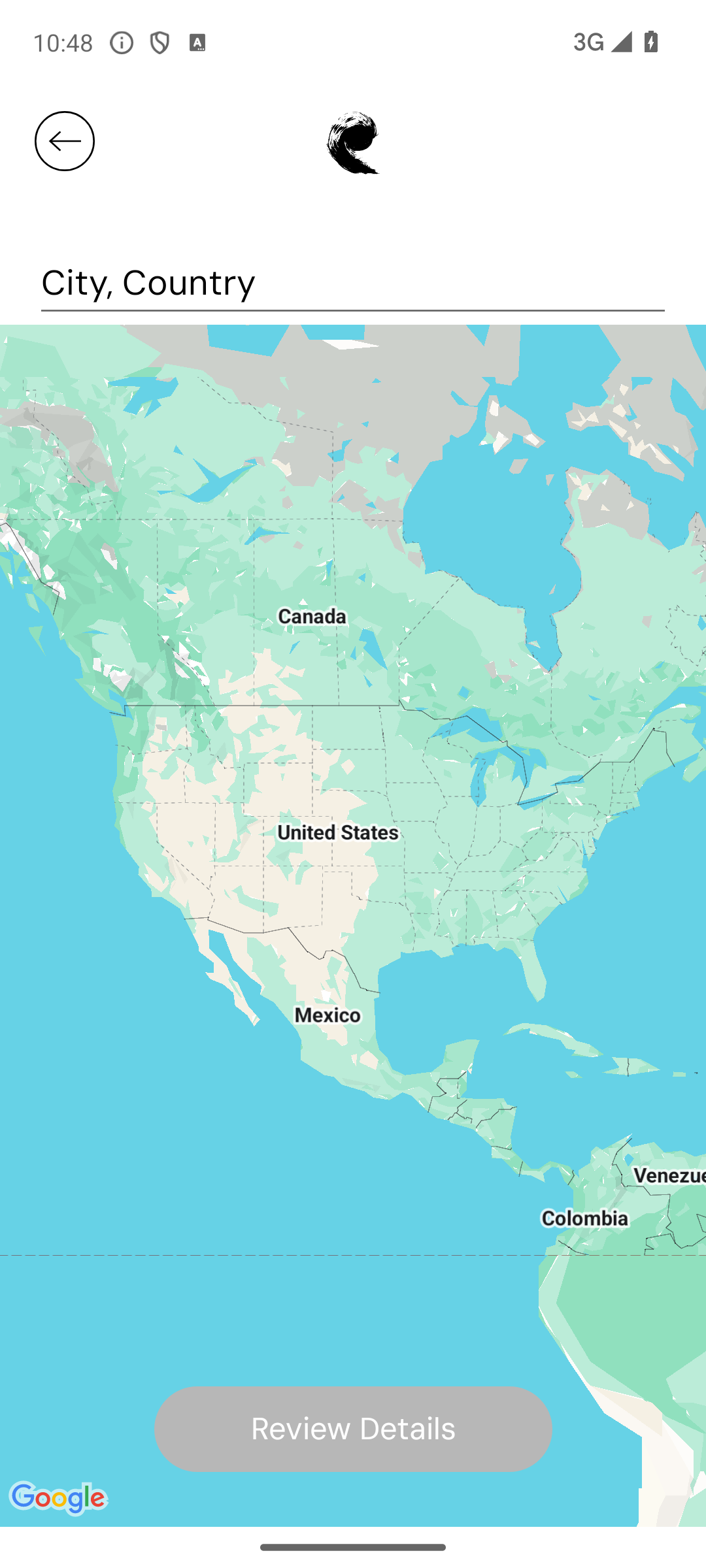 16 after next
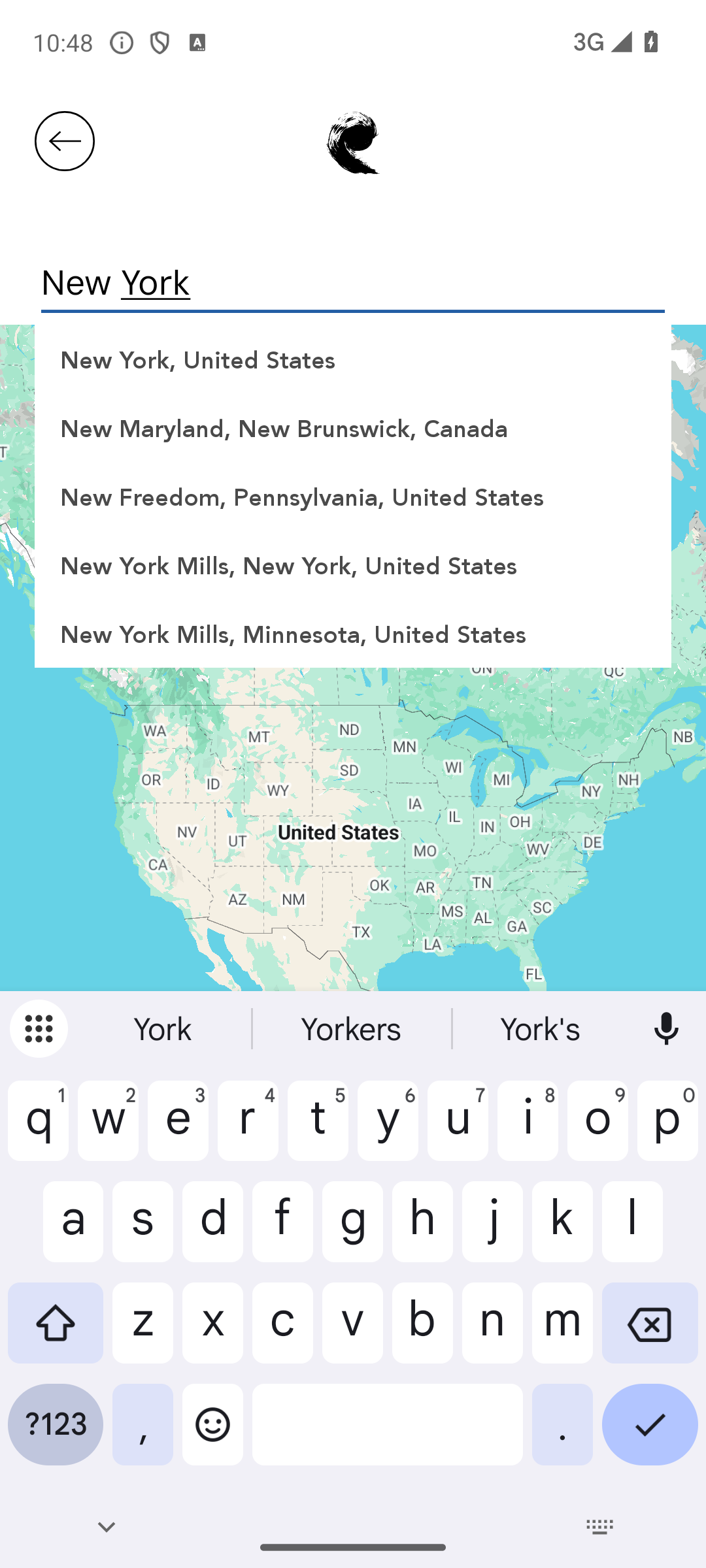 17 birthplace autocomplete
 18 birthplace selected
 19 review details
 20 after review tap
 21 place ready
 22 details review
 23 os notif dialog
 24 after notif allow
 25 review summary
 26 after view my pattern
 27 trait detail
 28 read insight
 29 insight swiped
 30 airship modal
 30 home
 31 home
 32 tab lens
 33 lens scroll2
 34 tab indepth
 35 indepth 2
 36 indepth paywall
 37 you indepth
 38 indepth chat reply
 39 indepth after msgs
 40 indepth msg2
 41 indepth after 7
 42 indepth quota
 43 indepth hub
 44 tab bonds
 45 create custom friend
 46 friend filled
 47 after save friend
 48 friend place
 48b friend place dd
 49 friend saved
 50 bonds hub
 51 bond result
 52 bond scroll1
 53 bond scroll end
 54 bond exclusive upsell
 55 after explore now
 56 start exploring
 57 you tab
 58 menu
 59 settings
 60 PAYWALL
 61 paywall scrolled
 62 play billing sheet
 63 tab discover
 64 discover scrolled
 65 discover item
 66 listen insight gate
 67 audio player
 68 audio ch2
 69 you audio card
 70 personality audio gate
 71 audio chapters locked
 72 locked chapter paywall
 73 locked tap
 74 audio player top
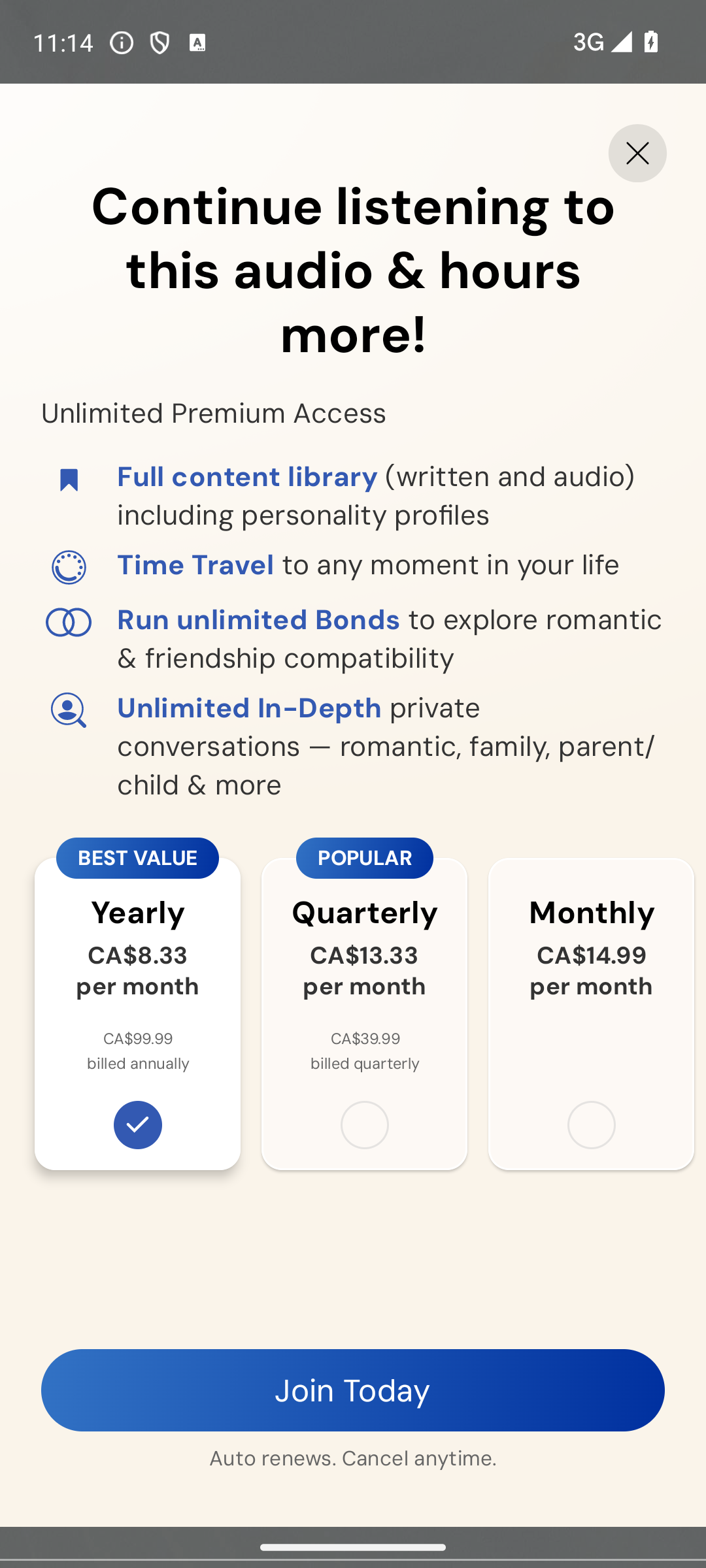 75 play locked chapter
 76 bonds count
 77 bonds remaining info
 78 get more bonds paywall
 79 astrology wheel
 80 your transits
 81 time travel gate
 82 time travel picker
 83 time travel result
 84 tt year list
 85 your pattern list
 86 your pattern list end
 87 friends screen
 88 you tab scrolled
 89 you tab bottom
 90 go deeper section
 91 go deeper item
 92 play listing
 93 play iap
 94 lens sign detail
 95 lens cancer
 96 lens godeeper paywall
Co-Star — native walkthrough
31 screenshots · partial — phone / Facebook wallFour onboarding screens, about 90 seconds, and it pays out before asking for anything:
birth date, birth time (with an explicit SKIP), birth city, and then a full chart plus three blunt personality
verdicts, free, with no account and no payment. Birth time is optional and the privacy line sits on every data
screen. Then the wall: phone number plus SMS OTP, or Facebook — no email, no Google, no Apple, no
guest mode, which is where our walk stopped. That gate is a growth decision, not an auth decision: the
manifest declares READ_CONTACTS and the phone number is the friend-graph key, which is exactly why
no email option exists. Items behind the wall — the live Do / Don’t verdict, the SHOP price list,
the add-friend flow — are not captured, and the one-time-IAP monetisation shape is inferred from the Play
listing, not verified.
 01 launch
 02 welcome
 03 onboard 01 birthdate
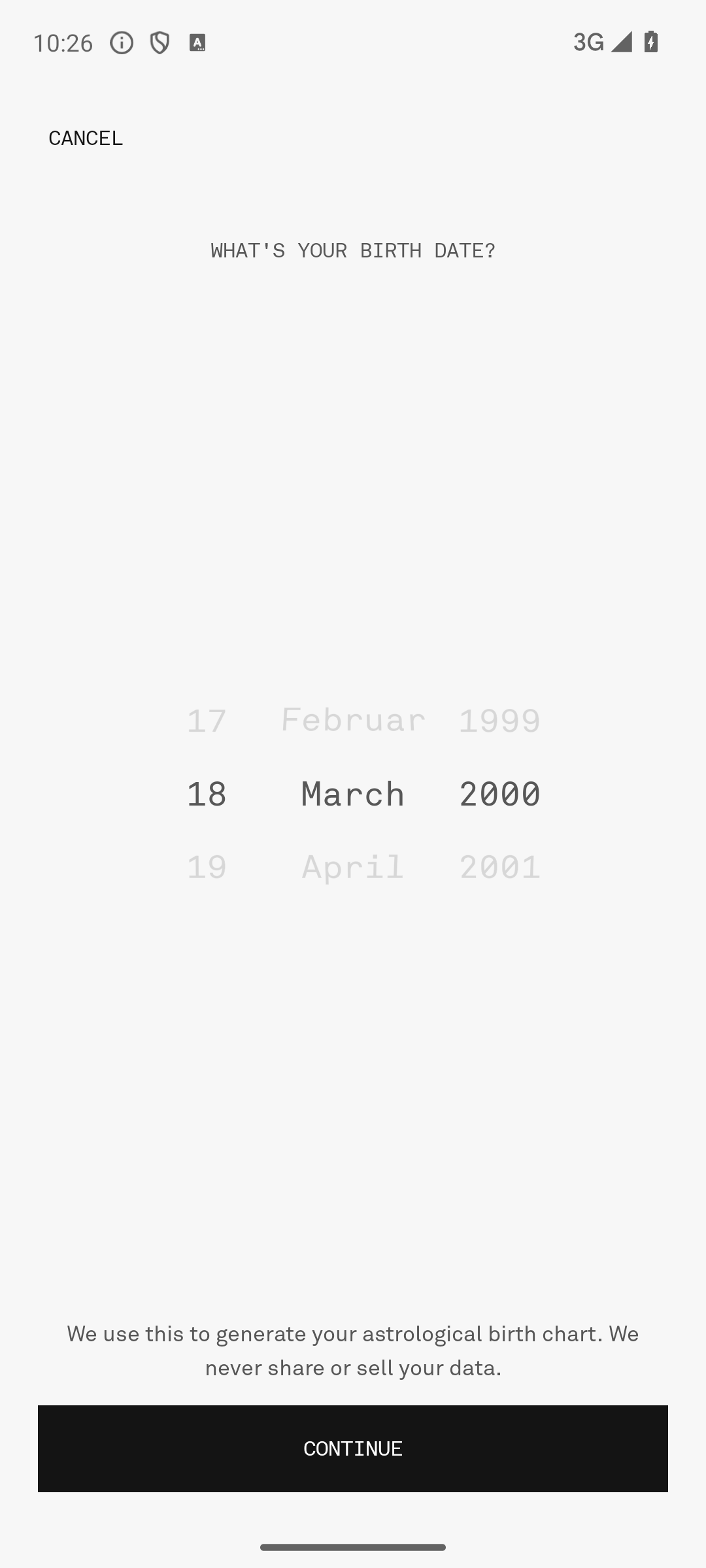 03 onboard 01
 04 onboard 02 birthtime
 04 onboard 02
 05 onboard 03 birthplace
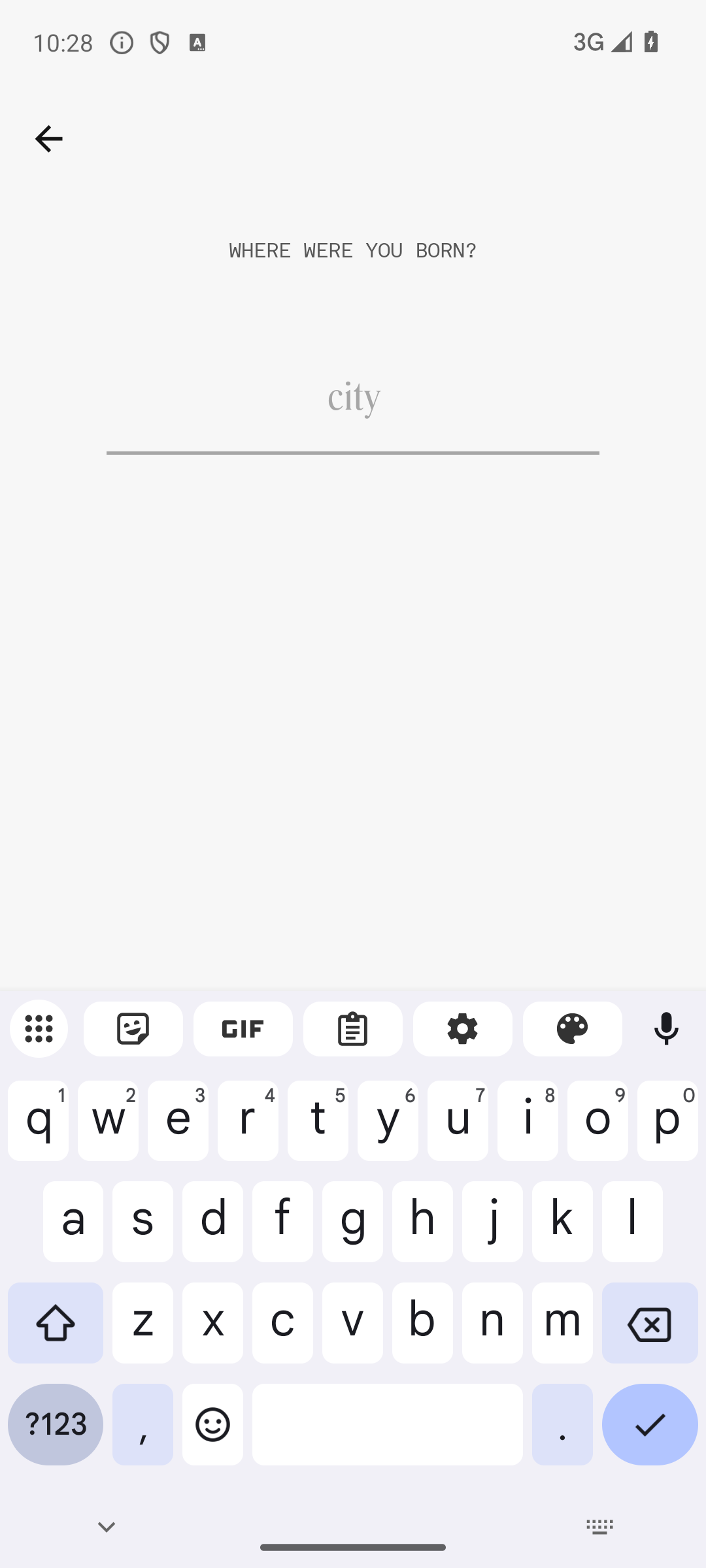 05 onboard 03
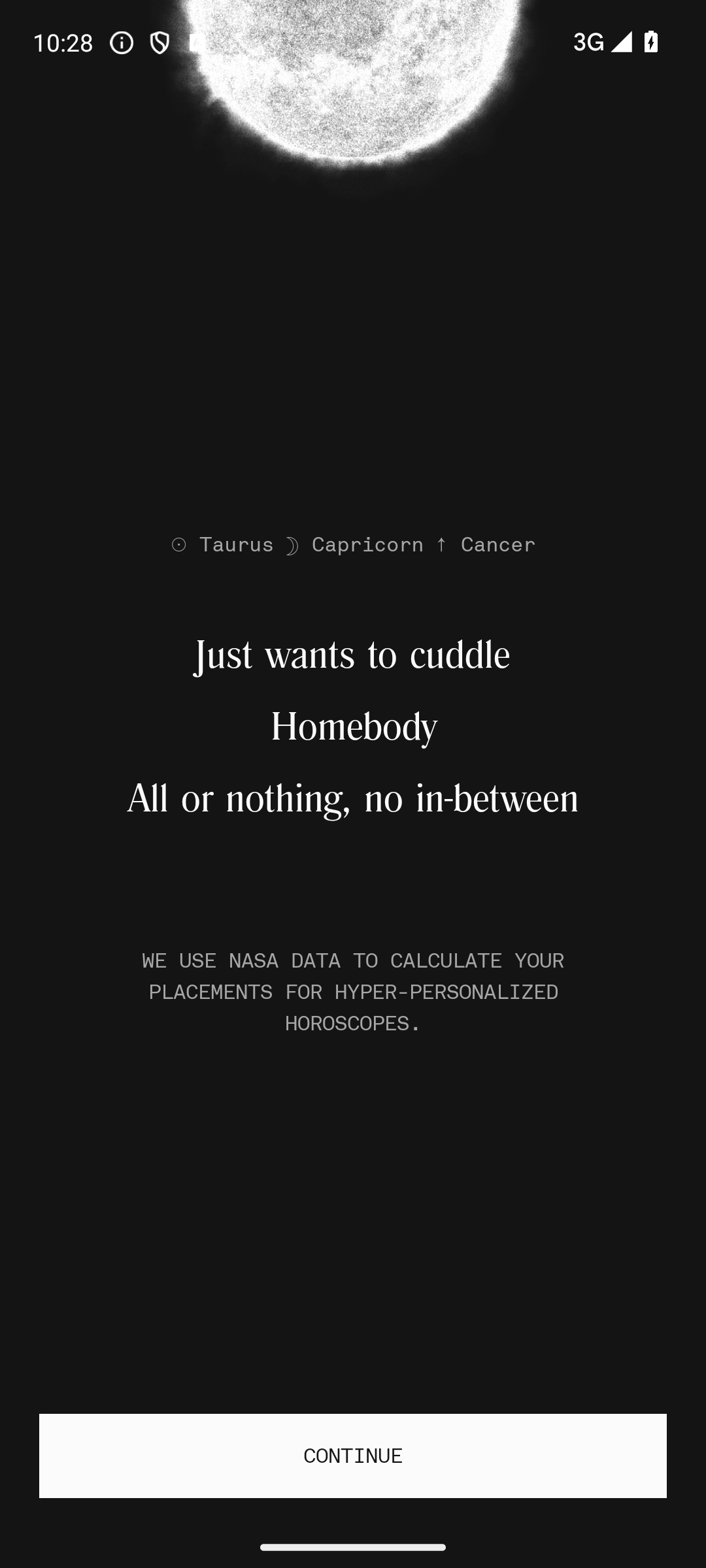 06 onboard 04
 07 onboard 05
 08 phone filled
 09 after phone next
 09 after phone submit
 10 invalid phone error
 11 facebook oauth
 11 facebook signin
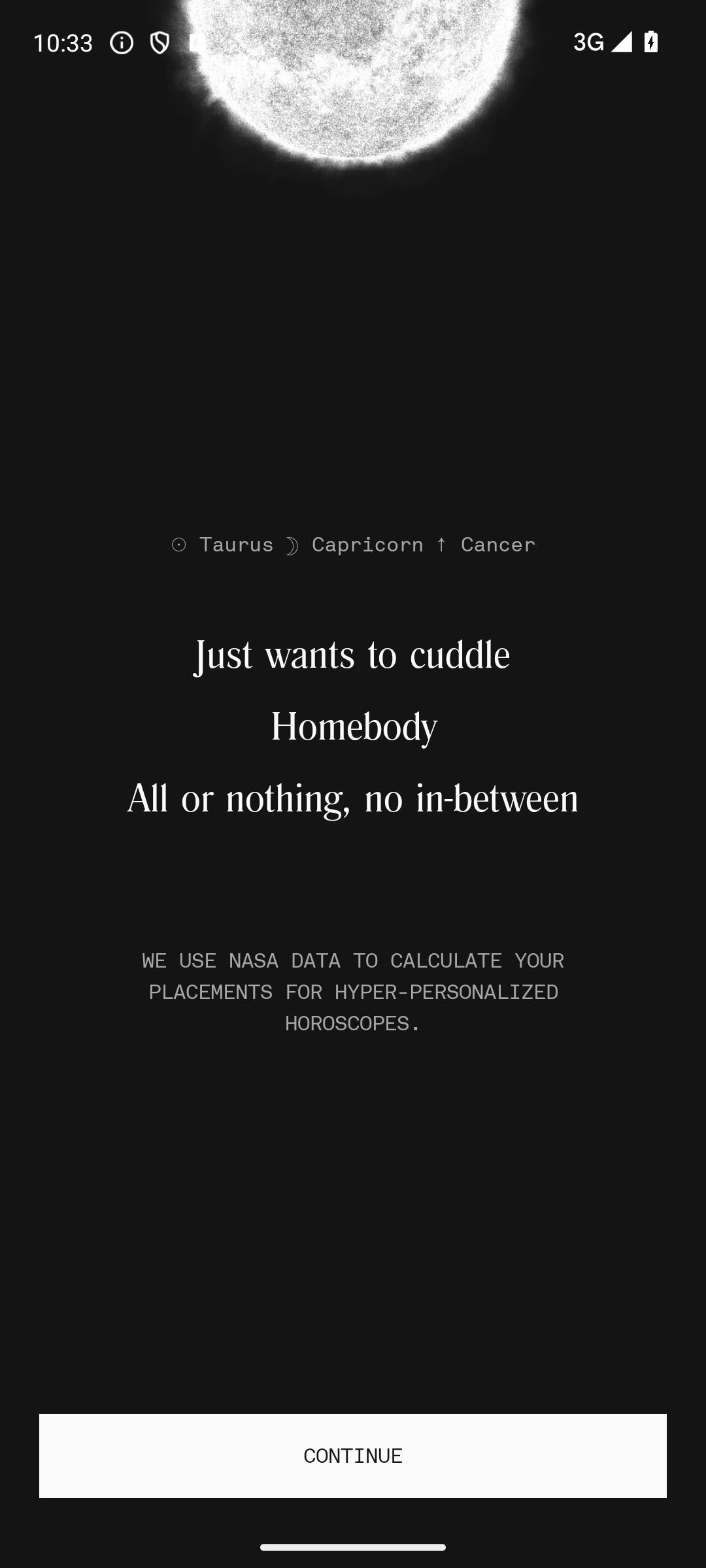 12 app back at phone wall
 13 play listing
 14 play iap
 15 play about
 16 play app info
 17 play app info scrolled
 18 login only phone or facebook
 19 play gallery
 20 play shot1
 21 play shot2
 22 play shot3
 23 play shot4
 24 play shot5
 25 play shot6
 26 play description
CHANI — native walkthrough
15 screenshots · partial — phone-OTP wallThe highest-rated app in the category at 4.92★ on 57,446 US ratings, and the honest counterexample to Nebula. $11.99 a month or $107.99 a year badged “25% off monthly cost” — and the badge is true (monthly annualises to $143.88; the annual plan is 24.9% cheaper), with a 14-day trial on monthly and 30 days on annual, and a one-tap deep link straight to Play’s subscription screen to cancel. The free tier is genuinely generous: daily horoscopes, the full birth chart, a 28-day course, the weekly podcast, tarot card, 7-day forecast. Premium gates depth, not basics — CHANI gives away what Nebula charges for and still holds the higher rating at a flat price. Onboarding is inverted against Nebula: account creation comes first, name plus phone plus email plus password, before a single astrology question, and that phone-plus-SMS-OTP wall is where our walk stopped. The pricing, badge, trial and cancel facts above come from CHANI’s own support documentation, which is authoritative; only the in-app paywall pixels are missing.
 00 playstore listing
 01 first screen
 01 launch
 02 after promo close
 03 onboarding start
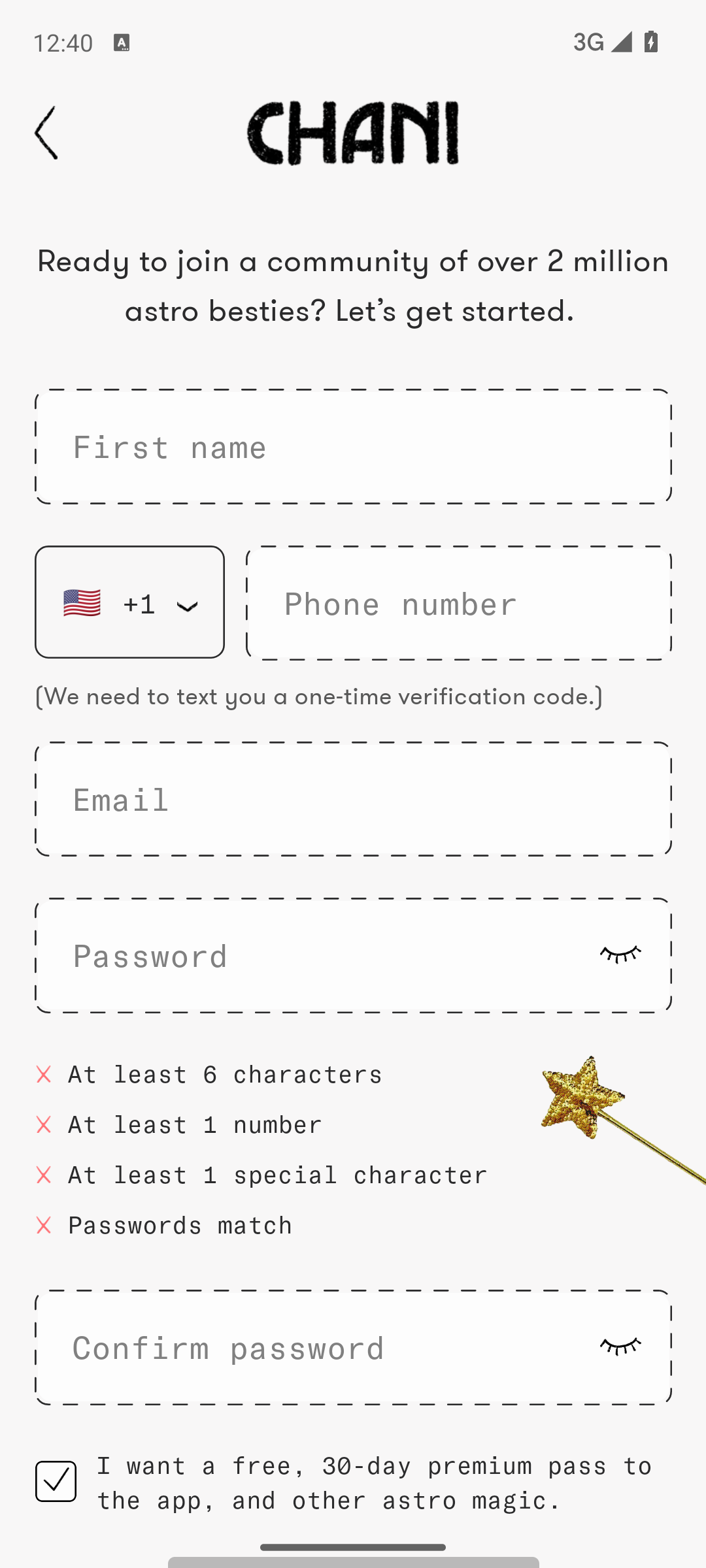 04 onboard 01
 05 signup filled
 06 after create
 07 after create submit
 08 otp or next
 08 otp screen
 09 welcome again
 10 form no phone
 11 after create nophone
 12 play listing
Ship these
- Value before the wall — Co-Star’s instant reveal, adapted: her sketch or reading lands before any account demand.
- Price ON the button — “Start · $14.77/mo”. Nobody in the category does it.
- Honest badge and honest default — if it says best value it must BE best value annualised, and that is what we pre-select. Show the annualised cost of every tier; that is the number Nebula relies on you not computing.
- Disclosure above the button, dynamic per plan — Nebula’s placement is correct even though their funnel is not. Copy the structure, keep our terms.
- One-tap cancel in-app — CHANI’s deep link is the floor; ours should cancel in the portal in two taps. This is simultaneously our ROSCA compliance, our underwriting asset and our review-score moat.
- Generous free basics, paid depth — CHANI’s model. Daily card free forever. Never claw back.
- Notification primer after the first aha, with a real example push, and no pre-checked box.
- Labels carry the jargon, prose carries the psychology — The Pattern’s credentialing trick, in Lara’s and Stella’s voices.
- A real viral loop — Nebula’s pre-created deliverable (the report is waiting when the invitee lands) beats an invite link, and it fits a compatibility or partner feature natively.
Caveats. CHANI and Co-Star were not fully walked — both hard-gate on phone plus SMS OTP we cannot receive. CHANI’s pricing, badge and cancel facts come from CHANI’s own support documentation (authoritative); Co-Star’s monetisation shape is inferred from the Play “per item” label and is explicitly unverified. The Pattern’s Time Travel is advertised as premium but worked free — state it as advertised-locked, not locked. Nebula’s per-minute meter was never seen running (both advisors went Busy); the pricing display is captured verbatim. Ratings mix stores: Co-Star is 4.5★ on Play and 4.79★ on iOS, the others are iOS.
Section 03 · 2026-08-21Revenue Models
Method
Three independent anchors per brand, then reconcile:
- Review-rate anchor — unsolicited-complaint-heavy Trustpilot profiles typically capture 0.05–0.3% of customers. Reviews/month ÷ rate → customers/month.
- Ad-footprint anchor — active creative counts and launch velocity imply a spend band typical for this niche; spend ÷ plausible CPA → trials/month.
- Unit-economics anchor — captured price ladder × typical trial-to-paid conversion, retention, and refund/chargeback drag → net revenue per trial start.
TryAstro (AA ECOM INDUSTRIES LLC) — funnel live ~4.5 months
Observed inputs: 187 active Meta ads (39 launched in one 3-day window — scaling), 17 Google ads; ~106 Trustpilot reviews in ~4 months (~26/mo); price ladder $1 (PWYW $1/$5/$9.95) → $49.99/mo after 7d; OTO ladder $41.97 / $29.97 / $19.97 (+downsells); $12 priority upgrade.
Assumptions (mid case): review rate 0.15% → ~17k trials/mo; trial-to-first-rebill 40%; avg 1.5 paid months at $49.99; refunds + chargebacks 20% of sub revenue; OTO + upgrade attach ~$9/trial start. → Net revenue per trial start ≈ $32 (low $18 / high $48).
| Case | Trials/mo | Rev/mo | Run-rate/yr |
|---|---|---|---|
| Low (0.3% review rate, softer conversion) | ~9,000 | ~$160k | ~$2M |
| Mid | ~17,000 | ~$450–550k | ~$5–6.5M |
| High (0.05% review rate, strong retention) | ~50,000 | ~$1.6M | ~$19M |
Cross-check (ad footprint): buying 17k trials/mo at $20–30 CPA = $340–510k/mo Meta spend (~$11–17k/day) — consistent with a 187-ad single-page account in aggressive scale mode, and with sub-economics that support CPA ≈ first-month value. The high case would need ~$1M+/mo spend: possible but not evidenced. Best guess: ~$5M/yr run-rate and climbing (the funnel is 4.5 months old and its ad velocity is accelerating).
Respontika / Staroly network (Kovexa / Spiritika) — operating ~3 years
Observed inputs: 83 active Meta ads (1-year continuous run, winner-duplication strategy); 452 lifetime Google creatives — peak Nov 2025, dark Jun–Jul 2026, Aug relaunch (31 live); 838 Trustpilot reviews over ~2.5–3 yrs (~25/mo avg); cancellation searches ~1,250/mo ≈ brand searches; four captured price ladders; a shared $10.99 upsell pair; iOS + Android apps.
FX assumptions
Every USD figure below is derived through three constants, stated as assumption, not measurement — approximate August 2026 rates: CAD→USD 0.73, GBP→USD 1.27, EUR→USD 1.09. Monthly-equivalent uses 52/12 = 4.33 weeks per month; multi-month terms are divided by their term length. FX is the second-largest source of error in this model after volume.
Price-architecture matrix — the four arms
| # | Arm | Trial | Recurring | Interval | Monthly-equiv (local) | Monthly-equiv (USD) | Currency | Descriptor | Upsells |
|---|---|---|---|---|---|---|---|---|---|
| 1 | Staroly weekly Meta ad path | $5.00 / 7d STAROLY66 | $14.50 | weekly | $62.79 | $62.79 | bare $ not disambiguated | STAROLY.COM | none |
| 2 | Native weekly | CA$1.00 / 7d RESPONTIKA90 | CA$9.99 | weekly | CA$43.26 | $31.58 | CAD (explicit) | RESPONTIKA.COM | $10.99 + $10.99 timer |
| 3 | Native monthly | CA$1.00 / 7d split $0.40+$0.60 RESPONTIKA97 | CA$39.99 | monthly | CA$39.99 | $29.19 | CAD (explicit) | respontika.com | same routes DOM only |
| 4 | Challenge backend different product | none | CA$9.99 CA$19.99 CA$29.99 | 1 / 3 / 6 months | CA$9.99 CA$6.66 CA$5.00 | $7.29 $4.86 $3.65 | CAD (explicit) | respontika.com | none |
The Staroly currency caveat is the biggest single sensitivity. Arm 1 carries
55% of modelled volume and its price rendered as a bare $ from the same
Canadian session that rendered arms 2–4 as explicit CA$. It is treated as USD throughout,
which is the assumption that most flatters the network. If it is CAD, arm 1's monthly-equivalent falls from
$62.79 to $45.84, its net-per-start from ~$28 to ~$21, and the mid case from ~$3.0M/yr to
~$2.4M/yr — a ~$600k/yr swing on one unresolved character.
Complaint-cited price points across markets
From the ~10-country complaint base. These are buyer reports, not transacted by us, and most do not state the billing interval — which is itself the complaint. Where the interval is unstated, the monthly-equivalent is given both ways Buyer reports
| Country | Cited charge | Interval cited | Monthly-equiv (local) | Monthly-equiv (USD, approx) |
|---|---|---|---|---|
| AT | €9.90 | recurring, unstated | €9.90 mo / €42.87 wk | $10.79 / $46.73 |
| GB | £12.99 | “seconds after” the £1, unstated | £12.99 mo / £56.25 wk | $16.50 / $71.44 |
| GB | £5.99 × 5 | 5 charges in one day | £29.95 in 24h | $38.03 in 24h |
| GB | £4.99 | one-time upgrade | n/a | $6.34 one-time |
| US | $10.00 | weekly (stated) | $43.30 | $43.30 |
| US | $14.50 | weekly (stated) | $62.79 | $62.79 |
| US | $14.99 | same-day, alongside the $1 | n/a | n/a |
| US | $29.99 | unstated | $29.99 mo / $129.86 wk | $29.99 / $129.86 |
| US | $39.99 | unstated (Play thread) | $39.99 mo / $173.16 wk | $39.99 / $173.16 |
| CA | CA$9.99 | weekly — captured live, arm 2 | CA$43.26 | $31.58 |
| CA | CA$39.99 | monthly — captured live, arm 3 | CA$39.99 | $29.19 |
Two things fall out. First, the captured CAD arms sit at the bottom of the observed band, not the middle — ~$29–32/mo in USD against a band reaching $43–63/mo at the stated-weekly reports. Second, the US $29.99 and $39.99 reports are almost certainly the monthly arm reaching US buyers, which arm 3 explains for the first time; before this capture those two rows had no matching captured ladder.
Arm-mix model — volume split
Total current volume is carried unchanged: ~10–12k trial starts/month, anchored on 838 Trustpilot reviews over ~2.5–3 years at a 0.15% review rate (~17k/mo lifetime average), discounted for the Jun–Jul 2026 dark period. Cancellation-search cross-check: ~1,250 cancel-intent searches/mo; if 15–35% of cancelling subscribers search, that implies ~3,500–8,500 cancellations/mo — a churn base of the same order as ~10k starts/mo. Splitting that total across arms is new and unmeasured; every share below is an assumption.
| Arm | Share of NEW trial starts | Why |
|---|---|---|
| 1 · Staroly weekly | 55% | Meta is the dominant paid lane (83 active ads, continuous 1-year run) and the Meta entry path 302s to Staroly. Paid social is the volume engine in this category. |
| 2 · Native weekly | 30% | Google display/search (452 lifetime creatives, 31 live), app installs, direct and organic brand traffic land on respontika's own funnel with no redirect. |
| 3 · Native monthly | 15% | A price-test arm reachable from the site map, consistent with the VWO install. Treated as a live minority variant, not a champion. |
| 4 · Challenge backend | ~0% | No trial, no sketch, and no cross-sell to it on any sketch page. It monetizes people already in the CRM, so it adds LTV to arms 1–3 rather than volume of its own. |
Net per trial start, per arm (mid case)
Shared assumptions: trial fee collected on ~95% of starts (card declines); trial→first-rebill 45% on the weekly arms; refund/chargeback drag 20% of subscription revenue; upsell attach 15% across the $10.99 offer and its timer downsell, at 15% drag. The monthly arm gets two deliberately different assumptions: conversion 35% (the disclosed rebill is 4× larger inside the same 7-day window) and drag 25% (a single CA$39.99 line is the kind of statement entry that produces a dispute, and their own refund policy refuses refunds once a subscription has billed more than once).
| Arm | Trial collected | Sub revenue per converted start | × conversion | Less drag | Upsell | Net / trial start |
|---|---|---|---|---|---|---|
| 1 · Staroly weekly | $5.00 × 0.95 = $4.75 | 4.5 wks × $14.50 = $65.25 | × 0.45 = $29.36 | −20% = $23.49 | none | ≈ $28 |
| 2 · Native weekly | CA$1.00 → $0.73 | 4.5 wks × CA$9.99 = $32.82 | × 0.45 = $14.77 | −20% = $11.82 | $1.40 | ≈ $14 |
| 3 · Native monthly | CA$1.00 → $0.73 | 1.5 mo × CA$39.99 = $43.79 | × 0.35 = $15.33 | −25% = $11.50 | $1.40 | ≈ $14 |
| 4 · Challenge (per buyer, not per start) | none | weighted first term CA$19.99 = $14.59; × 1.35 terms = $19.70 | n/a | −20% = $15.76 | none | ≈ $16 / buyer |
Arm 4's weighted first term assumes a 20 / 60 / 20 split across the 1/3/6-month plans, weighting the pre-selected 3-month default: 0.2×CA$9.99 + 0.6×CA$19.99 + 0.2×CA$29.99 = CA$19.99, with auto-renewal collecting 1.35 terms on average.
Blended, mid case:
0.55 × $28.24 = $15.53 (Staroly weekly)
0.30 × $13.95 = $4.19 (native weekly)
0.15 × $13.63 = $2.04 (native monthly)
= $21.76 per trial start, sketch arms only
+ challenge backend, 6% of starts later buy × $15.76 = $0.95
= $22.71 blended net per trial start ≈ $23
That is materially below the $28 the previous single-arm model carried, and the reason is not a change in their business — it is that two of the three sketch arms bill in CAD at roughly half the Staroly headline rate. The old $28 was the Staroly ladder priced as if it were the whole network.
Where the monthly arm actually changes the answer
At mid-case retention the monthly and weekly arms land in the same place (~$14 per start), because the monthly arm's 4× larger charge is offset by lower assumed conversion and higher assumed drag. The difference shows up in the ceiling, not the midpoint, and it is large:
- A single successful rebill collects CA$39.99 against CA$9.99 on the weekly arm. The floor per converted customer is 4× higher.
- The weekly arm's realistic collection tops out near CA$43–50 (4–5 charges before the cancel decision). Two monthly cycles is CA$80; three is CA$120.
- So in the high case — 50% conversion, 3 months retained, 20% drag — the monthly arm returns ~$38 per trial start against ~$27 for the native weekly arm.
Arm 3 is therefore not a cheaper alternative to the weekly arm, it is a higher-variance one: it converts fewer trials and disputes more of them, and the survivors are worth several times more. Running both simultaneously against the same quiz is a rational hedge, and the VWO install says they are measuring exactly that.
Cases and run-rate
Low = 30% trial→paid, ~3 weekly charges (or 1 monthly), 30% drag, 8% upsell attach, 2% challenge attach. Mid = as above. High = 55% trial→paid (50% monthly), ~7 weekly charges (3 monthly), 15% drag (20% monthly), 25% upsell attach, 12% challenge attach.
| Case | Trials/mo (current) | Blended net / start | Rev/mo | Run-rate/yr |
|---|---|---|---|---|
| Low | ~6,000 | ~$11 | ~$65k | ~$0.8M |
| Mid | ~11,000 | ~$23 | ~$250k | ~$3.0M |
| High | ~25,000 | ~$44 | ~$1.11M | ~$13.3M |
| Per-arm net / start | Low | Mid | High |
|---|---|---|---|
| 1 · Staroly weekly | $13.89 | $28.24 | $52.20 |
| 2 · Native weekly | $6.07 | $13.95 | $26.94 |
| 3 · Native monthly | $6.59 | $13.63 | $38.10 |
| Challenge add-on | +$0.32 | +$0.95 | +$1.89 |
| Blended | $10.77 | $22.71 | $44.40 |
The low case has moved down from the previous model's ~$1.1M/yr to ~$0.8M/yr, for the same reason the mid did: the CAD arms are cheaper than the ladder the old model used. The high case is essentially unchanged (~$13M), because at high retention the monthly arm's ceiling makes up what the CAD pricing gives away.
Best guess: ~$3M/yr current run-rate (previously ~$3–4M, now recomputed to the lower half of that band), with a lifetime peak at the Nov 2025 cadence plausibly 1.5–2.5× current, so ~$4.5–7.5M/yr at peak, rebuilding after the mid-2026 dark period. If the Staroly currency caveat resolves to CAD, subtract ~20%: mid becomes ~$2.4M/yr.
What this means for us
Both operators clear seven figures on the same avatar we serve, with monetization models (sub ambush) that generate the complaint and chargeback profile we deliberately avoid. The niche demonstrably supports $5M+/yr per operator on paid social alone — our ceiling constraint is creative volume and LTV architecture, not market size.
⭐ New, and the most useful thing in this rebuild: they solved the LTV problem with a content backend, not by raising the sketch price. The 28-day Challenge is a CA$9.99–CA$29.99 course sold on a term subscription with no trial, no sketch and no discount theater — $4–7/month of equivalent value, sold to people who already paid once. Across three sketch arms they never raised the front-end price to solve LTV; they built a second product and sold it into the same list. That is directly portable to us and it is the compliant half of their model: our Upsell Checkout v2 rail already does one-tap charges against a saved card, and a term-billed content product fits it far better than another one-time OTO.
Two more portable reads. The split-transaction tactic (CA$1.00 billed as $0.40 + $0.60) is processor-side behaviour, disclosed in the consent text — the fingerprint of an operator managing decline rates and per-MID risk across processors. We should not copy it, but seeing it on a competitor is a reliable tell that their processing is under strain. And the dual-entity footer on the Challenge arm only suggests the course routes through a different merchant of record than the sketch products: separating a low-dispute content product onto its own MID is exactly what an operator does when the primary MID is carrying too many disputes.
Section 04Steal List
Mechanics worth adapting in compliant form, pulled from both teardowns. Structure is portable; their execution mostly is not.
Answer-echo interstitials
Reflect the user's own answers back as a mini-reading every ~5 questions (“Signals received. Spring. Evening. Owl energy.”). Cheap, powerful, fully compliant personalization theater plus sunk cost. Top candidate for our SS quiz. Respontika runs the same device at Q10 and Q12.
Belief-priming micro-quiz over the loader
Four yes/no belief primers run during the “processing” wait (“spiritual openness directly amplifies the accuracy”). Monetizes dead loader time and pre-commits the buyer before the price screen ever appears.
Locked-portrait reveal bridge
A blurred deliverable plus a locked feature list as the pre-checkout page — countdown, energy- signal teaser panel, testimonials. The deliverable is visible and withheld in the same frame. Respontika uses the same device at its email gate.
Per-source compliance footers
One codebase, two legal footers switched by flow prefix: Refund Policy link for Google, “Your
Privacy Choices” for Meta/CPRA. We already do /ms landers; theirs is more systematic.
Pair it with per-variant server-side step tracking.
Twin Flame / Karmic / Soulmate taxonomy
Three tiers — Twin Flame ❌ wrong person, Karmic ⏰ wrong timing, Soulmate ✅ right everything. Converts a novelty purchase into a diagnosis and retro-validates every failed relationship without blaming her. The strongest single idea in either file, and it maps cleanly onto our CURIOSITY-state framework.
No-VO creative economics
Their entire video lane is burned-in text over a licensed pop track. No script, no talking head, no voice consistency work. Dramatically cheaper than our VO + Omni pipeline. Test one no-VO cut: the format is the hypothesis, not the script.
Winner duplication over iteration
22 collation clusters summing to 432 ads; the largest single cluster held 113. They mass-duplicate a handful of proven assets rather than testing many. Note the trade honestly: it is their edge, and their near-zero iteration is our edge against them.
Three-tier video length ladder
8–18s vox-pop scroll-stoppers buy cheap attention, ~50s mids bridge, 80–127s VSLs do the selling — all from one script spine. Structure, not deception. Buildable honestly today.
Sketch-spec preference capture
Hair, height, smile, first-thing-you-notice, eye energy, age range — the buyer designs the output while it is framed as destiny. Same trick our quiz-to-prompt chain already uses; theirs is more explicit and sits in a named section.
Bundle-builder and scholarship downsells
Trim the bundle and the per-item price rises, so trimming feels like a loss. And “Scholarship Rate — we'll cover half” halves a price without reading as a discount. Both worth adapting for our OTO ladder.
Single-frame proof asset
Split screen: pencil sketch on the left, matching real photo on the right, chips reading “Got this sketch” / “Met him 3 months later!”. The claim made literal in one frame. We do not currently have an equivalent. Ours would need to be a real customer.
Quiz-first CTA discipline
“TAKE TEST” on every creative, every format, for a year. Zero commerce language on the ad surface. Curiosity framing, no crisis framing — independent confirmation of our own read of the category.
Never copy
Opt-in copy against auto-renew fine print
TryAstro ships both disclosures in one page bundle; Respontika buries a tighter one. It is a ROSCA / negative-option exposure, it is the engine of both complaint piles, and it is what our transparent 3-place recurring display exists to prevent. “No refund after the second bill” is a chargeback machine.
Unsourced social proof and fabricated stats
“60M+ readings”, “21M+ people”, “4.8 · 133K+ reviews” against a real 3.3★/106, uncited Cosmopolitan and Bustle badges, client-side live-activity counters, and matched statistics fabricated to the just-given answer (“79% who value loyalty…”).
Fabricated testimonials from real living people
Julia Roberts, Teresa Caputo, Sam Elliott and Tyler Henry given first-person scripts they never said,
served from files named deep11.mp4. Straightforward false endorsement of identifiable people.
This is the profile that gets an ad account killed, and ours are not disposable.
Scripted spin with no decline path
A “free spin” that always lands on $1 TRIAL, leading to a win page with no visible decline control and the $49.99/mo attach in fine print. Manufactured chance plus a removed exit. Also on the list: “real psychic” framing on automated output, and privacy policies that deny ad cookies while loading four ad tags.
Section 05Sources
Everything below is a live external link. Registry and transparency pages are the primary evidence for the identity findings; the Ad Library pages are the handle for re-checking ad volume at any time.
Meta Ad Library — TryAstro
- Stars Aligned — 1080334358497209 (live, 187 active)
- Astrology Secrets Daily — 1071483029377353 (dormant shell)
Meta Ad Library — Respontika
- Love Sketch — 866466499876425 (live, 83 active)
- Anna Ley — 272803212582058 (dark)
- Nova Sinclair — 585922614600012 (dark)
- Soulmate Sketch — 595053747035199 (dark)
- Sofia Clairé — 889203500932062 (dark)
Google Ads Transparency
- AA ECOM INDUSTRIES LLC — TryAstro's verified advertiser
- Respontika Inc. — 452 creatives
- GM UNICORN CORPORATION LIMITED — Nebula's advertiser, ~40K–100K ads
FTC case & AppNebula
- FTC press release — FTC v. GM Universeapps Ltd., announced 2026-06-17
- CourtListener docket 4:26-cv-05232-HSG — N.D. Cal., 23 defendants, asset freeze 2026-06-04. Dkt 1 (complaint), 9 (TRO), 35 + 44 (PIs) and 49 (Answer) are free; Dkt 8's exhibits and 14 consumer declarations are $35 on PACER and unbought
- FTC case page — publishes only 4 PDFs; the investigator declaration and exhibit volumes are PACER-only
- appnebula.co/soulmate-sketch/prelanding — the walked funnel
- asknebula.com — the indexed organic moat (~274k visits/mo, never links to the funnel domain)
Internet Archive — the post-freeze evidence
- Funnel-builder config, 2026-06-08 — four days after the asset freeze, still carrying the guilt-line, “GET MY RESULTS”,
timeUpOffersandsecret_discount. Sibling funnelastrocartography-discovery, not soulmate-sketch. Confirmed HTTP 200 / 292,629 bytes on 2026-08-23 - Funnel-builder config, 2026-03-22 — the pre-filing soulmate-sketch baseline: 16 flows, the full 37-screen map, all fine-print copy
- CDX index — appnebula.co — how the 31 pre-filing paywall captures (and the zero post-filing ones) were enumerated
- Local mirror:
appnebula-20260822/raw/wayback/— 11 files, 6.8MB, all five configs JSON-validated
TikTok — the organic niche
- @tinapsychic11 (Tina Aldea) — 59.5M plays from 15 videos, the dominant organic operator; converts via
officialtinaaldea.com/soulmate - @intuitionart — “See Your Soulmate In 24 Hrs Or Less. LIMITED SESSIONS DAILY.” CTA “REVEAL MY SOULMATE”
- @asknebula — 4 followers, 0 videos.
@appnebuladoes not exist - #soulmatesketch (91 uses in corpus) · #twinflame (93 — ranks higher)
- Local corpus:
appnebula-20260822/raw/tiktok/— 570 videos, 10,671 comments, transcripts, profiles + pull/analysis scripts
Company registries
- Delaware Division of Corporations — search “AA ECOM INDUSTRIES”, file #10200404
- UK Companies House — KOVEXA LIMITED #15648552
- Cyprus registry — SPIRITIKA LIMITED ΗΕ 483921
Reputation
- Trustpilot — tryastro.org (3.3★ / ~106)
- Trustpilot — respontika.com (3.4★ / 838, 45.6% one-star)
- Trustpilot — appnebula.co — 1.5★ / 1,452, the sketch funnel
- Trustpilot — asknebula.com — 4.3★ / 17,674, the app. Same operator
- App Store — Nebula (id1459969523) — lifetime 4.574 across 170,586 ratings
Live funnels & offers
- tryastro.org/flows/g_v16_wsg — the live champion flow
- tryastro.org/video-reading — $60 “real psychic” video reading
- respontika.com/funnels/sketch-3p — 302s to staroly.com
- staroly.com — the sibling brand to watch
- daily-cosmic.com — TryAstro's advertorial bridge domain
Address intel
- 2332 Galiano Street, Coral Gables FL — 25 entities, none named Astro